
 Home
Home Chiang Mai(





Rating: 3.1/5 (8 votes)
 |
|  Map
Map 
 Have Map
  No Map
Lop Buri attractions
Attractions in Thailand
Open Days: Every day (please contact in advance)
Opening Hours: Please contact in advance
Ban Sai Thai Phuan Museum is located within Wat Ban Sai in Ban Sai Subdistrict, Ban Mi District, Lopburi Province. It is a community museum dedicated to preserving the stories, roots, and identity of the Thai Phuan people of Ban Sai in a meaningful way. Although it is not a large modern museum, it has a distinctive charm as a learning center created through the faith and cooperation of local people. Every object on display is not merely an old item placed in a cabinet, but evidence that helps tell the history, way of life, and wisdom of the Thai Phuan community in Lopburi in a profound way.
This museum was established by the Ban Sai Subdistrict Cultural Council, with Ajarn Somkid Joomthong, a former teacher from Ban Sai School, serving as a key figure in driving the idea and overseeing the museum. It began with donations of valuable old objects, everyday household items, traditional tools, antiques, and culturally meaningful objects from the community, which were then collected and displayed as a learning resource for local residents and visitors. The creation of the museum clearly reflects that the Ban Sai community did not allow Thai Phuan culture to gradually fade away over time, but instead chose to preserve and pass it on in a serious and intentional way.
The Thai Phuan people of Ban Sai are an ethnic group descended from the Phuan people, whose original homeland was in Xiangkhouang, Laos. They later migrated to settle in Thailand around 200 years ago. Thai Phuan communities are now spread across 19 provinces in different regions of Thailand, but Ban Mi District in Lopburi Province is regarded as one of the most important centers of Thai Phuan settlement and is often described as one of the areas with the largest Thai Phuan populations in the country. The importance of Ban Sai Thai Phuan Museum therefore lies in its role as a direct representative of the shared memory and identity of the Thai Phuan community in this area.
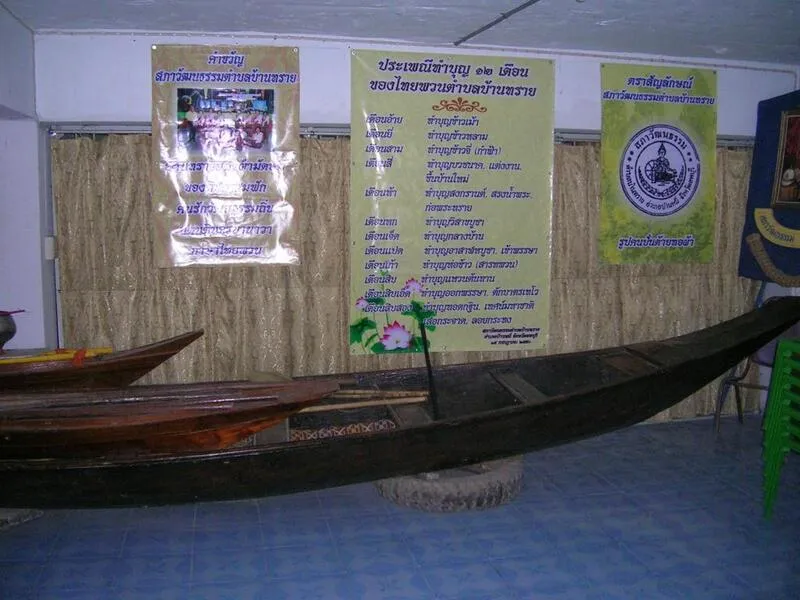
Inside the museum, visitors will find displays of various objects that reflect the culture of the Thai Phuan people of Ban Sai. These include household earthenware, a reconstruction of a traditional sleeping room or kuang huan, the making of mudmee woven textiles, an old boat, a Nang Kwak figure, display cabinets of Thai Phuan clothing, and exhibits about the twelve-month cycle of traditions. These displays help visitors understand the life of the community more clearly than general written descriptions, because every item is closely connected to the real lives of the people of Ban Sai and reflects the wisdom used in daily living in a very concrete way.
The earthenware displayed in the museum is important as a representation of household life in the past. These containers reflect a period when daily life was closely tied to natural materials and local wisdom. The use of clay vessels was not only related to cooking and food preparation, but also reflected a way of thinking about using resources appropriately and in harmony with the environment. These objects are therefore valuable evidence that helps younger generations understand that life among the Thai Phuan in the past was simple, yet full of detail and knowledge accumulated through community experience.
Another especially interesting section is the reconstruction of the kuang huan, or bedroom, which allows visitors to see the private living space of Thai Phuan people more clearly. The kuang huan does not only reflect housing style or furniture arrangement, but also tells of family relationships, household order, and patterns of living in traditional society in a deep and meaningful way. Seeing such a reconstructed space makes the museum feel more alive, because visitors are not simply viewing isolated objects, but are able to see the overall world of a household that once truly existed.
Mudmee weaving is another core element of Thai Phuan identity in Ban Sai. Woven cloth is not only used as clothing, but is also a symbol of wisdom, refinement, and community identity. Presenting mudmee weaving within the museum helps visitors understand that textile production is part of life and culture, not merely a decorative craft. It is connected to traditions, the role of women in the community, and the transmission of knowledge from one generation to the next.
The old boat and the Nang Kwak figure displayed in the museum expand learning from everyday life into the realms of belief and social context. The old boat reflects the relationship between people and transportation routes in the past, while Nang Kwak represents beliefs concerning prosperity, trade, and fortune. When these objects are placed alongside household items and traditional clothing, visitors can gain a clearer overall picture of the Thai Phuan community as a society shaped by livelihood, faith, and a deep attachment to its own culture.
The clothing of the Thai Phuan people displayed in glass cabinets is another very important part of the museum, because dress is a clear marker of ethnic identity. Thai Phuan attire reveals differences in community identity, ways of life, and the value people place on belonging to the same group. These garments are therefore not displayed only for their beauty, but as a confirmation that even as time passes, the Thai Phuan community of Ban Sai continues to value its roots and chooses to preserve its distinct identity.
The twelve-month cycle of Thai Phuan traditions in Ban Sai is another element that makes this museum especially engaging, because it helps visitors understand the rhythm of the community throughout the year and the merit-making ceremonies and rituals that continue to connect people together. These traditions are not merely calendar events, but a structure of social relationships, faith, and ties to the agricultural seasons, which have long formed the foundation of Thai Phuan community life.
Among the traditions of the Thai Phuan of Ban Sai, the Soe Krajad tradition is one of the most distinctive and deserves detailed mention. It is held in November after the end of Buddhist Lent and is associated with the Thet Mahachat ceremony. It takes place one day before the Mahachat sermon so that people can meet, visit, talk, and make merit together before gathering to listen to the sermon the next day. The belief that listening to the full Mahachat sermon, all 13 chapters, in a single day brings great merit makes this tradition powerful in both religious and social dimensions.
Another deeply meaningful tradition is the Kam Fa festival, held on the third waxing day of the third lunar month, and directly connected to the agricultural life of the Thai Phuan people. Kam Fa expresses reverence for nature in order to ask for timely rainfall and agricultural abundance. Offering grilled sticky rice and bamboo-roasted sticky rice during the ceremony is therefore not just a general act of merit-making, but also an expression of the relationship between the community and the land, water, rain, and seasons, which lies at the heart of an agricultural society.
What gives Ban Sai Thai Phuan Museum even greater depth is its display of prehistoric objects and tools from the archaeological sites of Wat Chan Sen and Ban Chiang. This part of the exhibition means that the museum does not tell only the story of the Thai Phuan community over the past 200 years, but also connects visitors to the world of archaeology and the much longer history of humanity. The Phuan people of Ban Sai also regard Ban Chiang as belonging to fellow Phuan kin, which adds yet another layer of emotional and cultural connection to the displays.
Although the museum’s object management remains simple and does not follow the systematic style of modern museums, this simplicity is actually one of the charms of a community museum. It reflects the fact that cultural knowledge is still truly held in the hands of local people. Each object still carries the story of its former owner, the memory of a family, and traces of the community itself. This straightforward style of display does not reduce the value of the museum, but instead allows visitors to sense the sincerity and living spirit of the community very clearly.
The atmosphere of Ban Sai Thai Phuan Museum is calm, friendly, and closely connected to the setting of the temple and the community, because it uses space within Wat Ban Sai as its exhibition area. Its identity as a temple museum means that it does not feel rigid or overly formal like a museum in a large city. Instead, it gives visitors the feeling of learning about culture in a real place where people are still living all around. After touring the museum, visitors can continue to absorb the atmosphere of the Thai Phuan community of Ban Sai through the temple, the houses, and the way of life of local people in the area.
In terms of its present-day importance, Ban Sai Thai Phuan Museum continues to play a clear role as a learning center for the community and for young people. It allows younger generations to understand the origin, way of life, and wisdom of their ancestors through real objects and real stories, not only through fading oral accounts. As long as the community continues to use the museum as a learning space and connects it to cultural activities, the museum does not remain frozen in the past, but continues to serve as a living means of passing culture on into the present.
Getting There The most convenient way to travel to Ban Sai Thai Phuan Museum is by private car, heading to Wat Ban Sai in Ban Sai Subdistrict, Ban Mi District, Lopburi Province. Since the museum is located within the temple grounds, using a navigation system and pinning Wat Ban Sai will make the journey easier. Before visiting, visitors should call in advance to confirm the museum’s readiness and the most suitable time for entry.
For those who wish to explore Lopburi in a deeper way beyond the better-known tourist attractions in the town center, Ban Sai Thai Phuan Museum is a highly worthwhile destination. It offers an opportunity to learn about Thai Phuan identity through real household items, real clothing, reconstructed domestic spaces, and traditions that are still practiced today. A visit here is therefore not just about viewing old objects, but about understanding the roots of the people of Ban Mi and appreciating the value of a living community culture that still endures in the present.
| Place Summary | A Thai Phuan community museum within Wat Ban Sai, collecting traditional household objects, old utensils, and information about the Thai Phuan ethnic community of Ban Sai in order to preserve its history, way of life, and local wisdom. |
| Highlights | Household earthenware, a reconstructed kuang huan, mudmee weaving, an old boat, a Nang Kwak figure, display cabinets of Thai Phuan clothing, the twelve-month cycle of traditions, and prehistoric objects from Wat Chan Sen and Ban Chiang. |
| History / Period | Established as a museum in 2001, beginning with donations of old household items and antiques from people in the community, with the Ban Sai Subdistrict Cultural Council playing the main role in its establishment. |
| Address | Wat Ban Sai, Village No. 2, Ban Sai Subdistrict, Ban Mi District, Lopburi Province 15110 |
| Getting There | Traveling by private car to Wat Ban Sai in Ban Mi District is the most convenient option, and visitors should contact the museum in advance before visiting. |
| Open Days | Every day (please contact in advance) |
| Opening Hours | Please contact in advance |
| Admission Fee | Free of charge |
| Zones | Traditional household objects zone, reconstructed kuang huan zone, mudmee weaving zone, Thai Phuan clothing zone, twelve-month traditions zone, and prehistoric artifacts zone. |
| Nearby Tourist Attractions | 1. Wat Huai Kaeo 5 km 2. Wat Khao Sanam Chaeng 7 km 3. Wat Koen Kathin 9 km 4. Wat Khung Tha Lao 11 km 5. Chan Sen Museum 22 km |
| Nearby Restaurants | 1. Lung Pok Noodle Shop (Thuan Thong), Ban Sai Branch 1, 1 km, Tel. 084-882-2866, 087-038-3615 2. Krua Lung Wai, Ban Mi District, Lopburi, 10 km, Tel. 036-471-745 3. Wang Coffee & Homestay, 11 km, Tel. 085-666-9865 4. Ban Mi Food Center, Rim Thang Restaurant by Boonsuphan Catering, 11 km, Tel. 083-880-2889 5. PunThai Coffee, Ban Mi Municipal Road, Lopburi, 11 km, Tel. 061-386-7312 |
| Nearby Accommodations | 1. Ban Mi Mini House Homestay, 10 km, Tel. 061-658-5791 2. Enkai Villa Ban Mi, 11 km, Tel. 064-464-6145, 081-292-9299 3. Saeng Manee Resort, 13 km, Tel. 093-661-5594 4. Rata Resort, 14 km, Tel. 086-535-6770 5. The Charlotte Smart Hotel Lopburi, 35 km, Tel. 064-979-2905 |
| Main Contact Number | 08-3178-8822 |
Frequently Asked Questions (FAQ)
Q: Where is Ban Sai Thai Phuan Museum located?
A: The museum is located within Wat Ban Sai, Village No. 2, Ban Sai Subdistrict, Ban Mi District, Lopburi Province 15110.
Q: Is Ban Sai Thai Phuan Museum still open?
A: Yes, it is still open to visitors and is open every day, but advance contact is required.
Q: What can visitors see inside Ban Sai Thai Phuan Museum?
A: Visitors can see earthenware, traditional household objects, a reconstructed kuang huan, mudmee weaving, an old boat, a Nang Kwak figure, Thai Phuan clothing, the twelve-month cycle of traditions, and prehistoric artifacts from Wat Chan Sen and Ban Chiang.
Q: What is the origin of the Thai Phuan people of Ban Sai?
A: The ancestors of the Thai Phuan people of Ban Sai originally came from Xiangkhouang in Laos before migrating to settle in Thailand around 200 years ago.
Q: Is there an entrance fee for Ban Sai Thai Phuan Museum?
A: There is no admission fee, but visitors should contact the museum in advance each time for convenience.
Q: What are the major traditions of the Thai Phuan people of Ban Sai?
A: The main traditions clearly mentioned are the Soe Krajad tradition, the Thet Mahachat ceremony, and the Kam Fa festival, all of which are connected to religion, community gatherings, and agricultural life.
 Ban Sai Thai Phuan Museum Map
 Category:
  Group:
  Last Update: 2 DayAgo
Comment
 Nearby Attractions
| Keyword (Advance) |
 Region
|
 Muang Lop Buri(