
 Home
Home Chiang Mai(





Rating: 4.4/5 (5 votes)
 |
|  Map
Map 
 Have Map
  No Map
Lop Buri attractions
Attractions in Thailand
Open Days: Daily
Opening Hours: 08:00 - 17:00
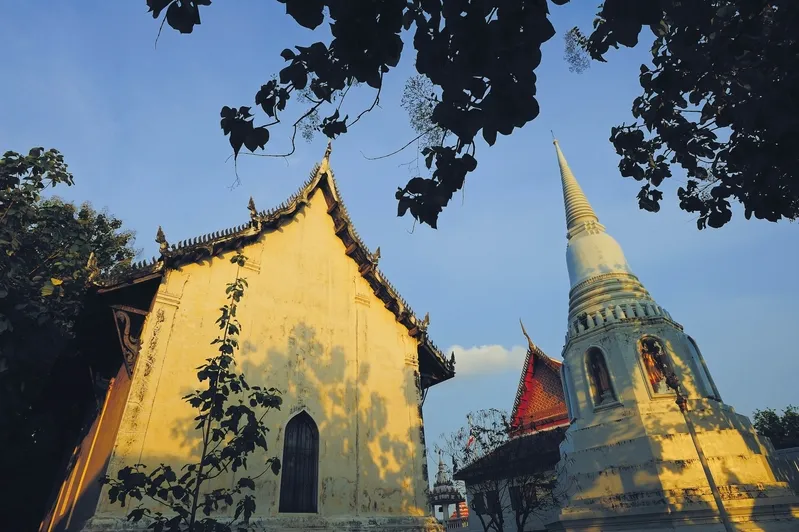
Wat Sao Thong Thong Royal Monastery is an ancient temple in the heart of Lopburi that is important both as a historic Buddhist temple and as part of the historical district from the reign of King Narai the Great. The temple is located on Rue de France in Tha Hin Subdistrict, Mueang Lopburi District, directly opposite Lopburi Municipal Fresh Market. At the rear, it is close to Tha Khunnางริมแม่น้ำลพบุรี, to the north it is near the former royal residence for ambassadors, and to the south it is near King Narai’s Palace. This location means that Wat Sao Thong Thong is not simply an ordinary city temple, but one of the key sites that helps illustrate Lopburi’s past as a historic city and as a city once closely connected with foreign communities.
The importance of Wat Sao Thong Thong begins with the original history of the site, because it was not originally a single temple as seen today. Instead, it was divided into 2 temples: Wat Ruak and Wat Sao Thong Thong. Wat Ruak had an ordination hall, while Wat Sao Thong Thong had a vihara. Later, Phraya Boran Ratchathanin (Phon Techakup), the commissioner of the Ayutthaya administrative region, reported his opinion to Somdet Phra Maha Samanachao Krom Phraya Vajirananavarorasa during an inspection of the Sangha in the Ayutthaya region, suggesting that the 2 temples should be merged into one because their religious structures already complemented each other. His proposal was approved, and the unified temple was named Wat Sao Thong Thong, a name that has continued to the present day.
Wat Sao Thong Thong has long been described as an ancient temple, and Somdet Krom Phraya Damrong Rajanubhab proposed that the principal vihara and the main Buddha image were likely the work of Ayutthaya-period craftsmen and, at the very least, were probably built during the reign of King Narai the Great. This interpretation gives Wat Sao Thong Thong exceptional importance in historical terms because it links the temple to the period when Lopburi flourished as a center of politics, diplomacy, and culture in Siam.
The temple stands on a mound that is higher than the surrounding area, covering approximately 15 rai and 1 ngan, with roads entering the temple from all 4 sides. This topographical character makes the temple prominent within the old urban layout and highlights its role as a religious site placed in an important position within Lopburi. Once inside the temple grounds, visitors can feel the atmosphere of an old temple within a city neighborhood, one that still preserves a sense of calm despite being close to markets, roads, and major historic attractions.
The most important ancient structure to see in the temple is the vihara, which is considered the historical heart of the site. There is a theory that this vihara may not originally have been built as a Buddhist religious structure. A map drawn by a French cartographer indicated that this area was once the residence of Persian envoys, leading to the possibility that the original vihara may once have served as a place of worship for Persians or Muslims before later becoming part of the temple. This makes Wat Sao Thong Thong especially fascinating because it reflects the relationship between religion, art, and foreign communities in Ayutthaya-period Lopburi.
In addition to the vihara, the temple also contains several old buildings linked to the history of diplomacy and the reception of foreign guests, including Tuek Pichu, Tuek Khotsarat, and Tuek Khorosan. These buildings are believed to have been used as residences or reception halls for visiting dignitaries and foreign envoys, especially Persians. The word “Pichu” is derived from French and means “small,” suggesting that this building may have been connected to French officials serving in Lopburi. Meanwhile, “Khorosan” is the name of an important city in Persia, which further reinforces the connection between this site and the Persian community in the past.
When viewed in the wider context of Lopburi, Wat Sao Thong Thong is important for more than its role as a religious site. It is closely related to the axis of space that connects King Narai’s Palace, the former royal residence for ambassadors, Tha Khunnาง, and Rue de France. If King Narai’s Palace symbolizes royal power, then Wat Sao Thong Thong represents religious life and the coexistence of people of many ethnic backgrounds in Lopburi during the reign of King Narai.
Wat Sao Thong Thong is also important in terms of cultural heritage conservation because the Fine Arts Department registered the ancient monuments within the temple grounds on August 2, 1936. This official registration shows that the site has long been recognized as having significant archaeological and historical value. Registration has also helped ensure that the monuments within the temple, such as the vihara and the old buildings, continue to be preserved as important evidence of Lopburi’s past.
Today, Wat Sao Thong Thong remains a third-class royal monastery of the common type and continues to play an important role in the Lopburi urban community, both in religious life, in Sangha activities, and as a destination for those interested in historical and cultural tourism. Visitors who come here do not merely come to pay respects, but also walk through a space connected to stories at the level of the city, the royal court, and international relations all at once.
The latest verified information indicates that Wat Sao Thong Thong Royal Monastery has Phra Wachirachariyaphon as its abbot, reflecting that the temple continues to play an active role today, both as one of Lopburi’s important temples and as a spiritual center for the surrounding community.
The atmosphere of Wat Sao Thong Thong differs from that of larger temples or temples famous mainly for ceremonial importance in other provinces, because the charm here lies in slowly walking through the grounds and reading history through architecture. Once inside the temple area, visitors can feel the age of the buildings, the close relationship between the temple and the surrounding community, and the continuity of the old city that has not been cut off from daily life. Those who enjoy historical travel will especially appreciate Wat Sao Thong Thong, because every point within the site is connected to the story of ancient Lopburi.
Getting There is very convenient, because the temple is located in Lopburi’s old city area on Rue de France, near King Narai’s Palace, Baan Wichayen, Phra Prang Sam Yot, and Lopburi Municipal Fresh Market. Visitors traveling by car can head directly to Rue de France, while those already touring Lopburi’s old city can easily walk to the temple, as it is located in a district where many major attractions stand close together. It is therefore ideal for a half-day or full-day sightseeing route within Lopburi city.
For first-time visitors, the best approach is not to simply enter, pay respect, and leave immediately. Instead, take time to look at the old vihara, observe how the temple grounds are elevated above the surrounding area, look along Rue de France, and note the positions of nearby historical sites. When these elements are connected together, it becomes clear that Wat Sao Thong Thong is not merely one old temple, but an important part of Lopburi as a historical city of national significance.
With all of these elements combined, Wat Sao Thong Thong is a destination well suited both for those interested in paying respects at temples in Lopburi, for those who enjoy studying Ayutthaya architecture and history, and for those who want to understand Lopburi more deeply than the familiar images of monkeys or King Narai’s Palace alone. This temple may not be the loudest or most dramatic destination, but it is without doubt one of the most historically profound temples in Lopburi.
| Place Summary | Wat Sao Thong Thong Royal Monastery is an ancient temple in the center of Lopburi, located on Rue de France near King Narai’s Palace, the former royal residence for ambassadors, and Lopburi Municipal Fresh Market. It is significant in terms of religion, history, and the urban layout of King Narai’s period. |
| Highlight | The old vihara, the Ayutthaya-style principal Buddha image, the location on Rue de France, and ancient buildings such as Tuek Pichu, Tuek Khotsarat, and Tuek Khorosan, all of which are connected to the history of foreign communities in Lopburi. |
| History / Period | Originally, the site consisted of 2 temples, Wat Ruak and Wat Sao Thong Thong, before being merged into one temple. It is believed that the principal vihara and the main Buddha image date back at least to the reign of King Narai the Great. |
| Latest Abbot / Caretaker | Phra Wachirachariyaphon |
| Address | Rue de France, Tha Hin Subdistrict, Mueang Lopburi District, Lopburi Province 15000 |
| Travel | Located in Lopburi’s old city area, near King Narai’s Palace, Baan Wichayen, Phra Prang Sam Yot, and Lopburi Municipal Fresh Market. It can be reached conveniently by car, local transport, or on foot from nearby attractions. |
| Zones | The vihara, the principal Buddha image area, the group of buildings including Tuek Pichu, Tuek Khotsarat, Tuek Khorosan, and the temple grounds within the Rue de France historical district. |
| Nearby Attractions | 1. King Narai’s Palace 2. Baan Wichayen 3. Phra Prang Sam Yot 4. San Phra Kan Shrine 5. King Narai National Museum |
| Nearby Restaurants | 1. moon coffee Tel. 0972484743 2. Khao Pla Kae Kor Kaew Tel. 0955626028 3. Sao Thong Pad Thai and Resort Tel. 0634463364 4. Khrua Khun Waeo Cook-to-Order near Bus Terminal Line 2 Tel. 0867557306 5. Kimki Phanit Tel. 0972465624 |
| Nearby Accommodations | 1. Nett Hotel Lopburi Tel. 036411738, 036421460 2. Lopburi Inn Hotel Tel. 036412300 3. Lopburi Inn Resort Tel. 036420777 4. Windsor Heritage Resort Tel. 0982643994 5. Paklop Resort Tel. 0864242492 |
Frequently Asked Questions (FAQ)
Q: Where is Wat Sao Thong Thong located?
A: Wat Sao Thong Thong Royal Monastery is located on Rue de France in Tha Hin Subdistrict, Mueang Lopburi District, Lopburi Province, near King Narai’s Palace, Baan Wichayen, and Lopburi Municipal Fresh Market.
Q: How many temples did Wat Sao Thong Thong originally consist of?
A: Originally, the site consisted of 2 temples: Wat Ruak and Wat Sao Thong Thong, before they were merged into a single temple under the name Wat Sao Thong Thong.
Q: Why is Wat Sao Thong Thong important in Lopburi’s history?
A: The temple is connected to Lopburi during the reign of King Narai the Great in terms of Ayutthaya art, urban planning, and relations with foreign communities, especially along Rue de France and the diplomatic quarter.
Q: What are Tuek Khorosan and Tuek Pichu at Wat Sao Thong Thong?
A: They are old buildings within the temple grounds that are believed to have been connected with the reception of foreign guests and envoys, especially Persians and French visitors.
Q: Who is the current abbot of Wat Sao Thong Thong?
A: The latest verified information states that Phra Wachirachariyaphon is the abbot of Wat Sao Thong Thong Royal Monastery.
Q: Which nearby attractions can be combined with a visit to Wat Sao Thong Thong?
A: Visitors can easily combine a visit with King Narai’s Palace, Baan Wichayen, Phra Prang Sam Yot, San Phra Kan Shrine, and King Narai National Museum, as all are located within Lopburi’s old city area.
 Wat Sao Thong Thong Map
 Category:
  Group:
  Last Update: 1 DayAgo
Comment
 Nearby Attractions
| Keyword (Advance) |
 Facebook Fanpage
 Region
 Art, Culture and Heritage
 Historical Sites and Monuments(
 Landmarks and Memorials(
 Royal Palace(
 Art, Craft Centres, Tradition(
 Museums(
 Historical Houses and The Ancient City(
 University
 Other religious and spiritural sites(
 Suburban Living
 Village, Community(
 Floating Market(
 Nature and Wildlife
 National Parks and Marine Reserves(
 Mountain (Doi)(
 Dam, Reservoir, Lake(
 Waterfalls(
 Hot Springs(
 Caves(
 Flower Field(
 Entertainment and Agricultural
 Zoos and Aquariums(
 Farm, Parks, Gardens and Ecotourism(
 Outdoor and Adventure Activities(