
 Home
Home Chiang Mai(






Rating: 4.3/5 (4 votes)
 |
|  Map
Map 
 Have Map
  No Map
Lop Buri attractions
Attractions in Thailand
Open Days: Every Day
Opening Hours: 08:30 – 17:30
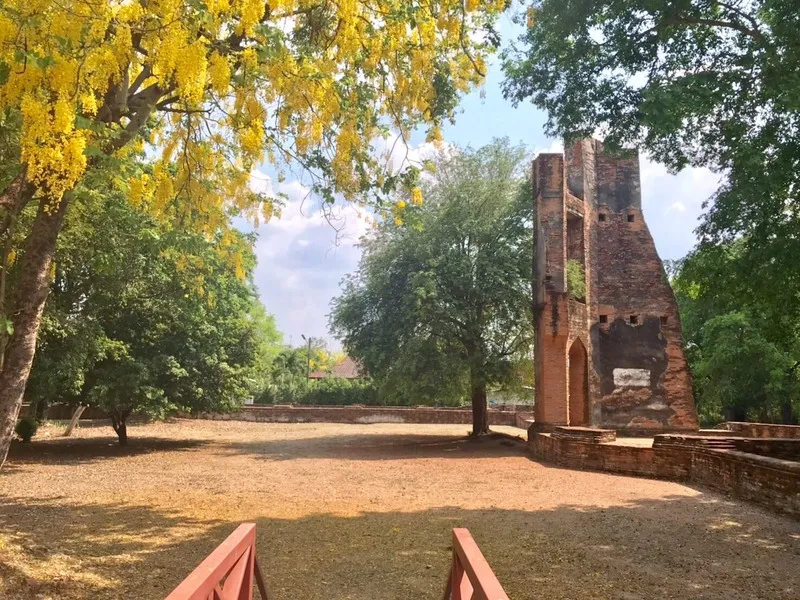
Wat San Paolo is another important ancient site in Lopburi Province that reflects a significant moment in Thai history, when Siam seriously opened its doors to relations with the Western world during the reign of King Narai the Great. Although only the remains of some structures and part of the tower survive today, this site still holds great historical value because it stands as evidence of the settlement of French Jesuit priests, the spread of Christianity in Lopburi, and the introduction of European astronomical and mathematical knowledge into Siam during the Ayutthaya period.
Wat San Paolo is located within Lopburi Municipality, an area filled with important historical sites from the time of King Narai the Great, including Narai Ratchaniwet Palace, Baan Wichayen, and other ancient monuments related to Siam’s relationship with Western nations. When considering the context of Lopburi in that era, it is clear that Lopburi was not merely a secondary city of Ayutthaya, but a city of high political, diplomatic, and cultural significance. It is therefore not surprising that French priests and missionary groups were permitted to establish a religious and scholarly center in this city.
The origin of Wat San Paolo is directly connected to the royal policy of King Narai the Great. He granted land to French Jesuit priests who had come to reside in Lopburi for use as a place of religious worship and as living quarters for the clergy. This royal grant reflects the openness of the Ayutthaya court toward foreigners, especially the French, who played a major role in the court at that time in religion, science, and diplomacy.
The name “Wat San Paolo” is believed to be a local variation of the words “Saint Paul” or “Saint Paolo,” in keeping with the naming conventions of Christian religious sites. Historical documents also support this interpretation. On a map of Lopburi prepared in 1687 by the French engineer De La Mare, this site is described as a church of the Jesuit order, with an octagonal tower located at the center front of the residence and used for astronomical observation and mathematical studies. This detail makes Wat San Paolo more than just a religious site, because it is also connected to the history of science in Thailand.
The role of the Jesuits during the reign of King Narai the Great was not limited to spreading Christianity. They also introduced European scientific knowledge into Siam. Many priests in this order were skilled in astronomy, mathematics, and geography, and therefore attracted strong interest from the royal court. In an age when observing the sky, calculating time, and making maps were considered advanced forms of knowledge, a site like Wat San Paolo, used for learning and observation, was highly significant. It also shows that Siam at that time did not reject knowledge from abroad, but was ready to accept and adapt it to suit its own context.
The most prominent architectural feature of Wat San Paolo is its octagonal tower, which still remains today as an important piece of evidence. This tower has been widely described as a space used for astronomical observation and mathematical study, leading many to regard it as the “first observatory in Thailand.” From a historical perspective, this tower was therefore not merely part of a religious building, but a symbol of the connection among faith, religion, science, and international relations in the Ayutthaya period. The presence of an observatory within the Jesuit complex also reflects that this group of priests did more than provide religious leadership; they were also transmitters of modern knowledge to Siam.
When examining the surviving remains, it becomes clear that Wat San Paolo displayed an intriguing blend of Thai and European architectural forms. The buildings were constructed of brick covered with plaster and divided into rooms according to their uses. At the same time, lotus-pattern ornamentation, a characteristic of Thai craftsmanship, was incorporated into the structure. This kind of fusion shows that construction in that period was not a direct imitation of European models, but rather an adaptation to Siamese taste, materials, and craftsmanship. As a result, Wat San Paolo stands as an important example of cultural exchange expressed through architecture.
Today, although the complex is no longer preserved in its complete original form, the octagonal tower and parts of the ruined buildings still allow visitors to imagine the site’s importance during its period of prosperity. Walking among the brick-and-plaster ruins, where the layout of rooms can still be partially seen, makes it clear that this place was once more than an ordinary religious site. It served as a residence, a place of worship, and a center of learning at the same time. The feeling of standing among these ruins is therefore not simply that of viewing an old structure, but of standing amid the traces of major international events in Thai history.
In terms of atmosphere, Wat San Paolo feels different from Buddhist temples or Buddhist ruins in Lopburi because it has the character of a Christian religious site combined with local architectural features, making the place appear both unusual and historically charming. Those who enjoy visiting ancient monuments are often especially interested in Wat San Paolo because it tells another side of Lopburi, not only as a city of royal palaces and Buddhist sites, but also as a city of contact with foreigners and of serious openness to Western influence.
The importance of Wat San Paolo therefore exists on several levels at once. The first is its religious significance as a site of the Jesuit order. The second is its political and diplomatic significance, because the existence of this place is linked to Siamese–French relations during the reign of King Narai. The third is its scientific importance, since the octagonal tower was used for astronomical observation. The fourth is its architectural importance as a clear example of a building that combined Thai and European forms. This ancient site thus brings together several strands of history within a single space in a way that is rarely found.
From a tourism perspective, Wat San Paolo is a place well worth visiting for those who want to understand Lopburi on a deeper level than simply seeing Phra Prang Sam Yot or Narai Ratchaniwet Palace. This site helps explain just how connected Lopburi was to the outside world during the reign of King Narai. Travelers interested in history, international relations, religion, or the history of science often find that Wat San Paolo offers deeper understanding than merely serving as a place for photographs.
Visitors to Wat San Paolo should place particular importance on showing respect for the site and helping preserve the monument, because this area consists of fragile ruins. Walking through the site should be done carefully. Visitors should not climb on the ruins, write on surfaces, or do anything that could damage the remains. Dressing respectfully and viewing the place with composure are also appropriate, because even though it is now more of an ancient monument than an active place of worship, it still carries significant religious and historical meaning.
Getting There to Wat San Paolo is fairly convenient because it is located within Lopburi Municipality, close to other important attractions and not far from Lopburi Railway Station. Travelers arriving by car can easily include it in the same itinerary as Narai Ratchaniwet Palace, Baan Wichayen, Phra Prang Sam Yot, and San Phra Kan within a single day. Those traveling by train can get off at Lopburi Railway Station and continue by local transport or on foot without much difficulty. This accessibility makes Wat San Paolo another destination well suited to inclusion in a Lopburi old-town route.
The best time to visit Wat San Paolo is in the morning or late afternoon, when the light helps reveal the dimensions of the octagonal tower and the surrounding ruins more clearly, while the weather is also less intensely hot. Those interested in photographing ancient architecture especially appreciate these hours, because the light brings out the textures of the brick, plaster, and architectural details very well. Visitors coming to study history should also allow time to walk around slowly, so they can better understand the relationship among the various elements within the site.
Wat San Paolo is therefore not merely another set of old ruins in Lopburi, but a place that reveals Siam in the act of engaging dynamically with the outside world. It is a site where religion, science, diplomacy, and art come together in one location. The more one studies the history of this place, the more clearly one sees that Wat San Paolo possesses value far beyond what is immediately visible, and that it is one of the ancient monuments that most deeply and clearly explains the story of Lopburi in the era of King Narai the Great.
| Summary | A Christian religious monument from the reign of King Narai the Great, located within Lopburi Municipality. It originally served as both a church and residence for French Jesuit priests, and features an octagonal tower associated with astronomical observation. |
| Highlights | The octagonal tower said to be the first observatory in Thailand, Jesuit building ruins, Thai–European blended architecture, and evidence of Siamese–French relations during the Ayutthaya period |
| History / Period | Built during the reign of King Narai the Great, when he granted land to French Jesuit priests for religious rites and residence. It appears on De La Mare’s 1687 map of Lopburi. |
| Address | Tha Hin Subdistrict, Mueang Lopburi District, Lopburi Province |
| Coordinates | 14.8014, 100.6162 |
| Travel | Located in Lopburi city near Lopburi Railway Station. It can be reached conveniently by car or local transport, and can be combined with other major historical sites in Lopburi. |
| Facilities | Outdoor ancient monument viewing area, open-air access path, photo spots, and surrounding space within the old city zone |
| Zones | 1. Octagonal Tower 2. Brick-and-Plaster Building Ruins 3. Former Jesuit Residential Room Area 4. Open Courtyard Around the Monument 5. Architectural Viewing and Photo Area |
| Nearby Tourist Attractions | 1. Baan Wichayen — approx. 0.5 km 2. Narai Ratchaniwet Palace — approx. 0.8 km 3. Phra Prang Sam Yot — approx. 1.2 km 4. San Phra Kan — approx. 1.3 km 5. Wat Phra Si Rattana Mahathat, Lopburi — approx. 1.5 km |
| Nearby Restaurants | 1. Noom Guesthouse & Restaurant Lopburi — approx. 0.8 km — Tel. 036-427-693, 064-154-4342 2. Ko Heng 2498 Boat Noodles, Talat Bon Mueang — approx. 1.2 km — Tel. 081-524-9324, 062-227-9551 3. Phae Baan Rim Nam — approx. 2.5 km — Tel. 036-618-005 4. Cafe.small Talk — approx. 2.8 km — Tel. 094-449-9489 5. Khanom Jeen Phuket Lopburi — approx. 3 km — Tel. 086-810-3413 |
| Nearby Accommodations | 1. Nett Hotel — approx. 0.9 km — Tel. 036-411-738, 036-421-460 2. The Residence Hotel-2, Lopburi — approx. 1.8 km — Tel. 081-948-4003 3. PJ Loft Hotel Lopburi — approx. 2 km — Tel. 094-952-4246, 088-695-9615 4. Lopburi Inn Resort — approx. 4.5 km — Tel. 036-420-777, 036-614-790 5. MDR Hotel — approx. 5 km — Tel. 094-409-9492, 036-614-411 |
Frequently Asked Questions (FAQ)
Q: What is Wat San Paolo in Lopburi?
A: Wat San Paolo is a Christian religious monument from the reign of King Narai the Great. It was built to serve as both a place of worship and a residence for French Jesuit priests in Lopburi.
Q: How is Wat San Paolo connected to King Narai the Great?
A: King Narai the Great granted land to the French Jesuit priests to use for religious ceremonies and residence, making Wat San Paolo one of the key pieces of evidence of Siamese–French relations during that era.
Q: Why is Wat San Paolo said to be the first observatory in Thailand?
A: Because within the site there is an octagonal tower which, according to historical records, was used for astronomical observation and mathematical studies, leading it to be described as the first observatory in Thailand.
Q: Where is Wat San Paolo located?
A: Wat San Paolo is located within Lopburi Municipality, in Tha Hin Subdistrict, Mueang Lopburi District, Lopburi Province, not far from Lopburi Railway Station.
Q: What remains of Wat San Paolo can visitors still see today?
A: Today, visitors can still see the octagonal tower and some brick-and-plaster building ruins, which serve as important evidence of a Christian religious site and Thai–European blended architecture from the Ayutthaya period.
Q: What is the architectural style of Wat San Paolo?
A: Wat San Paolo features a Thai–European blended architectural style. The structures were built in Western brick-and-plaster form, but also include lotus motifs and certain elements that reflect traditional Thai craftsmanship.
Q: What kind of travel experience is Wat San Paolo suitable for?
A: It is suitable for historical, cultural, and architectural tourism, especially for visitors interested in Siamese–European relations, Christianity in Siam, and the development of science in the past.
Q: What places can be visited together with Wat San Paolo?
A: It can be conveniently combined with Baan Wichayen, Narai Ratchaniwet Palace, Phra Prang Sam Yot, San Phra Kan, and Wat Phra Si Rattana Mahathat, Lopburi, all within the Lopburi old-city route.
 Wat San Paolo Map
 Category:
  Group:
  Last Update: 2 DayAgo
Comment
 Nearby Attractions
| Keyword (Advance) |
 Region
|
 Muang Lop Buri(