
 Home
Home Chiang Mai(






Rating: 3.6/5 (5 votes)
 |
|  Map
Map 
 Have Map
  No Map
Lop Buri attractions
Attractions in Thailand
Open Days: Daily
Opening Hours: 08:00 – 16:30
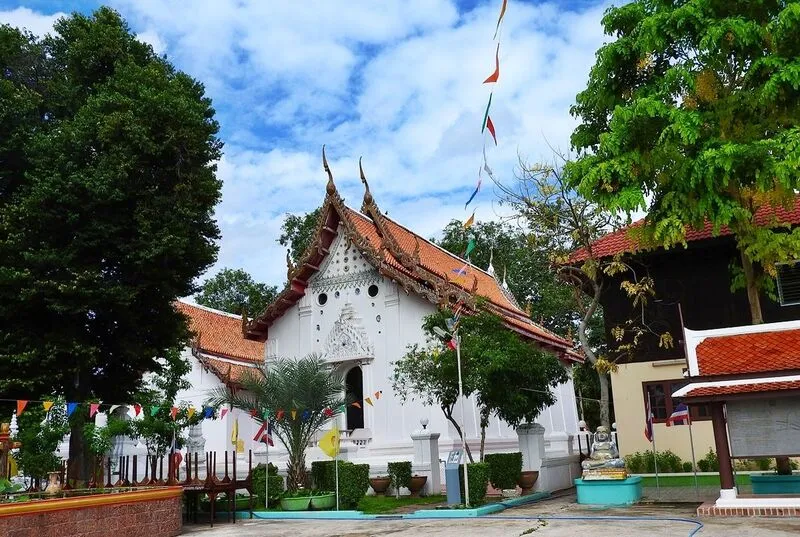
Wat Tong Pu is an ancient temple located behind Phibun Wittayalai School in Tha Le Chup Son Subdistrict, Mueang Lopburi District, Lopburi Province. This temple is regarded as one of the important temples of Lopburi because its value extends beyond being a religious site for the local community. It is also a place that preserves historical and architectural evidence reflecting the prosperity of Lopburi during the Ayutthaya period, especially in the reign of King Narai the Great, when Lopburi played a prominent role in politics, military affairs, and the arts.
The name of Wat Tong Pu is especially interesting because the word “Tong Pu” is explained as a Mon term meaning a gathering place for troops or a place where forces assembled before going to war. This meaning is consistent with local accounts that say the area of Wat Tong Pu once served as a gathering point for Thai armies in the past. As a result, the temple is important not only in a religious sense, but also in connection with military history and the historical urban structure of the area.
Considering the temple’s location, it can be seen that Wat Tong Pu stands within the old city area of Lopburi, where many historical sites are scattered throughout the landscape. In the past, Lopburi had already been an important city since the Lavo period, and later in the Ayutthaya era it was greatly developed, especially when King Narai the Great used Lopburi as a second capital. The city’s importance at that time led to the construction of palaces, forts, temples, and public infrastructure. Wat Tong Pu is therefore part of the historical landscape that helps tell the story of Lopburi during one of the most prosperous periods in its history.
Although there is no clear evidence stating the exact year Wat Tong Pu was founded, several ancient structures within the temple grounds display artistic features consistent with architecture from the reign of King Narai the Great. This is particularly evident in the design of the vihara, the doors and windows, as well as some elements of the ordination hall and the chedi. For this reason, Wat Tong Pu is frequently mentioned as an important ancient temple deserving study, and it is considered valuable in terms of archaeology, history, and architectural art.
One of the temple’s notable highlights is its Thai-style ordination hall, which has a gently curved base. This type of base gives the building a more graceful appearance than a standard architectural base. The soft curve not only reflects the craftsmanship of artisans in the past, but also reveals the concept of beauty in Thai architecture during the Ayutthaya period, which emphasized harmonious proportions and balanced lines.
Another highly important structure is the vihara, whose architectural style clearly belongs to the period of King Narai the Great. Its most distinctive features are the pointed-arch windows and doorways. This form is one of the artistic traits found in buildings from King Narai’s reign, when artistic influences from various sources were adapted to fit the Thai context. These pointed arches give the vihara of Wat Tong Pu a character different from that of ordinary temple buildings and serve as important evidence helping to confirm the temple’s artistic age.
Within the temple grounds there is also a highly interesting ancient chedi. It has been compared to the chedi of Luang Pho Saeng at Wat Mani Chonlakhan, though it is smaller in size. Even though it is smaller, it still has elegant and well-balanced proportions. This makes the chedi another feature worth observing during a visit, because it reflects the taste and construction style of chedis in Lopburi during the Ayutthaya period very clearly.
What makes Wat Tong Pu stand out even more than many other ancient temples is that it still preserves important antiquities. One of the most frequently mentioned objects is the ancient water structure used for bathing Buddha images, commonly referred to as the “Nam Phu Song Nam Phra.” This is considered a highly significant antiquity, and it has been described as the only surviving object of its kind in Thailand. It is therefore extremely valuable both in terms of art history and as evidence of religious rituals in the past.
The ancient Buddha-bathing fountain is not merely an old object displayed within the temple. It also represents the culture of bathing Buddha images in the past, which was closely related to ritual practices, faith, and religious life in old Thai society. The fact that Wat Tong Pu has managed to preserve this antiquity enhances the temple’s value as a learning site for those interested in the history of Thai religion and ritual.
In addition to the ordination hall, vihara, chedi, and Buddha-bathing fountain, the temple also contains other structures worth seeing, including the scripture hall, the storage building, and the bell tower. These buildings make the overall layout of Wat Tong Pu more complete as an ancient temple complex. The scripture hall was important as the place for keeping the Tripitaka or religious manuscripts. The storage building reflects the system for keeping temple property in the past, while the bell tower demonstrates the role of the temple as a community center where sound signals were used in both religious ceremonies and daily life.
When walking around Wat Tong Pu, what is immediately felt is the peaceful, shady atmosphere that still retains the character of an old community temple in a historic city. Although the temple is located within the urban area and close to a school, the interior of the temple grounds remains fairly quiet. Large trees provide shade, creating a relaxing environment suitable for viewing the historical structures at an unhurried pace. They also help visitors absorb the feeling of a place that has endured through time for many generations.
Wat Tong Pu also reflects the image of an old Mon temple in Lopburi. The temple’s name and the historical accounts associated with it lead many people to connect this temple with Mon communities that once played a role in the Chao Phraya basin. This association means that Wat Tong Pu is important not only to the local history of Lopburi, but also to the history of ethnic communities and cultural diversity in Thai society in the past.
Today, Wat Tong Pu still functions as a community temple, with monks residing there and religious activities continuing as usual. The temple is therefore not merely an ancient monument frozen in the past, but a living space that still holds meaning for the surrounding community. Because the historical remains continue to exist alongside the everyday life of local people, a visit to Wat Tong Pu differs from visiting an abandoned ruin. Visitors can experience both the past and the present in the same place.
For those interested in the history of Lopburi, Wat Tong Pu is a place well worth visiting. The temple brings together many interconnected dimensions, including military history, urban history, architecture from the reign of King Narai the Great, and important antiquities that are extremely rare in Thailand. Combined with its calm atmosphere and convenient location, Wat Tong Pu is suitable for merit-makers, history-minded travelers, and visitors who want to understand Lopburi more deeply than by visiting only the city’s best-known landmarks.
Getting There Reaching Wat Tong Pu is convenient because the temple is located behind Phibun Wittayalai School in Tha Le Chup Son Subdistrict, Mueang Lopburi District. Those traveling by private car can take the main roads into Lopburi city, head toward the area around Phibun Wittayalai School, and then enter from the back of the school to reach the temple. Visitors arriving by train can get off at Lopburi Railway Station and continue by local taxi or hired transport. Those traveling from Bangkok by bus or van can also continue from the city center to the temple using local transport in Lopburi.
In summary, Wat Tong Pu is an important ancient temple in Lopburi with value in many dimensions, including architecture, history, religion, and culture. The details of its ordination hall, vihara, chedi, scripture hall, storage building, bell tower, and Buddha-bathing fountain all confirm that this is not merely another old temple, but a place that keeps the memory of Lopburi alive. For those who have the opportunity to visit Lopburi and are interested in a historical site that is peaceful, profound, and different from the usual tourist attractions, Wat Tong Pu is truly a place worth stopping to see.
| Place Summary | An important ancient temple in Lopburi, located behind Phibun Wittayalai School, featuring architecture from the reign of King Narai the Great and rare antiquities. |
| Highlights | An ordination hall with a gently curved base, a vihara with pointed-arch doors and windows, an ancient chedi, and an ancient Buddha-bathing fountain. |
| History / Period | An ancient temple of Lopburi, believed to be connected to the Ayutthaya period, especially the reign of King Narai the Great. In the past, it was also used as a gathering place for Thai troops. |
| Current Abbot or Temple Head | Phra Maha Narong Vatthano, Pali Level 7 |
| Address | Behind Phibun Wittayalai School, Tha Le Chup Son Subdistrict, Mueang Lopburi District, Lopburi Province 15000 |
| Coordinates | 14.8072209907, 100.616727967 |
| Getting There | Travel from Lopburi city center to the area around Phibun Wittayalai School, then enter behind the school to reach the temple. It is accessible by private car, hired transport, and local public transportation. |
| Open Days | Daily |
| Opening Hours | 08:00 – 16:30 |
| Facilities | Temple grounds, ritual area, internal walkways, and shade from large trees |
| Zones | Ordination hall, vihara, chedi, scripture hall, storage building, bell tower, and an area displaying important temple antiquities |
| Nearby Attractions | 1. Phra Kan Shrine – approximately 1 km. 2. Phra Prang Sam Yot – approximately 1 km. 3. Ban Wichayen – approximately 1 km. 4. Narai Ratchaniwet Palace – approximately 1 km. 5. Wat Phra Si Rattana Mahathat, Lopburi – approximately 1 km. |
| Nearby Restaurants | 1. Pa Jit Made-to-Order Food, next to Wat Tong Pu – approximately 0.1 km. Tel. 091-794-3512 2. Moo Satay Krua Khao Suk Lopburi – approximately 0.2 km. Tel. 091-405-1637 3. Manok Coffee behind Wat Tong Pu – approximately 0.2 km. Tel. 080-042-1819 4. Hom Kab Khao – approximately 0.3 km. Tel. 096-171-1581, 096-383-8233 5. Kin Saep Som Tam – approximately 0.3 km. Tel. 080-992-3742 |
| Nearby Accommodations | 1. Lopburi Inn Hotel – approximately 1 km. Tel. 036-412-300 2. Nett Hotel – approximately 1 km. Tel. 036-411-738, 036-421-460 3. Lopburi City Hotel – approximately 1 km. Tel. 087-333-3444 4. Windsor Resort Lopburi – approximately 2 km. Tel. 036-422-554 5. Benjatara Boutique Resort – approximately 5 km. Tel. 036-422-608, 081-946-1108 |
| Main Contact Number | 081-528-1734 |
Frequently Asked Questions (FAQ)
Q: Where is Wat Tong Pu located?
A: Wat Tong Pu is located behind Phibun Wittayalai School in Tha Le Chup Son Subdistrict, Mueang Lopburi District, Lopburi Province.
Q: Why is Wat Tong Pu important?
A: Wat Tong Pu is an important ancient temple in Lopburi, associated with the reign of King Narai the Great, and in the past it served as a gathering place for Thai troops.
Q: What is interesting inside Wat Tong Pu?
A: Inside the temple are an ordination hall with a gently curved base, a vihara with pointed arches, an ancient chedi, a scripture hall, a storage building, a bell tower, and an ancient Buddha-bathing fountain that is extremely rare.
Q: What is the ancient Buddha-bathing fountain at Wat Tong Pu?
A: It is an important antiquity used in Buddha-bathing rituals and has been described as the only surviving object of this type in Thailand.
Q: What time is Wat Tong Pu open to visitors?
A: The temple is open daily from 08:00 – 16:30.
Q: Who is the current abbot of Wat Tong Pu?
A: Phra Maha Narong Vatthano, Pali Level 7, is listed as the temple’s current caretaker and a member of the local monastic administration.
 Tel: 036413198
 Wat Tong Pu Map
 Category:
  Group:
  Last Update: 2 DayAgo
Comment
 Nearby Attractions
| Keyword (Advance) |
 Region
|
 Muang Lop Buri(