
 Home
Home Chiang Mai(






Rating: 4/5 (4 votes)
 |
|  Map
Map 
 Have Map
  No Map
Lop Buri attractions
Attractions in Thailand
Open Days: Daily
Opening Hours: 06.00 - 18.00
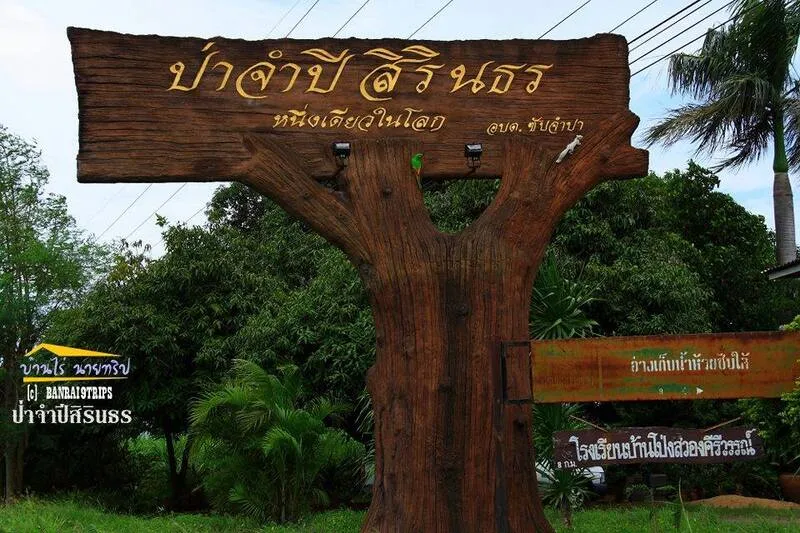
Pa Champi Sirindhorn, also widely known as Pa Sub Champa, is one of the most distinctive natural attractions in Lopburi Province. This is not just an ordinary forest, but a rare freshwater peat swamp forest with highly specific ecological characteristics. It is also the site where “Champi Sirindhorn”, a newly discovered plant species of the world with the scientific name Magnolia sirindhorniae Noot. & Chalermglin, was first identified. This discovery made Ban Sub Champa in Sub Champa Subdistrict, Tha Luang District, widely recognized as a natural area of high scientific, ecological, and eco-tourism value.
This natural area lies in Village No. 1 and Village No. 7 of Sub Champa Subdistrict, Tha Luang District, Lopburi Province, covering approximately 96 rai and 3 ngan. It is located south of the ancient city of Sub Champa, which means that a visit to Pa Champi Sirindhorn is not only about exploring a rare forest, but also about connecting the journey with local history, ancient settlement stories, and the heritage of the surrounding community. For this reason, the area carries a remarkable charm that blends nature and culture in a very clear way.
The most important highlight of Pa Champi Sirindhorn is that it is a “freshwater peat swamp forest,” a type of ecosystem rarely found in Thailand. This is especially true in the Central region, where people usually imagine agricultural land, rice fields, or lowland plains rather than this kind of wetland forest. Pa Sub Champa is clearly different, because the land here remains waterlogged and fed by underground seepage throughout the year. The water does not come only from surface sources. Instead, rainwater falls onto nearby limestone mountains, seeps through the rock layers, collects underground, and then resurfaces in the forest area. This creates year-round moisture and forms the foundation of this unique local ecosystem.
From a geographical and geological perspective, Pa Champi Sirindhorn is especially interesting because water that passes through limestone develops properties different from water found in ordinary areas, particularly in terms of higher alkalinity. This directly affects the types of plant species that are able to grow here. As a result, Pa Sub Champa is not simply a wetland with standing water, but a peat swamp forest with a very particular combination of soil and water conditions that supports biodiversity unlike that of other forest types.
The significance of this forest increased greatly when a new plant species in the magnolia family was discovered here in 2000. This species was clearly different from the champi and champa species commonly known elsewhere. Ordinarily, plants in this family are found on higher ground, mountainous areas, or land with good drainage. Yet the plant found in Pa Sub Champa thrives in a peat swamp forest with year-round standing water. This discovery therefore carried substantial importance in botany and led to further serious scientific study.
The new species was later granted royal permission to bear a name derived from the royal name, becoming Magnolia sirindhorniae, with the Thai name “Champi Sirindhorn.” This name reflects not only the plant’s scientific importance, but also the distinguished status of this site as a natural area tied to the conservation of rare plant resources in Thailand. For anyone interested in botany, seeing the original habitat of this species in person is a highly valuable experience.
In botanical terms, Champi Sirindhorn is a graceful and distinctive plant. Its flowers appear singly in the leaf axils near the ends of the branches. The flower buds are spindle-shaped, with a single pale green bract covered in fine hairs. As the flower begins to open, the bract splits and falls away. These features make Champi Sirindhorn especially interesting both in taxonomy and in the study of flowering plant evolution. In general, the best time to see the flowers is around June to July, which is why this period attracts particular interest from nature travelers and plant enthusiasts.
Plants in the magnolia family are regarded as one of the most ancient groups of flowering plants still existing in the modern world. In other words, they have retained many primitive characteristics when compared with a large number of flowering plants seen today. For that reason, the presence of Champi Sirindhorn in such a highly specific natural environment has value far beyond that of simply being a rare flower. It is also relevant to understanding plant diversity, biological adaptation, and the fragility of the ecosystems that support highly localized species such as this one.
The atmosphere of Pa Champi Sirindhorn is appealing in a way that differs from many popular natural attractions. It is not about dramatic scenery or busy sightseeing, but about tranquility, cool moisture, and the feeling of stepping into a natural area that still retains much of its original identity. Visitors can sense the coolness of the wetland environment, the shade of large trees, and the calm stillness that makes walking through the forest both relaxing and quietly fascinating. Every step here feels like movement through a delicate ecological system.
As a tourist destination, Pa Champi Sirindhorn is especially suitable for people who enjoy educational travel, including school groups, university students, bird watchers, plant lovers, wetland enthusiasts, and general travelers who want to see another side of Lopburi beyond Phra Narai Ratchaniwet, monkey landmarks, or sunflower fields. Hidden within Tha Luang District is a rare forest of real significance, and visiting here can completely expand one’s impression of Lopburi Province.
Another reason why Pa Champi Sirindhorn is so interesting is the relationship between the forest and the Sub Champa community. Local residents have long played an important role in caring for the area and recognizing its value. Preserving this forest does not depend only on scientific knowledge or state agencies, but also on the cooperation of people in the community. Peat swamp ecosystems are extremely sensitive to changes in water systems, land use, and surrounding activities. The fact that the local community still values and helps protect the forest is therefore a major reason why Pa Champi Sirindhorn remains an important learning site today.
In terms of local history, Pa Champi Sirindhorn is located near the ancient city of Sub Champa, an important archaeological site in Lopburi associated with Dvaravati culture. Visiting this forest therefore offers a deeper dimension than simply viewing nature. The surrounding area once supported an ancient community, and archaeological evidence found nearby indicates settlement and historical importance in the past. When combined with the natural value of the peat swamp forest, this makes the Sub Champa area significant in both environmental and historical terms.
For travelers who enjoy photography, Pa Champi Sirindhorn offers visual qualities quite different from mountain forests. The interest lies in the wet forest floor, exposed roots, localized plant species, surface textures in nature, and a still atmosphere more suited to documentary or nature photography than to lively sightseeing imagery. If you visit during a suitable season and under favorable weather conditions, you may see beautiful shafts of light filtering through the forest canopy over the wetland below.
However, the beauty of this place comes with an important condition: the ecosystem is fragile. Visitors should therefore practice responsible travel by keeping noise to a minimum, avoiding picking flowers or collecting plant samples, not leaving rubbish behind, and not walking outside designated pathways. Areas of this type can lose ecological balance more easily than many people expect, especially when their most important plants are rare and closely tied to national conservation efforts.
In recent years, Pa Champi Sirindhorn has also faced environmental pressure from several factors, including drought, changes in underground water conditions, and, more recently, reports of wildfire in the area in March 2026. This means the forest is not only a beautiful natural attraction, but also a clear reminder of the urgent need for restoration and serious conservation. Anyone planning a visit should always check the latest status of the site in advance to make sure access is still possible at the time of travel.
Despite its vulnerability and the challenges involved in protecting it, the value of Pa Champi Sirindhorn remains very clear today. It serves as a field learning site for botany, an important place for studying peat swamp ecosystems, a key source of information for researchers, and a space that helps the public understand how a natural resource that may seem small in terms of land area can still have enormous significance in terms of biodiversity.
Travelers who like to take their time and absorb a place slowly will find that Pa Champi Sirindhorn rewards that kind of visit. There is no need to rush. This is not a destination for a quick check-in alone, but a place to better understand why a forest of less than 100 rai can matter so much to a country, whether in terms of the discovery of a new plant species, the conservation of wetlands, or the continuation of local knowledge shaped by long coexistence with nature.
If you are planning a full-day trip, a visit to Pa Champi Sirindhorn can be combined very well with the ancient city of Sub Champa, since both are located in the same area and complement one another in content and experience. Travelers can explore both the story of a rare forest and the traces of an ancient community nearby, creating a journey that brings together nature, culture, and history in a single destination.
Those interested in seasonal travel should plan carefully. If your main goal is to see the flowering season of Champi Sirindhorn, you should focus on around June to July. If your interest is more in general nature study, then periods with milder weather will make walking more comfortable. The condition of the peat swamp depends on water levels and weather patterns in each year, so it is always wise to check current information before setting out, especially in years affected by drought or wildfire.
In terms of preparation, visitors should wear comfortable footwear suitable for wet ground, bring their own drinking water, prepare hats or sun protection according to the weather, and allow enough travel time. Pa Champi Sirindhorn lies in a rural part of Tha Luang District, so travel by private car is the most convenient option. It also makes it easier to plan stops at nearby points of interest along the way.
Getting There from Bangkok generally involves taking Phahonyothin Road, Highway 1, through Saraburi Province, then following Highway 21. At Muang Khom Junction, turn onto Highway 205, then continue along Highway 2256 through Tha Luang District before entering local roads in Sub Champa Subdistrict. This is the main route commonly used by travelers and is most suitable for private vehicles. Once you enter the Sub Champa area, you can continue directly to both Pa Champi Sirindhorn and the ancient city of Sub Champa.
In the overall picture, Pa Champi Sirindhorn deserves recognition as more than just another natural attraction in Lopburi. It is the discovery site of a new plant species of the world, a rare freshwater peat swamp forest with highly specialized conditions, an area connected with an ancient city, and an important example of a natural landscape that requires serious care and conservation. For anyone who enjoys travel that offers knowledge, tranquility, and a fresh perspective on Thailand’s natural heritage, Pa Sub Champa is a destination well worth remembering.
Even though Pa Champi Sirindhorn is filled with natural and scientific value today, it also reminds us that some of the most important natural resources are not necessarily large in area or highly commercialized in reputation. Some places are no more than a small forest, yet they support forms of biological knowledge and biodiversity that cannot be found anywhere else in the world. A visit here is therefore not just tourism, but an opportunity to see the value of Thailand’s natural diversity in a deeper way.
| Summary | A rare freshwater peat swamp forest in Sub Champa Subdistrict, Tha Luang District, Lopburi Province, and the discovery site of “Champi Sirindhorn,” a newly identified plant species of the world. |
| Highlights | A freshwater peat swamp forest with year-round seepage water, alkaline water and soil influenced by limestone, and major botanical importance as the natural habitat where Champi Sirindhorn was discovered. |
| History / Period | An important natural area of Ban Sub Champa where Champi Sirindhorn was discovered in 2000. The forest lies south of the ancient city of Sub Champa, which is linked to the archaeological context of the Dvaravati period in the surrounding area. |
| Address | Village No. 1 and Village No. 7, Sub Champa Subdistrict, Tha Luang District, Lopburi 15230 |
| Getting There | From Bangkok, take Highway 1 through Saraburi, then continue onto Highway 21, Highway 205, and Highway 2256 through Tha Luang District before entering Sub Champa Subdistrict. Travel by private car is the most convenient option. |
| Open Days / Opening Hours | Daily, 06.00 - 18.00 |
| Fees | No clearly verified latest admission fee was found, so it is best to confirm before visiting. |
| Facilities | The surrounding area is overseen by the local community and local administrative agencies, and the visit can be combined with the ancient city of Sub Champa. |
| Zones | Peat swamp forest zone, entrance area, nearby ancient city of Sub Champa zone, and Sub Champa community zone. |
| Current Status | The area continues to be recognized and managed by local authorities, but wildfire was reported in March 2026, so visitors should confirm current access conditions before traveling. |
| Nearby Tourist Attractions | 1. Ancient City of Sub Champa — adjacent to Pa Champi Sirindhorn 2. Thung Peng — approximately 3 km 3. Wang Kan Lueang Waterfall — approximately 30 km 4. Pa Sak Jolasid Dam — approximately 45 km 5. Suan Bua Luang R.9, Lopburi — approximately 90 km |
| Nearby Restaurants | 1. A Diao, Tha Luang District — approximately 18 km — 089-028-9750 2. The House Cafe, Tha Luang District — approximately 18 km — 095-779-4712 3. Sila T. (Bar&Bistro est 2021), Tha Luang District — approximately 18 km — 064-137-9554, 092-248-8428 4. Nia Rim Khuen Restaurant, Kaeng Phak Kut Subdistrict, Tha Luang District — approximately 28 km — 095-954-0360 5. Alice Somtam, Hua Lam, Tha Luang District — approximately 24 km — 096-214-2815 |
| Nearby Accommodations | 1. Monkey FARM, Tha Luang District — approximately 18 km — 061-842-3899, 091-333-0399 2. Ban Rai Phu Thong Resort, Tha Luang District — approximately 20 km — 098-444-1477 3. Nam Fah Resort, Lopburi — approximately 24 km — 081-752-9527 4. Nuanprang Resort — approximately 48 km — 086-605-7659 5. Pannara Hotel, Lopburi — approximately 100 km — 061-136-5550 |
| Main Contact Number | Sub Champa Subdistrict Administrative Organization: 036-788-101 |
Frequently Asked Questions (FAQ)
Q: What is Pa Champi Sirindhorn?
A: Pa Champi Sirindhorn, also known as Pa Sub Champa, is a rare freshwater peat swamp forest in Tha Luang District, Lopburi Province, and the discovery site of “Champi Sirindhorn,” a newly identified plant species of the world.
Q: Where is Pa Champi Sirindhorn located?
A: It is located in Village No. 1 and Village No. 7, Sub Champa Subdistrict, Tha Luang District, Lopburi Province, south of the ancient city of Sub Champa.
Q: When does Champi Sirindhorn bloom?
A: In general, the best chance to see the flowers is around June to July, although flowering conditions may vary depending on the weather each year.
Q: Why is Pa Champi Sirindhorn important?
A: The area is important in terms of ecology, botany, and conservation because it is a rare freshwater peat swamp forest and the natural habitat of a highly localized plant species.
Q: How do I get to Pa Champi Sirindhorn?
A: The most convenient way is by private car, using the main route through Saraburi into Lopburi, passing Tha Luang District and then continuing on local roads into Sub Champa to reach the forest and the ancient city.
Q: Is Pa Champi Sirindhorn currently open to visitors?
A: Wildfire and restoration work were reported in the area in March 2026, so visitors should check with the Sub Champa Subdistrict Administrative Organization or local authorities before traveling.
Q: Can Pa Champi Sirindhorn be visited together with other attractions?
A: Yes. It is commonly combined with a visit to the ancient city of Sub Champa, and travelers can continue on to other natural attractions or rest stops in Tha Luang District depending on their itinerary.
 Pa Champi Sirindhorn Map
 Category:
  Group:
  Last Update: 11 HourAgo
Comment
 Nearby Attractions
| Keyword (Advance) |
 Facebook Fanpage
 Region
 Art, Culture and Heritage
 Historical Sites and Monuments(
 Landmarks and Memorials(
 Royal Palace(
 Art, Craft Centres, Tradition(
 Museums(
 Historical Houses and The Ancient City(
 University
 Places of Worship
 Temple(
 Other religious and spiritural sites(
 Suburban Living
 Village, Community(
 Floating Market(
 Mountain (Doi)(
 Dam, Reservoir, Lake(
 Waterfalls(
 Hot Springs(
 Caves(
 Flower Field(
 Entertainment and Agricultural
 Zoos and Aquariums(
 Farm, Parks, Gardens and Ecotourism(
 Outdoor and Adventure Activities(