
 Home
Home Chiang Mai(






Rating: 3.6/5 (5 votes)
 |
|  Map
Map 
 Have Map
  No Map
Lop Buri attractions
Attractions in Thailand
Open Days: Daily
Opening Hours: 08.00 - 17.00
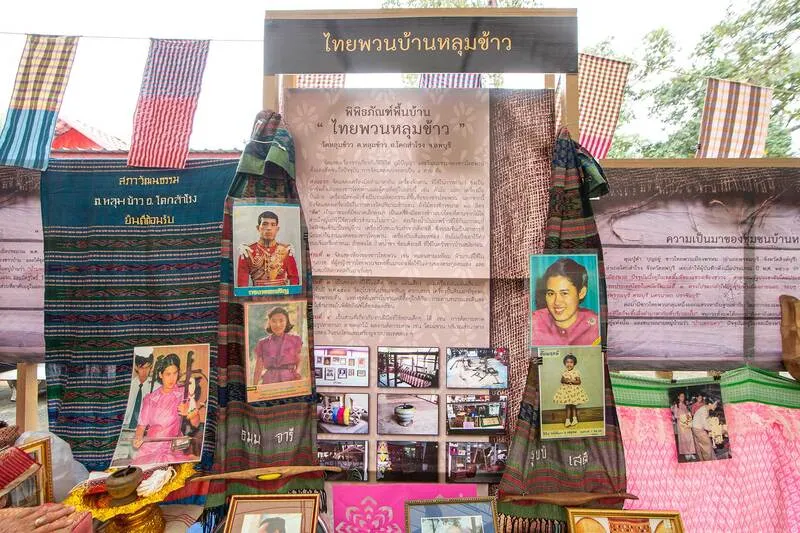
Thai Phuan Folk Museum of Lum Khao, Lopburi Province is a community museum located within Wat Lum Khao in Khok Samrong District, Lopburi Province. It is one of the province’s most valuable local learning centers because it preserves household utensils, farming tools, handicrafts, and objects that reflect the way of life of the Thai Phuan people in the area for younger generations to learn from. The museum’s appeal does not come from the size of its building or the grandeur of its displays, but from its importance as a place that sincerely preserves the memory of the community and remains closely connected to the real lives of local people.
The interest of the Thai Phuan Folk Museum of Lum Khao begins with the name of the village itself. The name “Ban Lum Khao” has been explained through a legend passed down in the community. In the past, during times of severe flooding, rice crops were damaged by water and there was not enough rice to eat. The villagers therefore had to set out in search of a new place to make a living. Along the way, they once stopped to eat near Nong Kwian Hak. After the meal, vultures gathered and ate the remaining wrapped rice. The villagers saw this as an inauspicious sign and returned home. Later, they set out again in search of a new place and finally arrived in what is now Ban Lum Khao. Seeing a large stream rich in fish, they decided to settle there. When they dug a pond, they found rice husks and paddy rice in the soil, so the place came to be called “Lum Khao.” This legend has been passed down through the words of the elders in the community.
The fact that the museum is located within Wat Lum Khao gives the place a truly community atmosphere, because the temple is the center of village life. Establishing the museum within the temple grounds reflects cooperation between the community and the monks in preserving local memories. Visitors therefore do not simply come to see old objects, but feel as though they are stepping into a place that is still alive, full of stories, and still cared for by people who continue to preserve its meaning.
This museum is highly important to the Thai Phuan community in Lopburi, because the term “Thai Phuan” is not merely an ethnic label. It represents a language, culture, clothing traditions, weaving, basketry, and a distinctive way of life. The establishment of the Thai Phuan Folk Museum of Lum Khao is therefore a way of preserving the identity of the community through real objects once used in daily life, whether farming tools, household items, or objects connected to traditions and rituals.
The history of the museum began around 1990 from the intention of Uncle Paiboon Chueasuey, who wanted there to be a place to preserve household items, basketry, and the farming tools of earlier generations so they would not disappear over time. He consulted the abbot of Wat Lum Khao and received permission to use the space beneath one of the temple buildings as the starting point for the museum. From there, he began collecting objects from neighbors, people in the village, and nearby areas for display.
In the early period, the museum was only an open space marked off as an exhibition area and did not yet have a complete display structure. However, with support from the community, community development officers, and relevant organizations, the museum gradually took shape. Later, it received budget support to improve the wooden floor and other details for practical use, making the museum a more complete learning center while still retaining its community atmosphere.
The museum is divided into 4 main exhibition sections. The first section focuses on farming tools and basketry directly related to the agricultural way of life of the Thai Phuan people and local residents. The items on display include ploughs, yokes, cotton-spinning tools, weaving tools, and rice-farming equipment, as well as rice-measuring tools such as a 20-liter wooden rice measure and a “sat,” a bamboo container used for measuring smaller quantities of rice. There are also coconut-oil lamps, khanom jeen presses, lod chong presses, stone grinders for flour, small ceramic cups, tea cups, and zinc spoons, all of which help visitors clearly imagine daily life in the past.
The second section shows what a Thai Phuan room or household interior looked like, including triangular pillows, curtains used in ordination ceremonies, and household items that reflect the tastes and way of life of people in the past. In particular, the curtains were woven by Thai Phuan women themselves for use in important family ceremonies and were passed down as family heirlooms. This section is highly valuable because it helps visitors understand life inside the home, not only images of farming or outdoor labor.
The third section is devoted to old objects once used in the past and items of historical significance, such as records, antique record players, a 1973 calendar, stone pounders, medicine mortars, and pottery excavated from Ban Phromthin, a nearby archaeological site. There are also slate boards and pencils for children to try using, so the learning experience is not limited to simply looking, but allows participation with real objects in an accessible way. This section therefore serves as a bridge between memories of the past and learning for younger generations.
The fourth section is related to handicrafts and activities that can be used to teach children, such as paper-cutting in kanok and floral patterns, as well as the making of hanging lanterns from cut paper. In addition, at the center of the museum there is a display case of banknotes and coins from various countries, most of which were donated by visitors. This makes the museum a place that continues to grow through cooperation between caretakers, the community, and visitors.
The atmosphere inside the Thai Phuan Folk Museum of Lum Khao is simple, warm, and friendly. It is clearly different from large museums in the city, because visitors feel as though they are walking through a place that the community has helped preserve, rather than a display hall created purely for tourism. The main charm of the museum lies in the sincerity of the exhibited objects and the sense that each item has truly passed through the lives of real people.
Today, the museum serves as more than just a place to keep old objects. Most visitors are students from nearby schools or schools in the district who come to learn about ways of life in the past. The museum therefore functions as a true cultural classroom for the community. It has also at times been used as a learning space for students in non-formal education, showing clearly that the place remains a living learning space, not merely a quiet storage place for old things.
The care and maintenance of the museum are supported by the temple, as it is located near the monks’ quarters and the abbot’s area. At the same time, budget support has at times come from the Community Development Office when improvements were needed. The caretakers and local women’s groups work together to write proposals for support. This process further confirms that the Thai Phuan Folk Museum of Lum Khao is a place created and sustained by the real strength of the community.
Getting There To reach the Thai Phuan Folk Museum of Lum Khao from Bangkok, take Highway No. 1, Phahonyothin Road, toward Lopburi Province. When you reach the King Narai the Great Monument, follow the signs to Khok Samrong District. Continue along Phahonyothin Road past several military camps until kilometer 181, where you will find the entrance arch to Wat Thanyathanityaram, or Wat Lum Khao. From there, continue for about 5 kilometers to reach the temple, which is where the museum is located.
Visitors traveling by bus can take a bus from Bangkok to Lopburi Province, then continue by local transport to Wat Lum Khao. Those traveling by train can take the northern line to Lopburi, then continue to Khok Samrong District and Wat Lum Khao. However, since the museum is a community museum located within a temple, visitors should contact the site in advance for convenience in traveling and visiting.
Overall, the Thai Phuan Folk Museum of Lum Khao in Lopburi Province is more than an ordinary local museum. It is a place that closely connects the legend of the village name, the memory of the community, the way of life of the Thai Phuan people, and the role of the temple as a center of learning. For those who want to see a deeper side of Lopburi beyond mainstream tourism, this is a place truly worth visiting and learning from.
| Place Name | Thai Phuan Folk Museum of Lum Khao, Lopburi Province |
| Address | Wat Lum Khao, Lum Khao Subdistrict, Khok Samrong District, Lopburi Province 15120 |
| Coordinates | 15.02627778, 100.63461111 |
| Open Days | Please contact in advance before visiting |
| Opening Hours | Please contact in advance before visiting |
| Admission Fee | Free of charge |
| Main Contact Number | 08-1981-5066 |
| Nearby Tourist Attractions | 1. Phra Prang Sam Yot – 43 km. Tel. 036-412-510 2. Phra Kan Shrine – 43 km. Tel. 036-412-510 3. King Narai’s Palace – 44 km. Tel. 036-411-458 4. Pa Sak Jolasid Dam – 56 km. Tel. 036-494-515 5. Wat Khao Wong Phrachan – 48 km. Tel. 036-705-289 |
| Popular Restaurants Nearby | 1. Krua Baan Khok – 6 km. Tel. 083-546-7750 2. Baan Khok Kitchen x Baan Khok Barista – 7 km. Tel. 061-479-3886 3. Krua Bak May – 8 km. Tel. 098-708-0839 4. Pad Thai Rongna Cafe & Country – 10 km. Tel. 081-115-5159 5. Khok Samrong Restaurant – 12 km. Tel. 036-441-387 |
| Nearby Accommodations | 1. Kesinee Resort – 8 km. Tel. 061-226-9298 2. Phupha Resort – 12 km. Tel. 081-800-2007 3. Aiyawa Resort – 10 km. Tel. 062-447-1235 4. Delight Lopburi Resort – 16 km. Tel. 098-569-9350 5. Nattida Resort – 15 km. Tel. 036-441-803 |
Frequently Asked Questions (FAQ)
Q: Where is the Thai Phuan Folk Museum of Lum Khao located?
A: It is located within Wat Lum Khao, Lum Khao Subdistrict, Khok Samrong District, Lopburi Province 15120.
Q: When was the Thai Phuan Folk Museum of Lum Khao established?
A: The museum was established in 1990 through the intention of Mr. Paiboon Chueasuey, who wanted to preserve the household items and farming tools of earlier generations.
Q: Where does the name Ban Lum Khao come from?
A: A local legend says that villagers searching for a new place to live dug a pond in this area and found rice husks and paddy buried in the soil, which is why the place came to be called “Lum Khao.”
Q: What can visitors see inside the museum?
A: Visitors can see farming tools, basketry, weaving equipment, a model of Thai Phuan household life, records, antique record players, an old calendar, archaeological objects, paper-cutting crafts, and learning materials for children.
Q: Who is this museum suitable for?
A: It is suitable for schoolchildren, students, those interested in Thai Phuan ethnicity, people who enjoy community museums, and travelers who want to learn about the local way of life in Lopburi beyond mainstream tourist attractions.
Q: Is the Thai Phuan Folk Museum of Lum Khao open every day?
A: Visitors should contact the museum in advance before visiting to ensure convenience and certainty of access.
 Thai Phuan Folk Museum Map
 Category:
  Group:
  Last Update: 1 DayAgo
Comment
 Nearby Attractions
| Keyword (Advance) |
 Region
|
 Muang Lop Buri(