
 Home
Home Chiang Mai(





Rating: 2.7/5 (6 votes)
 |
|  Map
Map 
 Have Map
  No Map
Lop Buri attractions
Attractions in Thailand
Open Days: Daily
Opening Hours: All day
Ban Kluai, Lopburi is one of the most important communities in Ban Mi District that clearly reflects the identity of Thai Phuan culture. Although it is not a large village and may appear ordinary to passing visitors, Ban Kluai is in fact a place where traditional weaving wisdom has been strongly preserved, and it remains one of the best-known sources of mudmee textiles in Lopburi Province.
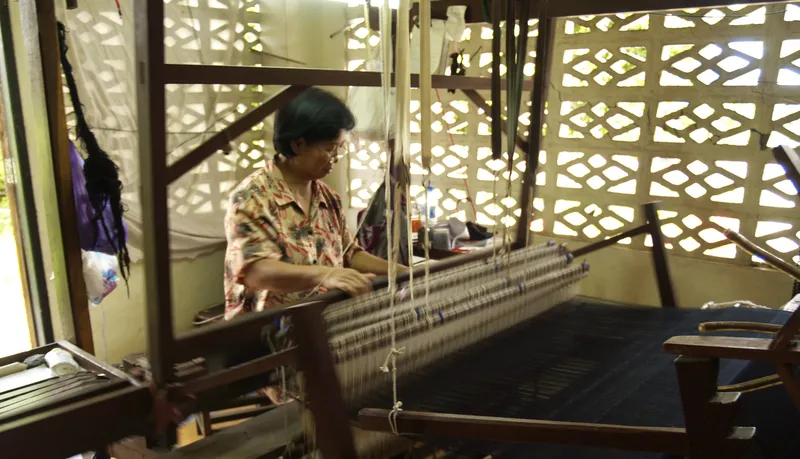
The outstanding quality of Ban Kluai does not come from large tourist sites or major historical monuments, but from the “reality of everyday life” that still continues within the community. Many households, especially in Village No. 1, are still actively engaged in mudmee weaving. The sight of handlooms, yarn, and the tie-dye process is therefore not simply something arranged for display, but a genuine part of daily life in the area.
Ban Kluai was established about 135 years ago by Thai Phuan people who migrated from Laos. That migration was not merely a relocation of people, but the carrying over of culture, language, beliefs, and many forms of local wisdom into a new place. One of the most important things they brought with them was the art of mudmee weaving, which has become a core foundation of Ban Kluai’s identity up to the present day.
The mudmee textiles of Ban Kluai have a distinctive character of their own. Cotton is used as the primary material, and the patterns are fine, dense, and continuous, clearly showing the skill of the weavers. This is different from mudmee in Northeastern Thailand, where the patterns are often larger and more widely spaced.
An important signature pattern of the area is the “eel intestine pattern,” which appears as long continuous lines and reflects both nature and the close observation of local weavers. In addition, the community also produces high-quality pha khao ma and khit textiles, both of which require special techniques and a high level of experience.
Weaving in Ban Kluai is deeply connected to the role of women in the community. Women are the ones who pass knowledge from one generation to the next, ensuring that the patterns, techniques, and meanings of the cloth remain alive and do not disappear over time.
Ban Kluai also reflects a community economy built on cultural foundations. Mudmee textiles are not merely handicraft products, but a major source of income for many households, and there has been ongoing group collaboration to improve product quality.
For visitors, Ban Kluai is a place where learning happens in a real and direct way. Travelers can see the weaving process, closely experience the daily life of the Thai Phuan community, and gain cultural understanding through firsthand experience rather than simple sightseeing. The atmosphere of Ban Kluai is simple, warm, and unhurried, allowing visitors to clearly feel the authentic rhythm of village life.
Mudmee Learning Sources in Ban Kluai and Local Weaving Groups Ban Kluai has mudmee learning sites spread across many households, especially in Village No. 1, which is considered the center of weaving in the community. Visitors can observe traditional weaving directly and speak with local weavers in person. Weaving groups in the area are usually organized as community occupational groups, helping one another develop and maintain weaving standards. Examples include the Ban Kluai Weaving Group and the Women’s Traditional Weaving Group, both of which continue to operate actively.
Step-by-Step Detailed Mudmee Weaving Process The mudmee weaving process in Ban Kluai begins with pattern design, which requires experience and a deep understanding of pattern structure. The next step is tying the yarn, using string to bind selected sections according to the desired design so that dye cannot penetrate those parts of the thread.
After the tying is complete, the yarn moves to the dyeing stage, which must be done carefully to ensure the color adheres evenly. Once dyed, the ties are removed, revealing the pattern on the yarn. The yarn is then arranged on the loom in preparation for the actual weaving stage.
The weaving stage requires a high degree of precision. The weaver must control the rhythm and position of the yarn so that it matches the intended pattern exactly. Even a small error can distort the entire cloth, so both skill and patience are essential.
Getting There Ban Kluai can be reached conveniently by traveling from Lopburi city into Ban Mi District and then continuing to Ban Kluai Subdistrict. It is suitable for travel by private car, or by train to Ban Mi Station followed by local transport into the community.
Today, Ban Kluai remains an important area for preserving Thai Phuan culture and stands as an example of a community that has managed to preserve its local wisdom while also adapting to the modern economy.
| Place Name | Ban Kluai |
| Place Summary | A Thai Phuan community in Ban Mi District, Lopburi Province, well known for cotton mudmee textiles and traditional weaving wisdom |
| Highlights | Fine cotton mudmee patterns, eel intestine pattern, high-quality pha khao ma, and Thai Phuan community life |
| History / Period | Established by Thai Phuan migrants from Laos about 135 years ago, with weaving wisdom continuously passed down to the present |
| Address | Ban Kluai Subdistrict, Ban Mi District, Lopburi Province |
| Getting There | Travel from Lopburi city to Ban Mi District, then continue to Ban Kluai Subdistrict. The journey takes only a short time, and visitors can travel by car or by train to Ban Mi Station and continue from there. |
| Facilities | Local weaving shops, community learning sites, local markets, restaurants, and accommodations in Ban Mi District |
| Nearby Attractions | 1. Thai Phuan Museum, Ban Sai, about 6 km 2. Wat Khao Sanam Chaeng, about 3 km 3. Wat Khao Sarika, about 5 km 4. Wat Khung Tha Lao, about 11 km 5. Wat Khao Wong Phrachan, about 18 km |
| Nearby Restaurants | 1. Ban Mi Food Center Boonsuphan To Chin, about 1 km, Tel. 083 880 2889 2. Krua Lung Wai, about 2 km 3. Nam Ji Boat Noodle Shop, about 2 km 4. Ruean Rap Tawan, about 2 km 5. Green Fox, about 2 km |
| Nearby Accommodations | 1. Saengmanee Resort, about 2 km, Tel. 093 661 5594 2. Rata Resort, about 3 km, Tel. 086 535 6770 3. Por 4 Resort 2, about 10 km, Tel. 080 662 6675 4. Lopburi Inn Resort, about 28 km, Tel. 036 420 777 5. Windsor Park Resort, about 29 km, Tel. 036 422 554 |
Frequently Asked Questions (FAQ)
Q: What is the highlight of Ban Kluai, Lopburi?
A: It is well known for finely patterned cotton mudmee textiles and Thai Phuan culture.
Q: How is Ban Kluai mudmee different from mudmee in the Northeast?
A: Ban Kluai mudmee has finer and denser patterns, while Northeastern mudmee usually features larger and more widely spaced motifs.
Q: What is the eel intestine pattern?
A: It is a signature Ban Mi pattern characterized by long continuous lines resembling an eel.
Q: Is weaving still practiced in Ban Kluai?
A: Yes, it is still actively practiced, especially in Village No. 1 of the community.
Q: Can visitors go there to learn about weaving?
A: Yes, visitors can observe and learn directly from weaving groups in the community.
 Ban Kluai Map
 Category:
  Group:
  Last Update: 11 HourAgo
Comment
 Nearby Attractions
| Keyword (Advance) |
 Facebook Fanpage
 Region
 Art, Culture and Heritage
 Historical Sites and Monuments(
 Landmarks and Memorials(
 Royal Palace(
 Art, Craft Centres, Tradition(
 Museums(
 Historical Houses and The Ancient City(
 University
 Places of Worship
 Temple(
 Other religious and spiritural sites(
 Floating Market(
 Nature and Wildlife
 National Parks and Marine Reserves(
 Mountain (Doi)(
 Dam, Reservoir, Lake(
 Waterfalls(
 Hot Springs(
 Caves(
 Flower Field(
 Entertainment and Agricultural
 Zoos and Aquariums(
 Farm, Parks, Gardens and Ecotourism(
 Outdoor and Adventure Activities(