
 Home
Home Chiang Mai(






Rating: 4.3/5 (4 votes)
 |
|  Map
Map 
 Have Map
  No Map
Lop Buri attractions
Attractions in Thailand
Open Days: Daily
Opening Hours: All day
Ban Mi, Lopburi is one of the most well-known districts in Lopburi Province for its mudmee textiles. When people talk about Ban Mi, they often think of the Thai Phuan community, handwoven cloth, and a way of life that still clearly preserves the atmosphere of traditional culture. Although Ban Mi does not have the same image of large-scale historical monuments as Lopburi city itself, it stands out as an area that has continuously preserved its ethnic roots and weaving wisdom with remarkable strength.
Ban Mi has long been famous for mudmee weaving, and its strength is not limited to being a source of handwoven textiles for sale. More importantly, it is a place where weaving culture is still directly connected to the everyday lives of people in the community. Ban Mi mudmee is therefore not merely a handicraft product, but the result of history, migration, memory, and the identity of the Thai Phuan people that has been passed down for generations.
Most residents of Ban Mi District are Thai Phuan people who migrated from Laos about 130 years ago. They brought with them the name of their former village, “Ban Mi,” and used it as the name of their new settlement in Lopburi. This is highly significant because the name “Ban Mi” is not only a geographical label, but also a symbol of cultural continuity from the old homeland to the new one. The district name itself is like a living record of shared memory that remains with the community to this day.
The migration of the Thai Phuan from Laos to Ban Mi was not merely a relocation of people. It also involved the carrying over of language, beliefs, styles of dress, traditions, and many forms of local wisdom. One of the most important cultural inheritances that remains clearly visible today is mudmee weaving, which has become a cultural marker that distinguishes Ban Mi from other districts in Lopburi.
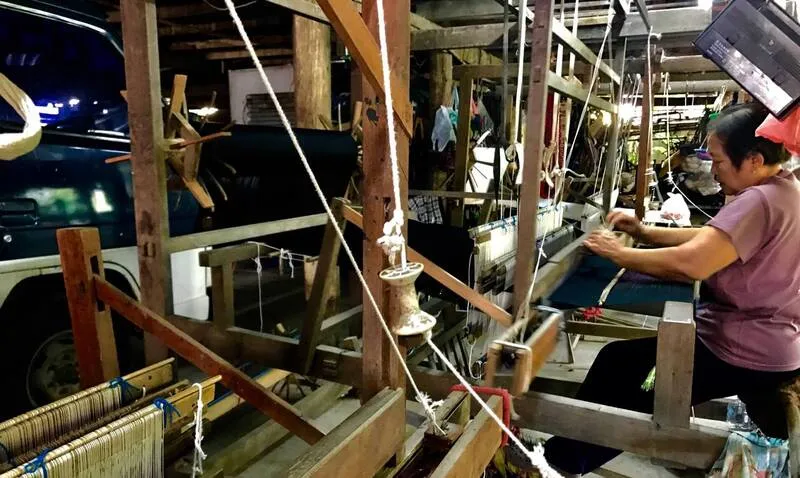
For the people of Ban Mi, the term “mudmee” does not simply mean a beautiful handwoven cloth. It represents a body of knowledge that requires experience, patience, and a deep understanding of patterns. The weaving process begins with designing the motif, tying the threads, dyeing them, untying them, and then weaving them so that the pattern appears precisely. This entire process makes Ban Mi mudmee more valuable than ordinary cloth and turns it into a craft that truly tells the story of the community.
The strength of Ban Mi mudmee lies in the refinement of its patterns and the system of naming them, which is closely connected to the way of life, beliefs, and environment of the Thai Phuan people. Research on Thai Phuan mudmee in Ban Mi District has found that the names of textile patterns are clearly related to nature, agriculture, Buddhist beliefs, and the material culture of local people. This means that each piece of cloth is not only beautiful in form, but also functions as a kind of cultural language that reflects the worldview of its maker.
From a tourism perspective, Ban Mi is therefore interesting not simply as a district known for local products or woven textiles, but as a place where visitors can genuinely spend time learning. If explored with intention, Ban Mi reveals the charm of the Thai Phuan community through its spoken language, traditional clothing, community museums, temples, and weaving groups that still work as part of real life rather than as staged tourist displays.
Ban Mi also plays an important role in the local economy because mudmee is not only a cultural heritage but also an important OTOP product of both the district and Lopburi Province. Official Lopburi provincial information clearly states that mudmee weaving is one of Ban Mi’s signature products, with weaving groups established in several subdistricts such as Ban Kluai, Ban Sai, and other parts of the district. This reflects that weaving still has a real role in the community economy and is not merely a memory of the past.
Traveling in Ban Mi should therefore not be seen only as shopping for woven cloth. It should be seen as stepping into the living world of the Thai Phuan community. Visitors can explore Thai Phuan learning centers, local museums, temples connected to the community, and weaving shops or weaving groups that reflect the skill of people in the area. Visiting Ban Mi in this way helps people understand that mudmee is not the product of factories or purely commercial processes, but something born from the rhythm of life in the community.
In terms of atmosphere, Ban Mi has the charm of a small community town that is unhurried. The area is not hectic like major tourist destinations, but instead feels peaceful and easy to approach. Houses, shops, markets, and community spaces create a friendly impression. Travelers who appreciate the charm of smaller towns and want to see the real lives of local people often feel that Ban Mi is a place where they truly “see something real,” rather than simply ticking off tourist attractions.
Another aspect that makes Ban Mi interesting is the relationship between textiles, culture, and the identity of women in the Thai Phuan community. Mudmee weaving in Ban Mi is not only an economic activity, but also reflects the role of women as inheritors of knowledge, guardians of textile patterns, and the people who connect family memory to the wider community. Mudmee therefore has a deep social and cultural dimension far beyond being a handicraft made for sale.
For travelers interested in culture, Ban Mi is a destination well worth visiting. It offers stories of migration, Thai Phuan ethnic life, traditional weaving, and community learning resources that together provide a broader view of local culture in Lopburi. A trip to Ban Mi is therefore ideal for people who want to understand culture in depth, rather than travel only for photography.
If planned as a 1-day trip, Ban Mi can serve as a main destination in its own right, or as part of a route connecting nearby attractions within the district and province. Places that often interest visitors include mudmee learning centers, Thai Phuan museums, local temples, and traditional markets that clearly reflect the lifestyle of Ban Mi people. These places help make a trip to Ban Mi more than just reading signs or observing from the outside; they create an experience connected to real people in the area.
Getting There Ban Mi District is easily accessible by both car and train. From Lopburi city, visitors can drive along the province’s main routes into Ban Mi District in a relatively short time. Those traveling by train can get off at Ban Mi Railway Station, which makes it convenient to reach the community area and local market. Travel within the district is suitable for private cars, local hired transport, or walking slowly through areas where attractions are located close together.
In terms of present-day importance, Ban Mi is not merely one district of Lopburi, but a cultural area that plays a vital role in preserving Thai Phuan identity in the upper central region. Mudmee weaving remains both a community memory and a form of cultural capital that can be developed into a creative economy today. This is why Ban Mi still matters, not only as a weaving district, but as a place that helps explain ethnicity, culture, and the survival of local wisdom in the modern world.
When viewed as a whole, Ban Mi is much more than a district famous for mudmee textiles. In reality, Ban Mi is a place that shows that culture does not exist only in museums. It is found in the hands of weavers, in the name of the village, in spoken language, in the community, and in memories passed continuously from one generation to the next. For those who want to understand Lopburi beyond its familiar image of monkeys or historical monuments, Ban Mi is one destination that should not be overlooked.
| Place Name | Ban Mi District |
| Place Summary | An important district in Lopburi Province, well known for mudmee textiles and Thai Phuan culture |
| Highlights | Thai Phuan mudmee textiles, Thai Phuan communities, and cultural and local wisdom learning sites |
| History / Era | A Thai Phuan community that migrated from Laos and brought the original village name “Ban Mi” to the new settlement |
| Address | Ban Mi District, Lopburi Province |
| Getting There | Accessible by both private car and train, with Ban Mi Railway Station serving the district |
| Open Days | Daily |
| Opening Hours | All day |
| Facilities | Community markets, railway station, weaving shops and community learning sites, accommodations and restaurants within the district |
| Nearby Attractions | 1. Thai Phuan Museum, Ban Sai, about 6 km 2. Wat Khao Sanam Chaeng, about 3 km 3. Wat Khao Sarika, about 5 km 4. Wat Khung Tha Lao, about 11 km 5. Wat Khao Wong Phrachan, about 18 km |
| Nearby Restaurants | 1. Ban Mi Food Center Boonsuphan To Chin, about 1 km, Tel. 083 880 2889 2. Krua Lung Wai, Ban Mi District, about 2 km 3. Nam Ji Boat Noodle Shop, about 2 km 4. Ruean Rap Tawan, about 2 km 5. Green Fox, about 2 km |
| Nearby Accommodations | 1. Saengmanee Resort, about 2 km, Tel. 093 661 5594 2. Rata Resort, about 3 km, Tel. 086 535 6770 3. Por 4 Resort 2, about 10 km, Tel. 080 662 6675 4. Lopburi Inn Resort, about 28 km, Tel. 036 420 777 5. Windsor Park Resort, about 29 km, Tel. 036 422 554 |
Frequently Asked Questions (FAQ)
Q: What is Ban Mi, Lopburi most famous for?
A: Ban Mi is best known for mudmee textiles and Thai Phuan culture, which are important identities of the district.
Q: What ethnic group makes up most of the people in Ban Mi?
A: Most people in Ban Mi are Thai Phuan, who migrated from Laos and have long settled in the area.
Q: How is Ban Mi mudmee different from other woven fabrics?
A: Ban Mi mudmee stands out for its patterns, tie-dye techniques, and strong connection to Thai Phuan culture.
Q: What type of travel is Ban Mi suitable for?
A: It is suitable for cultural tourism, learning local wisdom, and shopping for handwoven textiles.
Q: Is it convenient to travel to Ban Mi?
A: Yes. It is easy to reach by both private car and train, with Ban Mi Railway Station serving the district.
Q: Are there Thai Phuan learning sites in Ban Mi?
A: Yes, especially the Thai Phuan Museum at Ban Sai and Thai Phuan communities in the area, which help visitors better understand traditional ways of life and culture.
 Ban Mi Map
 Category:
  Group:
  Last Update: 14 HourAgo
Comment
 Nearby Attractions
| Keyword (Advance) |
 Region
|
 Muang Lop Buri(