
 Home
Home Chiang Mai(






Rating: 3.3/5 (10 votes)
 |
|  Map
Map 
 Have Map
  No Map
Lop Buri attractions
Attractions in Thailand
Open Days: Daily
Opening Hours: 08:00 – 17:00
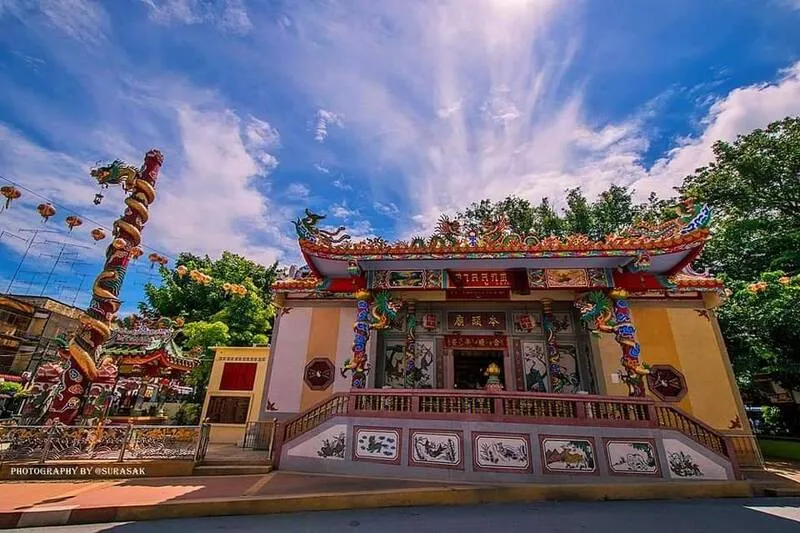
Lopburi City Pillar Shrine, also known to many people as the “Arrow Shrine,” is a small site that holds remarkably deep historical and spiritual significance. Although its outward appearance is not grand when compared with Lopburi’s other famous historical landmarks, this shrine is one of the places that helps explain the old city of Lopburi in a more profound way. This is because the shrine connects the concept of the city pillar, local beliefs, folk legend, and the wider context of Lopburi as an important city with a long and continuous history across many eras.
The shrine stands on the riverside road behind Wat Puen Yai, close to Ban Wichayen, in Tha Hin Subdistrict, Mueang Lopburi District. It is a small pavilion with an area of only about 12 square meters. Inside, there is a stone pillar rising about 1 meter above ground level. The simplicity of the place means that those unfamiliar with it may walk past without noticing, but for people interested in the history of old Lopburi, this small site carries considerable meaning. The stone pillar is regarded as being connected with the city pillar tradition of Lopburi and is also linked to the local legend of the “Arrow Shrine,” which has been passed down in the area.
The most striking feature of Lopburi City Pillar Shrine is that it is a place that is “small in size but weighty in meaning.” Compared with the city pillar shrines of many other provinces, which are often built on a grand scale and clearly function as formal provincial symbols, Lopburi’s city pillar shrine feels quiet, simple, and older in mood. Its distinctiveness therefore lies not in its size or grandeur, but in the charm of a place that still preserves the atmosphere of the old city very clearly. Visitors can immediately sense that this is not merely a check-in point, but a space that still carries the memory of the city.
Historically, the idea of the “city pillar” in Thai society is associated with defining the center of a city and affirming the stability of a community. A city pillar is therefore not just a structure, but a symbol of authority, urban foundation, and the auspiciousness of the city itself. For Lopburi, whose history stretches back to the Lavo period and continued into the Ayutthaya era, the idea of the city pillar becomes even more interesting. This city was not merely an ancient town, but once served as an important secondary royal capital during the reign of King Narai the Great.
Another fascinating aspect of Lopburi City Pillar Shrine is the name “Arrow Shrine,” which reflects layers of belief and folk legend surrounding the place. A widely told legend explains that the stone or rock inside the shrine is connected to the arrow of Phra Ram. This gives the site more than just a fixed historical meaning; it also adds a dimension of imagination and faith that makes it especially memorable to local people. The name “Arrow Shrine” is therefore more than a label. It is an example of how local society interprets and transmits the meaning of a place through storytelling.
When considered within the wider context of old Lopburi, the city pillar shrine stands in a highly meaningful location. It is close to Ban Wichayen, Wat Puen, and not far from other major historic monuments in the old city. The fact that this small site sits among city-level heritage landmarks means that visiting the city pillar shrine should not be seen as stopping at an isolated attraction, but rather as experiencing one part of Lopburi’s wider historical network. Visiting the shrine together with Ban Wichayen, King Narai’s Palace, and Phra Prang Sam Yot helps create a fuller picture of Lopburi in terms of politics, foreign relations, religion, and everyday life.
The atmosphere of Lopburi City Pillar Shrine is especially appealing because of its calmness and simplicity. The area is not as crowded as San Phra Kan or Phra Prang Sam Yot, yet in another sense it feels even more strongly like an old city. Visitors can see the riverside road, old community spaces, traces of nearby historic structures, and a quietness that makes it easy to imagine the past. A place like this is ideal for travelers who enjoy historical atmosphere, prefer a slower pace, and want to see Lopburi from a deeper perspective than its most popular tourist attractions alone can offer.
Inside the shrine, the feature that draws the most attention is the stone pillar that rises above the ground. The presence of a stone pillar instead of a wooden pillar or a more conventional symbolic form makes Lopburi City Pillar Shrine different from many city pillar shrines elsewhere in Thailand. This difference gives the place strong comparative value for those interested in cultural history, because it shows that the belief in the city pillar does not take exactly the same form across the country, but can vary according to local background and the legends embraced by each community.
Another interesting aspect is the relationship between the city pillar shrine and the Thai-Chinese community of Lopburi. Several sources explain that the Arrow Shrine has also served as a place for religious ceremonies among Thai-Chinese residents in Lopburi. This makes Lopburi City Pillar Shrine significant not only within a political-historical framework, but also as a reflection of the city’s cultural diversity. Lopburi has long been a place where many groups of people have interacted, connected, and created shared meanings together.
For general tourists, Lopburi City Pillar Shrine may not be a place where they spend a long time, but it is a site that can add a strong sense of completeness to a trip. Once visitors have seen this shrine, they begin to understand that Lopburi is not a city defined only by Khmer monuments and monkeys. It is also a city with small places that tell profound stories about belief and local identity. Stopping at the city pillar shrine is therefore especially suitable for those who want a Lopburi trip with substance, not just a collection of photos from famous places.
In terms of travel planning, Lopburi City Pillar Shrine fits very well into a half-day or full-day walking trip around the old city. It can be connected almost immediately with Ban Wichayen, then continued to King Narai’s Palace, San Phra Kan, and Phra Prang Sam Yot without much difficulty. Whether visitors begin at Lopburi Railway Station or in the town center, they can arrange a route that covers several places in one line of travel. Including the city pillar shrine in the itinerary adds more historical depth to the trip and prevents it from revolving only around the most famous landmarks.
Getting There to Lopburi City Pillar Shrine is quite convenient for travelers using a private car, as the shrine lies in the old city and is close to Ban Wichayen, which is easy to locate on a map. If coming from Bangkok, you can drive into Lopburi town and head toward the Ban Wichayen and Wat Puen Yai area, then follow the riverside road behind the temple to reach the shrine. Those traveling by train can get off at Lopburi Railway Station and then take local transport or walk through the old-city monument zone as convenient. For people who enjoy walking and taking photographs, this area is ideal for a slow exploration, since the route passes old buildings, historical sites, and the atmosphere of the old quarter throughout the way.
The most suitable times to visit are in the morning or late afternoon, because the weather is not too hot and the light is good for photography. This is especially useful if visitors want to continue on foot to other places in the old city. Coming in the morning makes it easier to organize a full day of sightseeing and also allows visitors to experience the quiet atmosphere of the city pillar shrine more clearly. Midday, by contrast, can be much hotter and make walking among several sites in one day more tiring.
The importance of Lopburi City Pillar Shrine today therefore exists in historical, spiritual, and tourism terms at the same time. Historically, it helps connect an understanding of the structure of the old city and the continuity of Lopburi from past to present. Spiritually, it remains a place of worship that still holds meaning for local people. In tourism terms, it represents “another side of Lopburi” that is quiet, deep, and full of charm for those who want to know the city beyond its most superficial image.
When viewed as a whole, Lopburi City Pillar Shrine clearly proves that the value of a tourist site does not always depend on its size or fame. Sometimes a very small place can express the character of a city more sharply than a much larger monument, because it preserves memory, belief, and traces of people’s lives without relying on grandeur. Lopburi City Pillar Shrine is therefore suitable for history lovers, those who come to pray for blessings, and travelers who enjoy discovering small details that carry more meaning than first meets the eye.
For anyone planning a trip to Lopburi and wanting to understand the city more deeply, Lopburi City Pillar Shrine is one of the places that should not be overlooked. Even though a visit may not take long, stopping here helps visitors see Lopburi as a city where national-level history, local belief, and layered cultural blending all exist together in an intriguing way. When combined with nearby places such as Ban Wichayen, King Narai’s Palace, and Phra Prang Sam Yot, it makes an old-city Lopburi trip both more complete and more meaningful.
| Name | Lopburi City Pillar Shrine (Arrow Shrine) |
| Place Summary | A small shrine in the old city of Lopburi, located behind Wat Puen Yai near Ban Wichayen. Inside is a stone pillar rising about 1 meter above the ground and believed to be connected with the city pillar tradition of Lopburi. |
| Highlights | A very small city pillar shrine, featuring a stone pillar as its key element, linked to the Arrow Shrine legend, and located close to Ban Wichayen and the old-city heritage zone of Lopburi. |
| History / Period | Believed to be related to the city pillar tradition of Lopburi and long regarded as an important sacred site for communities in the old city. It is also known by the name “Arrow Shrine.” |
| Address | Riverside Road behind Wat Puen Yai, near Ban Wichayen, Tha Hin Subdistrict, Mueang Lopburi District, Lopburi 15000 |
| Coordinates | 14.803235, 100.609200 |
| Getting There | Drive into Lopburi town and head toward Ban Wichayen and Wat Puen Yai, then continue to the riverside road behind the temple. If traveling by train, get off at Lopburi Railway Station and continue by local transport or by walking through the old-city zone. |
| Open Days | Daily |
| Opening Hours | 08:00 – 17:00 |
| Facilities | Small worship area, located within the old-city zone with easy access to other attractions, and surrounded by shops and restaurants in the nearby area. |
| Current Status | Open for worship and visits as usual, and remains one of the important sacred places in the old city of Lopburi. |
| Nearby Tourist Attractions | 1. Ban Wichayen, about 0.1 km 2. Wat Puen Yai / Wat Mani Chonlakhan, about 0.2 km 3. King Narai’s Palace, about 0.5 km 4. San Phra Kan, about 1.2 km 5. Phra Prang Sam Yot, about 1.3 km |
| Nearby Restaurants | 1. Noom Guesthouse & Restaurant, about 0.8 km, Tel. 064 154 4342 2. Mudmee Thai Phuan Restaurant Lopburi, about 1.6 km, Tel. 036 412 883 3. Inside.lopburi, about 2.1 km, Tel. 063 440 4483 4. Jungle Cafe, Ram Decho Branch, Lopburi, about 2.2 km, Tel. 082 093 7567 5. Bualuang Garden Restaurant, about 3.1 km, Tel. 036 413 009 |
| Nearby Accommodations | 1. Noom Guesthouse, about 0.8 km, Tel. 036 427 693 2. Windsor Park Resort, about 2.0 km, Tel. 036 422 554 3. Lopburi Inn Hotel, about 4.4 km, Tel. 036 412 300 4. PJ Loft Hotel Lopburi, about 5.1 km, Tel. 094 952 4246 5. Lopburi Inn Resort, about 8.5 km, Tel. 036 420 777 |
Frequently Asked Questions (FAQ)
Q: Where is Lopburi City Pillar Shrine located?
A: Lopburi City Pillar Shrine is located on the riverside road behind Wat Puen Yai, near Ban Wichayen, in Tha Hin Subdistrict, Mueang Lopburi District, Lopburi Province.
Q: Does Lopburi City Pillar Shrine have another name?
A: Yes. Local people and several tourism sources also call it the “Arrow Shrine,” a name connected with the local legend of the city.
Q: What is the main highlight of Lopburi City Pillar Shrine?
A: Its main highlight is that it is a very small city pillar shrine with a stone pillar rising about 1 meter above the ground, and it combines historical importance, local belief, and folk legend in one place.
Q: What type of trip is Lopburi City Pillar Shrine suitable for?
A: It is especially suitable for historical sightseeing and walking exploration in old Lopburi, and can easily be included in the same route as Ban Wichayen, King Narai’s Palace, San Phra Kan, and Phra Prang Sam Yot.
Q: Is it convenient to reach Lopburi City Pillar Shrine by train?
A: Fairly convenient. Visitors can get off at Lopburi Railway Station, then continue by local transport or by walking through the old-city area to reach the shrine and nearby landmarks.
Q: What is the best time to visit Lopburi City Pillar Shrine?
A: Morning or late afternoon is the best time, because the weather is more comfortable, it is easier to continue exploring the old city, and the light is better for photography.
Q: How is Lopburi City Pillar Shrine different from city pillar shrines in other provinces?
A: The main difference is that it is very small and features a stone pillar as its key element, giving it the atmosphere of an old historical-city shrine rather than the larger and more formal city pillar shrines found in many other provinces.
 The City Shrine Map
 Category:
  Group:
  Last Update: 8 HourAgo
Comment
 Nearby Attractions
| Keyword (Advance) |
 Facebook Fanpage
 Region
 Art, Culture and Heritage
 Historical Sites and Monuments(
 Landmarks and Memorials(
 Royal Palace(
 Art, Craft Centres, Tradition(
 Museums(
 Historical Houses and The Ancient City(
 University
 Temple(
 Suburban Living
 Village, Community(
 Floating Market(
 Nature and Wildlife
 National Parks and Marine Reserves(
 Mountain (Doi)(
 Dam, Reservoir, Lake(
 Waterfalls(
 Hot Springs(
 Caves(
 Flower Field(
 Entertainment and Agricultural
 Zoos and Aquariums(
 Farm, Parks, Gardens and Ecotourism(
 Outdoor and Adventure Activities(