
 Home
Home Chiang Mai(





Rating: 4/5 (5 votes)
 |
|  Map
Map 
 Have Map
  No Map
Lop Buri attractions
Attractions in Thailand
Open Days: Daily
Opening Hours: 05:30 – 17:00
San Phra Kan is one of the most important historical and sacred sites in Lopburi Province, as it brings together history, art, belief, and the modern image of the “Monkey City” in one place more clearly than anywhere else. When people think of Lopburi, many tourists first think of Phra Prang Sam Yot and monkeys, but in reality San Phra Kan is another key landmark that completes the identity of the city. This is not merely a photo stop or a place to pay respect, but also a historical monument that clearly reflects the Khmer civilization that once flourished in this area.
What makes San Phra Kan more special than an ordinary tourist attraction is that several layers of meaning coexist in the same place. The first layer is its identity as an ancient Khmer shrine dating back to around the 16th Buddhist century. The second is its role as a spiritual center for the people of Lopburi, who revere Chao Pho Phra Kan as a guardian deity protecting the city. The third is the physical transformation of the shrine itself, which includes both the ancient base and the later structure built afterwards. The final layer is the modern image of the large monkey population living around the site, which has become one of the province’s best-known symbols.
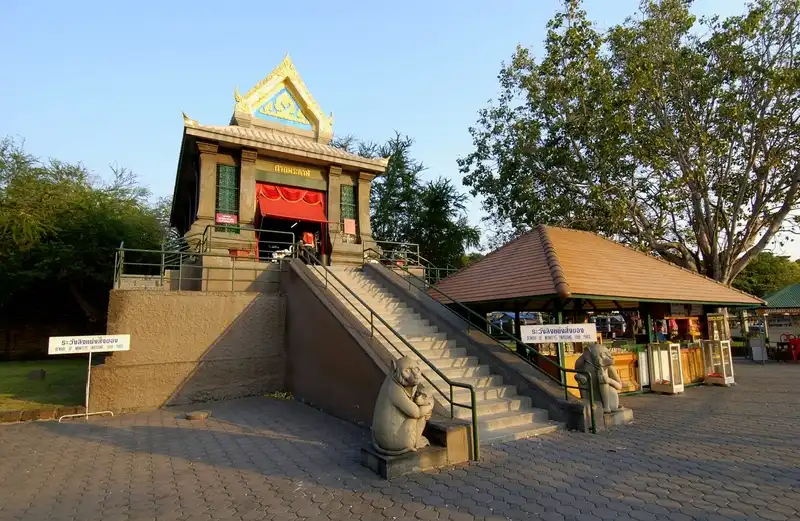
From the outside, many visitors may see only a Thai-style shrine standing near the roundabout and the railway, but a closer look reveals that San Phra Kan has a far more complex historical structure. The original base of the shrine is an ancient laterite construction raised above ground level. This elevated form is exactly why people in the past called the site “San Sung,” meaning “High Shrine.” This old name is highly significant, because it reflects both the form of the monument and the memory of local people before the name “San Phra Kan” became the one widely recognized today.
The location of San Phra Kan is historically very important, as it stands along the railway on the eastern side of Phra Prang Sam Yot, in the old quarter of Lopburi where many major historical monuments are concentrated. The fact that San Phra Kan stands so close to Phra Prang Sam Yot is not accidental, but reflects that this area was once a major center of ancient Lavo in terms of religion, politics, and settlement. For that reason, visiting San Phra Kan should not be seen as visiting a single stand-alone attraction, but rather as entering the core historical monument zone of Lopburi, where visitors can continue on to Phra Prang Sam Yot, Wat Nakhon Kosa, Wat Phra Si Rattana Mahathat, King Narai’s Palace, and Ban Wichayen in the same trip.
Historically, San Phra Kan is an ancient Khmer shrine built from stacked laterite blocks forming a high base. This base is a crucial feature because it helps confirm both the age and the artistic style of the Lopburi monument group very clearly. The use of laterite as the main construction material is consistent with many Khmer-influenced monuments found in central Thailand, especially in areas that once served as important cities or centers of government and religion.
Another very important piece of evidence is the sandstone lintel carved with the image of Vishnu reclining on the cosmic ocean. This is not merely decorative art, but reflects Brahmanical-Hindu beliefs that once had a strong influence across the Chao Phraya basin. Vishnu reclining on the cosmic ocean depicts the god resting above the Ocean of Milk upon the serpent Ananta, a symbol of cosmic order and sacred power. When such imagery is found at San Phra Kan, it strongly confirms that this site once played an important role within the religious system of ancient society.
Beyond the lintel, an octagonal stone inscription engraved in ancient Mon script was also discovered in the area of San Phra Kan. This detail further increases the archaeological value of the site, because it shows that Lopburi in the past was not shaped by a single culture alone, but was instead a place of overlap and exchange among multiple cultural groups, including the Mon, the Khmer, and later the Thai of Ayutthaya. This evidence is therefore valuable not only as an artifact of one location, but also as a key to understanding the historical development of the region as a whole.
The front shrine that visitors see today is a later structure built in 1951 on the original foundation associated with continuous use of the site since the reign of King Narai the Great. This continuity is highly meaningful in social-historical terms, because it shows that this sacred place was never abandoned or stripped of its role over time. Instead, it has continued to be used, inherited, and reinterpreted according to each period.
Inside the sanctuary are 2 standing Vishnu images made of stone. The smaller one is regarded as an early type of deity image found in Thailand, while the larger one is Lopburi-style sculpture. However, its original head was lost, and later a sandstone Buddha head from the Ayutthaya period was placed onto it. This detail is especially interesting because it turns San Phra Kan into a place that reflects restoration, lived use, and the continuity of faith in a way that is not frozen in an original form, but instead evolves with people and time.
In terms of living faith, San Phra Kan has long been a place deeply revered by both Lopburi residents and visitors. Chao Pho Phra Kan is seen as a guardian deity protecting the city. Many people come here to pray for work, safe travel, good fortune, and a smooth life. Some make vows and later return to fulfill them according to their beliefs. The atmosphere of the shrine is therefore not only that of an ancient historical site, but also that of a sacred place that remains actively woven into the lives of people today.
It would be impossible to speak of San Phra Kan without mentioning the monkeys, because the monkey troops living around the shrine have become one of Lopburi’s most memorable images for decades. Local stories say that this area was once filled with large Krang trees and served as a habitat for wild monkeys. When people began bringing food and fruit to offer at the shrine in fulfillment of vows, the monkeys gradually came down to eat the offerings and became more familiar with humans, eventually turning into an inseparable part of Lopburi’s old-city landscape.
The monkeys at San Phra Kan are therefore not just a tourism element, but also part of the province’s story and identity. Many tourists come specifically to see the monkeys in person, but once they arrive, they often discover that San Phra Kan holds a much deeper historical and spiritual dimension. Even so, visitors should take good care of their belongings, especially mobile phones, glasses, hats, water bottles, and bags of food, because the monkeys in this area are highly agile and very accustomed to people.
The atmosphere of San Phra Kan is especially distinctive because it blends an urban historical monument, a sacred space, and contemporary daily life. On one side, visitors can see Phra Prang Sam Yot; on the other, they can hear trains and the movement of the city. At the same time, the shrine itself still retains the calm atmosphere of a place of worship. If you come in the morning, sunlight gradually falls across the shrine and the laterite base, revealing the texture of the ancient material beautifully. It is an ideal time for walking, paying respect, and taking photographs.
As a travel destination, San Phra Kan is very well suited to a half-day or full-day trip focused on exploring old Lopburi, because many important sites are close enough to be linked together easily. Visitors arriving by train will find it especially convenient, as they can get off at Lopburi Railway Station and walk into the historical zone without much difficulty. Starting at San Phra Kan and continuing to Phra Prang Sam Yot, Wat Nakhon Kosa, King Narai’s Palace, and Ban Wichayen creates a route that helps visitors understand Lopburi as a historical city much more clearly than simply stopping at one place and leaving.
Getting There to San Phra Kan is very convenient for both private-car travelers and those using public transportation. If traveling from Bangkok, you can drive to Lopburi via the main highways, which takes a little over 2 hours depending on traffic. Once you enter the city, head toward the Phra Prang Sam Yot zone and the Sri Sunthon roundabout. Those traveling by train can get off at Lopburi Railway Station and walk into the old-city tourism area with ease. Within the city, local transport and hired vehicles can take visitors onward to nearby attractions conveniently.
The best time to visit San Phra Kan is in the morning, when the weather is still comfortable for walking and the light is ideal for photography. If you plan to visit several places in one day, it is best to arrange your route in advance, for example starting at San Phra Kan, continuing to Phra Prang Sam Yot, and then moving on to King Narai’s Palace or Ban Wichayen. This will save time and allow you to experience the overall character of old Lopburi more fully.
Today, San Phra Kan remains important on at least 3 levels at once. The first is its historical significance as evidence of Khmer influence and the development of ancient Lavo. The second is its spiritual significance as a center of faith for local people and visitors. The third is its importance to the province’s image, because when people speak of Lopburi, the image of San Phra Kan and the monkeys around it remains one of the most powerful associations with the city.
Those interested in history will see San Phra Kan as a trace of the old world layered into the present-day city. Those interested in art will see the beauty of the laterite base, the lintel, and the deity images that have changed over time. Pilgrims will focus on worship and prayer, while general tourists will remember the atmosphere of Lopburi’s monkey-filled city. It is precisely this variety of perspectives that makes San Phra Kan such an accessible destination for many kinds of visitors, rather than something limited to only one category.
San Phra Kan is therefore not just one of Lopburi’s famous tourist attractions, but one of the places that best explains the identity of Lopburi itself. It brings together history, faith, art, and contemporary life within the same space. When visitors walk away from the shrine and look back once more, many feel that this place is not merely a “stop” on an itinerary, but a space that still holds shared meaning in the lives of real people. That is exactly why San Phra Kan continues to hold such power both as a destination for travelers and as a cultural heart of Lopburi.
| Name | San Phra Kan |
| Place Summary | An ancient Khmer shrine in the heart of Lopburi, near Phra Prang Sam Yot, with an old laterite base, a later shrine structure built on the original site, and a long-standing role as a spiritual center of the city. |
| Highlights | An ancient Khmer monument formerly known as “San Sung” or “High Shrine,” featuring a lintel of reclining Vishnu, an octagonal inscription in ancient Mon script, the revered Chao Pho Phra Kan, and the monkey troops that have become symbolic of Lopburi. |
| History / Period | The original base dates to around the 16th Buddhist century in the Khmer cultural period, while the present front shrine was built in 1951 on the same long-used sacred site. |
| Key Evidence | A sandstone lintel carved with reclining Vishnu and an octagonal stone inscription engraved in ancient Mon script. |
| Name Origin | The site was originally called “San Sung” because of its elevated base. Later, it became associated with reverence for Chao Pho Phra Kan and came to be known as “San Phra Kan.” |
| Address | Narai Maharat Road, near Phra Prang Sam Yot, Tha Hin Subdistrict, Mueang Lopburi District, Lopburi 15000 |
| Coordinates | 14.80222, 100.61500 |
| Getting There | Visitors driving can head directly into Lopburi city toward the Phra Prang Sam Yot zone and the Sri Sunthon roundabout; travelers by train can get off at Lopburi Railway Station and walk into the old city easily; local transport and hired vehicles connect the main attractions in the area. |
| Open Days | Daily |
| Opening Hours | 05:30 – 17:00 |
| Fees | No admission fee |
| Facilities | Worship area, walking space around the shrine, nearby shops and restaurants, and parking areas within the old-city zone near the site. |
| Current Status | Open for worship and tourism as usual, remains one of Lopburi’s key landmarks, and visitors should watch their belongings because of the monkeys in the area. |
| Nearby Tourist Attractions | 1. Phra Prang Sam Yot, about 0.1 km 2. Wat Nakhon Kosa, about 0.1 km 3. Prang Khaek Shrine, about 0.3 km 4. King Narai’s Palace, about 0.7 km 5. Ban Wichayen, about 0.9 km |
| Nearby Restaurants | 1. Noom Guesthouse & Restaurant, about 0.4 km, Tel. 064 154 4342 2. Mudmee Thai Phuan Restaurant Lopburi, about 0.8 km, Tel. 036 412 883 3. Inside.lopburi, about 1.3 km, Tel. 063 440 4483 4. Jungle Cafe, Ram Decho Branch, Lopburi, about 1.4 km, Tel. 082 093 7567 5. Bualuang Garden Restaurant, about 2.5 km, Tel. 036 413 009 |
| Nearby Accommodations | 1. Noom Guesthouse, about 0.4 km, Tel. 036 427 693 2. Windsor Park Resort, about 1.4 km, Tel. 036 422 554 3. Lopburi Inn Hotel, about 3.8 km, Tel. 036 412 300 4. PJ Loft Hotel Lopburi, about 4.5 km, Tel. 094 952 4246 5. Lopburi Inn Resort, about 7.9 km, Tel. 036 420 777 |
Frequently Asked Questions (FAQ)
Q: Where is San Phra Kan located in Lopburi?
A: San Phra Kan is located on Narai Maharat Road near Phra Prang Sam Yot in Mueang Lopburi District, making it ideal for exploring the old city on foot and visiting several nearby attractions in one trip.
Q: Why is San Phra Kan important?
A: It is both an ancient Khmer shrine and an important historical monument of old Lavo, while also serving as a spiritual center for the people of Lopburi who revere Chao Pho Phra Kan as the city’s guardian deity.
Q: How is San Phra Kan connected to Lopburi’s monkeys?
A: The area around the shrine has long been home to large monkey troops, which later became one of Lopburi’s most recognizable symbols. Many tourists visit San Phra Kan specifically to see them, although they should be careful with their belongings.
Q: Is San Phra Kan open every day?
A: Yes. San Phra Kan is open daily and remains one of the key attractions in Lopburi’s old city, where people come regularly for worship and sightseeing.
Q: Is it convenient to visit San Phra Kan by train?
A: Yes, it is very convenient. Once you arrive at Lopburi Railway Station, you can easily reach the old-city zone and continue on to San Phra Kan, Phra Prang Sam Yot, and other nearby historical sites.
Q: What is the best time to visit San Phra Kan?
A: Morning is the best time, because the weather is more comfortable for walking, the light is better for photography, and it is easier to continue on to other important attractions in the old city afterward.
Q: What is the difference between San Phra Kan and Phra Prang Sam Yot?
A: Phra Prang Sam Yot is a Khmer sanctuary best known for its three prangs and striking architecture, while San Phra Kan is an older shrine with an ancient base and a later structure used for worship, and is especially famous for its close association with Lopburi’s monkeys. Both sites are close to each other and should be visited together.
 San Phra Kan Map
 Category:
  Group:
  Last Update: 14 HourAgo
Comment
 Nearby Attractions
| Keyword (Advance) |
 Facebook Fanpage
 Region
 Art, Culture and Heritage
 Historical Sites and Monuments(
 Landmarks and Memorials(
 Royal Palace(
 Art, Craft Centres, Tradition(
 Museums(
 Historical Houses and The Ancient City(
 University
 Temple(
 Suburban Living
 Village, Community(
 Floating Market(
 Nature and Wildlife
 National Parks and Marine Reserves(
 Mountain (Doi)(
 Dam, Reservoir, Lake(
 Waterfalls(
 Hot Springs(
 Caves(
 Flower Field(
 Entertainment and Agricultural
 Zoos and Aquariums(
 Farm, Parks, Gardens and Ecotourism(
 Outdoor and Adventure Activities(