
 Home
Home Chiang Mai(






Rating: 4.5/5 (4 votes)
 |
|  Map
Map 
 Have Map
  No Map
Lop Buri attractions
Attractions in Thailand
Open Days: Every day
Opening Hours: 08:00 – 16:30
Wat Lai is an ancient temple of great importance in Lopburi Province in terms of history, art, and local devotion. The temple is located along Bang Kham Canal in Khao Samo Khon Subdistrict, Tha Wung District. The surrounding atmosphere feels peaceful and simple, while still preserving the character of an old temple with a long and continuous story. In the bigger picture, Wat Lai is not only a place for worship and merit-making, but also an important destination for those interested in Ayutthaya-era history, traditional Thai art, and local Lopburi traditions that are still alive today.
The distinctiveness of Wat Lai begins with its setting along Bang Kham Canal. This waterway has long been connected to the surrounding community and gives the temple the atmosphere of a riverside temple that feels calm and serene, unlike temples in busy urban areas. As soon as visitors step into the temple grounds, they can sense the shaded surroundings, the openness of the historic structures, and the age of the place reflected in its layout, principal buildings, and surviving artistic works that remain impressive to this day.
Wat Lai was notably mentioned in the travel writing of Prince Damrong Rajanubhab in his work Thiao Tam Thang Rotfai (“Travels Along the Railway”). He clearly recorded that Wat Lai was a first-class ancient temple dating back to the Ayutthaya period and was restored during the reign of King Borommakot. This royal writing is especially valuable because it confirms both the age and the significance of the temple in the eyes of historians and learned figures at the national level. It also shows that Wat Lai has long been recognized, rather than being merely a local temple known only within the surrounding community.
From a historical perspective, Wat Lai dates back to the early Ayutthaya period, which means the temple has passed through many important periods of Thai history. Its restoration during the reign of King Borommakot further links it with a time when Thai art flourished greatly, particularly in stucco work and architecture that clearly preserved the identity of Ayutthaya-period temple design. The importance of Wat Lai therefore lies not only in its age, but also in the artistic value and cultural evidence that the temple has managed to preserve up to the present.
Another central feature of Wat Lai is “Phra Si Ariya,” a sacred image that has long been revered by local people. Phra Si Ariya of Wat Lai is not simply a Buddha image enshrined in the temple, but a spiritual center tied closely to an important local tradition for many generations. In the past, the vihara housing Phra Si Ariya was damaged by a forest fire during the reign of King Rama V, which caused the image to deteriorate. King Chulalongkorn then graciously ordered it to be brought to Bangkok for restoration before it was returned and re-enshrined at Wat Lai. This event reflects the significance of Phra Si Ariya at a level that was connected with both the royal court and Thai society at that time.
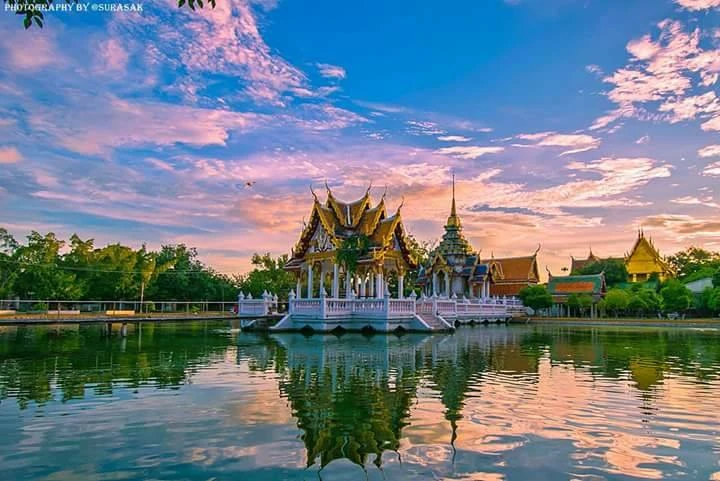
Today, the temple has built a new vihara to house Phra Si Ariya, with a dignified and striking front façade in the form of a four-porched pavilion. Visitors can immediately see that this is one of the temple’s key highlights. This new structure does not simply serve as a proper place to enshrine the image, but also continues the long-standing chain of devotion that people have had toward Phra Si Ariya since ancient times. During important festivals, local residents still carry Phra Si Ariya out in procession as an annual community tradition, reflecting the uninterrupted continuation of faith even as the outside world has changed greatly.
In terms of architecture, the temple’s vihara is one of its most outstanding elements because it is a clear example of early Ayutthaya architectural style. One of its defining features is the use of wall openings instead of windows, a form that reflects the aesthetic taste and craftsmanship of that period. Inside the vihara is a large principal Buddha image in the Mara-Vijaya posture, lacquered and gilded in a beautiful manner, with a decorative aureole resembling that of Phra Phuttha Chinnarat in Phitsanulok Province. This beauty allows visitors not only to appreciate the sacredness of the place, but also to witness the refined skill of ancient Thai artisans.
What gives Wat Lai an even more prominent status at the national level is the stucco relief found on both the front and rear of the vihara, depicting the Ten Jataka Tales and the Pathom Somphoth. This body of stucco work is important not merely as decoration for a religious building, but is recognized as one of the nation’s most significant large-scale wall relief sculptures. It reflects religious ideas, artistic technique, and Ayutthaya aesthetic taste in a complete and compelling way. Those interested in Thai art can immediately see that these works are not simply beautiful decorative motifs, but artistic evidence of serious historical value deserving careful study.
The Ten Jataka scenes represented in the stucco work express the concept of the Bodhisattva and the cultivation of merit, while the Pathom Somphoth depicts important episodes in the life of the Buddha. The presence of both narrative cycles in the key areas of the vihara makes Wat Lai a place where art and Buddhist teaching are inseparably joined together. Visitors therefore do not only admire the visual beauty, but also come closer to the religious worldview that the builders and craftsmen intended to convey through sculpture.
Besides the vihara, the temple contains several other interesting features, including the ordination hall, a pavilion-like structure with a prang-shaped spire, and the temple museum, which preserves many old objects for display. These include Buddha images, porcelain wares, tools, utensils from earlier periods, and various other artifacts that reflect the lifestyle and beliefs of the past. The presence of a museum gives Wat Lai a role beyond that of a merit-making site, turning it into a place of learning for those interested in Lopburi’s history and the surrounding community in a broader sense.
The atmosphere of Wat Lai is especially suitable for those who enjoy visiting temples slowly rather than stopping briefly and rushing away, because this place contains details that invite gradual appreciation in terms of history, art, and peaceful surroundings. Since the temple stands by the water, it carries the mood of an old riverside temple that has long been tied to the canal-side community. As visitors walk around different parts of the temple, they feel as if they are reading several layers of history at once: the story of the Ayutthaya court, local devotion, ancient art, and local traditions that have continued unbroken to the present day.
The importance of Wat Lai today exists on several levels at once. First, it remains an active temple with an ongoing religious role and continues to be a center of faith for the community. Second, it is a source of artistic and architectural heritage of clearly outstanding value. Third, it continues to preserve the Phra Si Ariya procession tradition, a local cultural identity of Lopburi that is especially admirable. For those interested in art history, visiting Wat Lai is like seeing living evidence of the past that still remains active in the present.
Getting There to Wat Lai can be done by taking Highway 311 on the Lopburi - Sing Buri route, then turning onto Highway 3028 at the traffic light intersection around kilometer 18, and continuing for about 6 kilometers to reach the temple. There are also several regular bus routes passing by, such as the Lopburi - Tha Khlong route, the Khok Samrong - Ban Mi route, and the Sing Buri - Ban Mi route. This makes Wat Lai an ancient temple that is not too difficult to reach, both for travelers using private cars and for those traveling by public bus.
For visitors, the best experience at Wat Lai comes from setting aside enough time, because the temple contains far more detail than may first appear from the outside. Those who enjoy art should spend time in the vihara at an unhurried pace, while those interested in local tradition should study the period of the Phra Si Ariya procession in advance. Dressing modestly, respecting the sacred space, and avoiding loud noise inside the important buildings are all practices that should always be observed, especially in the vihara, the ordination hall, and the area where Phra Si Ariya is enshrined.
Looking at the temple as a whole, Wat Lai is a place that brings together rare completeness in history, art, religion, and local culture. It is not only a destination for religious tourism, but also a place suited to those who want to understand the continuity between the past and the present through a real historic site. Seeing the Ayutthaya-style vihara, the stucco reliefs of the Ten Jataka Tales and Pathom Somphoth, the vihara of Phra Si Ariya, and the temple museum in person makes it even clearer why Wat Lai deserves to be recognized as more than just another old temple in Lopburi.
For those who love ancient temples and want a place with stories, historical weight, and authentic heritage to see, Wat Lai is a destination well worth visiting. Standing within this old riverside temple along Bang Kham Canal makes it clear that what remains is not just old architecture, but the memory of the land, the faith of the people, and the artistic and cultural heritage that still speaks quietly through its walls, vihara, and traditions that continue to this day.
| Summary | Wat Lai is an ancient temple along Bang Kham Canal in Khao Samo Khon Subdistrict, Tha Wung District, Lopburi Province. It is significant for its history, art, and the Phra Si Ariya tradition. |
| Highlights | Early Ayutthaya-style vihara, stucco reliefs of the Ten Jataka Tales and Pathom Somphoth, Phra Si Ariya, the four-porched pavilion-style vihara, and the temple museum. |
| History / Period | An ancient temple dating back to the early Ayutthaya period, later restored during the reign of King Borommakot. |
| Current Abbot / Temple Caretaker | Phra Khru Sathukit Borihan (Phipat) Panitachitto |
| Address | Village No. 10, Khao Samo Khon Subdistrict, Tha Wung District, Lopburi Province 15150 |
| Getting There | Take Highway 311 on the Lopburi - Sing Buri route, then turn onto Highway 3028 at the traffic light intersection around kilometer 18 and continue for about 6 kilometers. Regular bus routes include Lopburi - Tha Khlong, Khok Samrong - Ban Mi, and Sing Buri - Ban Mi. |
| Open Days | Every day |
| Opening Hours | 08:00 – 16:30 |
| Facilities | Parking area, worship area, vihara, ordination hall, Phra Si Ariya vihara, temple museum. |
| Zones | Vihara, ordination hall, Phra Si Ariya vihara, prang-spired pavilion structure, temple museum, and the Bang Kham canal-side area. |
| Nearby Attractions | 1. Wat Kamphaeng, about 1.8 km 2. Wat Bang Phan, about 4.2 km 3. Sing Buri Buddhist Relief Association (Cheng Bu Tang), about 5.2 km 4. Sing Buri Museum, about 7 km 5. Sing Buri City Pillar Shrine, about 7.7 km |
| Nearby Restaurants | 1. Phad Thai Bang Mon, about 8.2 km. Tel. 062-329-3531 2. Baanbake Singburi, Bang Phutsa branch, about 7.4 km. Tel. 089-120-2022 3. Nai Hua Korean Grilled Pork, about 7.5 km. Tel. 089-850-5285 4. Mae La Pla Phao, about 7.5 km. Tel. 036-813-701, 080-910-8563 5. Kesara Cafe and Bakery, downtown branch in front of the vocational college, about 7.4 km. Tel. 098-046-3168 |
| Nearby Accommodations | 1. Central Park Mansion, about 5.8 km. Tel. 036-523-444 2. Ban Bussarin, about 7.8 km. Tel. 036-522-789 3. Baan Chidchon Resort Singburi, about 6.6 km. Tel. 081-852-0648 4. The Room Residence Singburi, about 8.1 km. Tel. 095-935-2888 5. Palm House Singburi, about 7.9 km. Tel. 096-884-4533 |
| Main Contact Number | 036-489-105 |
Frequently Asked Questions (FAQ)
Q: Where is Wat Lai located?
A: Wat Lai is located along Bang Kham Canal, Village No. 10, Khao Samo Khon Subdistrict, Tha Wung District, Lopburi Province.
Q: In which period was Wat Lai established?
A: Wat Lai is an ancient temple dating back to the early Ayutthaya period and was later restored during the reign of King Borommakot.
Q: What are the main highlights of Wat Lai?
A: The main highlights of Wat Lai are its early Ayutthaya-style vihara, stucco reliefs of the Ten Jataka Tales and Pathom Somphoth, Phra Si Ariya, and the long-standing Phra Si Ariya procession tradition.
Q: Why is Phra Si Ariya of Wat Lai important?
A: Phra Si Ariya is a major sacred image of Wat Lai that has been revered by local people since ancient times. It was damaged by a forest fire during the reign of King Rama V, later taken to Bangkok for restoration, and then returned to be enshrined at the temple as before.
Q: What time is Wat Lai open for visitors?
A: It is open every day from 08:00 – 16:30.
Q: How do I get to Wat Lai?
A: You can take Highway 311 on the Lopburi - Sing Buri route, then turn onto Highway 3028 around kilometer 18 and continue for about 6 kilometers. There are also regular bus routes including Lopburi - Tha Khlong, Khok Samrong - Ban Mi, and Sing Buri - Ban Mi.
Q: Who is Wat Lai suitable for?
A: Wat Lai is suitable for those interested in ancient temples, Ayutthaya art, local history, cultural tourism, and people who want to make merit in a peaceful canal-side atmosphere.
 Tel: 036489105
 Wat Lai Map
 Category:
  Group:
  Last Update: 11 HourAgo
Comment
 Nearby Attractions
| Keyword (Advance) |
 Facebook Fanpage
 Region
 Art, Culture and Heritage
 Historical Sites and Monuments(
 Landmarks and Memorials(
 Royal Palace(
 Art, Craft Centres, Tradition(
 Museums(
 Historical Houses and The Ancient City(
 University
 Other religious and spiritural sites(
 Suburban Living
 Village, Community(
 Floating Market(
 Nature and Wildlife
 National Parks and Marine Reserves(
 Mountain (Doi)(
 Dam, Reservoir, Lake(
 Waterfalls(
 Hot Springs(
 Caves(
 Flower Field(
 Entertainment and Agricultural
 Zoos and Aquariums(
 Farm, Parks, Gardens and Ecotourism(
 Outdoor and Adventure Activities(