
 Home
Home Chiang Mai(






Rating: 4.2/5 (5 votes)
 |
|  Map
Map 
 Have Map
  No Map
Lop Buri attractions
Attractions in Thailand
Open Days: Every Day
Opening Hours: 08:00 – 17:00
Wat Yang Na Rangsi is an old temple on the bank of the Lopburi River in Talung Subdistrict, Lopburi Province, with outstanding value in local history, riverside community life, and the preservation of Thai folk wisdom. This temple is important not only as a religious center for the local community, but also as a cultural destination where visitors can clearly see the connections between the temple, the river, transportation, and the way of life of the people in the Lopburi river basin. This is especially true because the temple is home to the Folk Boat Museum, which is recognized as the first folk boat museum in Thailand.
The location of Wat Yang Na Rangsi has long been closely connected with the Lopburi River. According to local information widely known in the area, the temple stands on the western bank of the river and lies along the Lopburi – Bang Pa Han Road, making it fairly easy to reach today. However, if we look back into the past, the significance of this place was not centered on the road, but on the waterway itself. The Lopburi River was the lifeline of the people in this area, supporting travel, trade, fishing, and the transport of goods in daily life.
The temple was originally known as “Wat Phaya Yang.” This name came from a giant yang tree that once stood prominently within the temple grounds amid a grove of yang trees. That great tree served as a symbol of the temple and a memorable landmark for the community. It is therefore no surprise that the temple’s earliest name was directly connected to the surrounding natural landscape. Later, the temple came to be called “Wat Yang Si Suthammaram” before finally becoming “Wat Yang Na Rangsi,” the name it still uses today. These changes in name over time reflect how the place did not remain static, but instead grew together with the community and its local history.
The appeal of Wat Yang Na Rangsi lies not only in its former name or its riverside setting, but also in its role as a central space for the Talung community. Temples of this kind are not merely places for religious ceremonies. They are also gathering places, sources of local storytelling, and spaces that connect people in the community with their own past. In a riverside community such as this, the temple has an even greater role because it supports local activities in religion, society, and culture all at once.
The most important feature that made Wat Yang Na Rangsi well known nationwide is the presence of the “Folk Boat Museum.” This museum was created from an awareness of the value of traditional boats, which once served as an essential means of transport for people in central Thailand, especially those living along rivers before roads and automobiles replaced water transport. People’s lives were deeply tied to boats. Boats were not merely vehicles, but also tools for livelihood, travel, and an important part of local wisdom developed to suit river conditions and practical use.
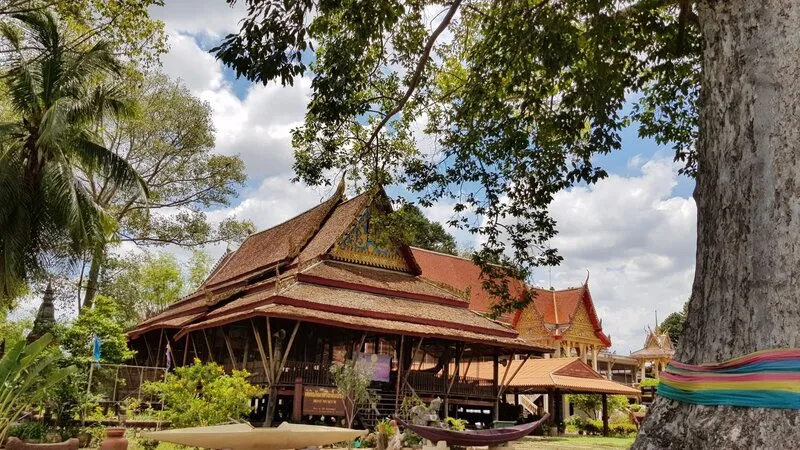
The Folk Boat Museum at Wat Yang Na Rangsi is housed inside the temple’s old wooden sermon hall. This building was constructed in 1927 and holds great architectural value as an outstanding example of a rural central Thai temple hall that still preserves its original form and atmosphere. The structure is entirely wooden and conveys a sense of simplicity combined with elegance. It reflects the wisdom of Thai craftsmen in earlier times, who knew how to create buildings well suited to the climate, the intended function, and the setting of a rural temple.
This wooden sermon hall received an Outstanding Architectural Conservation Award in 1993, further confirming its value as a cultural heritage structure worthy of preservation. The significance of the hall lies not only in its age, but also in its architectural form, which clearly reflects the character of a rural central Thai temple pavilion. When considered together with its location beside the Lopburi River, the building gains an atmosphere that is deeply consistent with the cultural story of the riverine community.
Another point that gives the sermon hall of Wat Yang Na Rangsi its own distinct charm is the belief that its design was modeled after the pavilion pictured on the reverse side of the 1-baht banknote issued during the reign of King Rama VIII. This connection means that the hall is not merely an old temple building, but also an architectural form linked to a wider historical and cultural memory of Thailand. That banknote has become increasingly difficult to find today, so seeing a hall associated with the image on it adds another layer of interest to this temple.
After the restoration of the sermon hall was completed in 1988, the idea of establishing the Folk Boat Museum took shape in a concrete way. The interior of the hall was then used to collect and display different types of folk boats so that later generations could learn closely about the riverside way of life. The creation of this museum marked an important turning point, because it allowed Wat Yang Na Rangsi to do more than preserve a religious site. It also became a guardian of local memory and folk wisdom.
The Folk Boat Museum at Wat Yang Na Rangsi has long been recognized as the first folk boat museum in Thailand. A key strength of the museum is its display of boats that were once actually used in the daily lives of people in the Lopburi river basin. These include rowing boats, cargo boats, fishing boats, and boats used for everyday travel. The details of each type of boat reveal how deeply Thai communities in the past understood the nature of water. Each boat was not built without thought, but designed specifically to suit particular uses and water conditions.
Another interesting aspect is that this museum is valuable not only for tourists, but also as a cultural learning center for young people, students, and those interested in ethnography, local history, and vernacular architecture. The displayed objects and the atmosphere of the wooden hall make learning about folk boats more than simply reading information labels. It becomes an experience that helps visitors understand that boats were once truly at the heart of life in river communities.
The atmosphere inside Wat Yang Na Rangsi carries the charm of a riverside community temple that is becoming harder to find today. The quietness of the grounds, the shade of large trees, and the line of the Lopburi River running close to the temple all create a relaxing feeling for visitors. Those who enjoy visiting temples in a calm setting often feel that this temple is more intriguing than temples crowded with tourists, because it does not emphasize grandeur, but instead stands out through its stories and the living presence of local heritage.
As visitors walk around the temple grounds, they will see the harmony between the religious buildings, the old wooden structure, and the riverside atmosphere. All of this gives Wat Yang Na Rangsi a very distinct identity. The temple is not merely a backdrop for the museum, and the museum is not merely an added attraction for the temple. Instead, both parts support each other naturally. The temple gives the museum its cultural roots, while the museum gives the temple a more prominent educational role.
Today, Wat Yang Na Rangsi holds importance on several levels at once. First, it remains important to the local community as a temple that continues to play a religious and social role. Second, it is important as a place that preserves Thailand’s heritage of folk boats. Third, it has become important to Lopburi’s cultural tourism, because visitors here do not only see a temple, but also gain an understanding of the riverside way of life along the Lopburi River through boats and vernacular architecture.
For those interested in history and local ways of life, Wat Yang Na Rangsi is an ideal place to explore slowly and thoughtfully. The interest of this place does not lie in taking a few photographs and then moving on. Instead, it comes from pausing to examine the details of each boat, observing the structure of the old sermon hall, and connecting what is seen in the present with the past of the central Thai river communities. If visitors take their time, they will sense that this place has far deeper cultural layers than what appears at first glance.
Visitors should dress respectfully and behave appropriately, since this is still an active Buddhist temple. Although the museum is a major highlight, the entire area remains within the context of a living temple. Visiting therefore requires respect for the place and for the local community. Visitors should avoid making loud noises that disturb people coming to make merit, and should ask for details in advance if they intend to visit the museum in depth, because the most recent information has stated that advance contact is recommended for convenience.
Getting There to Wat Yang Na Rangsi can be done via the Lopburi – Bang Pa Han route or the road along the irrigation canal. At around kilometer 9, the temple will appear on the right-hand side. Traveling by private car is the most convenient option. Those wishing to use public transport can take the Lopburi – Ban Phraek bus route, which departs from Lopburi Bus Terminal and provides fairly straightforward access to the temple area. This form of travel shows that the temple still remains connected to local routes of movement, even though the role of the river is no longer what it was in the past.
The best time to visit Wat Yang Na Rangsi is in the morning or late afternoon, when the weather is less hot and the riverside atmosphere feels gentler than under the midday sun. Visiting during quieter hours allows visitors to fully appreciate the charm of the temple, from the sound of the breeze by the river to the shade of the trees and the simple stillness of the old wooden hall. These elements make this temple very different from mainstream tourist attractions in Lopburi city.
Wat Yang Na Rangsi is therefore a place where many kinds of value come together in a single site, including the character of an old community temple, the beauty of wooden architecture, the importance of the Folk Boat Museum, and the memory of life in the Lopburi river basin. For those who wish to know Lopburi in a deeper way beyond its royal palaces or famous monuments in the city center, a visit to this temple opens another side of Lopburi that is warm, simple, and full of stories of genuine value.
| Summary | An old riverside temple on the Lopburi River in Talung Subdistrict, Lopburi Province, and home to the first Folk Boat Museum in Thailand |
| Highlights | Folk Boat Museum, wooden sermon hall built in 1927, rural central Thai temple pavilion architecture, riverside temple atmosphere on the Lopburi River, and the story of its former name Wat Phaya Yang |
| History / Period | Originally called Wat Phaya Yang, later known as Wat Yang Si Suthammaram before becoming Wat Yang Na Rangsi. The wooden sermon hall was built in 1927, restored in 1988, and later became the home of the Folk Boat Museum, which officially opened in 1990. |
| Current Abbot / Caretaker | Phra Athikan Songkhram Atimano |
| Address | Moo 2, Talung Subdistrict, Mueang Lopburi District, Lopburi 15000, Thailand |
| Coordinates | 14.7469433, 100.5978725 |
| Travel | Take the Lopburi – Bang Pa Han route along the irrigation canal road. Around kilometer 9, the temple will be on the right-hand side, or use the Lopburi – Ban Phraek public bus route from Lopburi Bus Terminal. |
| Open Days | Every Day |
| Opening Hours | 08:00 – 17:00 |
| Fees | No admission fee |
| Facilities | Worship areas within the temple, exhibition space for the Folk Boat Museum, wooden sermon hall, riverside walking area, and parking area |
| Zones | 1. Folk Boat Museum 2. Historic Wooden Sermon Hall 3. Ordination Hall and Sacred Temple Area 4. Riverside Area Along the Lopburi River 5. Temple Courtyard and Large Tree Zone |
| Nearby Tourist Attractions | 1. Baan Wichayen — approx. 6 km 2. Narai Ratchaniwet Palace — approx. 7 km 3. Phra Prang Sam Yot — approx. 7 km 4. San Phra Kan — approx. 7 km 5. Wat Mani Chonlakhan — approx. 9 km |
| Nearby Restaurants | 1. Baan Khao Rim Nam — approx. 3 km — Tel. 090-985-8885, 082-234-5664 2. Kin Khao Cafe — approx. 3 km — Tel. 062-419-2493 3. Krua Klang Thung — approx. 9 km — Tel. 081-906-5446 4. Phae Baan Rim Nam — approx. 8 km — Tel. 036-618-005 5. Krua Mai Hom Lopburi — approx. 9 km — Tel. 061-606-3179 |
| Nearby Accommodations | 1. The Residence Hotel-2, Lopburi — approx. 9 km — Tel. 081-948-4003 2. Lopburi Inn Resort — approx. 10 km — Tel. 036-420-777, 036-614-790 3. Nett Hotel — approx. 8 km — Tel. 036-411-738, 036-421-460 4. MDR Hotel — approx. 10 km — Tel. 094-409-9492, 036-614-411 5. PJ Loft Hotel Lopburi — approx. 8 km — Tel. 094-952-4246, 088-695-9615 |
| Main Contact | 036-656-390, 081-857-8761 |
Frequently Asked Questions (FAQ)
Q: Where is Wat Yang Na Rangsi located?
A: Wat Yang Na Rangsi is located in Moo 2, Talung Subdistrict, Mueang Lopburi District, Lopburi Province, beside the Lopburi River and along the Lopburi – Bang Pa Han route.
Q: What was Wat Yang Na Rangsi formerly called?
A: The temple was originally called Wat Phaya Yang because a giant yang tree once stood inside the grounds as an important symbol of the area, before the temple later became known as Wat Yang Si Suthammaram and then Wat Yang Na Rangsi.
Q: Why is the Folk Boat Museum at Wat Yang Na Rangsi important?
A: The museum is recognized as the first Folk Boat Museum in Thailand and serves as an important learning center about the riverside way of life in central Thailand.
Q: What is special about the wooden sermon hall at Wat Yang Na Rangsi?
A: The wooden sermon hall was built in 1927, is an example of rural central Thai temple architecture, and received an Outstanding Architectural Conservation Award in 1993.
Q: How can visitors enter the Folk Boat Museum?
A: The latest information advises visitors to make contact in advance before visiting, for convenience in accessing the museum area inside the temple.
Q: What kind of travel experience is Wat Yang Na Rangsi suitable for?
A: It is ideal for cultural and historical tourism, especially for visitors interested in riverside community life, old wooden architecture, and local museums.
Q: Is it easy to travel to Wat Yang Na Rangsi?
A: Yes. The temple can be reached conveniently by private car via the irrigation canal road on the Lopburi – Bang Pa Han route, or by public bus on the Lopburi – Ban Phraek line.
Q: How much time should visitors allow for visiting Wat Yang Na Rangsi?
A: Visitors who want to see the temple atmosphere, the wooden sermon hall, and the Folk Boat Museum in detail should allow enough time to walk around without rushing.
 Wat Yang Na Rangsi (Lop Buri Boat Museum) Map
 Category:
  Group:
  Last Update: 1 DayAgo
Comment
 Nearby Attractions
| Keyword (Advance) |
 Region
|
 Muang Lop Buri(