
 Home
Home Chiang Mai(






Rating: 3.5/5 (4 votes)
 |
|  Map
Map 
 Have Map
  No Map
Lop Buri attractions
Attractions in Thailand
Open Days: Every Day
Opening Hours: 08:00 – 17:00
Wat Mani Chonlakhan is an important ancient temple in Lopburi Province, valued for its history, art, and geographical significance to the city for a very long time. This temple is not only a place of worship for the local community, but also one of the key sites that helps explain the development of Lopburi from the past to the present. Its location is directly connected to the major transportation route linking Lopburi and Sing Buri, and it once stood amid surrounding waters, making it remembered as a temple with a landscape unlike any other in Lopburi.
One of the most fascinating aspects of Wat Mani Chonlakhan is that it is an old temple believed to date back to the reign of King Narai the Great. Although there is no definite evidence identifying exactly who built it or when it was founded, historical accounts, the ancient structures within the temple grounds, and the role of this area during the Ayutthaya period all make it clear that this temple belongs among the important temples of Lopburi. The temple was originally called “Wat Ko Kaeo,” a name that clearly reflected the original geography of the area, as the temple once stood in the middle of the Lopburi River and appeared like an island surrounded by water.
The former name “Wat Ko Kaeo” was not only beautiful but also described the relationship between the temple and its surrounding landscape very well. In the past, the Lopburi River flowed around the temple grounds until the site resembled an island in the middle of the water. Travelers passing between Lopburi and Sing Buri had to rely on a bridge or crossing route that passed by the temple, making Wat Mani Chonlakhan not only a sacred religious site, but also an important passageway for those entering and leaving Lopburi from the west. This image is what led the temple to be remembered for so long as the “western gateway to Lopburi.”
As time passed and the city changed, roads were cut through the area and the transportation system was developed further, gradually altering the temple’s former island-like setting. Although it no longer appears as a true island in the middle of the water, traces of its geography and the historical memory of its setting still remain in local stories and in the minds of many Lopburi residents. The temple still occupies a meaningful position in the city’s spatial identity. Anyone traveling from the Sing Buri side into Lopburi can still sense that this temple continues to serve as a symbolic transition point between the outer area and the city itself.
The name “Wat Mani Chonlakhan” was a royal name bestowed during the reign of King Chulalongkorn. It was associated with the care and restoration of the temple during that period. The new name is elegant and deeply connected with the temple’s relationship to water. The word “Mani” refers to a precious jewel, while “Chon” refers to water, giving the name the sense of a precious place set amid flowing water. The name was therefore especially suitable for this old temple, which once stood like an island in the middle of the river and played such an important role in Lopburi.
Another reason Wat Mani Chonlakhan stands out among Lopburi’s temples is that it was recognized as an important temple associated with the royal court and many members of the royal family. Because the area was once surrounded by water, it was well suited for royal visits and restful retreats. As a result, the temple received visits from several kings, including King Mongkut, King Chulalongkorn, King Vajiravudh, and King Prajadhipok, as well as many members of the royal family who came here to perform merit-making ceremonies.
Among the important historical events connected with the temple is the visit of King Chulalongkorn, who is said to have come to Thong Phrommat and enjoyed traditional poetic play there in the year 1872. This reflects the fact that the temple and its surrounding area were not merely religious grounds, but also places linked with royal activities and royal leisure. King Vajiravudh also came to present Kathin robes at this temple on 2 occasions, in 1915 and 1926, which further confirmed the temple’s importance as a royal temple under royal patronage.
When speaking of the most important feature inside Wat Mani Chonlakhan, what people remember most is the “Chedi of Luang Pho Saeng,” which is the temple’s most prominent ancient monument. This chedi has a tall, slender square form and a striking appearance, with architectural characteristics that immediately capture the attention of anyone interested in Thai art and architecture. Many visitors to Lopburi first become familiar with the temple through photographs of this chedi before learning its history, and once they see it in person, it becomes even clearer why the Chedi of Luang Pho Saeng has become the defining symbol of Wat Mani Chonlakhan.
The outstanding feature of the Chedi of Luang Pho Saeng lies in its architectural style, which differs from the typical chedis found in central Thailand. The chedi is built as a tall square structure resembling a Chiang Saen-style square chedi, yet each of its 4 corners is decorated with indented angle reductions, and the composition is arranged in beautifully layered tiers. In addition, pointed gabled niches appear on all 4 sides. These features create a form that feels both solid and graceful at the same time, making it a unique work of art and an important piece of evidence showing the complexity of artistic influences that shaped Lopburi in the past.
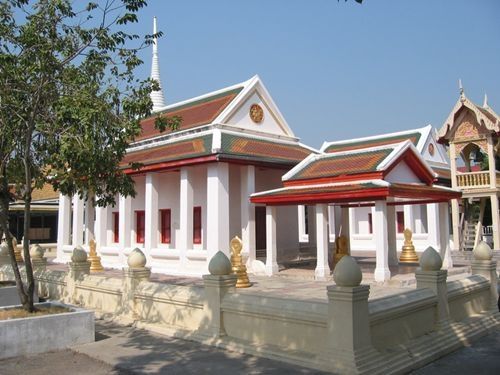
Beyond the Chedi of Luang Pho Saeng, the temple also contains other elements that contribute to its atmosphere of age and sacredness, whether in the ordination hall, the vihara, significant Buddha images, or the riverside areas that still reflect the temple’s connection with the city’s original landscape. Although some parts of the temple have been restored over time, the overall setting still gives the impression of an ancient temple layered with historical meaning in every corner. For those who appreciate temples that offer not only visual beauty but also deep historical stories, Wat Mani Chonlakhan is one destination that should not be overlooked.
Another historically important feature within the temple is the Bodhi tree planted by King Chulalongkorn. Originally, this tree stood as another symbol of the bond between the monarchy and the temple. Later, however, when a road was cut through the temple grounds, the Bodhi tree ended up divided into 2 parts by the road passing between them. This story offers a compelling illustration of how urban development and transportation projects can directly alter the landscape of historic sites, and Wat Mani Chonlakhan provides a clear example of a place where history, religion, and the changing city have all converged.
In terms of historical status, Wat Mani Chonlakhan was officially registered as an ancient monument by the Fine Arts Department on 2 August 1936. This registration shows that the temple is not valuable only at the local level, but is recognized nationally as a cultural heritage site worthy of preservation and study. Its status as an ancient monument further emphasizes that this temple is not simply a local place of worship, but a place that contains many layers of Lopburi’s history across different periods.
Wat Mani Chonlakhan is also remarkable as the “western gateway to Lopburi,” a role that is especially interesting from the perspective of urban history. When compared with the eastern side of Lopburi, where the statue of King Narai the Great stands at Thep Satri Circle, commonly known by locals as the King Narai Circle, it becomes clear that these 2 places function in similar symbolic ways. They are both points through which people perceive their entry into the city from different directions. Wat Mani Chonlakhan is therefore not just a beautiful or old temple, but one of the key landmarks in Lopburi’s spatial identity, both in the past and today.
The atmosphere of the temple today still has its own distinct charm. Visitors can feel the shade of the large trees, the calmness of the riverside setting, and the solemn beauty of ancient structures that have stood here for generations. Although the temple is not far from the main transportation route, once visitors enter the grounds they will notice that the pace seems to slow down, city sounds become softer, and the setting invites them to spend more time appreciating the details. The chedi’s shape, the old walls, the riverside space, and the various Buddha images together create an experience quite different from hurried visits to historical sites.
For those interested in Lopburi’s history, Wat Mani Chonlakhan is a place that connects many aspects of the city’s story at once, from Lopburi in the time of King Narai, to the river network and transportation routes, to the relationship between temples and the royal court, and the artistic value of ancient monuments. This temple is therefore ideal for worshippers, photographers who enjoy old temples, visitors wishing to learn about Lopburi’s cultural heritage, and travelers who want to follow the traces of a place that is not merely a popular attraction but a location of real historical meaning.
From a tourism perspective, Wat Mani Chonlakhan can be visited either as a destination in its own right or as part of a Lopburi old-town itinerary, since its location connects conveniently with other important places in the city. Travelers can easily combine it in a one-day route with Narai Ratchaniwet Palace, Phra Prang Sam Yot, San Phra Kan, Baan Wichayen, or other important temples in Lopburi. What makes Wat Mani Chonlakhan different, however, is its quieter atmosphere and the way it still feels like a living community temple while also being an ancient monument.
Visitors should dress respectfully and behave with care, because although the temple is valuable as a historical attraction, its heart remains that of a living Buddhist temple. When walking around the grounds, visitors should be mindful, avoid making excessive noise that may disturb worshippers, and show respect to the sacred areas, especially around the ordination hall, the vihara, and the places where people come regularly to pay homage. Visiting the temple with this awareness makes the experience more meaningful and shows proper respect to the site at the same time.
Getting There is easiest for visitors traveling by private car. From Lopburi city, take the route toward Lopburi – Sing Buri Road. The temple is located in Phrommat Subdistrict, Mueang Lopburi District, not far from the old city area and other major attractions in the city. Those without a private vehicle can use local hired transport in Lopburi or ask about local songthaew routes that pass near the temple. The journey itself is not complicated, and combining the visit with nearby attractions is a practical way to make the most of a day in Lopburi.
The best time to visit Wat Mani Chonlakhan is in the morning or late afternoon, when the light is softer and highlights the dimensions of the Chedi of Luang Pho Saeng beautifully. The riverside atmosphere also feels more relaxed than during the harsh midday heat, which is why photographers especially enjoy these hours. For those coming to make merit or pay respects, these times also offer a greater sense of peace. Visitors interested in historical exploration should allow enough time to walk around and observe the details carefully, as the value of the site becomes far clearer when it is not treated as only a brief photo stop.
Wat Mani Chonlakhan is therefore much more than an old temple in Lopburi Province. It is a place where many layers of value come together, including the city’s history, memories of the river and transportation routes, ties to the monarchy, unique ancient monuments, and the continuing role of the temple in the daily life of the community. The more one learns about the stories behind it, the clearer it becomes that this temple is truly important to Lopburi as a whole, and that it deserves a place on the itinerary of anyone who wishes to know Lopburi on a deeper level rather than only on the surface.
| Summary | A third-class royal temple of the common type, this is one of Lopburi’s important historic temples. Formerly known as Wat Ko Kaeo, it stands in Phrommat Subdistrict and is notable as a historic temple often regarded as Lopburi’s western gateway. |
| Highlights | The distinctive tall square Chedi of Luang Pho Saeng, its former name Wat Ko Kaeo, its past as a temple amid surrounding water, its association with several kings and members of the royal family, and its role as an important landmark on the Lopburi – Sing Buri route |
| History / Period | Believed to date back to the reign of King Narai the Great. It was originally called Wat Ko Kaeo, later received the royal name Wat Mani Chonlakhan during the reign of King Chulalongkorn, and was registered as an ancient monument on 2 August 1936. |
| Current Abbot / Caretaker | Phra Khru Wimonyanudom (Phra Ajarn Tio) — the most recent online references still identify him as the abbot of Wat Mani Chonlakhan, a royal temple |
| Address | Moo 4, Phrommat Subdistrict, Mueang Lopburi District, Lopburi 15000, Thailand |
| Coordinates | 14.8069, 100.6099 |
| Travel | Travel from Lopburi city toward Lopburi – Sing Buri Road. The temple stands on the western side of the city in Phrommat Subdistrict and is best reached by private car or local hired transport. It can also be included in a route with other major historical sites in Lopburi. |
| Facilities | Worship areas within the temple, walking areas for viewing the ancient structures, riverside surroundings, and on-site parking |
| Zones | 1. Chedi of Luang Pho Saeng 2. Ordination Hall 3. Vihara 4. Historic Bodhi Tree Area 5. Riverside Area and Surrounding Landscape |
| Nearby Tourist Attractions | 1. Narai Ratchaniwet Palace — approx. 4 km 2. Baan Wichayen (French Ambassador’s House) — approx. 4 km 3. Phra Prang Sam Yot — approx. 4.5 km 4. San Phra Kan — approx. 4.5 km 5. Wat Phra Si Rattana Mahathat, Lopburi — approx. 5 km |
| Nearby Restaurants | 1. Cafe.small Talk — approx. 0.9 km — Tel. 094-449-9489 2. Phae Baan Rim Nam — approx. 1 km — Tel. 036-618-005 3. Khanom Jeen Phuket Lopburi — approx. 3.5 km — Tel. 086-810-3413 4. Noom Guesthouse & Restaurant Lopburi — approx. 4.5 km — Tel. 036-427-693, 064-154-4342 5. Ko Heng 2498 Boat Noodles, Talat Bon Mueang — approx. 4.7 km — Tel. 081-524-9324, 062-227-9551 |
| Nearby Accommodations | 1. Lopburi Inn Resort — approx. 7.8 km — Tel. 036-420-777, 036-614-790 2. MDR Hotel — approx. 7.9 km — Tel. 036-614-411 3. The Tempo Lopburi — approx. 8 km — Tel. 036-422-555, 080-580-5580 4. Siam House Inter Place — approx. 8 km — Tel. 036-770-548 5. Narai Iyara Palace — approx. 8.5 km — Tel. 089-540-6350 |
Frequently Asked Questions (FAQ)
Q: Where is Wat Mani Chonlakhan located?
A: Wat Mani Chonlakhan is located in Phrommat Subdistrict, Mueang Lopburi District, Lopburi Province, on the route linking Lopburi and Sing Buri on the western side of the city.
Q: What was the temple’s former name?
A: The temple was formerly known as “Wat Ko Kaeo,” because the grounds once resembled an island in the middle of the Lopburi River before it later received the royal name “Wat Mani Chonlakhan” in the reign of King Chulalongkorn.
Q: Why is Wat Mani Chonlakhan called the gateway to Lopburi?
A: Because the temple stands on the important route connecting Lopburi and Sing Buri, travelers entering Lopburi from the west traditionally passed by this area, giving it the image of Lopburi’s western gateway.
Q: What is the most outstanding feature inside Wat Mani Chonlakhan?
A: The most outstanding feature is the Chedi of Luang Pho Saeng, a tall square chedi with a distinctive architectural style that has become the temple’s best-known ancient monument.
Q: How is Wat Mani Chonlakhan connected to King Narai the Great?
A: Based on the evidence known today, the temple is believed to date back to the reign of King Narai the Great, linking it directly to the period when Lopburi flourished in the Ayutthaya era.
Q: What kind of visit is Wat Mani Chonlakhan suitable for?
A: It is suitable both for merit-making and worship as well as for historical tourism, especially for visitors interested in old temples, ancient monuments, and Lopburi’s Ayutthaya-period heritage.
Q: How much time should visitors allow for a visit to Wat Mani Chonlakhan?
A: Visitors who want to admire the Chedi of Luang Pho Saeng, enjoy the atmosphere of the grounds, and photograph the architectural details should allow enough time to appreciate the site properly.
Q: What other places in Lopburi can be visited together with Wat Mani Chonlakhan?
A: It can easily be combined with major historical attractions in Lopburi such as Narai Ratchaniwet Palace, Phra Prang Sam Yot, San Phra Kan, and Baan Wichayen.
 Wat Mani Chonlakhan Map
 Category:
  Group:
  Last Update: 1 DayAgo
Comment
 Nearby Attractions
| Keyword (Advance) |
 Facebook Fanpage
 Region
 Art, Culture and Heritage
 Historical Sites and Monuments(
 Landmarks and Memorials(
 Royal Palace(
 Art, Craft Centres, Tradition(
 Museums(
 Historical Houses and The Ancient City(
 University
 Other religious and spiritural sites(
 Suburban Living
 Village, Community(
 Floating Market(
 Nature and Wildlife
 National Parks and Marine Reserves(
 Mountain (Doi)(
 Dam, Reservoir, Lake(
 Waterfalls(
 Hot Springs(
 Caves(
 Flower Field(
 Entertainment and Agricultural
 Zoos and Aquariums(
 Farm, Parks, Gardens and Ecotourism(
 Outdoor and Adventure Activities(