
 Home
Home Chiang Mai(






Rating: 4/5 (4 votes)
 |
|  Map
Map 
 Have Map
  No Map
Lop Buri attractions
Attractions in Thailand
Open Days: Daily
Opening Hours: 08.00 - 16.30
Wat Nakhon Kosa is an important historical site in Lopburi, located to the north of Lopburi Railway Station, close to Phra Kan Shrine and Phra Prang Sam Yot. In terms of location, this site stands in the middle of the old city area, which is filled with traces of civilizations from many different periods. It is therefore not merely an old temple, but a significant piece of evidence reflecting the development of Lopburi from the Dvaravati period, through the Lopburi period or Khmer influence, and into the Ayutthaya period. The distinctive feature of Wat Nakhon Kosa lies in the way historical structures from several eras overlap within the same area, allowing visitors to see the transition of religion, art, and political power through the remains that still survive today.
When speaking of Lopburi, many people first think of Phra Prang Sam Yot, Phra Kan Shrine, or King Narai’s Palace. However, when one looks more deeply into the details of the old city, it becomes clear that Wat Nakhon Kosa is another site of great importance for understanding the history of the area. This is because the site does not contain only Ayutthaya-period temple remains, but also much older evidence, including a large Dvaravati-period chedi and a Lopburi-period prang dated to around the 17th Buddhist century. These remains show that this area once served as a center of faith for many centuries before it was altered and reused in later times.
The oldest structure mentioned within Wat Nakhon Kosa is the large Dvaravati-period chedi. The presence of a chedi from this period is highly significant because Dvaravati art is considered one of the earliest foundations of Buddhism in the lower and central Chao Phraya basin. The existence of such a large chedi here indicates that Lopburi, or ancient Lavo, was once an important community with a long-standing religious and cultural prosperity. The Dvaravati chedi at Wat Nakhon Kosa does not function merely as an artistic element, but also stands as a witness to the period when Theravada Buddhism began to take root in this area.
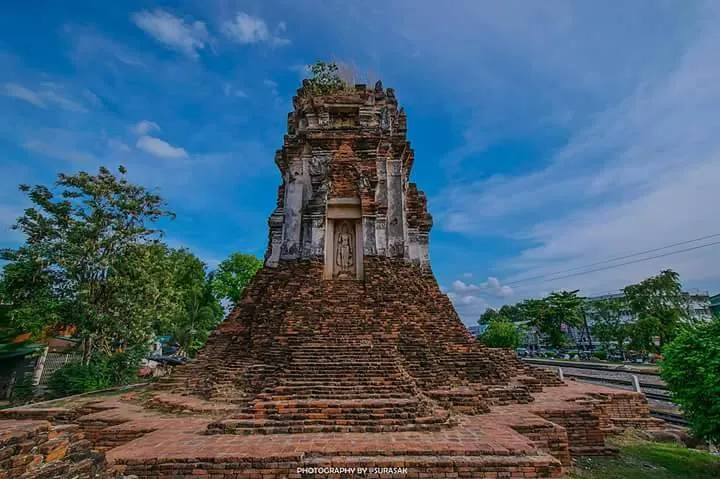
At the front of the site stands a Lopburi-period prang, dated to around the 17th Buddhist century. This kind of prang reflects Khmer artistic influence that spread into Lavo and nearby areas during that time. The prang form is associated with Brahmanical-Hindu sanctuaries, and later many such structures were altered or reused within a Buddhist context. Wat Nakhon Kosa therefore serves as a clear example of the transition from a Khmer-style religious site or sanctuary into a Buddhist space in the later period. The structure of the prang also confirms that this area was once part of the Lopburi cultural network.
One particularly interesting point is that the stucco Buddha image in the U Thong style found on the prang was not original to the time when the prang was built, but was added later. This detail is highly important historically because it reflects a shift in the role of the site from its original religious function to a new use in a different context. U Thong-style Buddha images are associated with the world of Ayutthaya and Buddhism in the later period, showing that this monument did not remain frozen in one moment in time, but was reinterpreted, modified, and continuously used according to changing social and religious beliefs.
Another important aspect that makes Wat Nakhon Kosa stand out archaeologically is the discovery of 2 large deity statues that show traces of having been modified into Buddha images. These statues are no longer kept at the site itself, but are now preserved at the King Narai National Museum in Lopburi. The conversion of deity statues into Buddha images is not a minor matter, because it reflects a profound religious transition. In other words, a place once associated with Brahmanical or Hindu beliefs was reused within a Buddhist context. Such changes can be found at several important historical sites in Thailand, but at Wat Nakhon Kosa this process can be seen especially clearly through actual material evidence.
Later, this former sanctuary was built over or developed into a temple during the Ayutthaya period. Clear evidence of this can be seen in the remains of a vihara, of which only the walls and rows of columns at the front survive, as well as a tall brick-built chedi standing behind it. These structures show the reinterpretation of the site from an earlier center of belief into a Buddhist temple, which corresponds to the tendency in Ayutthaya-period Lopburi to restore and adapt older religious places to fit the political authority and new religious worldview of Ayutthaya society. The presence of the vihara and brick chedi is thus important evidence that Wat Nakhon Kosa was not merely an abandoned ruin, but once regained significance in a later era.
The name “Wat Nakhon Kosa” itself also has an interesting origin. It has been hypothesized that Chao Phraya Kosathibodi, or “Kosa Lek,” during the reign of King Narai the Great, may have restored the temple, which is why it came to be called “Wat Nakhon Kosa” after his official title. Although this remains a hypothesis rather than conclusive proof, it carries historical weight because Lopburi in King Narai’s reign was a very important city within the Ayutthaya political system. It is therefore entirely possible that a high-ranking noble was involved in restoring a religious site in the city, and this may also explain why the temple was revived during the late Ayutthaya period.
When all of the evidence is considered together, Wat Nakhon Kosa emerges as a historical site containing at least 3 major layers of history: the Dvaravati period, the Lopburi period, and the Ayutthaya period. What makes the site special is that the traces of each era have not completely disappeared, but still appear together in the same place. This allows historians, archaeologists, and interested visitors to read the development of Lopburi through architecture and structural remains in a very tangible way. This place therefore has a value far beyond being just a photo spot or a quick stop; it is an outstanding learning site for the history of central Thailand.
The atmosphere of Wat Nakhon Kosa today differs from that of an active temple, because what stands out most is the condition of the ancient ruins rather than new buildings. Visitors can feel the solemn quietness of old bricks, partially surviving walls, and structures that have endured through a long passage of time. As one walks through the site, it is possible to see the influence of Dvaravati, the solidity of the Lopburi style, and the overlay of the Ayutthaya period all at once. This feeling is part of the unique charm of Wat Nakhon Kosa, because it is not a historical site that tells the story of only one moment in time, but a place that reveals the continuous transition of civilizations.
Another advantage of Wat Nakhon Kosa is its very accessible location for travelers exploring the old city of Lopburi. It is not far from Phra Kan Shrine, Phra Prang Sam Yot, Lopburi Railway Station, King Narai’s Palace, Ban Wichayen, and the King Narai National Museum. Visitors can therefore conveniently arrange a continuous walking route or use short-distance transport to connect each site. For those who want to explore Lopburi in a systematic way and truly understand the old city, Wat Nakhon Kosa should always be included in the same route as the major historical sites, because it helps complete the historical picture in a very meaningful way.
For those interested in Thai art, visiting Wat Nakhon Kosa offers far more than simply seeing an “old temple,” because each component carries a clear formal significance. The Dvaravati chedi tells the story of the early roots of Buddhism, the Lopburi prang reflects Khmer influence and the concept of a sanctuary or temple tower, the U Thong-style stucco Buddha image points to a reinterpretation of the space in a later age, while the Ayutthaya-period vihara and brick chedi demonstrate the role of the Ayutthaya state in taking over and reshaping the meaning of an older monument. Wat Nakhon Kosa is therefore like a history book written in brick, stucco, and art rather than in words.
From a tourism perspective, Wat Nakhon Kosa is suitable for visitors who prefer quiet places and want to understand Lopburi more deeply than through its most famous landmarks alone. Although this is not a temple with lively ritual activity or perfectly preserved buildings like a large active temple, its value lies in the authenticity of its ruins and the stories embedded in each layer of old brick. The more a visitor has read about the history or understood the basic artistic background beforehand, the more meaningful the visit becomes, because it becomes easier to see the connections between the different historical periods rather than viewing the site only on the surface.
Getting There Reaching Wat Nakhon Kosa is very convenient, as it is located within Lopburi city, near Lopburi Railway Station and Phra Kan Shrine. If traveling by train, visitors can get off at Lopburi Station and either walk onward or take a short local ride to the site. Those traveling by private car can approach from Narai Maharat Road, using Phra Kan Shrine or Phra Prang Sam Yot as landmarks, and then walk or drive a short distance to the historical site. Travelers arriving from Bangkok by van or bus can also get off in Lopburi town and continue easily to the site using local transportation.
In summary, Wat Nakhon Kosa is a highly important historical site containing multiple layers of value in one place, including history, art, archaeology, and cultural tourism. Its greatest distinction is the clear overlap of Dvaravati, Lopburi, and Ayutthaya civilizations, visible through the large chedi, ancient prang, U Thong-style stucco Buddha image, deity statues converted into Buddha images, vihara ruins, and later brick chedi. For those who wish to understand Lopburi more deeply than by looking only at its famous landmarks, Wat Nakhon Kosa is one place that should not be overlooked.
| Place Summary | An important historical site in Lopburi’s old city area, near Phra Kan Shrine and Lopburi Railway Station, with artistic evidence layered from the Dvaravati, Lopburi, and Ayutthaya periods. |
| Highlights | A large Dvaravati-period chedi, a Lopburi-period prang from around the 17th Buddhist century, Ayutthaya-period vihara ruins, and the story of large deity statues that were modified into Buddha images. |
| History / Period | A religious site layered through many eras, originally featuring a Dvaravati chedi, later a Lopburi-period prang, and eventually developed into a temple in the Ayutthaya period. |
| Address | Tha Hin Subdistrict, Mueang Lopburi District, Lopburi Province, near Phra Kan Shrine and Lopburi Railway Station |
| Coordinates | 14.801147, 100.615553 |
| Getting There | Located north of Lopburi Railway Station and near Phra Kan Shrine, it is easily accessible by private car, local hired transport, or by walking from the main historical attractions in the old city area. |
| Zones | Dvaravati-period chedi base, Lopburi-period prang, Ayutthaya-period vihara ruins, and the brick chedi at the rear |
| Nearby Attractions | 1. Phra Kan Shrine – approximately 0.1 km. 2. Phra Prang Sam Yot – approximately 0.2 km. 3. Wat Phra Si Rattana Mahathat, Lopburi – approximately 0.8 km. 4. Ban Wichayen – approximately 0.9 km. 5. King Narai’s Palace – approximately 1 km. |
| Nearby Restaurants | 1. Chalermthai Tom Yum Noodles Lopburi – approximately 0.2 km. Tel. 081-777-0157, 086-363-4946 2. Khao Tom Ho Restaurant – approximately 0.3 km. Tel. 036-411-672 3. Je Ju Pork Blood Soup – approximately 0.3 km. Tel. 084-094-3516, 080-109-8897 4. Baan Sahai Cafe – approximately 0.8 km. Tel. 090-924-7147 5. the mellow.cafe – approximately 1 km. Tel. 086-057-5414 |
| Nearby Accommodations | 1. Sri Indra Hotel – approximately 0.2 km. Tel. 096-195-5599, 098-997-7333 2. Tokyo Hotel Lopburi – approximately 0.6 km. Tel. 036-786-627, 094-242-5253 3. Nett Hotel – approximately 0.8 km. Tel. 036-411-738, 036-421-460, 094-350-8211 4. Lopburi Inn Hotel – approximately 1.5 km. Tel. 036-412-300 5. Windsor Resort Lopburi – approximately 3 km. Tel. 036-422-554 |
Frequently Asked Questions (FAQ)
Q: Where is Wat Nakhon Kosa located?
A: Wat Nakhon Kosa is located in Tha Hin Subdistrict, Mueang Lopburi District, Lopburi Province, north of Lopburi Railway Station and close to Phra Kan Shrine.
Q: Why is Wat Nakhon Kosa important?
A: Wat Nakhon Kosa is a historical site with layered evidence from many eras, including the Dvaravati, Lopburi, and Ayutthaya periods, making it highly important in the history and archaeology of Lopburi.
Q: What is interesting inside Wat Nakhon Kosa?
A: The highlights of Wat Nakhon Kosa are its large Dvaravati-period chedi, Lopburi-period prang, Ayutthaya-period vihara ruins, and the story of large deity statues that were modified into Buddha images.
Q: Where are the deity statues found at Wat Nakhon Kosa today?
A: The 2 large deity statues found at Wat Nakhon Kosa are now preserved at the King Narai National Museum.
Q: What is the origin of the name Wat Nakhon Kosa?
A: It has been hypothesized that Chao Phraya Kosathibodi, or Kosa Lek, during the reign of King Narai the Great, restored the temple, which is why it came to be called Wat Nakhon Kosa after his official title.
Q: Is it convenient to travel to Wat Nakhon Kosa?
A: Travel is quite convenient because the site is located in Lopburi’s old city area, near Lopburi Railway Station, Phra Kan Shrine, and Phra Prang Sam Yot, making it easy to continue to several nearby attractions.
 Tel: 036412510, 036413779
 Wat Nakhon Kosa Map
 Category:
  Group:
  Last Update: 2 DayAgo
Comment
 Nearby Attractions
| Keyword (Advance) |
 Region
|
 Muang Lop Buri(