
 Home
Home Chiang Mai(






Rating: 4.4/5 (5 votes)
 |
|  Map
Map 
 Have Map
  No Map
Lop Buri attractions
Attractions in Thailand
Open Days: Every Day
Opening Hours: 09.00 - 16.30 hrs.
Phra Narai Ratchaniwet is one of Thailand’s most important royal palaces, located in the heart of Lopburi. King Narai the Great ordered its construction in 1666 so that it could serve as a royal residence, an administrative center, and a venue for receiving foreign envoys at a time when Lopburi played the role of a secondary capital of the Ayutthaya Kingdom. For this reason, the palace is significant not only as an ancient architectural site, but also as clear evidence of an era when Siam flourished in politics, diplomacy, and international relations.
The palace complex is clearly divided into 3 zones: the outer court, the middle court, and the inner court. This layout reflects the royal court system and the hierarchy of space usage in the Ayutthaya period very clearly. Each zone served a different purpose, whether for state administration, receiving guests, or functioning as the private area of the king and the inner court.
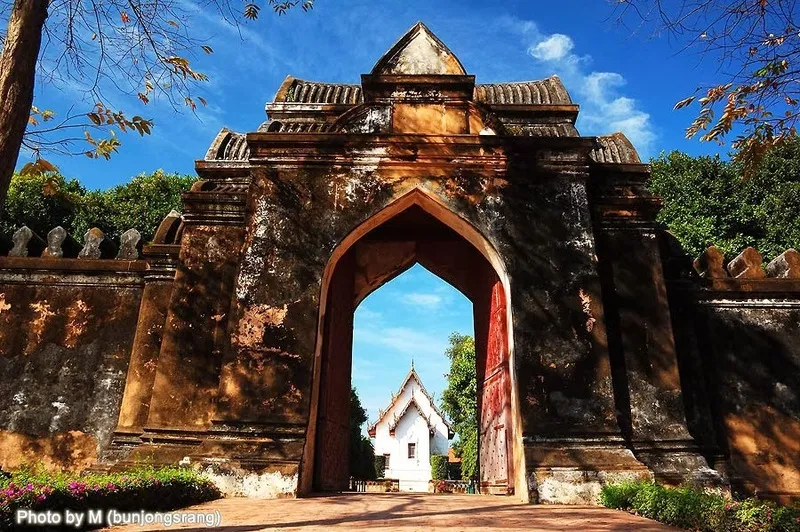
One of the most distinctive features of Phra Narai Ratchaniwet is its brick-and-mortar enclosure wall, topped throughout with rows of sema-like boundary markers, as well as its 11 gateways. The main entrance gateway is in a four-gabled form, with pointed arch openings, and the gable is decorated with stucco kranok motifs that evolved from lotus forms. These elements give the palace a unique architectural identity that reflects both Thai taste and foreign influence during the reign of King Narai the Great.
Another remarkable feature that makes Phra Narai Ratchaniwet especially famous is the series of small niches along the gateways and the walls of the middle and inner courts. These niches were cut in pointed arch forms resembling lotus petals and arranged in rows. They were used for placing lamps at night, with the total number estimated at around 2,000. The image of lamp light once shining across the palace walls helps visitors imagine the grandeur and elegance of the palace in its glorious days.
Phra Narai Ratchaniwet holds great importance in Thai history because it is directly associated with the opening of relations between Siam and the Western world in the 17th century. At that time, Lopburi was a city favored by King Narai the Great, who used it as a residence, an administrative center, and a place to welcome foreign diplomatic missions. The palace therefore served as an important stage in the history of Thai diplomacy during the Ayutthaya era.
Within the palace, the buildings can be divided into 2 major groups according to period: the structures dating from the reign of King Narai the Great, and the buildings restored or added during the reign of King Mongkut. After the fall of Ayutthaya, the palace was abandoned for a period of time. Later, in 1856, King Mongkut ordered its restoration so that it could serve as an inner royal capital, and he bestowed upon it the name “Phra Narai Ratchaniwet,” which has remained in use ever since.
The restoration carried out in the reign of King Mongkut means that the palace is not merely an Ayutthaya-period monument, but also reflects another historical layer from the early Rattanakosin period. Visitors can therefore see two overlapping periods of Thai history within the same site: the era of King Narai the Great, when Lopburi flourished as a secondary capital, and the era of King Mongkut, when the political and historical value of the place was revived.
Today, Phra Narai Ratchaniwet is both an important historic monument and the site of the King Narai National Museum. Within the same grounds, visitors can do more than simply walk around the palace buildings and walls; they can also learn about history, antiquities, and the story of Lopburi in many dimensions through the museum exhibitions. This makes the site suitable for general visitors, history enthusiasts, and those who want a deeper understanding of the historical development of Lopburi.
The atmosphere inside the palace feels calm, shaded, and rich with a strong sense of time. Visitors can enjoy walking among the remains of ancient buildings, walls, gateways, and open spaces within the royal compound. Although many structures survive only in partial form, the beauty of the palace layout and the architectural elements that remain are still powerful enough to convey the grandeur of the past.
Another period when Phra Narai Ratchaniwet becomes especially lively is during the annual King Narai Reign Festival in Lopburi. At that time, the palace grounds become an important setting for period costume activities, cultural performances, and events that connect modern people with the city’s history. This gives the palace a living role in the present, not merely as a place where the past is remembered, but as a site where history continues to be retold and re-experienced.
Getting There Phra Narai Ratchaniwet is located on Sorasak Road, Tha Hin Subdistrict, Mueang Lopburi District, within the historic quarter of the city. It is easy to reach from Lopburi Railway Station and from the main roads in town. Visitors traveling by car can access the site conveniently and find parking nearby, while those arriving by train or bus can continue into the palace area without difficulty. The site also fits easily into a one-day heritage route that includes Phra Prang Sam Yot, San Phra Kan, Ban Wichayen, and other important monuments in Lopburi.
For anyone wishing to understand Lopburi in greater depth, Phra Narai Ratchaniwet is one of the places that should not be missed. It stands at the heart of the city’s history, symbolizes the prosperity of the reign of King Narai the Great, and offers one of the clearest places in Thailand for understanding the relationship between power, politics, art, and diplomacy in the Ayutthaya era.
| Name | Phra Narai Ratchaniwet |
| Place Summary | An important royal palace from the reign of King Narai the Great in Lopburi, built in 1666 as a residence, an administrative center, and a place to receive foreign envoys. Today, it is a major historic monument and the site of the King Narai National Museum. |
| Highlights | The palace is divided into the outer, middle, and inner courts, with brick enclosure walls, 11 gateways, around 2,000 lamp niches, and architectural features reflecting both Ayutthaya and early Rattanakosin styles. |
| History / Period | King Narai the Great ordered the palace built in 1666. It was later restored in 1856 by King Mongkut, who gave it the name “Phra Narai Ratchaniwet.” |
| Address | Sorasak Road, Tha Hin Subdistrict, Mueang Lopburi District, Lopburi 15000 |
| Coordinates | 14.7999, 100.6106 |
| Travel | Located in Lopburi’s old town, the palace is easy to reach from Lopburi Railway Station and the city’s main roads. It is convenient for visitors traveling by private car and also works well as part of a walking or short-drive heritage route through central Lopburi. |
| Open Days | Every Day |
| Opening Hours | 09.00 - 16.30 hrs. |
| Fees | Thai visitors 30 Baht, foreign visitors 150 Baht |
| Facilities | Museum, ancient monument walking area, photo spots, coffee shop within the grounds, parking area, restrooms |
| Zones | Outer Court, Middle Court, Inner Court, King Narai National Museum Area |
| Nearby Tourist Attractions | 1. Ban Wichayen - approximately 350 m. 2. Phra Prang Sam Yot - approximately 900 m. 3. San Phra Kan - approximately 1 km. 4. Wat Phra Si Rattana Mahathat, Lopburi - approximately 1.1 km. 5. King Narai the Great Monument - approximately 1.3 km. |
| Popular Restaurants Nearby | 1. Inthanin Coffee Phra Narai Ratchaniwet - approximately 50 m. - Tel. 098-270-0809 2. Pad Thai Pa Teep - approximately 120 m. - Tel. 080-770-6311 3. Vietnamese Food by Khun Tai - approximately 180 m. - Tel. 036-411-220, 081-349-7161 4. Kojong 1984 Tha Hin - approximately 250 m. - Tel. 095-625-1505 5. Pooja Mala Shabu Skewers Na Wang - approximately 200 m. - Tel. 096-553-5165 |
| Popular Accommodations Nearby | 1. Lopburi City Hotel - approximately 800 m. - Tel. 087-333-3444 2. Grand Lopburi - approximately 2.3 km. - Tel. 092-496-4566, 092-249-0133 3. Lopburi Inn Resort - approximately 5.2 km. - Tel. 036-614-790 4. O2 Hotel Lopburi - approximately 5.8 km. - Tel. 064-967-7474 5. HOP INN Lopburi - approximately 6.1 km. - Tel. 02-080-2222 |
| Main Contact Number | 036-411-458 |
Frequently Asked Questions (FAQ)
Q: What is Phra Narai Ratchaniwet?
A: Phra Narai Ratchaniwet is the royal palace that King Narai the Great ordered to be built in Lopburi in 1666 as a residence, an administrative center, and a place to receive foreign diplomatic missions.
Q: Where is Phra Narai Ratchaniwet located?
A: Phra Narai Ratchaniwet is located on Sorasak Road in Tha Hin Subdistrict, Mueang Lopburi District, Lopburi, within the city’s historic quarter and not far from Lopburi Railway Station.
Q: How is Phra Narai Ratchaniwet divided?
A: The palace is divided into 3 main sections: the outer court, the middle court, and the inner court, reflecting the spatial arrangement of the Ayutthaya royal court.
Q: What are the highlights of Phra Narai Ratchaniwet?
A: Its main highlights include the brick enclosure walls, 11 gateways, around 2,000 lamp niches, and the atmosphere of an Ayutthaya-period palace later restored in the reign of King Mongkut.
Q: What is Phra Narai Ratchaniwet used for today?
A: Today, Phra Narai Ratchaniwet is an important national historic monument and the site of the King Narai National Museum, where visitors can see antiquities and learn about Lopburi’s history.
Q: How can I get to Phra Narai Ratchaniwet?
A: Visitors can travel to Lopburi by private car, train, or bus, then continue to Sorasak Road where the palace is located. It is also easy to combine the visit with other historic attractions nearby.
 Phra Narai Ratchaniwet Map
 Category:
  Group:
  Last Update: 2 DayAgo
Comment
 Nearby Attractions
| Keyword (Advance) |
 Region
|
 Muang Lop Buri(