
 Home
Home Chiang Mai(






Rating: 4.2/5 (5 votes)
 |
|  Map
Map 
 Have Map
  No Map
Lop Buri attractions
Attractions in Thailand
Open Days: Wednesday - Sunday
Opening Hours: 07.00-17.00 hrs.
Baan Vichayen, also widely known as the Royal House for Receiving Ambassadors, is an important historical site in the heart of Lopburi that clearly reflects Siam’s role in international diplomacy during the reign of King Narai the Great. This place is not merely a cluster of old buildings with elegant architecture, but a significant piece of evidence from the era when Lopburi served as a center of politics, royal reception, and contact with the Western world, especially the relationship between Siam and France in the late 17th century.
Baan Vichayen is located on Vichayen Road, about 300 meters from Prang Khaek, and to the north of King Narai’s Palace. This location immediately shows that the area was directly connected to the royal court of Lopburi in the age of King Narai, as it stood close to the royal residence and within one of the city’s most important districts. It was therefore highly suitable for receiving foreign diplomatic missions that came to pay an audience to the king.
In 1685, the first French diplomatic mission that came to meet King Narai stayed at this site. That event gave the Royal House for Receiving Ambassadors historical importance as an actual setting of Siamese–French diplomatic history, and it remains one of the key places that helps us understand how Siam at that time was not isolated from the outside world, but was opening its doors to European powers with caution and political sophistication.
Later, this site also became connected with an important historical figure, Constantine Phaulkon, a Greek who entered royal service in Siam and rose in rank until he was granted the title “Chao Phraya Wichayen.” The king bestowed upon him a residence to the west of the Royal House for Receiving Ambassadors, which is why the place later became popularly known among Thai people as “Baan Vichayen.” This name is therefore not merely the name of a place, but is directly tied to Phaulkon’s role as an influential political and diplomatic figure in King Narai’s court.
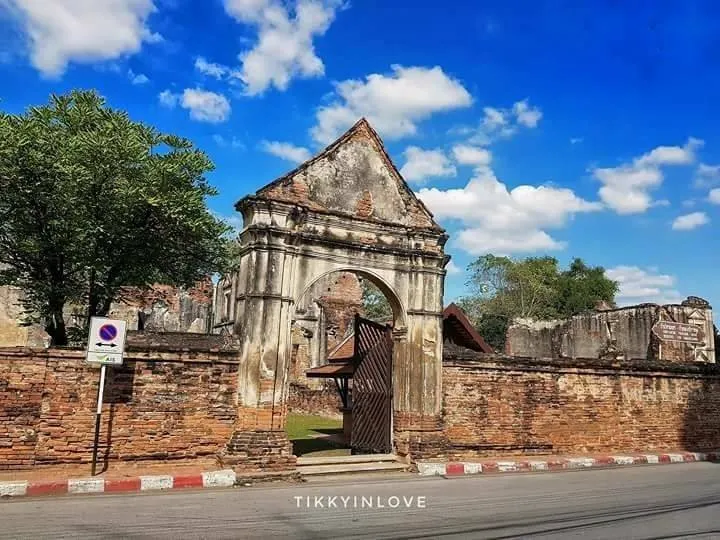
The area within the Royal House for Receiving Ambassadors is divided into 3 main sections, each reflecting different functions and architectural concepts in an interesting way. The western section consists of the residential buildings for the diplomatic missions, including a large 2-story brick building and a long, narrow single-story structure. The entrance arch is in the form of a semicircular curve, clearly showing the influence of European architecture. This section helps visitors imagine the reception zone that was designed to be both dignified and well organized for important guests.
The central section contains the most historically meaningful structures, because it includes the foundation of what is believed to have been a bell tower and a Christian church. The church stands behind a gabled entrance gateway, showing that this place was not only a residential compound for foreign guests, but also a center of religious practice for Christians who traveled with diplomatic missions or European missionaries.
The eastern section consists of a large 2-story building group, with a semicircular staircase at the front and entrance arches similar in style to those in the western section. This part is what gives Baan Vichayen its distinctive image among tourists and historians, because the buildings clearly display elements of Western Renaissance art, both in the form of the openings, the overall building composition, and the 2-story brick-and-plaster construction, which feels markedly different from traditional Thai buildings of the same period.
A major charm of Baan Vichayen lies in its architectural fusion. Some of the buildings are genuinely European in character, especially the large eastern building, which strongly reflects Renaissance influence. At the same time, however, the Christian church incorporates artistic details that connect it to Siam. The door and window frames take the form of Thai-style decorative arches, and the tops of the columns are shaped like elongated lotus petals, a distinctly Thai artistic feature. These elements have led the church within the Royal House for Receiving Ambassadors to be regarded as an important example of an early Christian church decorated with characteristics drawn from Buddhist artistic tradition in Siam.
In historical terms, Baan Vichayen is therefore a place that helps explain the relationship among political power, religion, and culture all in one location. It reflects how, during the reign of King Narai, Siam was not merely opening its city to foreign envoys, but was also selectively adopting influences in thought, architecture, and ritual practice, adapting them to local conditions.
When walking through the site today, visitors can see old walls, curved archways, window openings, and the foundations of buildings that still convey the grandeur of the place remarkably well. Although many structures survive only as partial walls and foundations, what remains is enough to evoke the atmosphere of diplomatic receptions, the residence of Chao Phraya Wichayen, and the lives of foreigners who once played a role in Lopburi during one chapter of Siamese history.
The atmosphere of Baan Vichayen today has a distinctive charm that differs from other historical sites in Lopburi. Beyond its antiquity, it also gives a strong sense of being a “cross-cultural space.” Visitors can see European, Siamese, and diplomatic-city identities layered together within a single site. For that reason, it is ideal for people interested in Ayutthaya history, those who enjoy architecture, and travelers who want to explore old Lopburi in greater depth rather than stopping only at its most photographed landmarks.
Another reason Baan Vichayen is worth visiting is its location near several other important historical places. Travelers can easily plan a connected route that includes Prang Khaek, King Narai’s Palace, Wat Phra Si Rattana Mahathat, and Phra Prang Sam Yot. Visiting this site is therefore not just a single stop, but part of a broader “historic Lopburi” experience that links politics, religion, art, and international relations in a compelling way.
For photography enthusiasts, Baan Vichayen offers many appealing angles, including the semicircular staircases, European-style archways, old brick walls, and the play of light and shadow across plaster surfaces. These features create photographs with a classic mood and a strong sense of the old city, especially in the morning and late afternoon when the light brings out the textures of the brick and plaster with greater depth.
In terms of its present-day significance, Baan Vichayen is not merely a tourist attraction, but also a historical learning site that helps later generations understand how Siam once had to negotiate with Western powers and how Lopburi’s role in the time of King Narai was far more complex than that of an ordinary secondary city. This historical site is therefore of great value for education, tourism, and understanding the roots of Thai diplomacy in the early modern period.
Getting There to Baan Vichayen is very convenient for those traveling within Lopburi city, as the site is located on Vichayen Road in the old town district. Visitors arriving by train can get off at Lopburi Railway Station and then walk or take a short ride. Those traveling by car can go directly to Baan Vichayen or Vichayen Road, and can easily plan a connected trip that also includes King Narai’s Palace, Prang Khaek, and Phra Prang Sam Yot in the same outing.
Overall, Baan Vichayen is a historical site that deserves to be explored with real attention, because every part of the compound carries a story, whether it is the role of the French diplomatic missions, the connection to Chao Phraya Wichayen, the fusion of Thai and European art, or the importance of Lopburi as a diplomatic city in the reign of King Narai. For anyone who wants to understand Lopburi more deeply than the familiar image of monkeys and Phra Prang Sam Yot, this is one place that should not be overlooked.
| Summary | An important historical site from the reign of King Narai the Great, used to receive foreign diplomatic missions and associated with Chao Phraya Wichayen. |
| Highlights | European architecture blended with Thai art, curved archways and 2-story brick-and-plaster buildings, a site of Siamese–French diplomatic history, an early Christian church in Siam, and a location in the center of Lopburi’s historical district. |
| History / Period | Built around the reign of King Narai the Great to receive foreign diplomatic missions. The first French embassy in 1685 stayed here. The site later became associated with Constantine Phaulkon, or Chao Phraya Wichayen. |
| Address | Vichayen Road, Tha Hin Subdistrict, Mueang Lopburi District, Lopburi 15000 |
| Getting There | Located in Lopburi’s old town, it is easily accessible by private car, train, and public transport. From Lopburi Railway Station, visitors can walk or take a short ride, and can conveniently continue on to King Narai’s Palace, Prang Khaek, and Phra Prang Sam Yot. |
| Open Days | Wednesday - Sunday |
| Opening Hours | 07.00-17.00 hrs. |
| Admission Fee | Thai visitors 10 baht, foreign visitors 50 baht, combined ticket for Thai visitors 30 baht, combined ticket for foreign visitors 150 baht |
| Facilities | Historical walking route, basic information signs, a tourist area connected with nearby historical sites, and cafés and restaurants within walking distance |
| Zones | The western section served as the residence of diplomatic missions, the central section contains the bell tower base and Christian church, and the eastern section consists of large 2-story European-style buildings |
| Nearby Tourist Attractions | 1. Prang Khaek – approx. 300 m. 2. Street Art @ Lopburi – approx. 400 m. 3. Wat Inthra – approx. 400 m. 4. Lopburi Railway Station – approx. 700 m. 5. Market / Walking Street in Lopburi Old Town – approx. 700 m. |
| Nearby Restaurants | 1. G&k And Orca – approx. 50 m. Tel. 086-065-5031 2. Khao Moo Tod Poon Jan – approx. 120 m. Tel. 095-710-2303 3. Joke Krungsri – approx. 250 m. Tel. 087-256-8243 4. Pizza Thai Prang Khaek Lopburi – approx. 300 m. Tel. 086-135-9640 5. Inthanin Coffee, King Narai’s Palace – approx. 600 m. Tel. 098-270-0809 |
| Nearby Accommodations | 1. Lopburi Residence Hotel – approx. 2.8 km. Tel. Please verify directly with the hotel before booking 2. Dad D Resort by Lopburi Inn – approx. 3.3 km. Tel. 036-420-777 3. Lop Buri Inn Hotel – approx. 4.1 km. Tel. 036-412-300 4. JRD Grand Place – approx. 4.6 km. Tel. 090-116-2292 5. Benjatara Boutique Resort – approx. 6 km. Tel. 036-422-608 |
| Main Contact Number | Fine Arts Office 4, Lopburi. Tel. 036-412-510, 036-413-779 |
Frequently Asked Questions (FAQ)
Q: What is Baan Vichayen?
A: It is an important historical site in Lopburi that once served as a residence for foreign diplomatic missions during the reign of King Narai the Great, and it is associated with Chao Phraya Wichayen, or Constantine Phaulkon.
Q: Where is Baan Vichayen located?
A: It is located on Vichayen Road, Tha Hin Subdistrict, Mueang Lopburi District, Lopburi Province, near Prang Khaek and not far from King Narai’s Palace.
Q: What days and times is Baan Vichayen open?
A: It is open to visitors from Wednesday to Sunday, from 07.00-17.00 hrs., and closed on Monday and Tuesday.
Q: How much is the admission fee for Baan Vichayen?
A: Admission is 10 baht for Thai visitors and 50 baht for foreign visitors, or visitors can buy a combined ticket at 30 baht for Thai visitors and 150 baht for foreign visitors to enter the designated historical sites in the same group.
Q: What is the highlight of Baan Vichayen?
A: Its main highlight is the Renaissance-style European architecture blended with distinctive Thai artistic details, as well as the Christian church area and diplomatic reception buildings that reflect Siamese–French diplomatic history.
Q: Who is Baan Vichayen associated with in history?
A: It is associated with King Narai the Great, the French diplomatic missions, and Constantine Phaulkon, or Chao Phraya Wichayen, who played an important role in the Siamese royal court at that time.
Q: What type of visit is Baan Vichayen suitable for?
A: It is ideal for those interested in Ayutthaya history, Siamese–European relations, historical architecture, and travelers who want to explore Lopburi’s old town through a connected route of several historical sites in one trip.
Q: Where can I get more information?
A: For more information, please contact Fine Arts Office 4, Lopburi, at 036-412-510 or 036-413-779.
 Tel: 036412510, 036413779
 Wichayen House (Ban Wichayen) Map
 Category:
  Group:
  Last Update: 1 DayAgo
Comment
 Nearby Attractions
| Keyword (Advance) |
 Region
|
 Muang Lop Buri(