
 Home
Home North(
 Chiang Mai(


Rating: 3.5/5 (4 votes)
 |
|  Map
Map 
 Have Map
  No Map
Nakhon Nayok attractions
Attractions in Thailand
Open Days: Daily
Opening Hours: 08.00 - 16.00
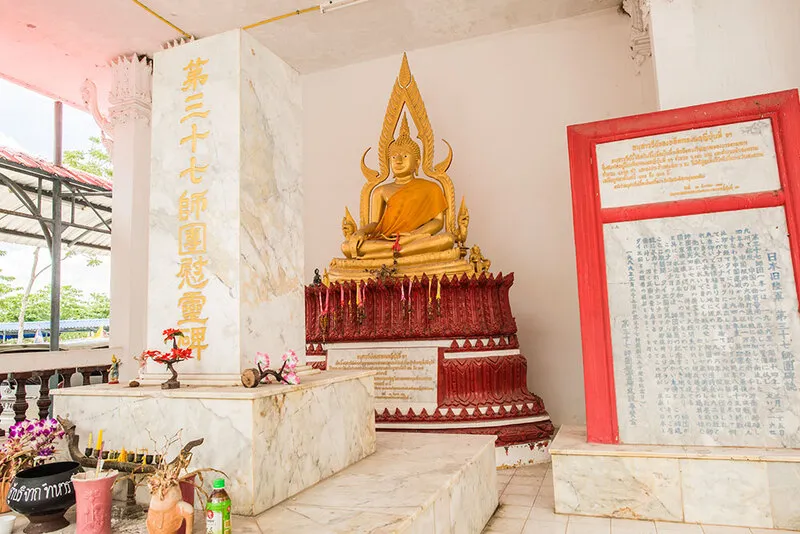
The Memorial to the 37th Japanese Division at Wat Phramani in Nakhon Nayok Province is an important site that clearly connects the history of World War II with a local Thai setting. This memorial was created to commemorate 7,929 Japanese soldiers of the 37th Division who died during the Greater East Asia War, and the ashes buried within the temple grounds were placed inside the officially constructed memorial base. As a result, this place serves as both a site of remembrance, a historical landmark, and a cultural destination with meaning far beyond that of an ordinary stop in Nakhon Nayok.
Upon arriving at Wat Phramani, visitors can immediately sense that this place has an atmosphere different from typical tourist attractions. While the temple is widely known for the sacred Luang Pho Pak Daeng and attracts many worshippers, the area around the memorial itself feels quiet, calm, and more suited to slow contemplation. The charm of the site lies in its blend of religious reverence, the solemnity of a memorial space, and the atmosphere of an old temple along the Sarika-Nang Rong route that still retains much of its natural character.
This memorial has its origins in the history of the Greater East Asia War between 1939 and 1945, when the Japanese military played a role in Thailand and used various areas as strategic bases. One of those places was Wat Phramani in Nakhon Nayok, where the 37th Japanese Division had once established a camp. This history makes Wat Phramani one of the sites connected to regional wartime history, not only as an important local temple, but also as a place that preserves traces of global events through Thailand’s real landscape.
After the war ended, the memory of the Japanese soldiers who died in this area was not allowed to fade away. The Association of War Comrades of the 37th Japanese Division therefore built this memorial in 1989 to honor the souls of 7,929 Japanese soldiers who died during the war. This detail is highly significant because it means the memorial is not merely a symbol of the military or of wartime strategy, but a space dedicated to remembering human lives lost in the context of war itself.
The relocation of the ashes once buried within the temple grounds into the memorial base gives this site the character of both a memorial and a place of mourning at the same time. Its meaning therefore goes much deeper than simply viewing a monument or reading an informational sign. Visitors stand in a place directly connected to the true stories of people who once lived, once came here to carry out duties in a land far from home, and died amid the violence of war. The feeling that arises here is usually not the excitement of ordinary sightseeing, but rather stillness and reflection on the losses of history.
What makes the Memorial to the 37th Japanese Division different from many other war-related sites is the fact that it stands within a Thai temple, a religious space and a center of local faith. Placing a war memorial inside a temple gives the site several overlapping dimensions. The first is historical memory, the second is ritual and beliefs concerning spirits, and the third is its role as a public space of the community that still receives visitors in the present day. This is why Wat Phramani carries a weight of meaning far greater than that of an ordinary temple.
From the perspective of Thai-Japanese relations, this memorial also has symbolic importance, because it reflects how the memory of war did not end with the fighting itself, but continued in the form of remembrance, memorial construction, and care for a place of loss for decades afterward. The fact that the Association of War Comrades of the 37th Japanese Division came to build the memorial in 1989 is therefore a sign that the memory of those who died remained alive and still needed a place for appropriate and peaceful expression.
However, Wat Phramani is not defined only by the history of war, because the temple grounds also contain several other features that make it a highly diverse destination. One of these is a model zoo featuring many cement sculptures of wild animals such as elephants, cattle, buffaloes, gaur, barking deer, and deer. This feature makes the temple atmosphere distinct from temples that focus solely on sacred Buddhist areas or archaeological remains, and it adds another layer of interest to a walk around the grounds, especially for families or groups of visitors of different ages.
Another important feature within Wat Phramani is the old Buddha image adorned with dok phikun floral motifs and red lips, commonly known as “Phra Phuttharup Pak Daeng,” or the Red-Lipped Buddha Image. According to local tradition, Lao migrants brought this Buddha image with them during the fall of Vientiane, and because the lips of the image are bright red, the name became firmly established among local people. This Buddha image is highly revered by both Thai and foreign visitors and stands as another major focus of devotion within Wat Phramani.
The fact that Wat Phramani contains both the memorial to the Japanese soldiers, the Red-Lipped Buddha Image, and other cultural elements gives this temple a distinctive character rarely found elsewhere in Nakhon Nayok. In other words, visitors do not encounter only a Thai religious site, but also a place that holds international history, local stories, beliefs connected to a sacred Buddha image, and the atmosphere of a temple along one of the province’s best-known nature routes all in one location. The layering of these stories gives Wat Phramani very high potential as a cultural learning site.
For present-day visitors, the Memorial to the 37th Japanese Division may not be the first point they specifically intend to visit, because Wat Phramani is more commonly associated with Luang Pho Pak Daeng. Yet once people walk into the memorial area and learn the background story, many end up spending more time there than expected. The place invites reflection on how a tourist area of today may once have been the backdrop to major global events, and how the stories of people who lived through wartime still quietly echo through this memorial.
The importance of this memorial is therefore not limited to ritual or remembrance for a particular group, but also extends to its value as a historical learning site for the general public, especially those interested in World War II, Thai-Japanese relations, and the local history of Nakhon Nayok. When the story is studied or explained in enough depth, visitors can clearly see that Wat Phramani is not merely a place to visit or a place to worship, but a site that helps explain the impact of war on local communities and society in a concrete way.
The overall atmosphere of the temple also allows history to be absorbed in a gentler way than through books or museums alone, because here people can walk through the actual space, see the memorial base, observe the temple grounds that once served as a military camp, and at the same time experience an environment that remains part of the daily life of the local community. This form of learning history through a real place makes the story of war feel less distant and encourages understanding at both an emotional and informational level.
Another reason this place is so interesting is that Wat Phramani lies along one of Nakhon Nayok’s most popular tourist routes, around kilometer 5 on the road to Sarika and Nang Rong waterfalls. This makes it easy for travelers visiting the province’s nature attractions to stop by. As a result, the Memorial to the 37th Japanese Division has strong potential as a stop that adds a cultural dimension to a Nakhon Nayok trip. Instead of planning only for waterfalls or cafes, visitors can add a historical and spiritual layer to the same route without difficulty.
Getting There To visit the Memorial to the 37th Japanese Division, take the same road used for Sarika and Nang Rong waterfalls. Wat Phramani is located at approximately kilometer 5 from the main route. Traveling by private car is the most convenient option, and because the temple is also widely known as the temple of Luang Pho Pak Daeng, that name can be used as a landmark or map pin as well. Once you arrive, it is best to allow enough time to walk around the temple grounds, because the points of interest include not only the memorial but also the Red-Lipped Buddha Image and other elements within the temple complex.
For visitors, it is important to behave respectfully and with composure, because while the memorial has historical significance, the entire area is still a temple and an active religious site where people continue to come to worship. Speaking softly, dressing appropriately, and avoiding climbing on or touching the memorial in an improper way are matters that should be strictly observed, especially when entering areas connected with the enshrining of the ashes of the deceased, which deserve the highest level of respect.
From an experiential point of view, a visit to the Memorial to the 37th Japanese Division becomes far more meaningful if one does not simply walk past it, but instead stops to read the story, understand the wartime context, and look at the surrounding temple grounds with a more open perspective. The significance of this place does not lie in the size of the memorial itself, but in the story of 7,929 men who never returned home, and in the fact that one place in Nakhon Nayok has quietly preserved the memory of them for so many years up to the present day.
In the end, the Memorial to the 37th Japanese Division at Wat Phramani is an example of a historical attraction with quiet power. It does not draw people in through spectacle, but through story, meaning, and an atmosphere that invites reflection. This place shows that Nakhon Nayok is not only about nature and leisure, but also about locations that reflect world history, international relations, wartime memory, and local faith all at once. For anyone who wants to experience a deeper side of Nakhon Nayok, Wat Phramani and this memorial are truly worth a visit.
| Place Name | The Memorial to the 37th Japanese Division at Wat Phramani |
| Place Summary | A memorial inside Wat Phramani created to honor 7,929 soldiers of the 37th Japanese Division who died during the Greater East Asia War, with their ashes placed inside the memorial base. |
| Highlights | A World War II memorial, historical links to the 37th Japanese Division, the Red-Lipped Buddha Image, a model zoo, and a site that combines historical learning with devotional tourism. |
| History / Period | Connected with the Greater East Asia War of 1939 - 1945, and the memorial was constructed in 1989 by the Association of War Comrades of the 37th Japanese Division. |
| Address | Wat Phramani, Moo 9, Sarika-Nang Rong Road, Ban Yai Subdistrict, Mueang Nakhon Nayok District, Nakhon Nayok Province |
| Getting There | Located around kilometer 5 on the road to Sarika and Nang Rong waterfalls. It is most convenient to travel by private car, and the temple can also be recognized by the name Wat Luang Pho Pak Daeng. |
| Open Days / Opening Hours | Daily, 06.00 - 18.00 |
| Facilities | Worship areas within the temple, walking areas, memorial viewing point, viewing area for the Red-Lipped Buddha Image, and the model zoo. |
| Zones | The Memorial to the 37th Japanese Division, the Red-Lipped Buddha Image area, the model zoo area, and the temple worship area. |
| Nearby Tourist Attractions | 1. Luang Pho Pak Daeng Market - 17 m 2. Nakhon Nayok Rong Kluea Market - 400 m 3. Thipwan Rattanaphong - 1.3 km 4. Teng Thoet Thoeng Night Vintage Market - 1.4 km 5. Eco Eyes Village - 1.6 km |
| Nearby Restaurants | 1. Tam Rim Na @ Khonyok - 300 m Tel. 095-835-6969 2. Nittaya Souvenir Shop at Nakhon Nayok - 400 m Tel. 083-116-7228 3. Kai Yang Khun Suek - 400 m Tel. 061-645-0394 4. Lourdes Cafe - 1.1 km Tel. 092-709-6960 5. Rin Cafe Nakhon Nayok - 5 km Tel. 086-954-5465 |
| Nearby Accommodations | 1. Baan Im Boon Homestay - 3.4 km Tel. 088-547-4944 2. Baan Thonglang Homestay - 4.4 km Tel. 081-373-8538 3. Siri Resotel Nakhon Nayok - 4.9 km Tel. 062-802-8717 4. Baan Chomphu Resort - 5.8 km Tel. 084-599-6142, 081-988-8074 5. Royal Hills Golf Resort & Spa - 9.8 km Tel. 081-701-1503 |
| Main Contact Number | 037-386-166 |
Frequently Asked Questions (FAQ)
Q: What is the Memorial to the 37th Japanese Division?
A: It is a memorial created to honor 7,929 soldiers of the 37th Japanese Division who died during the Greater East Asia War, with their ashes placed inside the memorial base within Wat Phramani.
Q: Where is the Memorial to the 37th Japanese Division located?
A: It is located within Wat Phramani, also known as Wat Luang Pho Pak Daeng, in Mueang Nakhon Nayok District, Nakhon Nayok Province.
Q: When was this memorial built?
A: It was built in 1989 by the Association of War Comrades of the 37th Japanese Division.
Q: What else is interesting at Wat Phramani besides the memorial?
A: The temple also has the Red-Lipped Buddha Image, which is an old Buddha image, and a model zoo with many cement animal sculptures.
Q: How do I get to the Memorial to the 37th Japanese Division?
A: Use the road to Sarika and Nang Rong waterfalls. Wat Phramani is located at about kilometer 5, and it is convenient to travel there by private car.
Q: Who is this memorial suitable for?
A: It is suitable for those interested in World War II history, Thai-Japanese relations, cultural tourism, and visitors who want to stop at an important site along the Nakhon Nayok tourist route.
 Tel: 037386166-7
 Memorial to the 37th Japanese Division at Wat Phramani Map
 Category:
  Group:
  Last Update: 3 DayAgo
Comment
 Nearby Attractions
| Keyword (Advance) |
 Facebook Fanpage
 Region
 Historical Sites and Monuments(
 Art, Craft Centres, Tradition(
 Museums(
 Educational Places
 Educational Gardens, Farm(
 University
 Places of Worship
 Temple(
 Church(
 Mosque(
 Other religious and spiritural sites(
 Suburban Living
 Village, Community(
 Local Market(
 Nature and Wildlife
 Dam, Reservoir, Lake(
 Waterfalls(
 Other natural attractions(
 Entertainment and Agricultural
 Farm, Parks, Gardens and Ecotourism(
 Outdoor and Adventure Activities(