
 Home
Home North(
 Chiang Mai(


Rating: 2.7/5 (13 votes)
 |
|  Map
Map 
 Have Map
  No Map
Bangkok attractions
Attractions in Thailand
Open Days: Daily
Opening Hours: 08.00 – 17.00
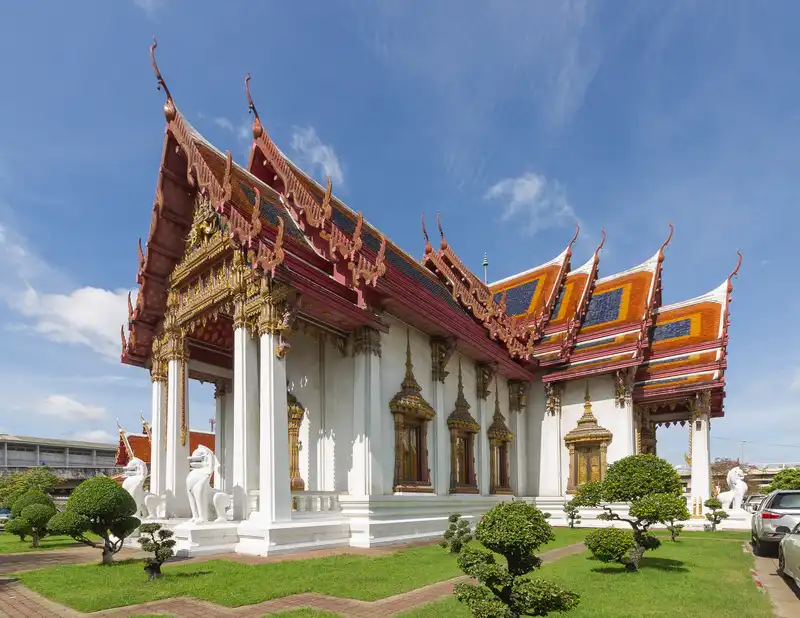
Wat Amarinthraram Worawihan, also widely known among locals as “Wat Bang Wa Noi,” is an important temple in the Siriraj–Bangkok Noi area that has long served as both a place of faith and a true community space. Located at No. 566, Arun Amarin Road, Siriraj Subdistrict, Bangkok Noi District, Bangkok, the temple does not stand apart from everyday life. Instead, it is a place people pass by, stop to make merit, place their hopes, and weave memories into the daily rhythm of Thonburi.
In terms of status, Wat Amarinthraram Worawihan is a third-class royal monastery (Worawihan type), with later official announcements reflecting developments in its classification. This gives the temple a distinctive character: it is both a “community temple” and a “royal temple” at the same time. It remains simple and approachable, yet it also carries visible traces of continued care and maintenance as a royal monastery over time.
The former name, “Wat Bang Wa Noi,” is often mentioned together with “Wat Bang Wa Yai,” which today is known as Wat Rakhang Khositaram. This shared local-history thread helps place Bangkok Noi into a clearer structure: temples here have never been only religious sites, but also key reference points for canal-side communities and long-standing travel routes. Entering the reign of King Rama I, a major reconstruction and re-foundation took place, along with the royal bestowal of the new name “Wat Amarinthraram”—the name people continue to use to this day.
Viewed through a historical timeline, Wat Amarinthraram Worawihan is described as an old temple with roots often presumed to reach back to the Ayutthaya period. It became more clearly prominent in the Thonburi era, when restoration work was carried out and the temple was established as a royal monastery. Later, in the reign of King Rama I, the temple was re-founded in a truly comprehensive way—effectively a full “rebuild of the entire monastery.” This included the ordination hall, cloisters, vihara halls, the crystal boundary wall, sala pavilions, bell tower, scripture hall, chanting hall, sermon hall, monastic quarters, supporting structures, and even the internal road layout. These elements show that the temple functioned not only as a site of ritual, but also as a lived architecture of faith that the community recognized and actively used.
For many devotees, the heart of a visit to this temple is paying respect to “Luang Pho Bot Noi,” often spoken of as a principal sacred image that people come to pray to and ask for blessings. The atmosphere of worship on site is generally calm, simple, and welcoming—for locals, for patients and relatives from the Siriraj area, and for visitors who intentionally include Thonburi temples in their Bangkok merit-making routes.
Beyond standard worship, some visitors also mention a community-style fortune ritual such as “lifting the elephant for divination.” If you choose to try it, it is best approached as a gentle encouragement for the heart rather than an outcome to cling to. Do everything respectfully and avoid disturbing those who are practicing or making merit, because the charm of a community temple lies in the calm that everyone helps to protect.
Because the temple sits in a lively urban area such as Siriraj–Bangkok Noi, its role as a “community center” is especially clear. It is a place for everyday merit-making, a gathering point for festivals, and a pause-button for city life when people want to step away from urgency. On crowded Bangkok days, a temple that still feels genuinely rooted in its neighborhood becomes even more valuable—it keeps faith close, tangible, and part of ordinary life.
Getting There If you are coming by private car or taxi, you can set your destination to Arun Amarin Road (Siriraj–Bangkok Noi area) and access the temple directly. If you are using public transport, a practical approach is to start from the Siriraj area or the Phra Nokk intersection, then take a short taxi or local ride that suits the traffic conditions. For travel by boat, you can use piers around the Wang Lang/Phra Nokk side as a connection point, then continue by road to the temple depending on where you begin your journey.
Overall, Wat Amarinthraram Worawihan tells the story of Thonburi Bangkok with a quiet depth: the history of a royal temple’s re-foundation, a living devotion centered on Luang Pho Bot Noi, and the everyday community role that gives the temple its continuing “breath” in daily life. If you are looking for a temple where you can both pay respects and feel the texture of old-and-real Bangkok in one visit, this is a place that helps you understand the city without having to force it.
| Place Name | Wat Amarinthraram Worawihan (Wat Bang Wa Noi) |
| Location | No. 566, Arun Amarin Road, Siriraj, Bangkok Noi, Bangkok 10700 |
| Zone | Siriraj – Bangkok Noi (Thonburi side) |
| Highlights | A third-class royal monastery (Worawihan type). A community temple in the Siriraj area, with Luang Pho Bot Noi as a key focal point of devotion and an approachable everyday merit-making atmosphere. |
| Period | Presumed Ayutthaya roots, more clearly prominent in the Thonburi era, and comprehensively re-founded in the early Rattanakosin period. |
| Key Developments | Restored and established as a royal monastery in the Thonburi period; later comprehensively re-founded in the reign of King Rama I, with the royal bestowal of the name “Wat Amarinthraram.” |
| Name Origin | Formerly known as Wat Bang Wa Noi; later granted the new name “Wat Amarinthraram” by King Rama I. |
| Travel | Arun Amarin Road (Siriraj–Bangkok Noi area) / Start from Siriraj or the Phra Nokk intersection and take a short taxi/local ride / Connect by boat via Wang Lang or Phra Nokk piers, then continue by road as convenient. |
| Current Status | Open for visits and merit-making during operating days and hours. |
| Contact Number | 089 365 8342 |
| Current Abbot | Phra Sunthonkitcaphiwat |
| Nearby Attractions (approx. road distance) | Wang Lang Market (approx. 2.0 km) Wat Rakhang Khositaram Woramahawihan (approx. 2.0 km) Siriraj Bimuk Sathan Museum (approx. 2.5 km) Wat Arun Ratchawararam Ratchaworamahawihan (approx. 3.5 km) The Grand Palace (approx. 4.5 km) |
| Nearby Restaurants (approx. road distance) + Phone | Supanniga Eating Room (Tha Tien) (approx. 4.0 km) Tel. +66 2 015 4224 The Deck by Arun Residence (approx. 4.0 km) Tel. +66 2 221 9158 Sala Arun Restaurant (approx. 4.0 km) Tel. +66 2 622 2932 Above Riva (Riva Arun) (approx. 4.0 km) Tel. +66 2 221 1188 Praya Dining (Praya Palazzo) (approx. 5.5 km) Tel. +66 81 402 8118 |
| Nearby Accommodations (approx. road distance) + Phone | Theatre Residence (approx. 2.0 km) Tel. +66 2 848 9488 Praya Palazzo (approx. 5.5 km) Tel. +66 81 402 8118 Riva Arun Bangkok (approx. 4.0 km) Tel. +66 2 221 1188 Sala Arun (approx. 4.0 km) Tel. +66 2 622 2932 SALA Rattanakosin Bangkok (approx. 4.2 km) Tel. +66 2 622 1388 |
Frequently Asked Questions (FAQ)
Q: Is Wat Amarinthraram Worawihan open every day?
A: It is generally open daily, and it is a community temple where people regularly stop by to make merit.
Q: What is the most popular place to pay respects inside the temple?
A: Many visitors come specifically to pay respect to Luang Pho Bot Noi, which is considered a key focal point of devotion at the temple.
Q: What was the temple’s former name?
A: It was formerly known as “Wat Bang Wa Noi,” and later King Rama I bestowed the new name “Wat Amarinthraram.”
Q: Is the “lifting the elephant for divination” tradition real?
A: Some visitors mention this practice. If you choose to do it, do so respectfully, treat it as encouragement, and avoid disturbing others in the temple.
Q: Who is the current abbot of the temple?
A: Referenced information identifies the current abbot as Phra Sunthonkitcaphiwat.
 Wat Amarinthraram Worawihan Map
 Category:
  Group:
  Last Update: 2 MonthAgo
Comment
 Nearby Attractions
| Keyword (Advance) |
 Facebook Fanpage
 Region
 Art, Culture and Heritage
 Historical Sites and Monuments(
 Landmarks and Memorials(
 Royal Palace(
 Art, Craft Centres, Tradition(
 Museums(
 Historical Houses and The Ancient City(
 Art Gallery(
 Educational Places
 Museum for Study(
 Library(
 University
 Church(
 Mosque(
 Other religious and spiritural sites(
 Research and Development
 Royal Project(
 Suburban Living
 Village, Community(
 Local Market(
 Floating Market(
 Nature and Wildlife
 River, Canal(
 Bays and Beaches(
 Other natural attractions(
 Entertainment and Agricultural
 Zoos and Aquariums(
 Animal camps and shows(
 Stadium(
 Farm, Parks, Gardens and Ecotourism(
 Amusement Park(
 Waterpark(
 Theater(
 Cinema(
 Shopping
 Shopping and Night Market(
 Department Store(
 Spas and Wellness
 Spas and Wellness(
 Restaurant
 Michelin Star(
 Accommodation
 Hotel(
 Call Customer Service in Tourism
 Call Customer Service in Tourism(
 Travel Articles, Recipes
 Travel Review, Food Review(
 Royal Thai Desserts, Traditional Dessert, Thai Dessert Recipes(