
lovethailand home >Eastern Travel Attractions >Sa Kaeo Travel Attractions > Art, Culture and Heritage
TL;DR: Art, Culture and Heritage of Eastern in Sa Kaeo
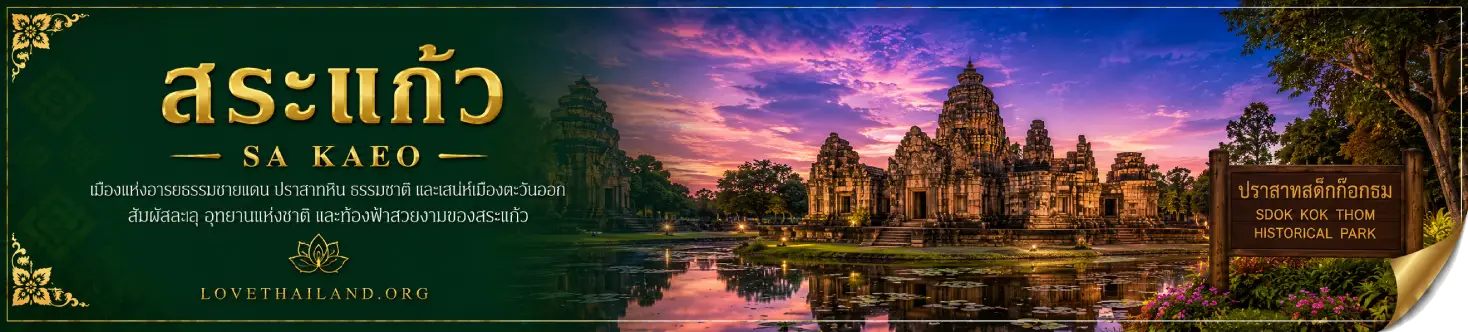

Art, Culture and Heritage
Arts, Culture, and Heritage Sites in Thailand form a fundamental foundation that allows Thai people to understand the origins of their nation and recognize the value of what their ancestors collectively created, preserved, and passed down from generation to generation. These elements are not limited to temples, historical sites, ancient cities, or beautiful works of art, but also include traditions, language, clothing, cuisine, performing arts, local wisdom, and the way of life of people in each region.
When looking at Thailand as a whole, it becomes evident that all 77 provinces possess their own heritage. Some provinces stand out for their ancient cities and historical sites, while others are renowned for traditional festivals, craftsmanship, or religious art. In contrast, certain areas reflect the value of traditional communities that continue to live in harmony with nature and long-standing cultural practices. This diversity is what gives Thailand its unique charm as a land rich in history and distinct local identities.
Studying Thailand’s arts, culture, and heritage is therefore not merely about appreciating the beauty of the past. It is about understanding the ideas, beliefs, and lessons embedded in what ancestors have left behind. Every ancient temple, city wall, tradition, and traditional community reflects how Thailand has grown through the collective efforts of countless people who built the nation, upheld religion, nurtured communities, and transmitted valuable knowledge to future generations.
The Northern region is distinguished by its Lanna cultural heritage. Key provinces such as Chiang Mai, Chiang Rai, Lamphun, Lampang, Nan, Phrae, and Mae Hong Son are home to ancient temples, sacred stupas, murals, and handicrafts that clearly reflect local cultural roots. The region is characterized by the elegance of Buddhist art, the preservation of local dialects, textile weaving, wood carving, and important traditions such as Yi Peng and the veneration of sacred relics, which remain integral to community life.
Chiang Mai is regarded as one of the most significant cultural cities in the country, featuring moats, city walls, important temples, and traditions closely tied to Lanna identity. Chiang Rai holds historical value alongside contemporary art that builds upon traditional cultural foundations. Lamphun, as the ancient city of Hariphunchai, is notable for its age and sacred relics serving as centers of faith. Meanwhile, Nan is renowned for its mural paintings and the atmosphere of an old town that clearly reflects the beauty of local culture.
The Central region serves as a major center of Thai civilization across multiple historical periods, particularly in governance, religion, and artistic development. Provinces such as Phra Nakhon Si Ayutthaya, Lopburi, Nakhon Pathom, Suphan Buri, and Bangkok are rich in historical heritage, including ancient cities, royal temples, palaces, riverside communities, and cultural learning centers. This region clearly illustrates the evolution of the Thai state.
Ayutthaya stands as a prominent example of a heritage city reflecting the prosperity of a former capital, with numerous archaeological sites demonstrating its role as a political, trade, and religious center. Bangkok, as the present capital, serves as the heart of Rattanakosin heritage, encompassing the Grand Palace, Wat Phra Kaew, Wat Pho, Wat Arun, and historic communities along the Chao Phraya River, all of which confirm the continuity of Thai history from past to present.
Lopburi is significant for reflecting the influence of multiple cultural periods, from Dvaravati and Khmer to the era of King Narai the Great. Nakhon Pathom is closely linked to the Dvaravati civilization and the early development of Buddhism in the region. Provinces such as Suphan Buri, Sing Buri, Ang Thong, and Samut Songkhram also feature old communities, riverside markets, and traditions that clearly represent the way of life of people in the Central plains.
The Northeastern region, or Isan, possesses distinctive cultural heritage in both historical sites and traditional lifestyles. Provinces such as Nakhon Ratchasima, Buriram, Surin, Sisaket, Ubon Ratchathani, Khon Kaen, Kalasin, Roi Et, Sakon Nakhon, Nong Khai, and Nakhon Phanom all contain traces of Mekong civilization and ancient Khmer influence, visible in stone sanctuaries, ancient cities, craftsmanship, and traditional beliefs still practiced in communities today.
Nakhon Ratchasima serves as the gateway to Isan and an important historical city. Buriram and Surin are known for their stone castles and strong local cultural identity. Ubon Ratchathani plays a significant role in religion, merit-making festivals, and local art, especially the Candle Festival that reflects both faith and craftsmanship. Yasothon represents the Bun Bang Fai festival, which clearly connects people with seasonal cycles and traditional Isan beliefs.
One of the most distinctive aspects of Isan is its intangible heritage, such as Mor Lam music, the khaen instrument, the Isan language, traditional festivals following the Heet Sip Song calendar, handwoven textiles, and local cuisine. These elements demonstrate the vitality of community culture more effectively than physical objects alone and show that Isan heritage is not just a matter of the past but continues to exist in everyday life.
The Eastern region has a distinct character because it is closely connected with the coast, trade, and historic urban communities. Provinces such as Chonburi, Rayong, Chanthaburi, Trat, Chachoengsao, Prachin Buri, and Sa Kaeo all carry historical narratives related to maritime travel, commerce, migration, and the coexistence of multiple cultures, particularly the influence of Chinese, Vietnamese, and coastal communities.
Chanthaburi is an old city with architectural value and various important religious sites. Chonburi contains fishing traditions, old communities, and the Buffalo Racing Festival, which reflects the local identity of the province. Rayong has connections to literature and local history, while Chachoengsao and Prachin Buri also feature important temples, riverside communities, and cultural routes that are suitable for study in both historical and cultural tourism contexts.
The Western region is significant as a land of border cities, frontier towns, and places shaped by multiple layers of history. Kanchanaburi, Ratchaburi, Phetchaburi, Tak, and Uthai Thani all preserve heritage that reflects the relationship between people, rivers, mountains, and old transportation routes. Kanchanaburi contains both ancient history, Mon communities, and traces of major events from the Second World War, while Phetchaburi is especially distinguished by its art, palaces, stucco craftsmanship, and famous local cuisine.
Ratchaburi is another province with interesting old communities and river-based culture, while Tak reflects the dimensions of border culture and the coexistence of multiple groups of people. The Western region therefore represents a blend of political history, security, trade, and local wisdom that has come together in a harmonious way.
The Southern region is one of the clearest reflections of Thailand’s cultural diversity because it has long been a place where Thai Buddhists, Thai Muslims, Chinese communities, and Malays have lived together. Provinces such as Nakhon Si Thammarat, Songkhla, Surat Thani, Phuket, Krabi, Trang, Phatthalung, Pattani, Yala, and Narathiwat all possess distinctive identities in art, culture, and history.
Nakhon Si Thammarat is an important center of Buddhism and history in the South, with Phra Borommathat Chedi and major traditions that reflect the faith of local people. Songkhla is an old city where many religions coexist in a fascinating way. Phuket is known for its Sino-Portuguese architecture and tin-mining history, while Pattani, Yala, and Narathiwat are areas with strong Malay Muslim cultural heritage, visible in their language, religious sites, food, and way of life.
The charm of the South lies not only in the beauty of the sea, but also in its community life, local traditions, folk performances such as nang talung and manora, and food that reflects the flavor and geography of the region. Understanding Southern Thailand therefore requires looking at trade, religion, ethnicity, and the relationship between people and the sea together.
When considered as a whole, it becomes clear that Thai heritage does not consist only of tangible elements such as temples, old cities, or archaeological sites. It also includes traditions, music, performance arts, food, and wisdom that continue to be passed down in everyday life. These elements give life to heritage sites so that they do not become silent places waiting only to be viewed by tourists, but instead remain places of memory in which local communities continue to participate.
Thai traditions in each region also reflect the worldview of Thai society very well. The North has Yi Peng and relic worship traditions. The Central region has temple fairs and riverside traditions. Isan has Bun Bang Fai and the Heet Sip Song tradition cycle. The South has Chak Phra, the Hae Pha Khuen That tradition, and local rituals connected with both Buddhism and Islam. These traditions show that people in each area of Thailand express faith, gratitude, and their relationship with nature in different ways, yet all share a common foundation in their connection to community and respect for what has been passed down from the past.
Thai heritage remains highly valuable in the present because, beyond serving as the foundation of local and national identity, it can also be developed into cultural tourism, the creative economy, and broader learning in contemporary society. Many provinces use cultural capital to build their image and create income for communities. At the same time, however, they face challenges in preservation, such as the deterioration of historical sites, urban transformation, and the shortage of people who continue to inherit local wisdom.
Therefore, preserving Thai art, culture, and heritage sites is not the responsibility of any single institution. It is a shared responsibility for communities, temples, schools, scholars, tourism operators, and younger generations. The more society recognizes the value of its cultural roots, the greater the chance these treasures can be preserved in a meaningful way.
Ultimately, tracing Thai heritage in every province is not simply about looking back at the past. It is about understanding how Thai people arrived where they are today and how they will continue into the future without being separated from their roots. Arts, culture, and heritage sites throughout Thailand therefore stand as the memory of the nation, the lessons of society, and an important force in building shared pride among Thai people in every region.
| Topic | Details |
| Overview of Thailand | Thailand has artistic, cultural, and historical heritage spread across all 77 provinces, including temples, archaeological sites, ancient cities, traditional communities, festivals, performances, craftsmanship, handicrafts, cuisine, and local wisdom. Each region has its own distinctive identity, yet all are connected as part of the nation’s civilizational roots. |
| Key Dimensions of Thai Heritage | 1) Tangible heritage, such as temples, stone castles, ancient cities, and historic buildings. 2) Intangible heritage, such as traditions, language, music, performance, and food. 3) Cultural landscapes, such as riverside communities, mountain communities, and coastal communities. 4) Local wisdom, such as weaving, woodcraft, stucco work, silverwork, and basketry. |
| Northern Region | Known for Lanna heritage, ancient cities, sacred temples, Lanna Buddhist art, mural paintings, traditional textiles, wood carving, silverwork, and local traditions such as Yi Peng, Fon Leb, and relic worship. Important provinces include Chiang Mai, Chiang Rai, Lamphun, Lampang, Phrae, Nan, Phayao, Mae Hong Son, Sukhothai, Phitsanulok, Kamphaeng Phet, and Tak. |
| Notable Provinces in the North | Chiang Mai: Lanna cultural city and important temples / Chiang Rai: contemporary art city rooted in Lanna heritage / Lamphun: Hariphunchai and important sacred relics / Lampang: teak city and architectural heritage / Nan: mural paintings and old-town culture / Sukhothai: World Heritage city and an important starting point of the Thai state / Kamphaeng Phet: ancient city linked to Sukhothai / Phitsanulok: historic city and Phra Buddha Chinnarat. |
| Cultural Strengths of the North | The North has strong continuity of local traditions. Many communities still preserve their dialects, clothing, weaving, and rituals. Ancient towns and historic temples remain part of daily life rather than being separated from the community. |
| Central Region | The political and cultural center of Thailand across many historical periods, distinguished by former capitals, royal culture, royal temples, palaces, riverside markets, water-related traditions, and Ayutthaya-Rattanakosin art. Important provinces include Bangkok, Phra Nakhon Si Ayutthaya, Lopburi, Nakhon Pathom, Suphan Buri, Sing Buri, Ang Thong, Saraburi, Ratchaburi, Phetchaburi, Samut Songkhram, Samut Sakhon, Samut Prakan, Pathum Thani, and Nonthaburi. |
| Notable Provinces in the Central Region | Bangkok: center of Rattanakosin heritage / Phra Nakhon Si Ayutthaya: World Heritage city and former capital / Lopburi: traces of Dvaravati, Khmer, and King Narai’s era / Nakhon Pathom: important area of Dvaravati civilization / Suphan Buri-Sing Buri-Ang Thong: ancient temples, historic towns, and riverside communities / Phetchaburi: stucco craftsmanship, palaces, and famous sweets / Ratchaburi: old communities, jar-making heritage, and traditional markets. |
| Cultural Strengths of the Central Region | The region contains a wide range of heritage, from royal traditions to local communities. It is deeply connected to the Chao Phraya River and canal networks, making it highly suitable for studying the relationship between state power, religion, trade, and the lives of river-based communities. |
| Northeastern Region | Noted for Khmer civilization, Mekong cultural traditions, the Heet Sip Song cycle, folk music, Mor Lam, khaen music, handwoven textiles, and agricultural-community life. Important provinces include Nakhon Ratchasima, Buriram, Surin, Sisaket, Ubon Ratchathani, Yasothon, Khon Kaen, Kalasin, Maha Sarakham, Roi Et, Sakon Nakhon, Nong Khai, Nakhon Phanom, Loei, Udon Thani, and Chaiyaphum. |
| Notable Provinces in the Northeast | Nakhon Ratchasima: gateway to Isan and historic city / Buriram-Surin-Sisaket: groups of stone sanctuaries and Khmer influence / Ubon Ratchathani: temple city, Candle Festival, and cultural center of lower Isan / Yasothon: Bun Bang Fai Festival / Khon Kaen-Maha Sarakham-Roi Et: centers of education, religion, and contemporary culture / Nong Khai-Nakhon Phanom: Mekong beliefs and old trade communities / Sakon Nakhon: city of culture, religion, and weaving / Udon Thani-Kalasin: archaeological sites and Ban Chiang-Mekong cultural heritage. |
| Cultural Strengths of the Northeast | The Northeast has exceptionally strong intangible heritage, including music, language, festivals, and the relationship between communities and seasonal cycles. It also retains clear continuity of community culture and preserves traces of ancient civilizations throughout the region. |
| Eastern Region | Known for coastal towns, trading communities, old cities, Chinese-Vietnamese-Thai cultural influence, seaside traditions, and maritime routes. Important provinces include Chonburi, Rayong, Chanthaburi, Trat, Chachoengsao, Prachin Buri, and Sa Kaeo. |
| Notable Provinces in the East | Chonburi: fishing traditions, old communities, and the Buffalo Racing Festival / Rayong: coastal city linked to literature and old communities / Chanthaburi: old town, architecture, religious sites, and gem trade / Trat: border town and maritime history / Chachoengsao: important temples, riverside communities, and old markets / Prachin Buri: religious heritage and archaeological sites / Sa Kaeo: area connected to Thai-Cambodian border culture. |
| Cultural Strengths of the East | The East clearly reflects the relationship between people and the sea, trade, and border cultures. It has old-town heritage and coastal communities well suited for development into cultural tourism routes. |
| Western Region | Known for border towns, war history, ethnic communities, ancient temples, and mountain-river cultural landscapes. Provinces often associated with this region include Kanchanaburi, Ratchaburi, Phetchaburi, Tak, and Uthai Thani in some cultural dimensions. |
| Notable Provinces in the West | Kanchanaburi: ancient history and the Second World War / Ratchaburi: old communities, craftsmanship, and river culture / Phetchaburi: city of art and palaces / Tak: border city and multi-ethnic culture / Uthai Thani: old-town community, temples, and riverside lifestyle that still retains a traditional atmosphere. |
| Cultural Strengths of the West | The region is rich in historical narratives, including frontier towns, war, migration, and the coexistence of various communities. It is well suited to the study of security, border trade, and cross-border culture. |
| Southern Region | Distinguished by a blend of Thai Buddhist, Thai Muslim, Chinese, and Malay cultures, with port cities, coastal communities, important religious sites, Sino-Portuguese architecture, folk performances, and regional cuisine. Important provinces include Nakhon Si Thammarat, Songkhla, Surat Thani, Phuket, Krabi, Trang, Phatthalung, Chumphon, Ranong, Phang Nga, Satun, Pattani, Yala, and Narathiwat. |
| Notable Provinces in the South | Nakhon Si Thammarat: city of Phra Borommathat and a center of Buddhism / Songkhla: old city and multi-religious culture / Phuket: Sino-Portuguese architecture and tin-mining history / Krabi-Phang Nga-Trang: coastal communities and maritime cultural landscapes / Phatthalung: Manora and Thale Noi way of life / Pattani-Yala-Narathiwat: Malay Muslim culture, old mosques, and southern border life / Surat Thani-Chumphon-Ranong: port cities, maritime routes, and old communities. |
| Cultural Strengths of the South | The South has a highly distinctive cultural blend visible in language, food, architecture, clothing, and traditions. It is also historically connected with maritime trade routes and the outside world. |
| Main Types of Heritage Sites Nationwide | 1) Heritage cities and old towns 2) Temples and religious sites 3) Stone sanctuaries and archaeological sites 4) Old market communities and riverside communities 5) Annual festivals and traditions 6) Local cuisine 7) Traditional handicrafts 8) Folk performances 9) Museums and learning centers 10) Coastal, mountain, and river cultural landscapes. |
| Lessons from Thai Heritage | Thai heritage helps people understand the roots of Thai society, see the strength of local communities, learn how people live together in diversity, recognize the value of ancestral wisdom, and use history as a reminder for thoughtful social development. |
| Importance in the Present Day | Artistic and cultural heritage helps create provincial identity, promotes quality cultural tourism, supports the creative economy, and gives younger generations a meaningful connection to their hometowns and the history of the country. |
| Challenges in Conservation | The deterioration of historical sites, urban expansion, the lack of successors in traditional craftsmanship, superficial tourism, social change, and the growing distance between younger generations and local wisdom. |
| Ways to Preserve Thai Heritage | Encourage local learning, support folk masters and traditional artisans, develop tourism with respect for context, use media and technology to transmit knowledge, and build cooperation among the state, communities, temples, schools, and the private sector. |
Frequently Asked Questions (FAQ)
Q: What is the difference between art, culture, and heritage in Thailand?
A: Art refers to expressions of creativity and beauty such as paintings, sculptures, and architecture. Culture refers to ways of life, beliefs, language, food, and traditions. Heritage refers to places or elements that carry historical and cultural value passed down for future generations.
Q: Why is studying Thai heritage important for people today?
A: It helps people understand the roots of society, learn lessons from the past, appreciate regional diversity, and ensure that modern development remains connected to the values created by previous generations.
Q: Which region of Thailand is most prominent in terms of art?
A: Each region has its own strengths. The North is known for Lanna art, the Central region for Ayutthaya and Rattanakosin art, the Northeast for Khmer-influenced architecture and Mekong culture, and the South for its multicultural blend of Thai, Chinese, and Malay influences.
Q: Does Thai heritage only include temples and historical sites?
A: No. It also includes traditions, language, music, performances, cuisine, handicrafts, and ways of life that are passed down through generations, which are equally important as physical heritage.
Q: Do smaller provinces have less cultural value than major cities?
A: Not at all. Many smaller provinces have deep historical narratives and preserve traditional ways of life more clearly than large cities, making them essential for understanding authentic Thai culture.
Q: How do Thai traditions help us understand Thai society?
A: Traditions reflect beliefs, relationships between people, religion, and nature, as well as values such as gratitude, respect for elders, unity, and social harmony.
Q: Where should someone begin when exploring Thai heritage?
A: It is best to start with a province or region of interest, then explore its history, important temples, old towns, traditions, cuisine, and communities to gain a deeper and more connected understanding.
Q: How is cultural tourism different from general tourism?
A: Cultural tourism focuses on understanding the meaning behind places, respecting local traditions, and learning about community contexts, rather than simply visiting or taking photos.
Q: What role do younger generations play in preserving Thai culture?
A: Younger generations play a crucial role as learners, communicators, creators, and inheritors. They can document local stories, share knowledge through digital media, support community products, and actively participate in cultural activities.
Q: How can Thai heritage contribute to the future of the country?
A: It helps build national identity, supports the creative economy, enhances cultural tourism, and provides a strong foundation of historical knowledge that leads to balanced and sustainable development.

 Historical Sites and Monuments(9)
 Landmarks and Memorials(3)
 Art, Craft Centres, Tradition(2)


