
lovethailand home >South Travel Attractions >Yala Travel Attractions >Muang Yala >Sateng > ASEAN Zebra Dove Singing Competition
TL;DR: ASEAN Zebra Dove Singing Competition, Yala attractions : Art, Culture and Heritage, Art, Craft Centres, Tradition.
ASEAN Zebra Dove Singing Competition
Open Days: Held Annually; The Latest Confirmed Edition Was Held From 4 – 5 April 2026
Opening Hours: Activity Hours Follow The Annual Schedule Announced By Yala City Municipality
The ASEAN Zebra Dove Singing Competition in Yala Province is one of southern Thailand’s most distinctive cultural events. It is not simply a bird contest, but a living tradition that connects people, sound, craftsmanship, dove breeding, local identity, tourism, and the creative economy of Thailand’s southern border region. The latest confirmed edition, the 38th ASEAN Zebra Dove Singing Competition in 2026, was held at the Zebra Dove Field in Suan Khwan Mueang, Yala City Municipality, from 4 to 5 April 2026. The event brought together dove enthusiasts from Yala, the southern border provinces, other parts of Thailand, and neighboring ASEAN countries.
Zebra doves have long been raised in Thailand for the beauty of their cooing sounds. In earlier times, the hobby was associated mainly with royal circles, court attendants, nobles, wealthy households, and older people who enjoyed listening to birds at home or during festive gatherings. Competitions were often held during special occasions, club events, association gatherings, or activities organized by agencies connected with dove enthusiasts. Over time, the hobby spread beyond elite circles to merchants, ordinary residents, breeders, craftsmen, and communities across southern Thailand.
In the South, zebra doves are valued primarily for their voices. Enthusiasts listen carefully for tone, resonance, rhythm, consistency, stamina, and the overall character of each bird’s call. This created a specialized culture with its own vocabulary. The community of zebra dove enthusiasts is often known in Thai as Chawa Wong. Tall hoisting poles are used to raise the cages during competition, while experienced judges walk around the field and listen with great precision. The contest is therefore a refined sound-based tradition rather than a casual bird show.
Yala Province played a major role in developing zebra dove singing contests from local gatherings into an ASEAN-level event. A major turning point came in 1986, when Yala Municipality, Yala Province, local zebra dove clubs, and southern dove-raising groups worked together to improve the field, rules, organization, and competition standards. The event was raised to a regional championship because neighboring countries such as Malaysia, Singapore, Indonesia, and Brunei also share similar dove-raising and dove-listening traditions. This ASEAN dimension turned the Yala competition into a cultural bridge linking people across borders.
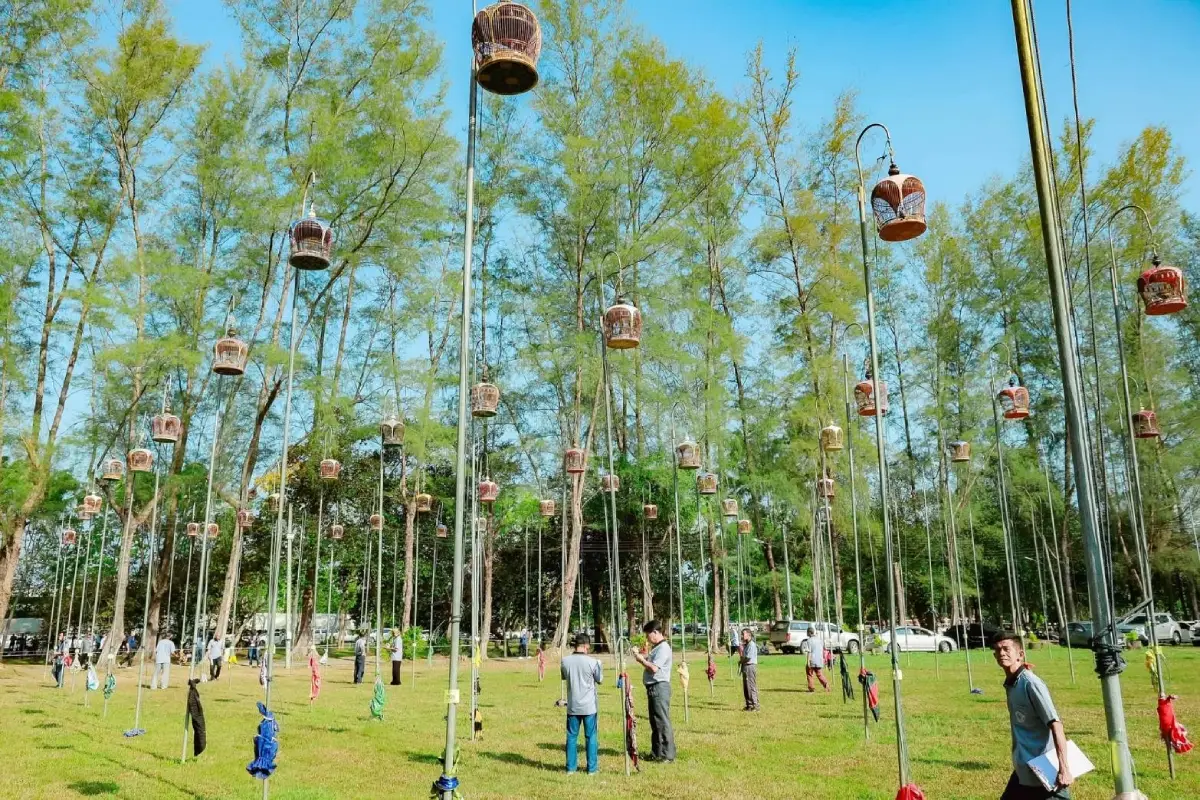
The strongest visual impression of the event is the competition field filled with rows of tall poles and carefully made birdcages. Owners bring their birds with great care, paying attention to health, training, feeding, cage condition, and the bird’s readiness before entering the field. When the contest begins, cages are hoisted high so that the birds can call in a proper competition environment. Judges then assess the quality of each bird’s voice according to the contest rules. A winning bird needs more than loudness; it must have a refined voice, good rhythm, steady calling, and the ability to maintain its sound.
The competition traditionally recognizes several voice categories, including large voice, medium voice, small voice, and combined voice. In the 2026 edition, the main categories were small voice, medium voice, large voice, and young-bird class. These categories make the judging fairer because each type of bird has a different vocal range and sound character. Separating the categories allows judges to compare birds with similar vocal qualities and gives owners at different levels a chance to compete appropriately.
A zebra dove singing contest requires a quiet, well-organized, and spacious field. Poles must be arranged with suitable spacing so judges can walk around and listen clearly. Suan Khwan Mueang is important because it contains a large and standardized zebra dove competition field. The park covers about 207 rai and functions as a major recreational space for Yala City. Its wide open area can accommodate cages, poles, judges, competitors, spectators, and supporting activities during the festival.
Suan Khwan Mueang, also known locally as Phru Ba Koi, is a major public park under Yala City Municipality. It is located in Municipal Zone 1, about 300 meters from the Yala City Pillar Shrine. The park was developed as a sports and recreation area with a large pond, a simulated beach, and rows of pine trees that create a coastal atmosphere in a landlocked province. Beyond serving as a public leisure space, the park has become strongly associated with the zebra dove singing competition, one of Yala’s most recognizable cultural events.
The atmosphere during the competition is different from ordinary festivals. Visitors see owners bringing cages into the field, some of them finely crafted wooden cages with decorative tops and cloth covers. When the birds are prepared, handlers hoist the cages onto the poles. The sound of many doves gradually fills the field, while judges listen closely to distinguish the quality of each call. For visitors, this creates a rare opportunity to see a living sound culture that is still actively practiced by real communities rather than staged only for tourism.
In Thai zebra dove culture, even the way people refer to the birds carries meaning. Enthusiasts often use a respectful counting word that elevates the status of the bird. Many owners do not treat their doves as ordinary pets. A good bird represents pride, personal skill, careful care, and sometimes the reputation of its owner. Birds that win major contests gain cultural, social, and economic value, especially within the network of serious breeders and sound judges.
Raising a competition zebra dove requires continuous knowledge. Owners must understand bird selection, sound quality, feeding, rest, cage management, training, and how to prepare the bird for the field. Experienced keepers know that each bird has its own behavior and calling pattern. Some birds call strongly in the morning, while others need more time to settle before producing their best voice. A competition therefore tests both the bird’s quality and the owner’s ability to understand and prepare it properly.
The ASEAN Zebra Dove Singing Competition also includes supporting activities that make the festival more attractive to general visitors. In 2026, parallel activities included a red-whiskered bulbul singing contest at the Yala City Municipality Youth Center and a three southern border provinces food festival at Chang Phueak Ceremonial Ground. These activities allow travelers to experience bird culture, local food, community products, and the city atmosphere in one visit.
The importance of the event extends far beyond the competition field. Zebra dove culture supports a wider creative economy. Upstream businesses include dove farms and breeders who specialize in bird selection and sound quality. Midstream businesses include cage makers, cage-top craftsmen, metal hook makers, cage-cover makers, feed suppliers, supplements, and bird-care equipment. Downstream businesses include hotels, restaurants, tea shops, transport services, souvenir vendors, and other local businesses that benefit when competitors and spectators travel to Yala. The event therefore has a broad economic impact on the city and the southern border region.
Yala uses the competition as an important cultural asset because the event is highly distinctive and naturally connected with neighboring countries. Participants from Malaysia, Singapore, Indonesia, and other parts of the region meet Thai dove enthusiasts in Yala to exchange knowledge, compare birds, discuss breeding, and build relationships. The field becomes more than a place to compete; it is a social network where culture, trade, and friendship cross borders.
Socially, the event brings people of different backgrounds together. Dove enthusiasts may differ in ethnicity, religion, occupation, or social status, but they share the same language of sound, care, and fair competition. The atmosphere is full of greetings, conversation, technical exchange, and mutual respect. This makes the ASEAN Zebra Dove Singing Competition not only a sport or hobby, but also a cultural space for coexistence and regional connection.
Travelers who do not raise birds can still enjoy the event. The field itself is visually memorable, with rows of cages, hoisting poles, judges, handlers, and spectators. Visitors can observe how birds are prepared, how cages are raised, how judges listen, and how the community interacts. The event is especially suitable for travelers who want to understand southern Thai culture beyond beaches, food, and temples. It reveals a different side of Yala: a city shaped by sound, craftsmanship, and community networks.
Visitors should observe the event with respect. Because sound is central to the competition, spectators should avoid making loud noise near judging areas. They should not tap cages, approach birds without permission, or disturb owners while they are preparing their birds. Photography should be done with courtesy, especially in working areas of the competition field. Respectful behavior helps preserve the atmosphere of the event and shows appreciation for the culture of the dove enthusiasts.
Getting There is convenient once travelers reach central Yala. Visitors can travel to Yala by private car, bus, or the southern railway line. Yala Railway Station is close to the old town area and several city attractions. From the city center, travelers can continue to Suan Khwan Mueang on Thetsaban 1 Road or use the Yala City Pillar Shrine area as a nearby reference point. During major event days, travelers should allow extra time for traffic, parking, competitors’ vehicles, and crowds around the field.
The competition can be combined with nearby attractions in Yala city. Suan Khwan Mueang is close to Yala City Pillar Shrine, Chang Phueak Ceremonial Ground, Yala Clock Tower Roundabout, Suan Si Mueang, Ban Rom Public Park, and Wat Khuhaphimuk. Travelers can spend the morning at the competition, then continue to nearby landmarks or local restaurants. Visiting in the morning is especially rewarding because it allows travelers to see bird preparation, cage hoisting, and the early stages of the singing contest.
Food is another reason to spend time in Yala during the event. The city has Thai Buddhist food, Thai Muslim food, Chinese-influenced dishes, roti, pulled tea, rice soup, halal food, and southern border cuisine. Many restaurants are located near Suan Khwan Mueang or within the city center. A visit to the competition can therefore be paired with a local meal, allowing travelers to experience Yala through both sound and flavor.
Travelers from outside Yala should stay in the city center for easier access to the competition field. Hotels near Suan Khwan Mueang, Thetsaban 1 Road, Si Bamrung Road, Jongrak Road, Phiphitphakdi Road, and the Yala Rajabhat University area are convenient for reaching the bird field, restaurants, the railway station, and city attractions. During the competition period, booking accommodation early is useful because the event attracts bird owners, spectators, traders, and visitors from many areas.
What makes this tradition distinct is the clear link between culture and livelihood. The sound heard in the field is the final result of many layers of knowledge: breeding, selection, listening skill, cage craftsmanship, pole arrangement, field design, judging standards, and large-scale event management. Seen in this way, the ASEAN Zebra Dove Singing Competition is a cultural ecosystem that transforms local knowledge into a regional event and gives Yala a strong identity unlike any other city in southern Thailand.
The event is ideal for travelers who want a deeper understanding of southern Thai culture. It tells the story of careful bird keepers, borderland relationships, Thai-ASEAN cultural links, and the economic potential of local heritage. What began as a long-standing love of listening to zebra doves has developed into a major annual event that continues to attract serious participants and curious visitors.
From past to present, the ASEAN Zebra Dove Singing Competition shows how a tradition can grow when communities, experts, local agencies, and businesses work together. A local bird-listening hobby became an event with thousands of competing birds. A home-based pastime became a standardized sound competition. A club activity became an annual festival that stimulates Yala’s economy. A southern local culture became a regional meeting point for ASEAN enthusiasts.
The ASEAN Zebra Dove Singing Competition in Yala Province deserves recognition as one of southern Thailand’s important sound-based cultural traditions. It combines history, voice, specialized listening, bird care, craftsmanship, local economy, and cross-border friendship. Visitors who come to Yala during the event can see the city alive with sound, watch zebra doves become a shared language among people, and experience a distinctive cultural atmosphere found only in this part of Thailand.
| Name | ASEAN Zebra Dove Singing Competition, Yala Province |
| Activity Area | Zebra Dove Field, Suan Khwan Mueang, Yala City Municipality |
| Address | Suan Khwan Mueang, Thetsaban 1 Road, Sateng Subdistrict, Mueang Yala District, Yala Province 95000, Thailand |
| Coordinates | Zebra Dove Field Area, Suan Khwan Mueang: G7QF+HC3, Sateng, Mueang Yala District, Yala Province |
| Highlights | A regional zebra dove voice competition with rows of hoisting poles, finely crafted cages, expert judges, and dove enthusiasts from Thailand and neighboring ASEAN countries. |
| History | Zebra dove raising has been practiced in Thailand for many generations. Yala elevated the contest into an ASEAN-level competition in 1986. |
| Name Origin | The name refers to a zebra dove contest judged by voice quality, with ASEAN participation from neighboring countries that share similar dove-listening traditions. |
| Distinctive Features | Birds are judged by cooing quality, resonance, rhythm, calling stamina, consistency, and tone according to competition categories. |
| Latest Competition Categories | Small Voice, Medium Voice, Large Voice, and Young-Bird Class |
| Latest Confirmed Period | The 38th edition in 2026 was held from 4 – 5 April 2026. |
| Main Areas / Zones | Zebra dove field, hoisting pole area, judging area, registration area, spectator area, bird-related activity area, food and vendor areas during the festival. |
| Organizer / Caretaker | Yala City Municipality, Tourism Authority of Thailand, government agencies, partner networks, and zebra dove enthusiast groups. |
| Main Contact Number | Yala City Municipality Tel. 073-223666 |
| Travel Information | Travel to central Yala by car, bus, or train, then continue to Suan Khwan Mueang on Thetsaban 1 Road. Allow extra time for traffic and parking during the event. |
| Current Status | The event remains active. The latest confirmed edition was the 38th competition in 2026 at the Zebra Dove Field in Suan Khwan Mueang, Yala City Municipality. |
| Nearby Tourist Attractions | 1. Yala City Pillar Shrine 0.6 km 2. Chang Phueak Ceremonial Ground 1 km 3. Yala Clock Tower Roundabout 1.3 km 4. Suan Si Mueang 2.1 km 5. Ban Rom Public Park 2.1 km 6. Wat Khuhaphimuk 8 km |
| Nearby Restaurants | 1. FUSHKA Suan Khwan Mueang Yala 0.1 km, Tel. 066-130-7178 2. Yasmeen Tea 0.5 km, Tel. 088-799-9300, 073-222-300 3. Kadah Suan Khwan Mueang 0.6 km, Tel. 084-855-6481 4. Suan Khwan Maphrao Hom 1 km, Tel. 083-023-1757 5. Sathani Khao Soup 2 km, Tel. 098-136-9261 6. 3 Siblings Halal 3 km, Tel. 098-463-0663, 081-306-8789 |
| Nearby Accommodations | 1. Park View Yala Hotel 1.5 km, Tel. 073-217-002 2. Yala Rama Hotel 2 km, Tel. 073-212563, 073-212815, 073-212841 3. The Linux Garden Hotel Yala 2 km 4. @INN YRU 2 km 5. MinimalYala 2 km 6. THE24 Residence Yala 2 km |
Frequently Asked Questions (FAQ)
Q: Where is the ASEAN Zebra Dove Singing Competition in Yala held?
A: It is held at the Zebra Dove Field in Suan Khwan Mueang, Yala City Municipality, on Thetsaban 1 Road in Mueang Yala District.
Q: When is the competition held?
A: It is an annual event with dates announced each year. The latest confirmed 38th edition was held from 4 to 5 April 2026.
Q: How are zebra doves judged in the competition?
A: They are judged by voice quality, resonance, rhythm, calling stamina, consistency, and overall tone according to the competition category.
Q: What were the latest competition categories?
A: The 2026 edition included small voice, medium voice, large voice, and young-bird class.
Q: Can general travelers watch the event?
A: Yes. Travelers can observe the public areas of the event, but they should remain quiet near judging zones, avoid touching cages, and respect the owners and officials.
Q: Why is Yala known for zebra dove singing competitions?
A: Yala has a long-running competition history, a standardized field in Suan Khwan Mueang, and strong networks of dove enthusiasts from Thailand and neighboring ASEAN countries.
Q: What attractions can visitors see nearby?
A: Nearby places include Yala City Pillar Shrine, Chang Phueak Ceremonial Ground, Yala Clock Tower Roundabout, Suan Si Mueang, Ban Rom Public Park, and Wat Khuhaphimuk.
Q: Which office should travelers contact for event details?
A: Travelers can contact Yala City Municipality at 073-223666 for the annual schedule and event information.
 Category: ●Art, Culture and Heritage
 Group: ●Art, Craft Centres, Tradition
Last Update : 2 WeekAgo
 Last Update : 2 WeekAgo

 Landmarks and Memorials(1)
Art, Craft Centres, Tradition(2)
Landmarks and Memorials(1)
Art, Craft Centres, Tradition(2)
 Museums(2)
 Educational Places
 Educational Gardens, Farm(1)
 Places of Worship
 Temple(6)
 Mosque(2)
 Other Sacred Sites(3)
 Suburban Living
 Village, Community(4)
 Nature and Wildlife
 National Parks and Marine Reserves(2)
 Mountain (Doi)(5)
 Dam, Reservoir, Lake(5)
 Waterfalls(13)
 Hot Springs(2)
 Caves(7)
 River, Canal(4)
 Islands(1)
 Other natural attractions(8)
 Entertainment and Agricultural
 Stadium(1)
 Farms, Parks and Ecotourism(4)
 Outdoor and Adventure Activities(1)
 Travel Articles, Recipes
 Travel Review, Food Review(2)


