
lovethailand home >South Travel Attractions >Yala Travel Attractions >Muang Yala >Yu Po > Wat Yuparam
TL;DR: Wat Yuparam is located at Ban Yupo, Village No. 1, Yupo Subdistrict, Mueang Yala District, Yala Province, open Daily, hours 08:00 – 17:00.
Wat Yuparam
Open Days: Daily
Opening Hours: 08:00 – 17:00
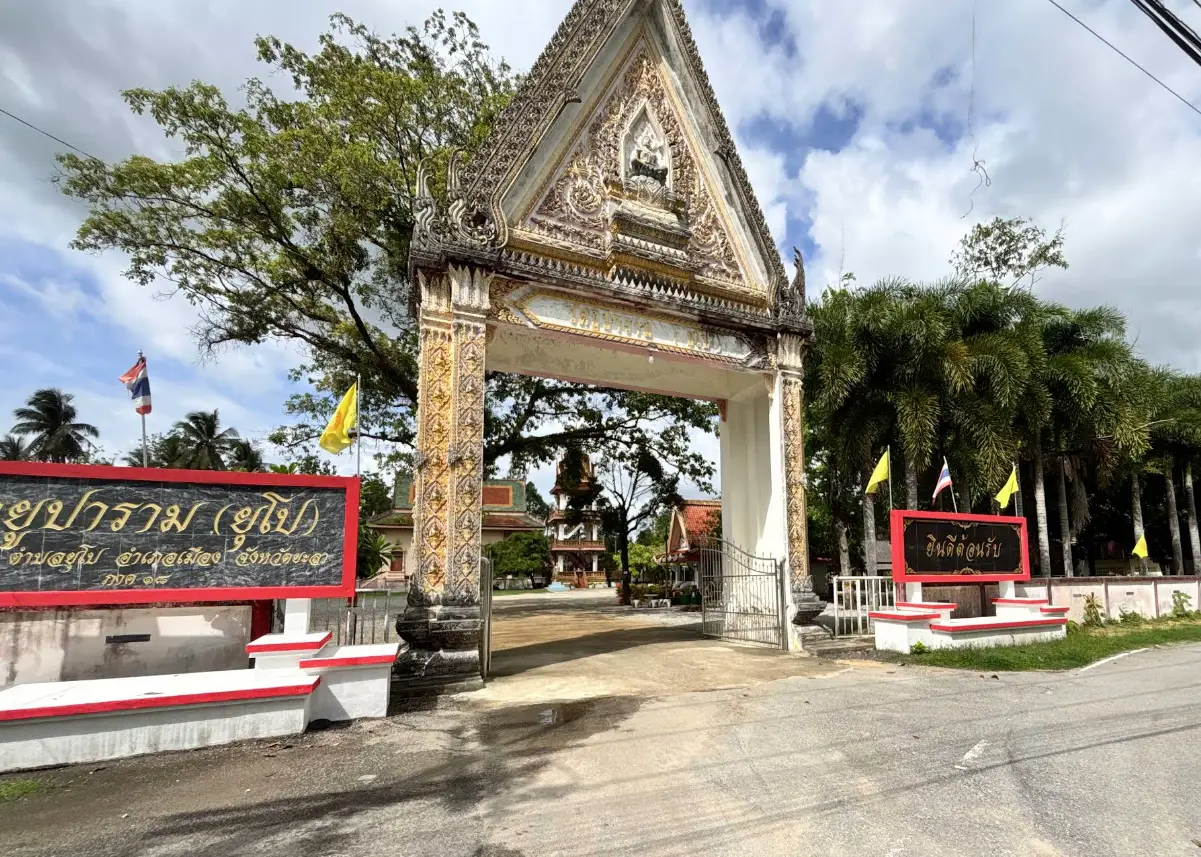
Wat Yuparam, also known locally as Wat Yupo, in Yala Province is a private Buddhist temple under the Mahanikaya order. It is located at Ban Yupo, Village No. 1, Yupo Subdistrict, Mueang Yala District, Yala Province. The temple is an important religious center for the Yupo community and Buddhists in Mueang Yala. Its value does not come from grand tourist-scale architecture or a highly commercialized visitor experience. Instead, Wat Yuparam is meaningful because it is an old community temple with a history dating back to 1839, a long connection with Ban Yupo, and a continuing role in Buddhist community life in Thailand’s southern border region.
The basic information provided for this article states that Wat Yuparam is located at Ban Yupo, Village No. 1, Yupo Subdistrict, Mueang Yala District, Yala Province. This remains the core location information confirmed by temple and community records. Recent official Buddhist-office reports also show that the temple remains active. In 2026, Wat Yuparam appeared in public reports about religious ceremonies connected with Phra Khru Nanthanaphiwat, a former ecclesiastical chief of Yupo, Lam Mai, and Lam Phaya Subdistricts and former abbot of Wat Yuparam. These events confirm the temple’s continuing role as a living religious site in Yala.
Wat Yuparam is best understood as a community temple rather than a conventional tourist attraction. It is suitable for visitors who want to make merit, pay respect, and understand Buddhist life in a multicultural southern border community. The temple is closely tied to the history of Yupo village, the role of monks in local society, the yearly rhythm of Buddhist ceremonies, and the relationship between people of different religious and cultural backgrounds. A visit here reveals the temple as a place of merit, memory, and faith used by local residents in daily life.
The name Yupo is essential for understanding the temple. Local accounts explain that the village was formerly called Ban Khupo, a name connected with a tree known in the local Malay language. As more Buddhist residents settled in the area, the pronunciation gradually changed into Ban Yupo or Yupo Subdistrict in Thai. Because the temple is called Wat Yuparam or Wat Yupo, its name is not only religious. It is also connected with local language, landscape, and community memory.
According to temple history records, Wat Yuparam received permission to be built as a temple on 2 April 1839. The construction was led by Phra Khru Thammakhan, or Phet Chittawaso. Local people have long referred to the temple as Wat Yupo. The temple later received its royal grant of Wisungkham Sima on 31 March 1959, with a Sima boundary measuring 40 meters wide and 80 meters long. The boundary-stone ceremony was held on 3 May 1972. These details show that Wat Yuparam has a long foundation and a formal Buddhist status rather than being a temporary religious site.
The royal grant of Wisungkham Sima and the boundary-stone ceremony are important because they allow a temple to function fully according to Buddhist monastic discipline. A Sima boundary defines the sacred area used for formal monastic acts, including ordination and other Sangha ceremonies. The fact that Wat Yuparam received the Sima grant in 1959 and completed the consecration in 1972 shows the development of the temple from a local place of faith into a complete Buddhist institution serving the Yupo community.
The temple’s buildings reflect the development of a community temple over time. Temple records mention an ordination hall, sermon hall, monks’ residences, dining hall, welfare hall, and bell tower. The ordination hall was built in 1975 with a reinforced-concrete structure, painted door and window panels, and a surrounding boundary wall. The sermon hall, measuring 12 meters wide and 30 meters long, was built in 1982. The monks’ residences include both concrete and wooden buildings. These structures show that Wat Yuparam was developed to support monks, worshippers, ceremonies, and community religious activity.
The ordination hall is the spiritual and ritual center of the temple. Built in reinforced concrete in 1975, it reflects the community’s intention to create a durable building for long-term Buddhist practice. Details such as painted doors, painted windows, and the surrounding boundary wall show that the hall was not only a practical structure but also a place created with respect for Buddhism and local craftsmanship.
The sermon hall is another important space because it supports the relationship between monks and laypeople. It is used for Dharma talks, community meetings, merit-making, welcoming participants during ceremonies, and various temple events. Community temples often remain active through their sermon halls because these buildings are where people gather repeatedly throughout the year. At Wat Yuparam, the sermon hall has also been used for major memorial and merit-making ceremonies, giving it both religious and community significance.
The bell tower is another meaningful part of Wat Yuparam. It has appeared in public news related to the temple and reflects continued care and development supported by local faith. In a Thai temple, a bell tower is more than an architectural feature. It is connected with sound, time, ritual atmosphere, and the identity of the temple. The presence of a bell tower helps complete Wat Yuparam’s character as a functioning Thai Buddhist community temple.
Wat Yuparam has had many abbots throughout its history. Temple records list 14 abbots, including Phra Khru Thammakhan, Phra Sanui, Phra Palat Thima, Phra Rot, Phra Chan, Phra Daeng, Phra Khru Wisutthisang, and Phra Athikan Nueap Nandiko, who later became widely known as Phra Khru Nanthanaphiwat. He played a major role in the temple and the surrounding community. He was also recognized as a former ecclesiastical chief of Yupo, Lam Mai, and Lam Phaya Subdistricts and former abbot of Wat Yuparam.
Phra Khru Nanthanaphiwat, respectfully known by local people as Pho Than Nueap, gives the temple a deeper social meaning. His role extended beyond temple administration. Local accounts describe him as a monk who helped people in the wider community, including both Buddhists and Muslims, through herbal knowledge, spiritual support, and personal assistance. This makes Wat Yuparam more than a Buddhist site for Buddhists alone. It is also part of the wider network of relationships within Yupo’s multicultural community.
Phra Khru Nanthanaphiwat passed away in 2025. In 2026, ceremonies for merit-making, moving his remains, and royal cremation were held at Wat Yuparam. Government officials, Yala Buddhist authorities, monks, local Buddhists, and disciples attended the ceremonies. These events reflect the strong bond between the former abbot, the temple, and the community. They also confirm that Wat Yuparam remains active as a religious site where important Buddhist ceremonies continue to take place.
Yupo community, where the temple is located, is an urban and suburban community with a multicultural character. It has strong kinship ties and a tradition of mutual support among residents. Both Buddhists and Muslims live in the area. Thai is the main language of communication, while the local Malay language is also part of the community’s cultural life. This context makes Wat Yuparam especially meaningful because it stands within a shared landscape where different religious communities live side by side.
Community records state that Yupo had 408 households and 1,272 residents in 2022. Most residents were Buddhist, with Muslims forming the next largest religious group. The community includes lowland areas that can flood during the rainy season, agricultural areas, land near the Pattani River, and a railway route passing through the area. This mix of water, railway, agriculture, and religious sites makes Wat Yuparam part of a complex local landscape rather than an isolated temple.
Culturally, Yupo community includes both Thai Buddhist and Muslim traditions in its yearly calendar. Buddhist-related traditions include New Year merit-making, Songkran, the Yala City Pillar celebration, and Chak Phra after the end of Buddhist Lent. Muslim community traditions such as Asura stirring during Muharram are also part of the wider cultural life of the area. These elements show that a visit to Wat Yuparam should be connected with the story of Yupo community, not viewed separately from its local context.
One important tradition connected with Wat Yuparam is Chak Phra, also known as the Buddha image procession after Buddhist Lent. This tradition is widely practiced in southern Thailand. A Buddha image is placed on a decorated ceremonial structure or Buddha boat and pulled in procession so that people can make merit and celebrate the end of Buddhist Lent. Wat Yuparam has appeared in connection with Yala’s Chak Phra procession, showing that the temple is part of the wider Buddhist ceremonial network of the city.
Chak Phra has a deeper meaning than a public procession. It is connected with the Buddhist narrative of the Buddha returning from Tavatimsa Heaven. Southern communities create and decorate Buddha boats, organize processions, make merit, listen to sermons, and use the occasion as a communal gathering. For Wat Yuparam, participation in this tradition helps keep local Buddhist culture visible and allows younger generations to experience the role of temples in southern Thai festivals.
Wat Yuparam is also connected with regular Buddhist activities throughout the year, including Buddhist holy days, almsgiving, Dharma listening, Buddhist Lent, the end of Buddhist Lent, Kathin, forest robe offerings, memorial ceremonies, and community merit-making. The strength of a community temple lies in these repeated activities. They maintain the relationship between monks, laypeople, and the wider village across generations.
For visitors, Wat Yuparam is suitable for a quiet visit of about 30 minutes to 1 hour. Those interested in local history should view the temple through four main dimensions: its long history beginning in 1839, its status as a Mahanikaya community temple, its role in Yupo’s multicultural society, and its connection with southern Buddhist traditions such as Chak Phra. This approach makes a visit more meaningful than simply stopping for a quick photograph.
The landscape of Yupo Subdistrict is also worth noticing. It is close to Yala city but still preserves a community atmosphere with village life, agriculture, kinship networks, lowland terrain, river connections, and railway memory. Entering Yupo allows visitors to see another side of Yala beyond the city center: an older community shaped by language, faith, water, transport routes, and local adaptation.
Visitors should remember that Wat Yuparam is not a large commercial tourist attraction with full visitor infrastructure. It is a working community temple. Visitors should dress modestly, speak quietly, avoid entering monks’ areas without permission, avoid touching temple objects inappropriately, and park without blocking local access. Photography of people or community ceremonies should be done with permission. Respectful behavior is essential because the temple remains part of everyday religious life for local residents.
Getting There is straightforward from central Yala. Travel toward Yupo Subdistrict in Mueang Yala District. The destination is Ban Yupo, Village No. 1. Private car or motorcycle is the most convenient way to reach the temple and continue to nearby communities. Train travelers can get off at Yala Railway Station and continue by hired vehicle or local transport to Yupo Subdistrict. Visitors unfamiliar with the route should use map navigation and confirm directions with local residents when approaching the village.
Wat Yuparam can be included in a half-day cultural itinerary in Mueang Yala District. Visitors can begin in Yala city, travel to Wat Yuparam for merit-making and a quiet look at the community temple, then continue to Wat Walukaram in Yupo Subdistrict or return to the city for Yala Learning Park, Yala City Pillar Shrine, Suan Khwan Mueang, Yala Clock Tower Roundabout, and Wat Khuha Phimuk. A more community-based route can also include Yupo’s local market and the story of the Chak Phra tradition.
Wat Walukaram, also known as Wat Khlong Sai Nai, is another nearby temple in Yupo Subdistrict and can be visited together with Wat Yuparam. City attractions such as Yala City Pillar Shrine, Yala Learning Park, Suan Khwan Mueang, and Wat Khuha Phimuk can extend the trip into a broader cultural route. This combination allows travelers to understand Yala at village, subdistrict, and city levels.
Dining options near Wat Yuparam are more limited than in central Yala, so travelers should plan meals ahead. Some local restaurants can be found along the Yupo, Sateng Nok, and Yala city routes. Visitors who want more choices can return to central Yala, where there are breakfast shops, tea shops, halal restaurants, cafés, made-to-order restaurants, and family dining options. Combining a temple visit with a meal in town makes the trip easier and more connected to everyday Yala life.
Accommodation for visitors to Wat Yuparam is best found in Mueang Yala District. Hotels in Sateng and Sateng Nok provide convenient access to the temple, restaurants, transport, Yala Railway Station, and other city attractions. Staying in central Yala also makes it easier to continue to Wat Khuha Phimuk, Yala City Pillar Shrine, Suan Khwan Mueang, or other districts such as Kabang, Than To, and Betong. Travelers planning to cover multiple districts should divide the trip into suitable days because distances in Yala can take time.
For families, Wat Yuparam is a useful place to teach children about community temples and Buddhist etiquette. Children can learn about the ordination hall, sermon hall, bell tower, merit-making, and the role of temples in village life. They can also learn how Buddhist traditions such as Chak Phra are preserved by temples and communities. A visit to a real community temple helps young visitors see that temples are not only places for worship but also places where people preserve memory, values, and relationships.
For travelers interested in multicultural society, Wat Yuparam is a valuable case study. It stands in Yupo, a community where Buddhists and Muslims live together. Local history reflects migration, language change, kinship, mutual support, and adaptation to social conditions in the southern border region. Stories about Phra Khru Nanthanaphiwat helping people across religious lines give the temple an important human dimension and help explain how religious spaces can support community relationships.
From a conservation perspective, Wat Yuparam should be seen as living local heritage. Preserving a temple like this means caring not only for buildings, but also for historical records, ritual continuity, monks, community participation, and the next generation’s understanding of the temple’s value. When local people continue to make merit, join ceremonies, and use the temple as a shared spiritual space, Wat Yuparam remains more than a name in a registry. It remains a meaningful center of community life.
Compared with major Yala attractions, Wat Yuparam may not be as visually famous as Wat Khuha Phimuk or Yala City Pillar Shrine. Its value is different. It represents the everyday Buddhist community life of Yupo. Temples like this complete the cultural map of Yala because they show that the province is made not only of major landmarks, but also of village-level religious sites that continue to support local identity and faith.
In summary, Wat Yuparam in Yala Province is an old community temple of Ban Yupo with a history beginning in 1839. It received its royal grant of Wisungkham Sima in 1959, completed its boundary-stone ceremony in 1972, and contains the essential structures of a working community temple, including the ordination hall, sermon hall, monks’ residences, dining hall, welfare hall, and bell tower. It is associated with Phra Khru Nanthanaphiwat, an important former abbot, and remains connected with Buddhist activities and the Chak Phra tradition. Visitors who want to understand Yala beyond its famous attractions should see Wat Yuparam as a doorway into Yupo community, Buddhist faith, and multicultural life in the southern border region.
| Name | Wat Yuparam, Or Wat Yupo |
| Location | Ban Yupo, Village No. 1, Yupo Subdistrict, Mueang Yala District, Yala Province |
| Address | Ban Yupo, Village No. 1, Yupo Subdistrict, Mueang Yala District, Yala Province 95000, Thailand |
| Yupo Community Coordinates | 6.6065164424285, 101.279140859842 |
| Place Type | Private Buddhist Temple Under The Mahanikaya Order |
| Highlights | An old community temple of Ban Yupo with a history dating back to 1839, connected with Buddhist faith, Chak Phra tradition, and Yupo’s multicultural community life. |
| History / Period | Received permission to be built as a temple on 2 April 1839, with construction led by Phra Khru Thammakhan, or Phet Chittawaso. |
| Name Origin | The name is connected with Ban Yupo, formerly called Ban Khupo after a tree name in the local Malay language before the name shifted into Thai pronunciation. |
| Buddhist Status | Received the royal grant of Wisungkham Sima on 31 March 1959 and completed the boundary-stone ceremony on 3 May 1972. |
| Important Former Abbot | Phra Khru Nanthanaphiwat, or Pho Than Nueap Nandiko, former ecclesiastical chief of Yupo, Lam Mai, and Lam Phaya Subdistricts and former abbot of Wat Yuparam. |
| Caretaker / Related Agencies | Wat Yuparam, Yala Sangha community, and Yala Provincial Office of Buddhism |
| Main Areas / Zones | Ordination hall, sermon hall, monk residences, dining hall, welfare hall, bell tower, temple courtyard, and community ceremonial areas. |
| Important Structures | Reinforced-concrete ordination hall built in 1975 and sermon hall measuring 12 meters wide and 30 meters long, built in 1982. |
| Traditions / Regular Activities | Buddhist holy days, almsgiving, Dharma listening, Buddhist Lent, end of Buddhist Lent, Kathin, forest robe offerings, and Chak Phra after Buddhist Lent. |
| Facilities | Worship area, halls, temple courtyard, ceremonial areas, and parking within the temple grounds. |
| Open Days | Daily |
| Opening Hours | 08:00 – 17:00 |
| Travel Information | From central Yala, travel to Yupo Subdistrict in Mueang Yala District. The temple is at Ban Yupo, Village No. 1. Train travelers can get off at Yala Railway Station and continue by hired vehicle or local transport. |
| Current Status | Still active as a Buddhist religious site with community and Sangha ceremonies in Yala Province. |
| Nearby Tourist Attractions | 1. Wat Walukaram, Yupo Subdistrict About 4 km 2. Wae Lak Khlong Sai Nai Community Market About 4 km 3. Yala Learning Park About 10 km 4. Yala City Pillar Shrine About 10 km 5. Suan Khwan Mueang Yala About 11 km 6. Wat Khuha Phimuk About 17 km |
| Nearby Restaurants | 1. Wan Moo Sateng Nok About 8 km, Tel. 093-719-6027 2. Sky House Tea Sateng Nok About 8 km, Tel. 080-968-9551, 092-351-9715 3. Half a Noon About 10 km, Tel. 088-786-8497 4. The Yum By Salaza About 10 km, Tel. 087-295-2875 5. Ra-Ru Kitchen Made To Order, Guay Jub, Chicken Rice, Halal About 10 km, Tel. 061-229-5229 6. Melaya Restaurant About 11 km, Tel. 062-229-9095 |
| Nearby Accommodations | 1. 999 Yala Hotel About 8 km, Tel. 073-222-630 2. Nibong Resort About 10 km, Tel. 073-224-341, 099-312-5548 3. Buri Sateng Hotel About 9 km, Tel. 096-642-9663 4. @INN YRU About 10 km, Tel. 062-182-2662 5. Park View Yala Hotel About 11 km, Tel. 073-217-002 6. Yala Grand Palace Hotel About 11 km |
Frequently Asked Questions (FAQ)
Q: Where is Wat Yuparam in Yala Province located?
A: Wat Yuparam is located at Ban Yupo, Village No. 1, Yupo Subdistrict, Mueang Yala District, Yala Province 95000.
Q: Does Wat Yuparam have another local name?
A: Yes. Local people also call it Wat Yupo because it is located in Ban Yupo, Yupo Subdistrict.
Q: Why is Wat Yuparam important?
A: Wat Yuparam is an old community temple with a history dating back to 1839. It is a Buddhist spiritual center for Yupo community and remains connected with local Buddhist activities.
Q: What are the opening hours of Wat Yuparam?
A: Wat Yuparam is open daily from 08:00 to 17:00.
Q: How do visitors get to Wat Yuparam?
A: From central Yala, travel to Yupo Subdistrict. The temple is located at Ban Yupo, Village No. 1. Train travelers can get off at Yala Railway Station and continue by local transport or hired vehicle.
Q: What traditions is Wat Yuparam connected with?
A: The temple is connected with regular Buddhist activities such as Buddhist holy days, Buddhist Lent, the end of Buddhist Lent, Kathin, forest robe offerings, and the Chak Phra tradition after Buddhist Lent.
Q: Who was an important former abbot of Wat Yuparam?
A: Phra Khru Nanthanaphiwat, or Pho Than Nueap Nandiko, was a former ecclesiastical chief of Yupo, Lam Mai, and Lam Phaya Subdistricts and a former abbot of Wat Yuparam.
Q: What places can visitors see near Wat Yuparam?
A: Nearby places include Wat Walukaram, Wae Lak Khlong Sai Nai Community Market, Yala Learning Park, Yala City Pillar Shrine, Suan Khwan Mueang Yala, and Wat Khuha Phimuk.
 Category: ●Places of Worship
 Group: ●Temple
Last Update : 2 WeekAgo
 Last Update : 2 WeekAgo
 Click to Access the Navigation Map GPS
 Art, Culture and Heritage
 Landmarks and Memorials(1)
 Art, Craft Centres, Tradition(2)
 Museums(2)
 Educational Places
 Educational Gardens, Farm(1)
Temple(6)
Educational Gardens, Farm(1)
Temple(6)
 Mosque(2)
 Other Sacred Sites(3)
 Suburban Living
 Village, Community(4)
 Nature and Wildlife
 National Parks and Marine Reserves(2)
 Mountain (Doi)(5)
 Dam, Reservoir, Lake(5)
 Waterfalls(13)
 Hot Springs(2)
 Caves(7)
 River, Canal(4)
 Islands(1)
 Other natural attractions(8)
 Entertainment and Agricultural
 Stadium(1)
 Farms, Parks and Ecotourism(4)
 Outdoor and Adventure Activities(1)
 Travel Articles, Recipes
 Travel Review, Food Review(2)


