
lovethailand home >South Travel Attractions >Yala Travel Attractions >Raman >Ba Lo > La Tomusor Waterfall
TL;DR: La Tomusor Waterfall is located at Kalaw Mountains, Raman District, Yala Province, on the Kota Baru – Tha Ruea route, open Daily, hours 08.00 – 17.00.

La Tomusor Waterfall
Open Days: Daily
Opening Hours: 08.00 – 17.00
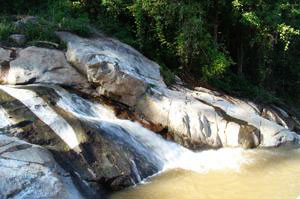
La Tomusor Waterfall in Yala Province is a natural waterfall on the Kalaw Mountains in Raman District. It is reached from the Kota Baru – Tha Ruea route, followed by an approximately 1.5 km walk from the roadside access point. The walking route passes an ancient durian orchard estimated to be around 300 years old, making this waterfall different from simple roadside stops. The area combines mountain scenery, fruit orchards, community forest, streams, and the agricultural landscape of Raman. It is suitable for visitors who enjoy quiet nature walks, waterfall photography, careful streamside relaxation, and a route combined with Kota Baru Old Town, Ban Kalo, Bukeh Pilo Waterfall, Wat Khuhaphimuk, Tham Sin Cave, and Yala city.
La Tomusor Waterfall is a small but meaningful natural attraction in Raman District, Yala Province. Its charm comes from a combination of waterfall scenery, mountain forest, orchard landscape, and a walking route that allows visitors to enter the area gradually rather than arriving directly by car. The waterfall is located on the Kalaw Mountains, a landscape associated with forested hills, local orchards, rubber plantations, streams, and communities in inland Yala.
The main experience begins at the access point on the Kota Baru – Tha Ruea road. From there, visitors walk about 1.5 km to reach the waterfall. This walking distance makes La Tomusor different from many roadside waterfalls. The route is short enough for visitors with normal walking ability, but it still requires preparation because the path may include moist soil, slopes, roots, stones, streamside sections, and slippery surfaces during or after rain.
A distinctive feature of the route is the ancient durian orchard, estimated to be around 300 years old. This detail gives the waterfall a strong sense of place. The journey is not only about reaching a stream but also about passing through an old agricultural landscape that reflects the long relationship between people, fruit trees, mountain soil, and local water sources in Raman District. Visitors should respect the orchard by not picking fruit, damaging trees, or entering private areas without permission.
The Kalaw Mountains form one of the important natural landscapes of Raman. The area contains forest, community-use land, orchards, and villages. Government forestry records identify parts of the broader Kalaw mountain area as national reserved forest landscape with patrol activity and forest-condition monitoring. This reinforces the environmental value of the area surrounding La Tomusor Waterfall and explains why visitors should treat the site as a sensitive natural setting.
La Tomusor Waterfall is not a large commercialized destination. Its value lies in quietness, local character, and the combination of stream, trees, rocks, and orchard route. Visitors who expect a major developed attraction with extensive facilities may find it simple, but those who enjoy slow travel, nature walking, and community landscapes will find the experience rewarding.
The name La Tomusor appears in public travel databases as the English name for น้ำตกลาตอมูซอ. Keeping the local name is important because place names in Raman often reflect Malay-local language, community identity, and inherited landscape memory. The waterfall is therefore more than a place to swim; it is also part of the cultural geography of Raman and the Kota Baru area.
The waterfall is suitable for a calm half-day trip from Yala city. Travelers can leave in the morning, drive toward Kota Baru, reach the access point, walk to the waterfall, spend time resting and taking photographs, and then continue to historical and cultural attractions nearby. This makes the trip more complete than visiting the waterfall alone.
The best time to visit is from morning to early afternoon. Daylight makes the walking route safer, allows more time for photography, and gives visitors enough time to return from the route before evening. Late visits are not recommended because natural trails become harder to read in low light, especially if rain begins or the ground becomes wet.
Seasonal conditions affect the experience. During the rainy months, the forest and stream are fresher and the waterfall may have stronger flow, but paths can be slippery and water levels can change quickly. During drier months, walking is usually easier, although the water volume may vary naturally. Weather should guide the decision to enter the route, especially when traveling with children or older visitors.
Water play should be limited to safe sections only. Visitors should choose shallow, calm, clear areas where the bottom can be seen. Jumping into pools, climbing wet rocks, crossing strong-flowing water, and entering the stream after heavy rain should be avoided. Children must be supervised closely at all times.
Photography at La Tomusor Waterfall is best approached slowly. Useful subjects include the walking route, ancient durian trees, stream rocks, forest shade, flowing water, natural pools, and the mountain atmosphere. The site is not defined by a dramatic cliff but by the small details along the trail. Waterproof protection for phones and cameras is useful because the area can be humid and wet.
The route to the waterfall passes through local community and agricultural areas, so visitors should use respectful travel behavior. Drive slowly on village roads, avoid blocking entrances, keep noise low, do not leave waste, and ask politely if directions are needed. Tourism should not create problems for residents or damage the orchard and stream environment.
La Tomusor Waterfall can be combined well with Kota Baru Old Town. Kota Baru is an important historical community in Raman, associated with the old Raman polity, former ruler’s residence, earthen wall remains, the Tomb of To Ni, and Malay-Muslim cultural memory. Combining the waterfall with Kota Baru gives travelers both nature and history in one route.
Ban Kalo is another useful nearby community to understand the area. It lies near Kota Baru and is associated with agriculture, local traditions, orchards, rubber plantations, and Malay cultural life. Visiting La Tomusor together with Ban Kalo helps travelers see Raman as a network of mountains, villages, orchards, and cultural routes rather than a single isolated attraction.
Bukeh Pilo Waterfall, also known as Tawan Ratsami Waterfall, is another natural site in Raman District that can be paired with La Tomusor. Bukeh Pilo is known for the golden-yellow appearance of underwater rocks when sunlight strikes the stream. A two-waterfall route gives visitors two different natural experiences: La Tomusor is defined by its walking route and ancient durian orchard, while Bukeh Pilo is defined by light, water, and rock color.
Wat Khuhaphimuk, also known as Wat Na Tham, and Tham Sin Cave are suitable cultural additions to the same wider itinerary. Wat Khuhaphimuk is an important Buddhist cave temple with ancient religious heritage, while Tham Sin Cave is known for old wall paintings. These sites help create a route that includes waterfall scenery, orchard landscape, old-town heritage, cave art, and religious history.
Food options are better planned around Raman, Kota Baru, and Yala city rather than at the waterfall itself. The waterfall area is natural and community-based, so full restaurant service should not be expected at all times. Travelers can find halal food, tea shops, local meals, cafés, and simple restaurants in Raman. Yala city provides a wider range of dining choices.
Most visitors should stay in Yala city for convenience. The city has more hotels, restaurants, fuel stations, shops, and transport options. From Yala city, La Tomusor Waterfall can be visited as a morning or afternoon trip, then combined with Kota Baru, Ban Kalo, Wat Khuhaphimuk, or Tham Sin Cave.
Useful items include non-slip footwear, drinking water, a change of clothes, towel, waterproof phone pouch, personal medicine, a trash bag, and some cash for local spending. During rainy weather, light rain protection is helpful. Visitors should avoid carrying heavy bags because the 1.5 km route may become harder on wet ground.
Main cautions include slippery natural paths, wet rocks, changing stream levels, and respect for orchard and village areas. Visitors should not split from the group, run on wet paths, climb mossy rocks, jump into unknown water, or leave food waste in the forest. If the water becomes muddy or the current increases, leave the stream immediately.
Getting There from Yala city: take the Yala – Kota Baru route for about 19 km, then continue toward the Kota Baru – Tha Ruea road to the waterfall access point. From the roadside access point, walk about 1.5 km to reach La Tomusor Waterfall, passing an ancient durian orchard estimated to be around 300 years old. A private car, rental car, or local hired vehicle is recommended. Travel during daylight and check weather conditions before entering the walking route.
Overall, La Tomusor Waterfall is a compact but distinctive nature destination in Yala Province. Its strongest identity comes from the Kalaw mountain setting, the 1.5 km walking route, the ancient durian orchard, the stream, and the quiet rural landscape of Raman. For travelers who prefer slow nature travel, local scenery, and a route that combines waterfalls with community heritage, La Tomusor Waterfall is a worthwhile stop near Yala city.
| Name | La Tomusor Waterfall |
| Thai Name | น้ำตกลาตอมูซอ |
| Location | Kalaw Mountains, Raman District, Yala Province, on the Kota Baru – Tha Ruea route |
| Address | Kalaw Mountain area, Ba Lo Subdistrict, Raman District, Yala 95140, Thailand |
| Highlights | Mountain waterfall, about 1.5 km walking route from the access point, and an ancient durian orchard estimated to be around 300 years old along the way |
| Distinctive Features | Natural waterfall in Raman’s mountain and orchard landscape, suitable for nature walking, resting, photography, and careful water play in safe sections |
| Importance | A nature attraction connected with the Kalaw Mountains, streams, ancient durian orchard, local agriculture, and the Raman – Kota Baru travel route |
| Area Context | The surrounding area includes mountains, community forest, rubber plantations, orchards, and Malay-local communities in Raman District |
| Travel Information | From Yala city, take the Yala – Kota Baru route for about 19 km, continue toward the Kota Baru – Tha Ruea road, then walk about 1.5 km from the access point to the waterfall |
| Current Status | Open as a natural attraction in Raman District, suitable for daytime nature walks and relaxation |
| Open Days | Daily |
| Opening Hours | 08.00 – 17.00 |
| Best Time To Visit | Morning to early afternoon, allowing enough daylight for the walking route and safe return |
| Facilities | Village-road access, walking route to the waterfall, stream area, natural resting points, and basic local services in nearby communities |
| Main Areas / Zones | Kota Baru – Tha Ruea roadside access point, 1.5 km walking route, ancient durian orchard, stream, rock area, natural pools, and the waterfall on the Kalaw Mountains |
| Caretaker / Coordinating Agency | Ba Lo Subdistrict Municipality, Raman District, Yala Province, and the local Kalaw mountain community |
| Main Contact Number | Ba Lo Subdistrict Municipality Tel. 0-7329-9523 |
| Website / Information Sources | LoveThailand.org, Princess Maha Chakri Sirindhorn Anthropology Centre community database, Forest Resource Management Office 13 Narathiwat Branch, Ministry of Culture database, and public travel databases |
| Nearby Tourist Attractions | 1. Ancient durian orchard on the waterfall walking route, about 1 km 2. Ban Kalo, about 8 km 3. Kota Baru Old Town, about 12 km 4. Tomb of To Ni and former Kota Baru ruler’s residence area, about 12 km 5. Bukeh Pilo or Tawan Ratsami Waterfall, about 15 km 6. Wat Khuhaphimuk or Wat Na Tham, about 25 km 7. Tham Sin Cave, about 27 km |
| Nearby Restaurants | 1. Cha Chak Kota BY DAH..U2T, about 12 km 2. Sami Junee Kitchen Raman, about 18 km 3. OWL CHA Yala Raman Branch, about 18 km, Tel. 098-729-4638 4. Fadel Food Raman, about 18 km, Tel. 096-212-1911 5. Krua Makan Islamic Food Raman, about 18 km, Tel. 084-720-0323 6. Ban Kabu, about 19 km |
| Nearby Accommodations | 1. @INN YRU Hotel, about 25 km, Tel. 062-182-2662 2. Park View Hotel Yala, about 25 km, Tel. 073-217001-5 3. Yala Rama Hotel, about 25 km, Tel. 073-212563, 073-212815, 073-212841 4. The Linux Garden Hotel Yala, about 26 km, Tel. 073-299-578 5. Yala My House Hotel, about 25 km, Tel. 073-221-236 6. Boonrapee Residence Yala, about 26 km, Tel. 099-489-9449 |
Frequently Asked Questions (FAQ)
Q: Where is La Tomusor Waterfall located?
A: La Tomusor Waterfall is located on the Kalaw Mountains in Raman District, Yala Province, along the Kota Baru – Tha Ruea route. Visitors walk about 1.5 km from the access point to reach the waterfall.
Q: What are the opening hours?
A: The waterfall is open daily from 08.00 to 17.00. Morning to early afternoon is the best time for the walking route and safe return.
Q: What makes La Tomusor Waterfall special?
A: Its main highlight is the 1.5 km walking route on the Kalaw Mountains, passing an ancient durian orchard estimated to be around 300 years old before reaching the natural waterfall.
Q: Who is La Tomusor Waterfall suitable for?
A: It is suitable for travelers who enjoy quiet nature walks, small waterfalls, old orchard landscapes, and community-based scenery in Raman District.
Q: Can visitors swim at La Tomusor Waterfall?
A: Water play is possible only in safe, shallow, calm sections where the bottom can be seen. Avoid entering the water after heavy rain or when the current is strong.
Q: How do travelers get to La Tomusor Waterfall?
A: From Yala city, take the Yala – Kota Baru route for about 19 km, continue toward the Kota Baru – Tha Ruea road, reach the access point, then walk about 1.5 km to the waterfall.
Q: What should visitors prepare before going?
A: Bring non-slip footwear, drinking water, a change of clothes, towel, waterproof phone pouch, personal medicine, a trash bag, and travel during daylight for safer access.
Q: What nearby attractions can be combined with the waterfall?
A: Good nearby options include Ban Kalo, Kota Baru Old Town, Tomb of To Ni, Bukeh Pilo Waterfall, Wat Khuhaphimuk, Tham Sin Cave, and Yala city.
 Category: ●Nature and Wildlife
 Group: ●Waterfalls
Last Update : 2 WeekAgo
 Last Update : 2 WeekAgo
 Art, Culture and Heritage
 Landmarks and Memorials(1)
 Art, Craft Centres, Tradition(2)
 Museums(2)
 Educational Places
 Educational Gardens, Farm(1)
 Places of Worship
 Temple(6)
 Mosque(2)
 Other Sacred Sites(3)
 Suburban Living
 Village, Community(4)
 National Parks and Marine Reserves(2)
 Mountain (Doi)(5)
 Dam, Reservoir, Lake(5)
Waterfalls(13)
Dam, Reservoir, Lake(5)
Waterfalls(13)
 Hot Springs(2)
 Caves(7)
 River, Canal(4)
 Islands(1)
 Other natural attractions(8)
 Entertainment and Agricultural
 Stadium(1)
 Farms, Parks and Ecotourism(4)
 Outdoor and Adventure Activities(1)
 Travel Articles, Recipes
 Travel Review, Food Review(2)


