
lovethailand home >South Travel Attractions >Yala Travel Attractions >Muang Yala >Sateng > Yala Provincial Central Mosque
TL;DR: Yala Provincial Central Mosque is located at Siroros Road, Ban Talat Kao, Sateng Subdistrict, Mueang Yala District, Yala Province, open Daily, hours 05:00 – 20:00.

Yala Provincial Central Mosque
Open Days: Daily
Opening Hours: 05:00 – 20:00
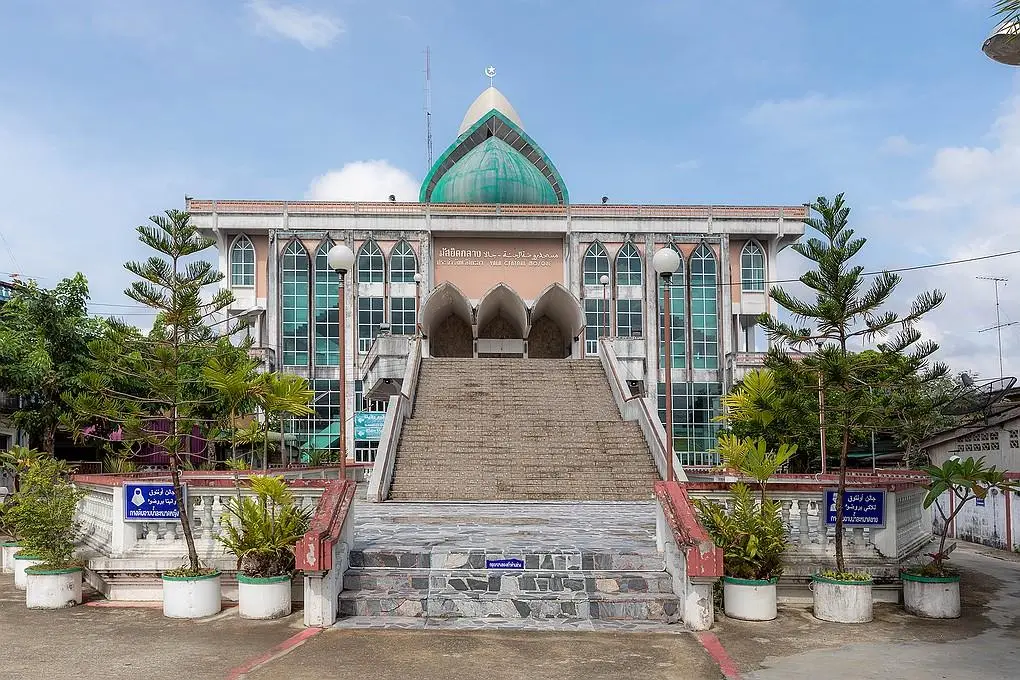
Yala Provincial Central Mosque, formally known as Masjid Raudhatul Jannah, is the main mosque of Yala Province. It is located at 835 Siroros Road, Ban Talat Kao, Sateng Subdistrict, Mueang Yala District, Yala Province. The mosque is one of the most important Islamic religious sites in Yala, with significance in religion, community life, architecture, and urban identity. Its large building, broad frontal staircase, square roofline, central dome, tall minaret, and arched façade make it one of the most recognizable landmarks in Yala city.
Yala Provincial Central Mosque is not only a place for photographs. It is a living mosque used continuously by the Muslim community of Yala. Daily prayers, Friday prayers, religious learning, weekly lectures, Ramadan activities, iftar gatherings, Eid observances, and community programs take place here. The mosque remains active because people come here not merely to see a building, but to worship, learn, meet, and maintain their religious and social bonds.
The mosque stands in the old market area on Siroros Road, one of the important urban roads in Yala. Siroros Road connects the railway station, commercial areas, hospitals, old communities, restaurants, and other city landmarks. This location gives the mosque strong urban meaning. It sits within the real daily life of the city, close to markets, food shops, community businesses, and local traffic. The mosque is therefore both a sacred place and part of the living rhythm of Yala’s old town.
The origin of Yala Provincial Central Mosque goes back to 1925, when Osman Doheh purchased a plot of land in Sateng Subdistrict, Mueang Yala District. The land measured about 250 square wah, and he expressed his intention that if anyone wished to build a mosque, he would donate the land for that purpose. After his death, his family and related community members worked to settle the land matter so the mosque could be built according to his intention. This beginning shows that the mosque grew from waqf, faith, and the dedication of property for the benefit of religion and community.
In the early period, Tok Guru Haji Awae Haji Tantu played an important role in preparing the site and beginning the construction of the mosque. In 1932, construction began as a one-storey wooden building with a tiled roof. In 1937, the ruler of Yaring supported the project by sending roof tiles, allowing the mosque building to be completed. This early story shows that the mosque did not arise only from state support. It grew through religious leadership, local cooperation, and community faith.
In 1954, Masjid Raudhatul Jannah was officially registered as a mosque under registration number 12. In 1956, government funding helped improve and expand the building so that it could accommodate more worshippers. This was an important transition. What began as a small mosque for a local community became a larger religious place serving an expanding urban Muslim population in Yala.
The major development of the present mosque building took place after state budget support for a new provincial central mosque building. From the late 1970s onward, funds were allocated to expand the site and build a new structure on the original mosque grounds. The present building is a large concrete mosque with multiple levels, generous usable space, and the capacity required for a provincial central mosque. It became both a religious institution and a symbol of Yala’s Muslim community.
The construction of the present central mosque was connected with broader development policy in Thailand’s southern border provinces. A state budget of 28,200,000 baht was used to build the mosque structure. The building can accommodate around 2,500 to 3,500 worshippers. Daily prayer times bring many worshippers, while Fridays and major religious occasions such as Eid al-Fitr and Eid al-Adha draw especially large numbers.
The mosque building is about 30 meters wide and 70 meters long, with a minaret about 38 meters high. One of its most distinctive features is the central dome. Instead of a simple closed lotus-bud shape, the dome is designed like an opening lotus, with visible petal-like forms. Clear glass near the top allows light to enter. This distinctive dome gives the mosque a strong architectural identity and makes it a visual landmark of Yala city.
The broad frontal staircase is another memorable feature. About 30 steps lead from the lower forecourt to the upper terrace and main entrance. When seen from the front, the staircase draws the eye upward toward the arched entrance, tall glass windows, central dome, and crescent finial. The composition creates a sense of dignity and calm, appropriate to a provincial central mosque.
The minaret is important both architecturally and religiously. Its height makes the mosque visible within the surrounding urban landscape, while the call to prayer gives the area a religious rhythm throughout the day. The mosque is therefore not only a structure seen from the street. It is also a space marked by sound, prayer time, and the daily practice of the Muslim community.
The mosque includes a main prayer hall, front forecourt, upper terrace, ablution areas, toilets, supporting buildings, reception areas, women’s facilities, a janazah washing facility, and spaces used for religious activities. Later improvements included marble flooring on several levels, additional supporting buildings, improved toilets, more ablution areas, a sign with lighting, and expanded exterior areas to receive the large number of people attending weekly Sunday religious lectures.
The second floor has also been used as a community radio space connected with the mosque. This gives the mosque an additional role in communication and public religious service. It helps share religious content, community information, and mosque activities beyond the physical building. In this way, the mosque serves not only worshippers inside the prayer hall but also the wider Muslim community.
Yala Provincial Central Mosque is managed by its mosque committee, with religious leaders and committee members overseeing worship, activities, facilities, maintenance, and coordination with local agencies. Recent public activity reports in 2026 identify Niming Nimudo as the imam of Yala Provincial Central Mosque and Hasan Patyabut as a member of the mosque committee. This confirms the mosque’s continuing active administration and current religious role.
Recent activities in 2026 confirm that the mosque remains a central religious and community institution. One important activity was the Ramadan relationship and iftar gathering, attended by the Yala governor, religious leaders, mosque committee members, local residents, and public institutions. Ramadan is a month of fasting, prayer, Quran recitation, charity, self-discipline, and community connection. The mosque becomes especially important during this period because it brings faith and social solidarity together.
The mosque also hosted a major cleaning and landscape-improvement activity before Ramadan in 2026. Public agencies, volunteers, religious leaders, and local residents joined the effort to prepare the mosque and its surroundings. Cleaning the mosque before Ramadan is more than building maintenance. It prepares both the physical space and the communal mind for a sacred month, reinforcing shared responsibility for a central religious site.
Every Sunday morning, Muslims from many areas come to the mosque for religious practice and learning. These Sunday gatherings give the mosque an educational role. People come to study Islamic teachings, learn religious obligations, listen to guidance, and strengthen moral understanding. In this sense, the mosque functions as a place of worship, a learning center, and a community classroom.
Friday is the busiest regular day because of Jumu’ah prayer. Worshippers gather to pray together and listen to the khutbah. Visitors who want to see the architecture should avoid disturbing prayer times, especially Friday midday. The mosque should always be approached first as an active sacred space and only second as a visitor destination.
Visitors should begin by viewing the mosque from the front courtyard, where the broad staircase, upper terrace, arched entrance, tall windows, central dome, minaret, and signboard can all be seen clearly. Anyone wishing to go closer to the prayer areas or take interior photographs should ask permission from mosque staff or worshippers. Men should wear modest clothing with sleeves and long trousers. Women should dress modestly with arms and legs covered and should cover the hair when entering or approaching prayer areas. Shoes must be removed before entering designated areas.
Yala Provincial Central Mosque is an excellent place to study Islamic architecture in southern Thailand. The building does not simply copy a Middle Eastern mosque. It combines Western-influenced building lines with Islamic elements such as the dome, minaret, arched openings, tall windows, and prayer spaces. This reflects Yala’s identity as a city shaped by Thai, Malay, Chinese, Islamic, and modern administrative influences.
Within Yala city, the mosque is one of the major landmarks, along with Yala Railway Station, Seri Market, the Clock Tower, Wat Mueang Yala, Wat Weluwan, Suan Khwan Mueang, and Chang Phueak Ceremonial Ground. Yala is known for its planned urban layout, and Siroros Road is one of the key routes within the city. A visit to the mosque therefore helps visitors understand religion, architecture, urban form, and community life at the same time.
The old market area around the mosque adds depth to the visit. After seeing the mosque building and its surroundings, visitors can continue to halal restaurants, tea shops, roti stalls, local food places, and commercial streets around Siroros Road. This connection between mosque, market, food, and community shows how religion and everyday life are closely linked in Yala.
Yala Provincial Central Mosque can be included in a cultural route through Yala city. A practical route can begin at the mosque in the morning or late morning, continue to Yala Railway Station, the old market, Phiphit Phakdi Road, Yala Learning Park, Yala City Pillar Shrine, Suan Khwan Mueang, Chang Phueak Ceremonial Ground, or Wat Khuha Phimuk. This route gives travelers a broad view of Islam, Buddhism, Chinese influence, urban planning, local food, and public spaces in Yala.
Getting There is straightforward from central Yala. The mosque is on Siroros Road in Ban Talat Kao, Sateng Subdistrict. From Yala Provincial Hall, travel along Siroros Road for about 2 kilometers. Train travelers can get off at Yala Railway Station and continue by local transport or a hired vehicle to the old market area. Visitors driving themselves should park only where it does not block mosque access or community traffic, especially on Fridays, Eid days, and major activity days.
The best time to view the building and take exterior photographs is in the morning or afternoon when the light is softer. The front courtyard and staircase provide the clearest view of the mosque’s proportions. During prayer times, visitors should prioritize silence and respect for worshippers. They should not walk in front of people praying, speak loudly, photograph people without permission, or enter restricted religious areas.
For families and young people, the mosque is a useful place to learn about Islam, architecture, and multicultural coexistence. Children can observe the dome, minaret, prayer areas, ablution facilities, Thai and Arabic signage, and etiquette for visiting an Islamic sacred place. Learning from the real site helps them understand that religion is not only a subject in books. It exists in buildings, sound, people, ritual time, and everyday community life.
Socially, Yala Provincial Central Mosque connects the Muslim community, religious leaders, government agencies, educational institutions, and local residents. Iftar gatherings, Ramadan preparation, religious lectures, Friday prayers, and major religious occasions make the mosque a place where faith and civic cooperation meet. It is a center of peace, cleanliness, knowledge, and community connection in Yala.
Compared with other key places in Yala, the mosque has a distinct role. Wat Khuha Phimuk represents ancient Buddhist heritage and cave worship. Yala City Pillar Shrine represents the city’s civic and spiritual center. Suan Khwan Mueang represents public recreation. Yala Provincial Central Mosque represents Islamic faith and Muslim community life in the city. A complete cultural trip through Yala should include religious sites, old markets, public parks, and community neighborhoods.
Visitors interested in history should understand the mosque through its development stages: Osman Doheh’s land donation intention, site preparation by religious leaders and local residents, the first wooden mosque, official registration as Masjid Raudhatul Jannah, expansion through government and public support, construction of the present concrete building, and later improvements to ablution areas, toilets, reception rooms, women’s facilities, janazah washing facilities, and lecture areas. The mosque is a community history written in architecture and use.
From a conservation perspective, the mosque should be treated as both an architectural and religious heritage site. Architecturally, it is valuable for its lotus-like dome, tall minaret, broad staircase, and position in the old urban area. Religiously, it is valuable because of daily prayers, Islamic learning, weekly lectures, community radio, Ramadan activities, and large gatherings. Preserving the mosque therefore means maintaining both the building and its living religious atmosphere.
In summary, Yala Provincial Central Mosque, or Masjid Raudhatul Jannah, is one of the most important Islamic landmarks in Yala. It has a broad 30-step staircase, a distinctive central dome, a 38-meter minaret, a large prayer capacity, and a long history rooted in local faith and community dedication. Today, it remains active through daily worship, Friday prayers, Ramadan programs, religious learning, iftar gatherings, mosque cleaning activities, and community cooperation. Travelers who want to understand Yala deeply should see this mosque as a center of faith, architecture, and Muslim community life in the southern border region.
| Name | Yala Provincial Central Mosque, Or Masjid Raudhatul Jannah |
| Location | Siroros Road, Ban Talat Kao, Sateng Subdistrict, Mueang Yala District, Yala Province |
| Address | 835 Siroros Road, Ban Talat Kao, Sateng Subdistrict, Mueang Yala District, Yala Province 95000, Thailand |
| Coordinates | 6.5664745805325, 101.29406701773 |
| Place Type | Provincial Central Mosque And Major Islamic Religious Site In Yala |
| Religious Name | Masjid Raudhatul Jannah |
| Mosque Registration Number | 12 |
| Highlights | Large provincial mosque building, broad 30-step staircase, distinctive lotus-like central dome, 38-meter minaret, and central role in Islamic religious life in Yala city. |
| History / Period | Originated from Osman Doheh’s land purchase in 1925, first built as a mosque in 1932, officially registered as Masjid Raudhatul Jannah in 1954, and developed into the present provincial central mosque building after the late 1970s. |
| Name Origin | Masjid Raudhatul Jannah is the original religious name. Yala Provincial Central Mosque reflects its role as the main mosque of Yala Province. |
| Key Early Figures | Osman Doheh, who purchased and dedicated the land; Tok Guru Haji Awae Haji Tantu, who helped prepare the site; and Haji Abdulhamid Abdulsomad, an early imam. |
| Imam | Niming Nimudo |
| Caretaker / Related Agencies | Yala Provincial Central Mosque Committee, Yala Provincial Islamic Committee Office, and Yala Muslim community. |
| Architecture | A three-storey concrete building, about 30 meters wide and 70 meters long, designed by architects of the Ministry of Education with a balanced combination of Western building lines and mosque-style framing. |
| Distinctive Features | Broad frontal staircase, lotus-like central dome, arched windows, tall glass panels, minaret, and upper terrace. |
| Approximate Capacity | Around 2,500 – 3,500 worshippers, with especially large numbers on Fridays and major Islamic religious days. |
| Main Areas / Zones | Front courtyard, main staircase, upper terrace, main prayer hall, minaret, ablution areas, men’s and women’s toilets, reception room, women’s facilities, janazah washing facility, community radio room, and religious activity areas. |
| Facilities | Prayer spaces, ablution areas, toilets, reception areas, activity courtyard, benches, shaded outdoor areas, and parking within or near the mosque area. |
| Open Days | Daily |
| Opening Hours | 05:00 – 20:00 |
| Admission Fee | Free general entry to visitor-accessible areas. |
| Contact Number | 073-214-592 |
| Main Activities | Daily prayers, Friday prayers, weekly Sunday religious lectures, Islamic learning, Ramadan activities, iftar gatherings, Eid observances, and mosque cleaning or preparation activities. |
| Visitor Etiquette | Dress modestly, speak quietly, remove shoes before entering designated areas, do not walk in front of people praying, do not photograph people without permission, and prioritize worshippers at all times. |
| Travel Information | From Yala Provincial Hall, travel along Siroros Road for about 2 kilometers. Train travelers can get off at Yala Railway Station and continue by hired vehicle or local transport to Siroros Road in the old market area. |
| Current Status | Still active as a central mosque for daily worship, Ramadan programs, iftar gatherings, religious lectures, and Muslim community activities in Yala city. |
| Nearby Tourist Attractions | 1. Yala Railway Station About 1 km 2. Old Market Area And Siroros Road About 1 km 3. Yala Learning Park About 1.5 km 4. Yala City Pillar Shrine About 2 km 5. Chang Phueak Ceremonial Ground About 2.5 km 6. Suan Khwan Mueang Yala About 3 km 7. Wat Khuha Phimuk About 10 km |
| Nearby Restaurants | 1. Roti-Ong Yala, Siroros Road About 100 m, Tel. 098-553-3151 2. Roti De Forest Talat Kao, Siroros Road About 300 m, Tel. 065-084-2972 3. Thai Islam Phochana, Siroros Road About 700 m, Tel. 080-549-2208 4. Khamprod Halal Siroros 6 About 800 m, Tel. 093-092-1765 5. Majong Soi 6 Talat Kao About 900 m, Tel. 084-507-1339 6. Laila Yala About 2 km, Tel. 091-646-6115 7. Melaya Restaurant About 2 km, Tel. 062-229-9095 |
| Nearby Accommodations | 1. Yala Grand Palace Hotel About 1 km, Tel. 073-215-711, 073-215-712 2. Yala Rama Hotel About 1.5 km, Tel. 073-221-990-2 3. Park View Yala Hotel About 2 km, Tel. 073-217-001-5 4. Nibong Resort About 2.5 km, Tel. 073-224-341, 099-312-5548 5. @INN YRU About 3 km, Tel. 062-182-2662 6. 999 Yala Hotel About 4 km, Tel. 073-222-630 7. Buri Sateng Hotel About 5 km, Tel. 096-642-9663 |
Frequently Asked Questions (FAQ)
Q: Where is Yala Provincial Central Mosque located?
A: Yala Provincial Central Mosque is located at 835 Siroros Road, Ban Talat Kao, Sateng Subdistrict, Mueang Yala District, Yala Province 95000, Thailand.
Q: What is the formal religious name of Yala Provincial Central Mosque?
A: Its formal religious name is Masjid Raudhatul Jannah, the original name used together with its role as Yala Provincial Central Mosque.
Q: Why is Yala Provincial Central Mosque important?
A: It is the main mosque of Yala Province and serves as a center for daily prayers, Friday prayers, religious learning, Ramadan activities, iftar gatherings, and Muslim community life in Yala city.
Q: What are the architectural highlights of Yala Provincial Central Mosque?
A: Highlights include its three-storey building, broad 30-step frontal staircase, lotus-like central dome, 38-meter minaret, arched windows, tall glass panels, and blended Western-Islamic architectural lines.
Q: What are the opening hours of Yala Provincial Central Mosque?
A: The mosque is open daily from 05:00 to 20:00.
Q: Is there an admission fee?
A: General entry to visitor-accessible areas is free. Visitors should respect prayer areas and follow mosque etiquette.
Q: What should visitors wear and do when visiting the mosque?
A: Visitors should dress modestly, speak quietly, remove shoes before entering designated areas, avoid walking in front of people praying, avoid photographing people without permission, and give priority to worshippers.
Q: What places can visitors see near Yala Provincial Central Mosque?
A: Nearby places include Yala Railway Station, the old market area, Yala Learning Park, Yala City Pillar Shrine, Chang Phueak Ceremonial Ground, Suan Khwan Mueang Yala, and Wat Khuha Phimuk.
 Category: ●Places of Worship
 Group: ●Mosque
Last Update : 2 WeekAgo
 Last Update : 2 WeekAgo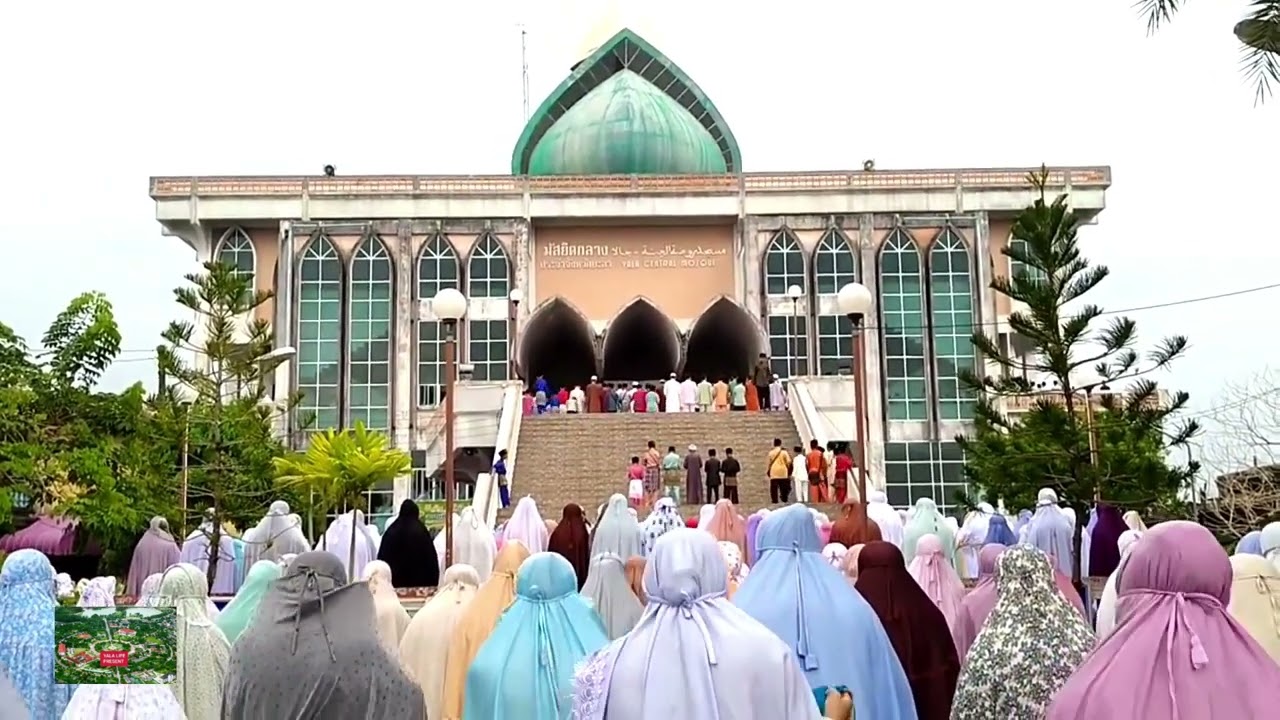
 Click to Access the Navigation Map GPS
Yala Provincial Central Mosque Map

 Art, Culture and Heritage
 Landmarks and Memorials(1)
 Art, Craft Centres, Tradition(2)
 Museums(2)
 Educational Places
 Educational Gardens, Farm(1)
 Temple(6)
Mosque(2)
Temple(6)
Mosque(2)
 Other Sacred Sites(3)
 Suburban Living
 Village, Community(4)
 Nature and Wildlife
 National Parks and Marine Reserves(2)
 Mountain (Doi)(5)
 Dam, Reservoir, Lake(5)
 Waterfalls(13)
 Hot Springs(2)
 Caves(7)
 River, Canal(4)
 Islands(1)
 Other natural attractions(8)
 Entertainment and Agricultural
 Stadium(1)
 Farms, Parks and Ecotourism(4)
 Outdoor and Adventure Activities(1)
 Travel Articles, Recipes
 Travel Review, Food Review(2)


