
lovethailand home >South Travel Attractions >Yala Travel Attractions >Muang Yala >Na Tham > Wat Khuha Phimuk (Wat Na Tham)
TL;DR: Wat Khuha Phimuk (Wat Na Tham) is located at Na Tham Subdistrict, Mueang Yala District, Yala Province, open Daily, hours 08:00 – 17:30.
Wat Khuha Phimuk (Wat Na Tham)
Open Days: Daily
Opening Hours: 08:00 – 17:30
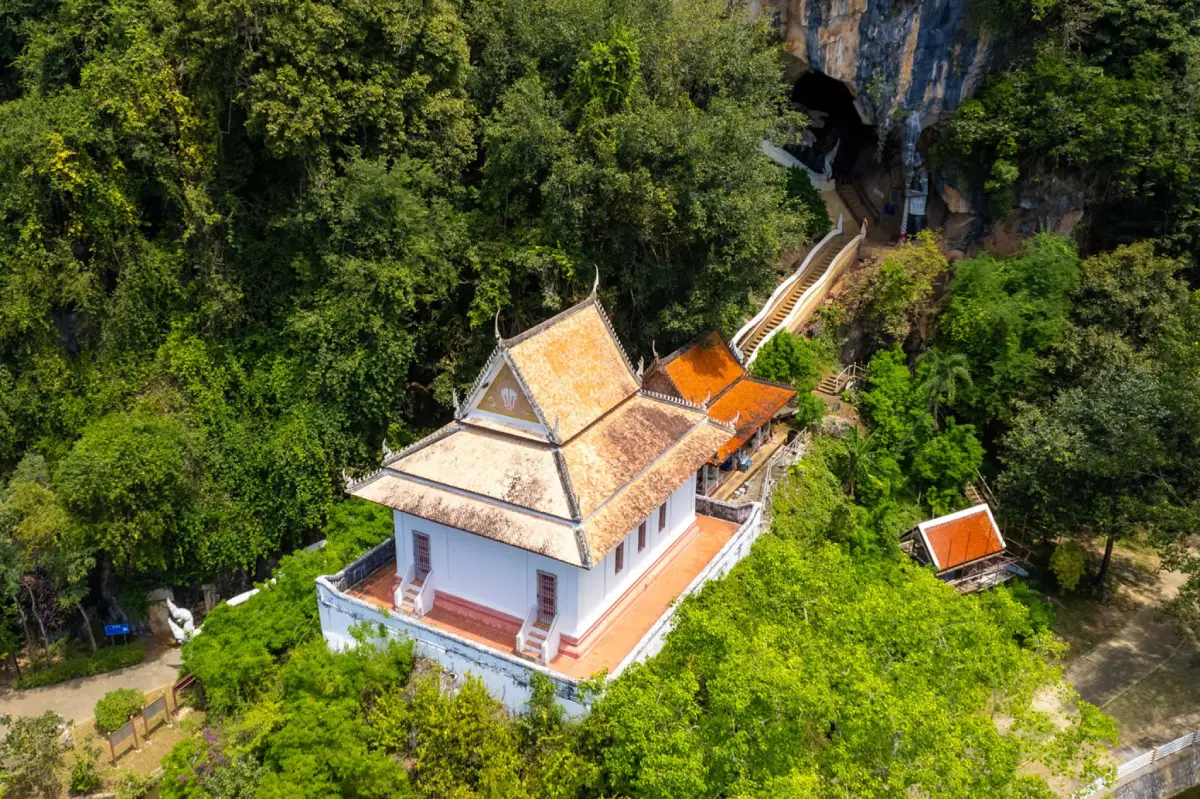
Wat Khuha Phimuk, also known as Wat Na Tham, in Yala Province is one of the most important Buddhist sacred sites in southern Thailand. The temple is located at 136 Moo 1, Ban Na Tham, Na Tham Subdistrict, Mueang Yala District, Yala Province, about 8 kilometers from Yala city on the route toward Yaha District. Its main attraction is a large cave that houses an ancient Reclining Buddha image. The temple also features the guardian giant statue known locally as Pho Than Chao Khao, the Srivijaya Cultural Hall, archaeological objects, limestone cave scenery, a stream, and a quiet temple setting surrounded by greenery. Wat Khuha Phimuk allows visitors to understand Yala beyond its border-town image, because the site preserves evidence of Buddhist history, local belief, southern craftsmanship, and community memory in one place.
Wat Khuha Phimuk is often described as one of the three major Buddhist sacred sites of the South, alongside Phra Borommathat in Nakhon Si Thammarat and Phra Borommathat Chaiya in Surat Thani. Its importance comes from its role as an old religious site that reflects the spread and prosperity of Buddhism in the southern peninsula during the Srivijaya period. Inside the cave, the ancient Reclining Buddha is the spiritual center for local residents, Yala Buddhists, and visitors from nearby areas. The cave hall is spacious, with a natural opening in the ceiling that allows sunlight to enter. When natural light falls onto the Buddha image and the cave walls, the result is a powerful scene where nature and religious art merge.
The temple was formerly known as Wat Na Tham, meaning the temple in front of the cave. The name directly reflects its geography, as the temple stands at the entrance area of a limestone cave. During the administration of Field Marshal Plaek Phibunsongkhram, the temple was renamed Wat Khuha Phimuk. The word khuha refers to a cave, while phimuk suggests the front or entrance area. The formal name therefore still preserves the meaning of the original location. Even today, many local people and travelers continue to call it Wat Na Tham because the old name remains closely tied to local memory and everyday speech.
The temple’s history is connected with the early development of Yala. Local records trace the story back to the period of King Mongkut, when Phraya Yaring was instructed to establish Yala and set up an administrative center at Ban Tha Sap. A temple was later built at the foot of the mountain near the cave. This location became linked with religious practice, limestone hills, cave worship, and old community routes. Because the temple stands beside a natural cave and mountain landscape, it became not only a place of Buddhist worship but also a historical learning site and a natural-cultural landmark for the people of Na Tham.
The most important sacred object inside the temple is the Reclining Buddha, known locally as Pho Than Banthom. The image is 81 feet and 1 inch long and is believed to date back to around 757 CE, during the period associated with Srivijaya influence. Local historical descriptions also explain that the image may once have been connected with the iconography of Narayana reclining on the cosmic ocean, as a naga hood appears near the head. It was later adapted into a Buddhist reclining image for worship. This makes the statue an important witness to cultural transformation, where older artistic ideas, local belief, and Buddhist devotion became part of the same sacred site.
Inside the cave, visitors enter a large hall-like space adapted for Buddhist worship while retaining the natural features of a limestone cave. The floor is used as the worship area, while the walls and ceiling show natural rock formations, stalactites, stalagmites, and openings where sunlight enters. The contrast between rugged natural stone and the monumental Buddha image gives the cave a distinctive spiritual atmosphere. Visitors do not simply see a large Buddha statue; they experience a sacred environment shaped by both natural geology and human faith.
On the stairway leading up to the cave stands the guardian giant statue known as Pho Than Chao Khao, or simply Chao Khao. It is one of the temple’s most recognizable symbols. The statue was built in 1941 during the Second World War period by Phra Phuttha Saiyarak, the seventh abbot of Wat Khuha Phimuk, together with community elders and local residents. It was created to strengthen morale and protect the people of Na Tham. The statue is about 6 meters high, standing upright while holding a club. Its dramatic face, clothing, and symbolic details reflect local imagination and southern folk craftsmanship, making it both a devotional object and a distinctive work of community art.
The belief surrounding Pho Than Chao Khao is an important part of Na Tham culture. Local people believe that the giant protects the cave and guards sacred objects from those with bad intentions. This belief should not be understood merely as a legend. It also functions as a cultural system that encourages people to respect the sacred area. Passing the statue before entering the cave is like crossing a symbolic threshold from ordinary space into a religious space. Visitors should keep their voices low, dress modestly, and behave respectfully throughout the temple grounds.
Wat Khuha Phimuk also houses the Srivijaya Cultural Hall, or Srivijaya Museum, which preserves ancient objects found at Wat Tham, Khao Kampan, and nearby areas. The collection includes clay votive tablets, fired-clay votive tablets, stone Buddha images, stupa fragments, brick bases of Buddha images, pottery, bronze images, and other archaeological evidence. These objects help explain the development of the Na Tham area from prehistoric settlement into the historical period. The cultural hall makes Wat Khuha Phimuk more than a place for worship; it is also a key learning site for understanding the history of Yala and the lower South.
The story of the Srivijaya Cultural Hall is meaningful in its own right. It grew from the effort of the temple and local community to gather archaeological objects that had been scattered across the area and keep them in one place for later generations. This preservation effort reflects the community’s awareness of the value of its own past. The objects are important not only because they are old, but because they show that Na Tham and Tha Sap were connected with wider cultural networks, religious exchange, and a long development of settlement in southern Thailand.
Wat Khuha Phimuk was registered as an ancient monument by the Fine Arts Department, with the announcement published in the Royal Gazette on 8 March 1935. This registration confirms the site’s value as an archaeological and artistic heritage site rather than only a local temple. Evidence found around Khao Wat Na Tham shows human use of the area from the prehistoric period to the early historical period. Finds include prehistoric pottery fragments, bronze stupas, votive tablets in Dvaravati-Srivijaya styles, and traces of wall art and carving in the cave environment. These details make the temple highly valuable for people interested in southern Thai archaeology.
Another important historical trace is the royal initials of King Prajadhipok, Rama VII, dated 1928 in the old calendar system, connected with his visit to Wat Khuha Phimuk with Queen Rambhai Barni. This evidence adds royal-historical significance to the temple. Later, in 1975, King Bhumibol Adulyadej, Queen Sirikit, and their two royal children visited the temple for the ceremony of raising the chofa finial of the ordination hall. These royal associations show that Wat Khuha Phimuk has been significant not only locally but also within broader Thai history.
The natural setting of Wat Khuha Phimuk is another major attraction. The temple is surrounded by limestone hills and cave formations. The grounds are shaded, and clear water flows through parts of the area. This makes the atmosphere different from many urban temples. Visitors can walk through the grounds, see the stream, climb the stairway toward the cave, and experience the cool quietness inside the cave hall. Nature here is not simply a background for photographs. It is part of the spiritual and cultural experience of the temple.
Main activities at Wat Khuha Phimuk include paying respect to the Reclining Buddha, visiting the Buddha cave, seeing Pho Than Chao Khao, observing stalactites and stalagmites, learning from the Srivijaya Cultural Hall, resting in the shaded temple area, and taking photographs respectfully. General access to the temple and the Buddha cave is free. The dark cave has a service fee of 20 baht. Visitors should wear comfortable walking shoes, be careful on damp or uneven surfaces, and watch their belongings, especially in areas where monkeys may be present.
Wat Khuha Phimuk remains an active center of Buddhist practice for the Na Tham community and Yala Buddhists. Regular and recent activities include Magha Puja programs, candlelight processions, meditation and religious practice, educational exhibitions for young people, Tak Bat Thewo, and the Chak Lak Ruea Phra procession during the end of Buddhist Lent. These activities show that the temple is not only an ancient site of the past. It is still a living temple where monks, local residents, students, government agencies, and the public continue to preserve Buddhist practice and local culture.
The current abbot of Wat Khuha Phimuk is Phra Khru Sitthi Punnyakom, also known as Chuladet Chullunako. His role is important because Wat Khuha Phimuk is simultaneously a working temple, an ancient monument, and a public learning site. The abbot must help maintain religious practice, coordinate community activities, care for the cave, the Reclining Buddha, the museum area, and the temple environment, and work with religious, cultural, and tourism-related agencies. The continued activity of the temple helps keep its significance alive in present-day Yala.
For visitors interested in Buddhist history in the South, Wat Khuha Phimuk deserves at least 1 to 2 hours. The site brings together Srivijaya-period Buddhist art, local belief, folk sculpture, archaeological evidence, natural cave scenery, and royal history. A quick visit may show only the Reclining Buddha and the guardian giant, but a slower visit reveals a much richer story. By reading signs, observing details, and connecting the site with the wider history of Yala, visitors can understand the temple as a living historical text written through mountain, cave, Buddha image, museum objects, and community memory.
What makes Wat Khuha Phimuk different from many cave temples is the layering of meanings. First, it is a Buddhist place of worship centered on the Reclining Buddha. Second, it is a natural attraction with caves, limestone formations, and a skylight. Third, it is an archaeological site with evidence from prehistoric and early historical periods. Fourth, it is a local museum that preserves objects found in the area. Fifth, it is a cultural space still used for Buddhist rituals and community activities today. These layers make the temple one of Yala’s most complete cultural destinations.
Khao Kampan, located near the temple area, adds another dimension to the story of Na Tham. It is associated with archaeological finds and is known for pink marble, one of Yala’s notable natural resources. The surrounding landscape of limestone hills, caves, marble, and ancient settlement traces helps explain why religious sites and local beliefs developed here. Visitors interested in geology and cultural landscapes can see how the physical environment influenced the creation of sacred spaces and the memory of the community.
Getting There from Yala city is straightforward. From the Yala City Pillar Shrine roundabout, take Highway 409 toward Yaha District and Na Tham Subdistrict for about 6.9 kilometers. Then turn left onto the road leading to Wat Khuha Phimuk and continue for about 500 meters, following the temple signs. The temple will be on the left. Traveling by private car is the most convenient option because visitors can combine the trip with Yala City Pillar Shrine, Suan Khwan Mueang, Chang Phueak Ceremonial Ground, and restaurants in the city. Travelers using public transport should reach central Yala first and then take local transport or a hired vehicle to Na Tham.
A good itinerary is to visit Wat Khuha Phimuk in the morning so there is enough time to see the cave without rushing. Morning and late-morning visits are especially suitable because natural light entering the cave can make the interior more impressive. After paying respect and walking through the temple grounds, visitors can return to Yala city for lunch or continue to Yala City Pillar Shrine, Suan Khwan Mueang, Yala Clock Tower Roundabout, or Suan Si Mueang. This route works well as a half-day cultural trip from central Yala.
Families with children can use Wat Khuha Phimuk as an educational visit. Children can learn about the Reclining Buddha, limestone caves, stalactites, stalagmites, the guardian giant, and ancient objects in the Srivijaya Cultural Hall. This kind of visit shows young people that history does not exist only in textbooks; it can be seen in real places. Useful questions include: why did people build a temple near a cave, why does the giant guard the entrance, why were ancient objects preserved here, and how did communities use sacred caves in the past?
Cultural travelers should visit Wat Khuha Phimuk respectfully. The temple is an active Buddhist site used by monks and local communities, not only a tourist attraction. Visitors should dress modestly, avoid loud noise inside the cave, avoid climbing on restricted areas, avoid touching ancient objects, and be considerate when taking photographs near people who are praying. Respectful behavior helps preserve the sacred atmosphere and allows the site to remain meaningful for both worshippers and travelers.
In Yala tourism, Wat Khuha Phimuk adds an important dimension to the province. Yala is not only Betong, sea mist, hot springs, or a well-planned city. It is also home to an ancient cave temple that shows the long presence of Buddhism in the lower South. Visiting this temple helps reveal Yala’s religious and cultural diversity. The province is home to Thai Buddhists, Thai Muslims, and Thai Chinese communities living together, and Wat Khuha Phimuk is one of the important landmarks of the Buddhist community within this multicultural setting.
There are a few local restaurants near the temple, especially Lae Pha Na Tham, which is known for southern Thai food and is located close to Wat Khuha Phimuk. More dining options are available in Yala city, including halal restaurants, tea shops, dim sum restaurants, Thai restaurants, and cafés. Families and travelers with elderly members should plan meals in advance because the Na Tham area has fewer restaurants than the city center. Returning to Yala city after the temple visit is convenient and offers a wider range of food choices.
Most travelers visiting Wat Khuha Phimuk should stay in Yala city for convenience. City hotels provide easier access to restaurants, fuel stations, shops, Yala Railway Station, Yala City Pillar Shrine, Suan Khwan Mueang, and other attractions. Staying in the city also makes it easier to continue to other districts such as Betong, Than To, or Kabang. Because distances between some attractions in Yala can take time, travelers should plan routes by district rather than trying to cover too many distant places in a single day.
Wat Khuha Phimuk is highly suitable for anyone who wants to understand southern Thai history through a real place. In one temple area, visitors can see Srivijaya influence, folk belief, local sculpture, royal history, archaeological conservation, and present-day community religious life. Every part of the temple tells a connected story: the stairway, the guardian giant, the Buddha cave, the dark cave, the Srivijaya Cultural Hall, the stream, and the limestone mountain. The temple is therefore much more than a place for a short photo stop.
Conservation is essential for Wat Khuha Phimuk because the site preserves both physical heritage and community memory. Physical preservation includes the cave, the Reclining Buddha, ancient objects, the guardian statue, and old buildings. Social preservation means helping younger generations understand the value of the temple and continue participating in Buddhist and cultural activities. When a community continues to use an ancient monument meaningfully, the place does not become a silent ruin. It remains a living learning space with relevance in the present.
Visitors should allow at least 1 hour for a basic visit to the Reclining Buddha and Pho Than Chao Khao. Those who want to read information, visit the Srivijaya Cultural Hall, observe the surroundings, and take photographs carefully should allow about 2 hours. Morning to early afternoon is recommended because the weather is more comfortable and the cave light is often more attractive. Visitors should bring drinking water, wear non-slip shoes, and dress respectfully for a religious site. During rain, extra care is needed on stairs and damp cave surfaces.
In summary, Wat Khuha Phimuk, or Wat Na Tham, is one of the most worthwhile places to include in a Yala city itinerary. It brings together religion, history, archaeology, nature, and living community culture. The ancient Srivijaya-related Reclining Buddha, Pho Than Chao Khao, the cave landscape, the Srivijaya Cultural Hall, archaeological objects, and ongoing Buddhist traditions make the temple one of the clearest expressions of Yala’s cultural depth. Travelers who want to know southern Thailand beyond beaches or border towns will find that Wat Khuha Phimuk tells the past, present, and spiritual identity of the area with rare completeness.
| Name | Wat Khuha Phimuk, Or Wat Na Tham |
| Location | Na Tham Subdistrict, Mueang Yala District, Yala Province |
| Address | 136 Moo 1, Ban Na Tham, Na Tham Subdistrict, Mueang Yala District, Yala Province 95000, Thailand |
| Coordinates | Approximately 6.5272, 101.2240 / Plus Code: G6GF+WHC, Na Tham, Mueang Yala District, Yala Province |
| Highlights | Large ancient Reclining Buddha inside a cave, natural cave hall, Pho Than Chao Khao guardian giant, Srivijaya Cultural Hall, and a shaded cave-temple atmosphere near Yala city. |
| History / Period | A major southern Buddhist sacred site associated with Srivijaya-period Buddhist influence and registered by the Fine Arts Department as an ancient monument on 8 March 1935. |
| Name Origin | Originally called Wat Na Tham because of its location in front of the cave. It was later renamed Wat Khuha Phimuk during the administration of Field Marshal Plaek Phibunsongkhram. |
| Distinctive Features | A cave temple combining Buddhist worship, ancient monument status, natural cave scenery, archaeological objects, folk belief, and living community rituals. |
| Reclining Buddha | A large ancient Reclining Buddha image, 81 feet and 1 inch long, housed inside the main cave and believed to date back to around 757 CE. |
| Important Sacred Objects | Pho Than Banthom, ancient Buddha images inside the cave, and Pho Than Chao Khao, the guardian giant statue built in 1941. |
| Main Areas / Zones | Temple courtyard, cave stairway, Pho Than Chao Khao statue, Reclining Buddha cave, dark cave, Srivijaya Cultural Hall, old ordination hall, stream area, and rest areas within the temple grounds. |
| Museum / Learning Site | The Srivijaya Cultural Hall preserves ancient objects from Wat Tham, Khao Kampan, and nearby areas, including clay votive tablets, stupa fragments, Buddha-image bases, stone Buddha images, pottery, and archaeological evidence. |
| Abbot | Phra Khru Sitthi Punnyakom (Chuladet Chullunako) |
| Caretaker / Related Agencies | Wat Khuha Phimuk, Fine Arts Department, and National Office of Buddhism |
| Open Days | Daily |
| Opening Hours | 08:00 – 17:30 |
| Admission Fee | General temple and Reclining Buddha cave access is free. The dark cave has a service fee of 20 baht. |
| Traditions / Regular Activities | Magha Puja activities, candlelight processions, meditation practice, youth exhibitions, Tak Bat Thewo, and the Chak Lak Ruea Phra procession during the end of Buddhist Lent. |
| Facilities | Temple courtyard, worship areas, rest areas, photo spots, cave stairway, museum area, and parking within the temple grounds. |
| Travel Information | From Yala City Pillar Shrine roundabout, take Highway 409 toward Yaha District and Na Tham for about 6.9 km, then turn left toward Wat Khuha Phimuk and continue for about 500 meters. |
| Current Status | Open to visitors and still active as a Buddhist temple, community religious site, and cultural learning destination. |
| Nearby Tourist Attractions | 1. Nang Montho Cave About 1 km 2. Suan Khwan Mueang Yala About 5.83 km 3. Yala City Pillar Shrine About 6.43 km 4. Chang Phueak Ceremonial Ground About 6.7 km 5. Yala Clock Tower Roundabout About 7.09 km 6. Suan Si Mueang About 7.19 km |
| Nearby Restaurants | 1. Lae Pha Na Tham About 1 km, Tel. 089-870-6410, 081-897-4471 2. Krua Lung Daeng Khuha Muk About 3 km, Tel. 083-256-1953 3. Morning kub Yala About 7 km, Tel. 087-477-6571, 086-291-5898, 082-731-1563 4. Khrua Isan Indy About 7 km, Tel. 093-321-7720, 098-013-8779 5. Yasmeen.Tea About 8 km, Tel. 088-799-9300, 073-222-300 6. FUSHKA Suan Khwan Mueang Yala About 8 km, Tel. 066-130-7178 |
| Nearby Accommodations | 1. Park View Yala Hotel About 7 km, Tel. 073-217-002 2. Yala Rama Hotel About 8 km 3. Yala Grand Palace Hotel About 8 km, Tel. 073-215-711, 073-215-712 4. @INN YRU About 9 km, Tel. 062-182-2662 5. The Linux Garden Hotel Yala About 9 km, Tel. 073-299-578 6. MinimalYala About 8 km |
Frequently Asked Questions (FAQ)
Q: Where is Wat Khuha Phimuk, or Wat Na Tham, located?
A: Wat Khuha Phimuk is located at 136 Moo 1, Ban Na Tham, Na Tham Subdistrict, Mueang Yala District, Yala Province, about 8 kilometers from Yala city.
Q: What is important about Wat Khuha Phimuk?
A: The temple is known for its large ancient Reclining Buddha inside a cave, Pho Than Chao Khao guardian giant, Srivijaya Cultural Hall, and its status as one of the South’s major Buddhist sacred sites.
Q: How large is the Reclining Buddha at Wat Khuha Phimuk?
A: The Reclining Buddha is 81 feet and 1 inch long. It is housed inside the main cave and is believed to date back to around 757 CE.
Q: What is Pho Than Chao Khao?
A: Pho Than Chao Khao is the guardian giant statue on the stairway leading to the cave. It was built in 1941 and is believed by local residents to protect the cave and Na Tham community.
Q: What are the opening days and hours of Wat Khuha Phimuk?
A: The temple is open daily from 08:00 to 17:30.
Q: Is there an admission fee at Wat Khuha Phimuk?
A: General access to the temple and the Reclining Buddha cave is free. The dark cave has a service fee of 20 baht.
Q: How do visitors get to Wat Khuha Phimuk?
A: From central Yala, take Highway 409 toward Yaha District and Na Tham Subdistrict, then turn left toward the temple and continue for about 500 meters following the signs.
Q: What Buddhist traditions or activities are held at Wat Khuha Phimuk?
A: Activities include Magha Puja observances, candlelight processions, meditation practice, youth exhibitions, Tak Bat Thewo, and the Chak Lak Ruea Phra procession during the end of Buddhist Lent.
 Category: ●Places of Worship
 Group: ●Temple
Last Update : 2 WeekAgo
 Last Update : 2 WeekAgo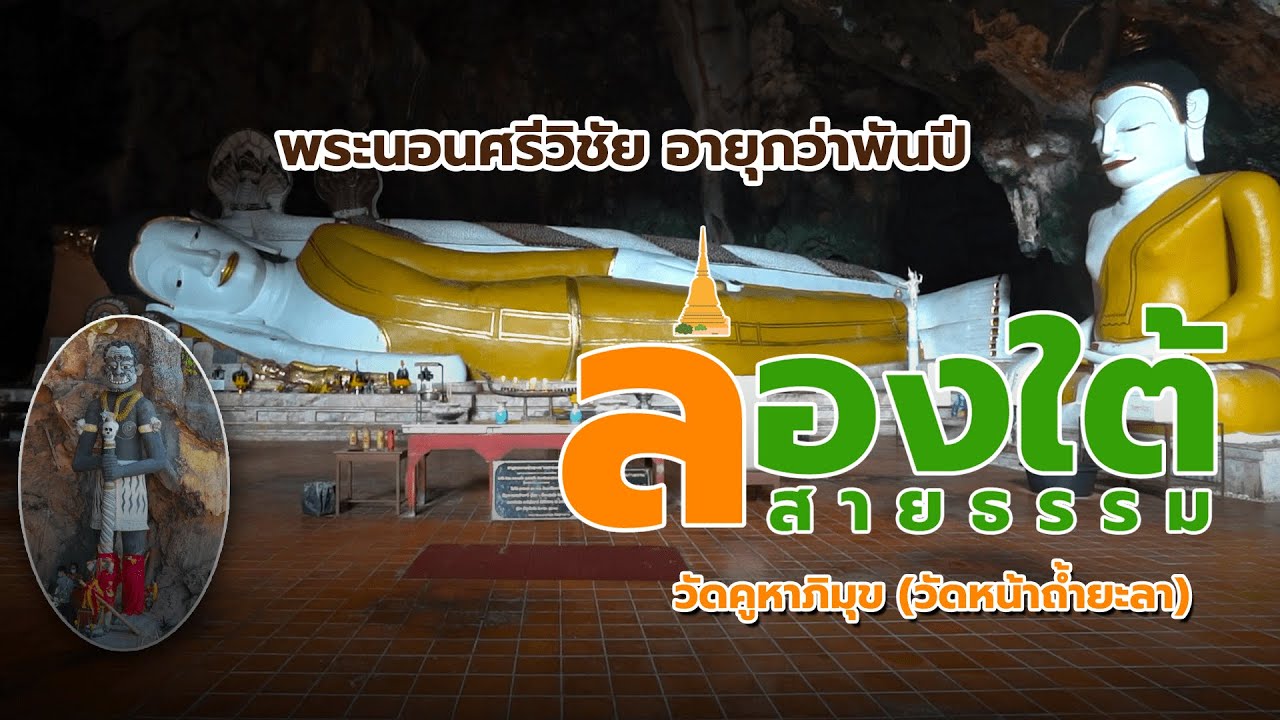
 Click to Access the Navigation Map GPS
Wat Khuha Phimuk (Wat Na Tham) Map

 Art, Culture and Heritage
 Landmarks and Memorials(1)
 Art, Craft Centres, Tradition(2)
 Museums(2)
 Educational Places
 Educational Gardens, Farm(1)
Temple(6)
Educational Gardens, Farm(1)
Temple(6)
 Mosque(2)
 Other Sacred Sites(3)
 Suburban Living
 Village, Community(4)
 Nature and Wildlife
 National Parks and Marine Reserves(2)
 Mountain (Doi)(5)
 Dam, Reservoir, Lake(5)
 Waterfalls(13)
 Hot Springs(2)
 Caves(7)
 River, Canal(4)
 Islands(1)
 Other natural attractions(8)
 Entertainment and Agricultural
 Stadium(1)
 Farms, Parks and Ecotourism(4)
 Outdoor and Adventure Activities(1)
 Travel Articles, Recipes
 Travel Review, Food Review(2)


