
lovethailand home >South Travel Attractions >Yala Travel Attractions >Muang Yala >Na Tham > Mae Nang Montho Cave
TL;DR: Mae Nang Montho Cave is located at Na Tham Subdistrict, Mueang Yala District, Yala Province 95000, Thailand, open Daily, hours Daytime visits are recommended; visitors should go with a local guide.

Mae Nang Montho Cave
Open Days: Daily
Opening Hours: Daytime visits are recommended; visitors should go with a local guide
Mae Nang Montho Cave in Yala is a distinctive natural cave attraction in Na Tham Subdistrict, Mueang Yala District, Yala Province. Located about 6 kilometers from Yala city, the cave is known for a large stalagmite at the far end of the cave that resembles a woman sitting in meditation. This striking natural formation is the origin of the name “Mae Nang Montho Cave.” Inside, the cave feels like a large natural hall with connected passages, some of which are very dark. Visitors should bring a flashlight, wear proper walking shoes, and enter with a local guide for safety.
Mae Nang Montho Cave is not a heavily developed show cave with lighting throughout the route. It is a natural limestone cave that requires preparation and care. Visitors reach the cave by walking uphill from the foothill area, passing scrub forest and a marble quarry area before reaching the cave entrance. The walk takes about 15 minutes. The route is not long, but it includes natural uphill terrain, so travelers should wear shoes with good grip, carry drinking water, and avoid entering the cave alone.
The cave is located in Na Tham Subdistrict, an area known for limestone hills and several cave-related attractions. The route follows the Yala–Yaha road and reaches the cave area about 1 kilometer before Wat Khuha Phimuk, also known as Wat Na Tham. This makes the cave easy to combine with other nearby cultural and natural sites, including Wat Khuha Phimuk, Tham Silp Cave, Khao Yala rock paintings, and attractions in Yala city. For travelers who want to see a more local and natural side of Yala, Mae Nang Montho Cave is a meaningful stop.
The interior of Mae Nang Montho Cave has a spacious hall-like form with several connected passages. Some parts are open enough to walk through comfortably, while other areas are very dark and require a reliable flashlight. Natural light reaches only limited parts of the cave, so visitors should not rely solely on a mobile phone light. A proper flashlight makes it easier to see the cave floor, wall surfaces, and the natural formations inside.
The beauty of Mae Nang Montho Cave comes from its limestone formations. Stalactites and stalagmites inside the cave were formed over a long period through mineral-rich water slowly depositing calcium carbonate. Some formations hang down from the ceiling, some rise from the floor, and others create shapes that look like natural sculptures. The most famous formation is the large stalagmite at the far end of the cave. Its shape resembles a woman sitting calmly in meditation, making it the visual symbol of Mae Nang Montho Cave.
The name “Mae Nang Montho” is connected with Nang Montho, an important female character in the Thai literary epic Ramakien. Local people associated the large stalagmite with the image of a seated woman, and the name became part of the cave’s identity. This gives the cave both natural and cultural meaning. It is not only a geological site but also a place where landscape, imagination, and Thai literary memory come together.
Visitors should arrange a local guide at the foothill before going up to the cave. The path to the entrance and the passages inside the cave can be confusing for first-time visitors. A local guide helps travelers identify the correct route, avoid unsafe areas, and find the main stalagmite formation at the end of the cave. This makes the visit safer and more informative, especially for visitors who are unfamiliar with cave trekking.
For photography, Mae Nang Montho Cave offers a different atmosphere from urban attractions in Yala. The low light, textured limestone, and unusual rock formations create dramatic scenes, but safety should come first. Visitors should not step backward without checking the ground, should not block narrow paths with equipment, and should not climb on or touch stalagmites and stalactites. These formations take a very long time to develop, and physical contact can damage their surfaces.
Mae Nang Montho Cave also helps visitors understand the landscape of Na Tham. Around Wat Khuha Phimuk and the nearby cave system, limestone hills, natural cavities, religious sites, and local communities are closely connected. This makes Na Tham one of the most interesting areas near Yala city for travelers who want to learn about both nature and culture. A visit to this cave gives a direct sense of how the local terrain shapes tourism, belief, and community life.
Although the cave is close to Yala city, visiting it requires more preparation than a simple city stop. Travelers who are uncomfortable in dark spaces, have difficulty walking uphill, or have mobility limitations should consider the conditions before going. Those who enjoy short nature walks and cave exploration will find the experience rewarding. The 15-minute walk allows visitors to pass through a quiet natural area before reaching the cave hall and its distinctive stalagmite formation.
Responsible behavior is essential inside the cave. Visitors should not enter without a guide, should not make unnecessary noise, should not write on the walls, should not touch or break rock formations, should not leave trash, and should not remove stones or natural objects from the cave. Stalactites and stalagmites grow very slowly. Protecting them is part of preserving the cave for future visitors and for the local community.
Getting There is easiest by private car, rental car, or a local driver familiar with Na Tham Subdistrict. From Yala city, take the Yala–Yaha road toward Na Tham. The cave area is located about 1 kilometer before Wat Khuha Phimuk. At the foothill, contact a local guide before walking uphill through scrub forest and the marble quarry area. The walk to the cave takes about 15 minutes. A morning or daytime visit is recommended so travelers have enough time to go up, explore the cave, and return safely.
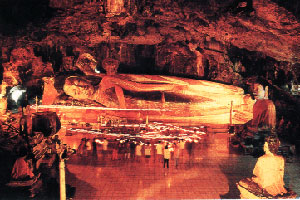
Mae Nang Montho Cave pairs well with Wat Khuha Phimuk because both places are on the same travel route. Wat Khuha Phimuk is an important religious site in Yala and is known for its cave setting and reclining Buddha. Mae Nang Montho Cave offers a more natural cave-trekking experience. Visiting both places gives travelers a fuller view of Na Tham as a landscape of caves, limestone hills, Buddhist heritage, and local community life.
Travelers with a full day can continue from Mae Nang Montho Cave to Tham Silp Cave, Khao Yala rock paintings, Suan Khwan Mueang Park, Yala City Pillar Shrine, Sanam Chang Phueak Park, and Yala Central Mosque. This route offers a balanced introduction to Yala through natural formations, religious landmarks, public parks, and urban identity. Yala is known for its cultural diversity, including Thai Buddhist, Thai Muslim, and Thai Chinese communities, and the cave route near Na Tham adds a strong natural dimension to that cultural experience.
The best time to visit is during daylight, especially in the morning or before late afternoon. Visitors should avoid going during heavy rain or close to dusk because the uphill path can become slippery and the interior of the cave is already dark. Good timing makes the visit safer and allows travelers to enjoy the cave without rushing.
Mae Nang Montho Cave is suitable for nature travelers, visitors interested in limestone landscapes, light adventure travelers, and people looking for a distinctive attraction near Yala city. Its strength is accessibility from the city combined with a genuine natural cave experience. The cave does not need large buildings or artificial effects to be memorable. Its quiet setting, uphill approach, dark interior, and meditating-woman-shaped stalagmite are enough to make it one of the notable cave attractions of Yala.
Families and groups should assess the physical condition of all travelers before entering. Children and older visitors should be closely supervised. Anyone with knee, ankle, or mobility concerns should be careful on the uphill path and inside the cave. A safe visit does not require going deep into every passage. Travelers should follow the local guide and visit only the areas suitable for their group.
Mae Nang Montho Cave shows how a natural place can carry both geological and cultural value. The limestone hill, short forest walk, dark cave chamber, natural rock formations, and name connected with Nang Montho from Thai literature all work together to create a clear identity. For travelers visiting Mueang Yala District, especially those already planning to see Wat Khuha Phimuk, this cave is a worthwhile addition to the itinerary.
In summary, Mae Nang Montho Cave is a meaningful destination for travelers who want to experience Yala beyond the city center. The cave offers a short uphill walk, a natural limestone interior, connected chambers, and a large stalagmite that gave the cave its name. Visitors should bring a flashlight, wear proper shoes, travel in daylight, and go with a local guide. With careful visiting, Mae Nang Montho Cave remains a distinctive natural and cultural landmark of Na Tham Subdistrict.
| Name | Mae Nang Montho Cave |
| Location | Na Tham Subdistrict, Mueang Yala District, Yala Province 95000, Thailand |
| Address | On the Yala–Yaha road, about 1 km before Wat Khuha Phimuk, Na Tham Subdistrict, Mueang Yala District, Yala Province |
| Coordinates | 6.529861, 101.233417 |
| Highlights | A large stalagmite at the far end of the cave shaped like a woman sitting in meditation, which gives the cave its name |
| History / Importance | A natural limestone cave in Na Tham, near Wat Khuha Phimuk, known for its distinctive stalagmite formation and local cultural association |
| Name Origin | The name comes from the large stalagmite resembling a meditating woman and is associated with Nang Montho from the Thai Ramakien epic |
| Distinctive Features | A spacious natural cave with connected passages; some areas are very dark and require a flashlight |
| Main Areas / Zones | Foothill guide contact area, uphill path through scrub forest and marble quarry area, large cave chamber, connected cave passages, and the far-end stalagmite formation |
| Travel Information | From Yala city, take the Yala–Yaha road toward Na Tham. The cave is about 1 km before Wat Khuha Phimuk. Contact a local guide at the foothill, then walk uphill for about 15 minutes through scrub forest and the marble quarry area |
| Current Status | Open as a natural cave attraction in Na Tham; visitors should enter with a local guide |
| Open Days | Daily |
| Opening Hours | Daytime visits are recommended; visitors should go with a local guide |
| Facilities | Road access reaches the foothill area; visitors then walk uphill. A flashlight, proper walking shoes, and drinking water are recommended |
| Caretaker / Guide | Local guides can be contacted at the foothill before walking up to the cave |
| Nearby Tourist Attractions | 1. Wat Khuha Phimuk, about 1 km 2. Tham Silp Cave, about 4 km 3. Khao Yala Rock Paintings, about 5 km 4. Suan Khwan Mueang Park, about 10 km, Tel. 073-223666 5. Yala City Pillar Shrine, about 10 km, Tel. 073-223666 6. Sanam Chang Phueak Park, about 10 km, Tel. 073-223666 |
| Nearby Restaurants | 1. Lae Pha Na Tham Restaurant, about 2 km, Tel. 089-870-6410 2. Krua Wahid, about 8 km, Tel. 085-628-5922 3. Bang Bee Khao Mok & Soup, about 9 km, Tel. 061-229-3212, 063-069-9560 4. Krua Kan Eng Yala, about 9 km, Tel. 082-801-5309, 093-061-4762, 063-675-4086 5. NAYU NESTA Tea Space, about 10 km, Tel. 065-096-5988, 062-993-9995 6. Dawaniz Siroros Branch, about 10 km, Tel. 092-479-9297 |
| Nearby Accommodations | 1. @INN YRU Hotel, about 8 km, Tel. 062-182-2662 2. Yala Park View Hotel, about 9 km, Tel. 073-217001-5 3. The Linux Garden Hotel, about 9 km, Tel. 073-299-578 4. Minimal@Yala, about 10 km, Tel. 097-220-0071 5. Yala Grand Palace Hotel, about 10 km, Tel. 073-215711, 073-215712 6. Yala Rama Hotel, about 10 km, Tel. 073-212563, 073-212815, 073-212841 |
Frequently Asked Questions (FAQ)
Q: Where is Mae Nang Montho Cave located?
A: Mae Nang Montho Cave is in Na Tham Subdistrict, Mueang Yala District, Yala Province, about 6 km from Yala city and about 1 km before Wat Khuha Phimuk.
Q: What is the main highlight of Mae Nang Montho Cave?
A: The main highlight is a large stalagmite at the far end of the cave shaped like a woman sitting in meditation, which gives the cave its name.
Q: Do visitors need a guide for Mae Nang Montho Cave?
A: Yes. Visitors should go with a local guide because the uphill path and some connected cave passages can be dark and confusing.
Q: What should visitors bring to Mae Nang Montho Cave?
A: Visitors should bring a flashlight, sturdy walking shoes, drinking water, and clothing suitable for uphill walking and dark cave conditions.
Q: How long does it take to walk to the cave?
A: The uphill walk from the foothill area to the cave takes about 15 minutes through scrub forest and the marble quarry area.
Q: Is Mae Nang Montho Cave suitable for children and older travelers?
A: It can be visited by children and older travelers with close supervision, but the group should assess fitness first because the route includes uphill walking and dark cave areas.
Q: What is the best time to visit Mae Nang Montho Cave?
A: Daytime is best, especially in the morning or before late afternoon, so visitors have enough time to climb up, explore, and return safely.
Q: What nearby places can be visited with Mae Nang Montho Cave?
A: Nearby places include Wat Khuha Phimuk, Tham Silp Cave, Khao Yala Rock Paintings, Suan Khwan Mueang Park, Yala City Pillar Shrine, and Sanam Chang Phueak Park.
 Category: ●Nature and Wildlife
 Group: ●Caves
Last Update : 2 WeekAgo
 Last Update : 2 WeekAgo
 Art, Culture and Heritage
 Landmarks and Memorials(1)
 Art, Craft Centres, Tradition(2)
 Museums(2)
 Educational Places
 Educational Gardens, Farm(1)
 Places of Worship
 Temple(6)
 Mosque(2)
 Other Sacred Sites(3)
 Suburban Living
 Village, Community(4)
 National Parks and Marine Reserves(2)
 Mountain (Doi)(5)
 Dam, Reservoir, Lake(5)
 Waterfalls(13)
 Hot Springs(2)
Caves(7)
Hot Springs(2)
Caves(7)
 River, Canal(4)
 Islands(1)
 Other natural attractions(8)
 Entertainment and Agricultural
 Stadium(1)
 Farms, Parks and Ecotourism(4)
 Outdoor and Adventure Activities(1)
 Travel Articles, Recipes
 Travel Review, Food Review(2)


