
lovethailand home >South Travel Attractions >Yala Travel Attractions >Be Tong >Be Tong > Suan Muen Buppha
TL;DR: Suan Muen Buppha is located at Piyamit 2 Village, Tano Maero Subdistrict, Betong District, Yala Province, open Daily, hours 08.00 – 17.30.

Suan Muen Buppha
Open Days: Daily
Opening Hours: 08.00 – 17.30
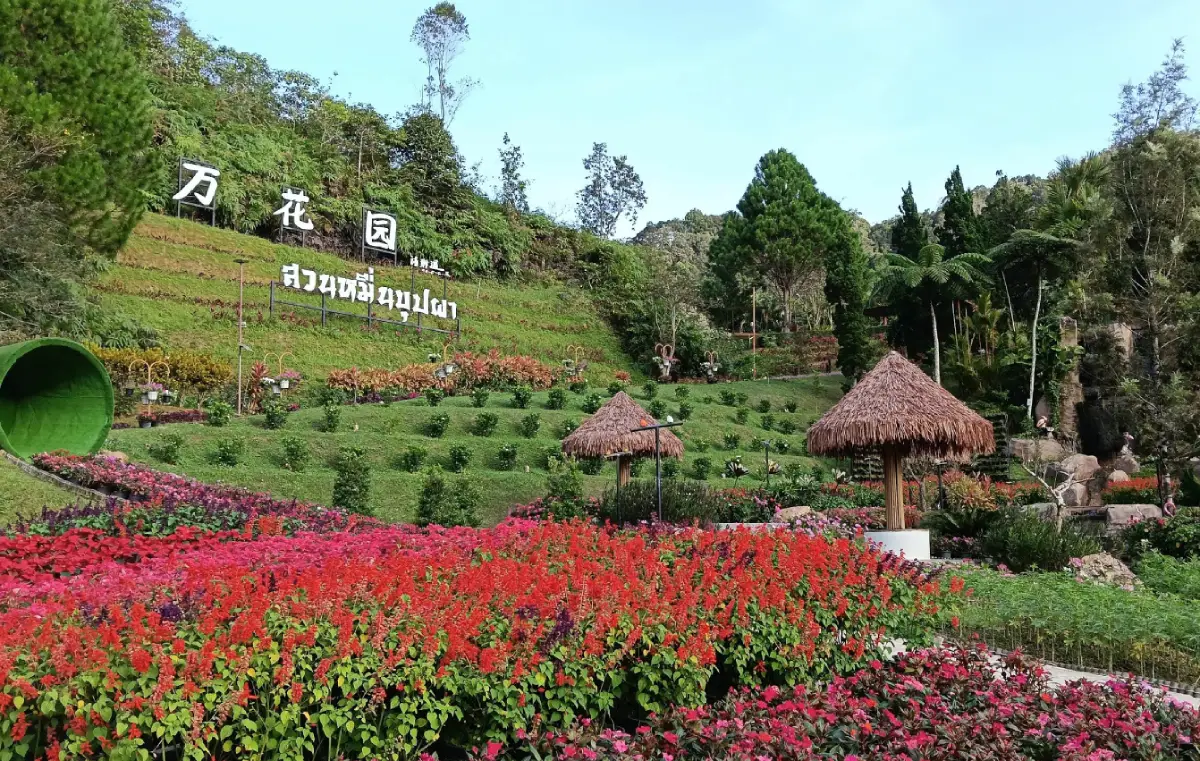
Suan Muen Buppha, also known as Betong Winter Flowers Garden, is one of the most distinctive attractions in Betong District, Yala Province. It is a cold-climate flower garden located in southern Thailand, a region usually associated with tropical weather, humid forest, border mountains, and southern cuisine rather than temperate blooms. The garden stands in Piyamit 2 Village, Tano Maero Subdistrict, Betong District, where the elevated mountain setting gives the area cooler air, suitable humidity, and enough water for many kinds of winter flowers. This makes the place unusual and memorable: visitors can walk among colorful flower beds on a mountain slope while still being in Thailand’s deep South.
The name Suan Muen Buppha means a garden of countless flowers. It is also associated with the Chinese name “Wan Fa Yuan,” a phrase that expresses the image of a garden filled with ten thousand flowers. The name matches the physical experience of the site. Flowers are planted in rows, displayed in open-air beds, arranged in greenhouse areas, and integrated into landscaped photo corners. The garden is not only a place for taking pictures. It is also an agricultural learning site, a community-based tourism destination, and a place where visitors can understand how Betong’s mountain climate supports plants rarely expected in southern Thailand.
The importance of Suan Muen Buppha comes from its connection with the Royal Initiative Winter Flower Project of Her Royal Highness Princess Maha Chakri Sirindhorn. The royal initiative began on 24 September 1994, encouraging trials of ornamental and flowering plants in highland areas of southern Thailand because of the region’s cool climate and development potential. Over time, the project introduced knowledge transfer, greenhouse production, flower propagation, crop improvement, and landscape development. What began as an agricultural livelihood project for a local mountain community gradually became one of Betong’s most recognized tourism attractions.
What makes the garden different from ordinary flower gardens is its context. Betong is a mountain border district surrounded by hills and forested areas. Some of its upland zones are around 800 m above sea level, giving them a cooler microclimate than many other parts of the South. This environment supports cold-climate flowers more often associated with northern Thailand, including chrysanthemums, roses, gerberas, gladiolus, lilies, hydrangeas, asters, peacock flowers, fuchsias, tulips, and many seasonal potted plants. The contrast between southern Thailand and winter flowers is the core appeal of the garden.
The garden is closely tied to Piyamit 2 Village. The village has a significant local history, as it was formerly associated with people who joined national development after earlier conflict periods. Today, the village remains an agricultural community with a distinct memory and identity. Farming is central to local livelihoods, and the winter flower project became another way to generate income, create skills, and connect the community with Betong’s tourism economy. For this reason, Suan Muen Buppha should not be understood only as a beautiful flower garden; it is also a story of community transition, agricultural knowledge, and local development.
Entering the garden feels like stepping into a mountain leisure area. The internal layout allows visitors to walk through flower beds, curved paths, rest pavilions, photo areas, landscaped slopes, and open viewpoints. Because the garden sits on hilly terrain, the flower displays are more layered than a flat garden. From lower angles, the rows of flowers climb upward with the land. From higher points, visitors can see colorful beds against the green background of the surrounding mountains. Morning visits often feel cooler and softer, while late afternoon light gives the flowers strong color without the harshness of midday sun.
The open-air flower beds are one of the main features. Flowers are arranged in rows and blocks of color, including yellow, red, pink, purple, white, and orange. Seasonal decorations, bridges, pavilions, sculptures, and photo structures add visual depth. These areas are best enjoyed slowly because the landscape changes with every viewpoint. A quick walk may produce a few photographs, but a slower visit reveals the relationship between planting patterns, slope, background mountains, and the design of the garden.
The greenhouse and production areas are also important. They show that the garden is not merely decorative. Some flowers require more controlled growing conditions, and greenhouse cultivation reflects the agricultural skill behind the displays. Lilies, chrysanthemums, roses, gerberas, gladiolus, and potted plants all require proper water management, light control, temperature awareness, pest management, pruning, and propagation knowledge. Seeing these areas helps visitors understand the practical work required to create the final visual beauty of the garden.
The garden receives special attention during tulip and lily festivals, often around the Chinese New Year and Valentine period. Tulips, lilies, and hydrangeas create a particularly strong image because many visitors do not expect to see these flowers blooming in southern Thailand. When they appear together in the cool air of Betong, the garden becomes colorful, romantic, and visually distinct from other Yala attractions. The exact display period depends on cultivation, weather, and the garden’s seasonal program, so visitors should check updated announcements before planning a trip focused on specific flowers.
Suan Muen Buppha also functions as a learning center for flower species and potted plants. The project has been described as a place where visitors can learn about dozens of chrysanthemum and potted-plant varieties, as well as related activities such as vegetable growing, fruit cultivation, fish raising, and community products. This variety makes the garden more valuable than a simple photo destination. It connects climate, mountain agriculture, community income, tourism services, and practical plant knowledge in one place.
The tram service helps make the garden accessible for more visitors, especially families with children, elderly travelers, and people who prefer not to walk long distances on sloping ground. A tram ride gives an overview of the flower beds, photo areas, and hilly landscape. Recent fee information indicates that some ticket categories include tram service, but prices and conditions may change during festivals or special events. Visitors should confirm details at the entrance or through the garden’s contact channel before traveling, especially in large groups.
Other facilities make the visit longer and more comfortable. The garden area includes food services, a café, local product sales, herbal product shops, rest areas, and accommodation. Some periods may include boat or paddle-boat style activities around landscaped water features. These elements allow the garden to support both short visits and longer stays. Travelers can stop for one hour to take photographs, or they can spend several hours enjoying the garden, food, cool air, and community atmosphere.
Food is an important part of the Betong experience, and Suan Muen Buppha fits naturally into a local food route. Betong is known for Betong chicken, kau yuk, stir-fried watercress, Betong noodles, dim sum, jee chong fun, Betong grass jelly, and flowing-water tilapia. Visitors can eat within the garden area or combine the visit with restaurants along the route back to town. In this sense, the garden is not isolated from Betong’s food culture. It can be part of a wider journey through mountain scenery, agriculture, and local cuisine.
Accommodation inside or near the garden allows visitors to experience the cool mountain atmosphere more fully. Recent local news reports mention many rooms available in the garden area. Staying nearby makes it easier to enjoy the morning air, light mist, quiet flower paths, and slow photography before day visitors arrive. This is suitable for travelers who prefer a relaxed itinerary rather than a fast day trip from the town center.
The best time to visit is usually in the morning. The air is cooler, the light is softer, and the garden atmosphere is more pleasant for walking and photography. Late afternoon can also be attractive, especially when combined with nearby places such as Betong Hot Spring and Piyamit Tunnel. Travelers who want to see tulips, lilies, or hydrangeas should follow the garden’s seasonal updates because flower displays depend on planting schedules, weather, and festival programming.
Basic preparation improves the visit. Comfortable walking shoes are useful because the garden includes paths, slopes, and outdoor areas. Visitors may want to bring drinking water, a hat, an umbrella, or rain protection depending on the weather. Even though Betong is cooler than many southern areas, midday sunlight can still be strong. During rainy periods, paths may become wet or slippery, so careful walking is necessary.
The garden suits many visitor types. Families can enjoy open space and accessible photo points. Elderly visitors can use the tram to reduce walking. Flower lovers can see plant varieties rarely found in the South. Photographers can frame flowers against mountain scenery. Students can learn about royal development projects, highland agriculture, and community-based tourism. First-time visitors to Betong can see a softer and more colorful side of the border town.
The deeper value of Suan Muen Buppha is that it shows how a community can use local strengths to create sustainable tourism. Betong has mountains, cool air, water resources, and farming knowledge. When these strengths were combined with technical support and the Royal Initiative, the village could move beyond ordinary agriculture into tourism, food service, accommodation, tram operation, community product sales, and educational activities. This turns the garden into a practical example of local economic development.
In landscape terms, the garden uses slope and mountain background effectively. Flower beds placed along different elevations create layered views. From below, the flowers rise with the hill. From above, visitors can see the colors spread across the terrain, with forest and mountain lines behind them. This makes the garden visually different from flat flower fields because the scenery feels more like a mountain garden shaped by both nature and design.
Travelers interested in agricultural tourism should look at the garden as a working learning space. Each flower bed represents choices about plant species, climate suitability, water systems, timing, and maintenance. The garden must manage bloom cycles for festivals, care for plants through changing weather, and maintain pathways and visitor areas at the same time. Understanding this background makes the visit more meaningful than simply taking pictures.
The garden is commonly combined with Piyamit Tunnel and Betong Hot Spring because all three are on a practical route from Betong town toward Tano Maero and Piyamit Village. Piyamit Tunnel offers history and forest walking. Betong Hot Spring offers mineral-water relaxation. Suan Muen Buppha offers flowers, mountain air, and community agriculture. Together, they form a strong half-day route that shows several dimensions of Betong in one trip.
A full-day itinerary can begin with breakfast or dim sum in Betong town, continue to Betong Hot Spring, then Piyamit Tunnel, and end at Suan Muen Buppha in the afternoon. Travelers focused on flower photography may prefer the opposite order: leave town early, visit the garden first, and then continue to the hot spring and tunnel. Those staying inside or near the garden can enjoy the quietest period in the morning before returning to the town center later in the day.
Travel from Betong town to Suan Muen Buppha follows the route toward Tano Maero Subdistrict and Piyamit 2 Village. The distance is about 19 km from the town center. The road is scenic but includes hills, curves, and some mountain sections, so careful driving is important, especially in rain or mist. Private cars are the most flexible option for travelers who want to combine several places, but local hired vehicles and tour services are also commonly used in Betong.
Getting There from Yala town to Betong usually involves a mountain road of about 140 km through Bannang Sata, Than To, and Aiyerweng before reaching Betong. From Betong town, continue toward Piyamit 2 Village in Tano Maero Subdistrict. The drive from Betong town to the garden usually takes around 30–45 minutes depending on road and traffic conditions. Travelers should allow extra time because the road includes curves and slopes, and the route is best combined with Betong Hot Spring, Piyamit Tunnel, or flowing-water tilapia restaurants along the way.
Recent fee information from local public-relations reporting lists Thai adult admission at 80 baht, Thai children and visitors aged 70 and above at 40 baht, free admission for disabled visitors, foreign adult admission at 120 baht, and foreign children and visitors aged 70 and above at 60 baht. The listed rates include tram service according to the latest information found. Because entrance fees and event conditions may change, visitors should verify current rates before arrival, particularly during festivals, holidays, and group visits.
Visitors should use the garden respectfully. Do not pick flowers, step into planted beds, move pots for photographs, litter, or disturb other visitors. When using the tram, board and exit only at appropriate points and supervise children closely. Flower gardens require time, labor, and maintenance, so responsible behavior directly helps preserve the attraction for future visitors and supports the local community that cares for it.
Overall, Suan Muen Buppha brings together the beauty of winter flowers, highland agriculture, Piyamit 2 community history, the Royal Initiative, and Betong tourism in one place. It shows that Betong is not only a town of mist, tunnels, hot springs, and local food. It is also a mountain flower destination where local knowledge and natural conditions have created something rare in southern Thailand. Visitors leave not only with colorful photographs, but also with a better understanding of how community, climate, and agriculture can become a meaningful travel experience.
| Name | Suan Muen Buppha / Betong Winter Flowers Garden |
| Location | Piyamit 2 Village, Tano Maero Subdistrict, Betong District, Yala Province |
| Address | Winter Flower Project, Piyamit 2 Village, Moo 2, Tano Maero Subdistrict, Betong District, Yala 95110, Thailand |
| Reference Coordinates | 5.88457, 101.02232 |
| Tourism Project Area | About 50 rai according to information on the renewed Suan Muen Buppha tourism area |
| Highlights | Southern Thailand’s distinctive winter flower garden with colorful hillside flower beds, greenhouse flowers, tram rides, restaurant, café, accommodation, and cool Betong mountain air |
| History / Importance | Part of the Royal Initiative Winter Flower Project, originating from the 24 September 1994 royal initiative to trial ornamental and flowering plants in cool highland areas of southern Thailand and support local livelihoods |
| Name Origin | The name Suan Muen Buppha means a garden of countless flowers and is associated with the Chinese name “Wan Fa Yuan” |
| Featured Flowers | Chrysanthemums, roses, gerberas, gladiolus, lilies, hydrangeas, asters, peacock flowers, fuchsias, tulips, and seasonal potted plants |
| Best Flower Season | Late year to early year is suitable for cool weather and winter flowers; tulips, lilies, and hydrangeas are often highlighted around Chinese New Year and Valentine seasonal displays |
| Travel Information | From Betong town, travel toward Tano Maero Subdistrict and Piyamit 2 Village, about 19 km away. The route is the same direction as Betong Hot Spring and Piyamit Tunnel. From Yala town to Betong, the road distance is about 140 km. |
| Current Status | Open as an agricultural tourism attraction, winter flower garden, restaurant, café, accommodation area, and community activity space of Piyamit 2 Village |
| Open Days | Daily |
| Opening Hours | 08.00 – 17.30 |
| Fees | Thai adults 80 baht; Thai children and visitors aged 70 and above 40 baht; disabled visitors free; foreign adults 120 baht; foreign children and visitors aged 70 and above 60 baht. The latest information found states that these rates include tram service. |
| Facilities | Tram service, restaurant, café, accommodation, photo spots, rest pavilions, garden paths, local product shops, and herbal product sales |
| Main Areas / Zones | Open-air flower beds, greenhouse flowers, potted plant areas, Wan Fa Yuan photo zone, tram route, Suan Muen Buppha restaurant, café, accommodation zone, and Winter Flower Project learning area |
| Caretaker / Manager Found | Piyamit 2 Winter Flower Project / Garden manager appearing in recent local news: Mr. Tohong Sae Li |
| Main Contact Number | Piyamit 2 Winter Flower Garden Community, Tel. 095-438-8153 |
| Nearby Tourist Attractions | 1. Piyamit Tunnel, about 3 km 2. Betong Hot Spring, about 9 km 3. Betong Grass Jelly Km.4, about 15 km 4. Betong City Museum, about 19 km 5. Betong Mongkhonrit Tunnel, about 19 km 6. Betong Clock Tower And Giant Mailbox, about 19 km 7. Southernmost Point Of Thailand, about 26 km |
| Nearby Restaurants | 1. Suan Muen Buppha Restaurant, about 0 m 2. Ko Ngiu Flowing-Water Tilapia Restaurant, about 8 km, Tel. 095-094-6153 3. Ban Khun Chai Betong, about 19 km, Tel. 084-692-8074 4. Thai Si Hee Dim Sum, about 19 km, Tel. 073-230-459 5. Baiyok Restaurant, about 19 km, Tel. 086-964-4692 6. Charoen Betong Chicken Rice, about 19 km, Tel. 084-015-2058 7. The Tunnel, about 19 km, Tel. 073-234-565 |
| Nearby Accommodations | 1. Suan Muen Buppha / Piyamit 2 Winter Flower Garden Community Accommodation, about 0 m, Tel. 095-438-8153 2. Grand Mandarin Betong Hotel, about 19 km, Tel. 077-323-333, 073-235-777 3. Betong Merlin Hotel, about 19 km, Tel. 073-230-222 4. Garden View Betong Hotel, about 19 km, Tel. 073-235881-4, 086-488-7190 5. Grandview Landmark Betong Hotel, about 19 km, Tel. 073-245-510 6. Butterfly Princess Betong Hotel, about 20 km, Tel. 073-230-888, 081-963-8276 |
Frequently Asked Questions (FAQ)
Q: Where Is Suan Muen Buppha Located?
A: Suan Muen Buppha, or Betong Winter Flowers Garden, is located in Piyamit 2 Village, Moo 2, Tano Maero Subdistrict, Betong District, Yala Province, about 19 km from Betong town.
Q: What Is The Main Highlight Of Suan Muen Buppha?
A: The main highlight is its status as a distinctive winter flower garden in southern Thailand, with colorful hillside flower beds, greenhouse flowers, tram rides, food services, accommodation, and cool Betong mountain air.
Q: How Is Suan Muen Buppha Connected With The Royal Initiative?
A: The garden is part of the Royal Initiative Winter Flower Project, which began with the idea of trialing ornamental and flowering plants in cool highland areas of southern Thailand to support local livelihoods.
Q: What Are The Opening Days And Hours?
A: The garden is open daily from 08.00 to 17.30. Morning is generally the most comfortable time for walking and photography.
Q: How Much Is The Entrance Fee?
A: The latest fee information found lists Thai adults at 80 baht, Thai children and visitors aged 70 and above at 40 baht, disabled visitors free, foreign adults at 120 baht, and foreign children and visitors aged 70 and above at 60 baht. The listed rates include tram service according to the latest information found.
Q: What Flowers Can Visitors See?
A: Visitors can see seasonal flowers such as chrysanthemums, roses, gerberas, gladiolus, lilies, hydrangeas, asters, peacock flowers, fuchsias, tulips, and various potted plants depending on the season.
Q: Can Visitors Stay Overnight At The Garden?
A: Yes. Accommodation is available through the garden or the Piyamit 2 Winter Flower Garden Community. Visitors should contact the garden in advance to confirm room availability and current conditions.
Q: What Nearby Places Can Be Combined With Suan Muen Buppha?
A: Nearby and connected places include Piyamit Tunnel, Betong Hot Spring, Betong Grass Jelly Km.4, Betong City Museum, Betong Mongkhonrit Tunnel, Betong Clock Tower, the Giant Mailbox, and the southernmost point of Thailand.
 Category: ●Entertainment and Agricultural
 Group: ●Farms, Parks and Ecotourism
Last Update : 1 WeekAgo
 Last Update : 1 WeekAgo
 Click to Access the Navigation Map GPS
 Art, Culture and Heritage
 Landmarks and Memorials(1)
 Art, Craft Centres, Tradition(2)
 Museums(2)
 Educational Places
 Educational Gardens, Farm(1)
 Places of Worship
 Temple(6)
 Mosque(2)
 Other Sacred Sites(3)
 Suburban Living
 Village, Community(4)
 Nature and Wildlife
 National Parks and Marine Reserves(2)
 Mountain (Doi)(5)
 Dam, Reservoir, Lake(5)
 Waterfalls(13)
 Hot Springs(2)
 Caves(7)
 River, Canal(4)
 Islands(1)
 Other natural attractions(8)
 Stadium(1)
Farms, Parks and Ecotourism(4)
Stadium(1)
Farms, Parks and Ecotourism(4)
 Outdoor and Adventure Activities(1)
 Travel Articles, Recipes
 Travel Review, Food Review(2)


