
lovethailand home >South Travel Attractions >Trang Travel Attractions >Muang Trang >Na Ta Luang > Khao Sam Bat Cave
TL;DR: Khao Sam Bat Cave is located at Moo 4, Na Ta Luang Subdistrict, Mueang Trang District, Trang Province, open Daily, hours 08.00 – 17.00.
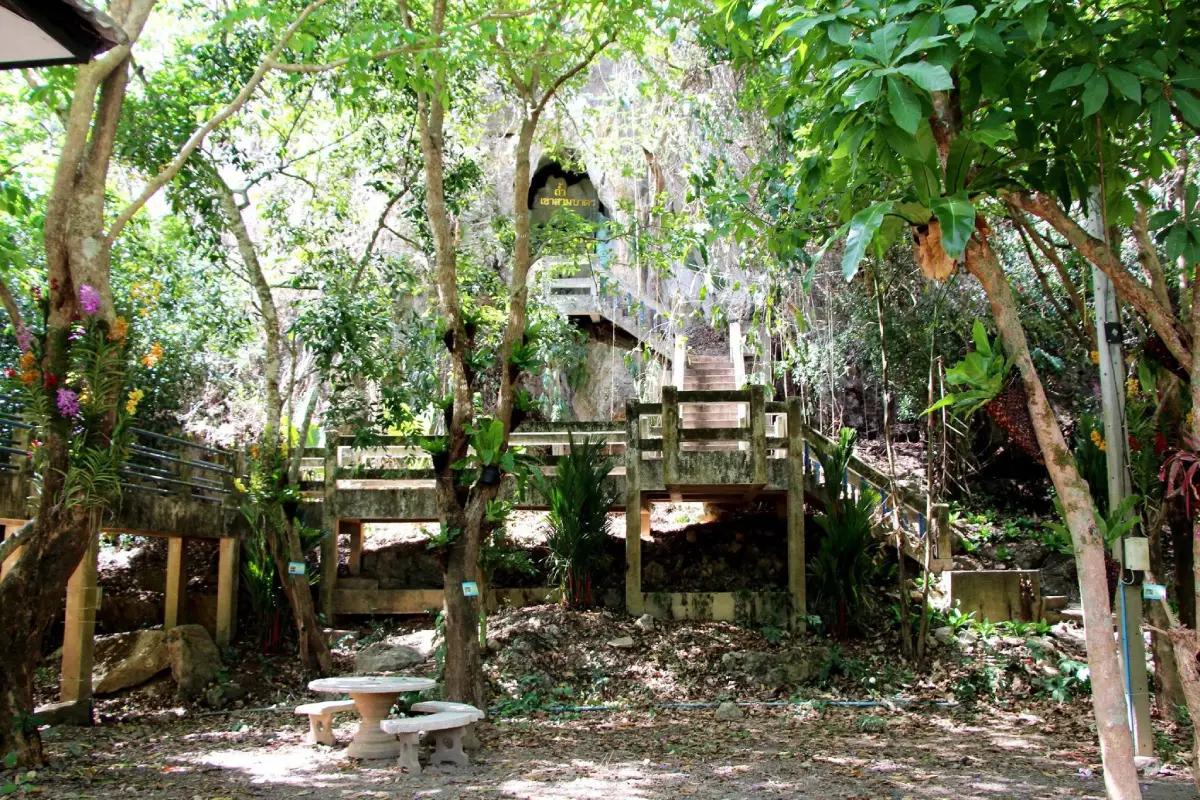
Khao Sam Bat Cave
Open Days: Daily
Opening Hours: 08.00 – 17.00
Khao Sam Bat Cave in Trang Province is an important archaeological and historical learning site in Moo 4, Na Ta Luang Subdistrict, Mueang Trang District. It sits on a small isolated limestone hill near the Trang River and Wat Phrai Son, about 5 km from Trang city. Inside the cave are prehistoric and historic-period remains, including a red painting resembling 3 connected hills, cord-marked pottery fragments, stone tools, polished stone axes, shells, shell beads, and a red Thai inscription from the Ayutthaya period recording the restoration of a Buddha image in 2157 BE. The cave is suitable for travelers interested in archaeology, local history, limestone caves, geology, and the old riverside communities of Trang.
Khao Sam Bat Cave is one of Trang Province’s most meaningful historical and archaeological sites. It is located in Moo 4, Na Ta Luang Subdistrict, Mueang Trang District, on a small limestone hill in the Ban Pa Mak and U-Taphao community area. The cave lies close to the Trang River and Wat Phrai Son. Its value goes beyond natural cave scenery. The cave preserves evidence from several periods of human use, including prehistoric occupation traces, ancient tools, pottery, red cave painting, and an Ayutthaya-period Thai inscription that helps explain the historical landscape of the Trang River basin.
The cave is close to Trang city. From central Trang, travel about 5 km northeast toward Na Ta Luang Subdistrict and the limestone hill known as Khao Sam Bat. The hill is situated within the monastic land of Wat Phrai Son in Moo 4. This short distance makes the site easy to include in a half-day city-based itinerary. Travelers can visit the cave in the morning and continue to Trang old town, Trang Railway Station, the clock tower, local restaurants, or nearby cultural sites in the same day.
The name “Khao Sam Bat” is tied to a local treasure legend. Local stories say that 3 monks’ alms bowls of treasure were hidden inside the cave, along with a cryptic riddle. The story continues that a high-ranking person once came on an elephant, solved the riddle, and took the treasure away. Whether read as folklore or memory, the legend gives the cave a strong local identity. It also shows how geography, belief, and oral tradition shape the way communities remember places.
The name is also linked with older forms such as “Khao Sam Bat,” “Khao Sa Bap,” and “Khao Sa Baap.” Local explanations connect the older name with a pool or water area inside the cave that villagers called “Sa Nam” or “Sa Bap.” The word “Sa” may relate to washing or cleansing, so Khao Sa Bap has sometimes been interpreted as a place of ritual cleansing. Over time, the name shifted in sound and meaning until it became Khao Sam Bat. This layered naming history makes the cave more than a physical site; it is also a record of local language and belief.
Geologically, Khao Sam Bat is a small isolated limestone hill on the Trang River plain, east of the river. The cave was formed by rainwater and underground water dissolving limestone over time. Some parts of the cave are now dry, while other parts still show traces of underground water activity. This combination of dry cave and water cave sections makes Khao Sam Bat a useful example of limestone cave formation in the Trang River basin.
The general form of the cave is compact but important. The cave mouth is about 4 meters wide and sits around 3–5 meters above ground level. The entrance route is steep. The ceiling is dome-like, and both sides of the cave wall contain small recesses and narrow pockets. The interior is cool, with some natural light entering certain sections, especially the area known as Tham Phra. Even so, visitors should walk carefully because parts of the cave floor slope downward, narrow passages occur inside, and some surfaces may be damp.
Khao Sam Bat Cave is divided into 4 main sections: the front cave, Tham Sao Phum, Tham Phra, and Tham Nam. The front section begins at the cave mouth and extends about 4 meters inward before the floor starts sloping downward. Tham Sao Phum begins around the sloping area and extends to a natural column formed by cave deposits, locally called Sao Phum. Tham Phra continues from that column toward the rear southern opening; it was named because a plaster Buddha image once stood there. Tham Nam branches from Tham Phra through a narrow passage about 3 meters long and has another exit to the north, about 17 meters above ground level.
The prehistoric evidence inside Khao Sam Bat Cave is highly significant. The most visible item is a red painting shaped like 3 connected hills, located on the left-side wall about 3 meters from the cave entrance in the front section. The painting is about 1.5 meters above the cave floor. It is an important symbolic trace of past human presence and helps establish the cave as more than a scenic natural shelter.
Other prehistoric evidence includes cord-marked pottery fragments with coarse red and black clay, tripod-pottery forms, flared-rim vessels, shallow bowls, stone tools, polished stone axes, stone hammers, shells, animal-bone fragments, turtle shell, freshwater shells, and shell beads. These finds suggest that the cave was suitable for human use because it was not too high, had dry usable space, and was located near water. The nearby river environment would have supported daily use, food resources, and movement between communities in the same basin.
The most important historic-period evidence is the wall inscription. It is written in red Thai letters on a white ground and is located in the front cave section about 3 meters above the floor. The inscription records a Buddhist community, including monks, novices, officials, local administrators, and laypeople, who restored a damaged Buddha image inside the cave and celebrated the merit. The inscription gives the year 2157 BE, placing the cave within the religious life of an Ayutthaya-period community.
Prince Narisara Nuwattiwong visited and examined the cave in 2445 BE and recorded the presence of writing on the cave wall. He identified the script as Ayutthaya-period Thai writing comparable with examples at Wat Pa Mok. In 2519 BE, Wanayut Na Wilat from Fine Arts Unit 9 surveyed the cave and reported Thai writing on the wall. In 2523 BE, an archaeological survey team from the Fine Arts Department reported Ayutthaya-period Thai inscription evidence together with prehistoric remains such as pottery and stone tools.
In 2533 BE, the Environmental Conservation Club of Saparachinee School in Trang conducted further exploration. The group reported that both prehistoric and historic-period evidence appeared together in the cave. They also recorded a newly found red painting shaped like 3 connected hills on a cave-wall recess. These repeated surveys make Khao Sam Bat Cave a dense archaeological site, not just a local cave attraction.
The Ayutthaya inscription is important not only because it mentions the restoration of a Buddha image. It also places Na Ta Luang and the Trang River basin within a wider historical landscape. Several historical references treat the Khao Sam Bat or Khao Sa Bap inscription as evidence of an early Trang settlement zone during the Ayutthaya period. A visit to the cave is therefore a way to understand old Trang through riverside settlement, religious activity, and written evidence preserved on limestone.
The cave is closely connected with Wat Phrai Son, also known historically as Wat Pa Mak. The temple is in Moo 4 of Na Ta Luang Subdistrict and belongs to the Mahanikaya order. Its setting is lowland, with canals, the Trang River, rubber gardens, and nearby houses. Because the cave is located within a monastic-land context and near a temple, visitors should treat the area with the same respect expected at a religious and archaeological site.
In local management terms, Khao Sam Bat is listed as a community tourist attraction of Na Ta Luang Subdistrict. Local information describes the site as covering more than 12 rai and being under the care of Na Ta Luang Subdistrict Municipality as public-benefit land. The municipality has promoted the area as a historical learning site and improved access with concrete walkways, handrails, and a community nature trail.
The community nature trail adds value to the cave visit. Travelers can observe the surrounding vegetation and rare local plants such as nom khwai, takhian thong, and chik nam. The area is generally moist and shaded. Walking through the natural setting before entering the cave helps visitors understand why this limestone hill and cave could have attracted past human use: it offered shelter, nearby water, vegetation, and access to the river landscape.
The area has also been associated with the Khao Sam Bat cultural learning center, an ancient-boat display, and a local history room. Reported displays have included pottery, Stone Age human models, sculpture of Prince Narisara Nuwattiwong, and figures connected with the local U-Taphao community story. These learning elements extend the site from a cave visit into a broader community-history experience.
Although Khao Sam Bat Cave is close to town and relatively easy to reach, visitors should prepare for a limestone cave environment. The path to the entrance is steep, the cave mouth is above ground level, and parts of the interior slope downward or pass through narrow spaces. Wear shoes with good grip, avoid slippery footwear, bring a small flashlight, and walk only along suitable routes. Do not climb cave walls, touch inscriptions, scratch surfaces, or move archaeological materials.
The most important rule is to protect the archaeological evidence. Red paintings, cave inscriptions, pottery fragments, and historical traces cannot be replaced if damaged. Visitors should view them with the eyes only, avoid touching them, avoid using flash at close range on sensitive surfaces, and never remove objects from the site. Even small contact can reduce the research and cultural value of fragile evidence.
Khao Sam Bat Cave is best for travelers who appreciate story, evidence, and place-based history. It may not have the largest stalactites or the most dramatic cave chambers in southern Thailand, but it has rare value from the combination of prehistoric painting, cord-marked pottery, stone tools, shell beads, historic inscription, and Ayutthaya-period Buddhist activity. A compact cave space becomes a readable page of Trang history.
Getting There from Trang city is simple. Travel about 5 km northeast toward Na Ta Luang Subdistrict and Moo 4, Ban Pa Mak. The cave is on a small isolated hill within the monastic land of Wat Phrai Son. Private car, rental car, motorcycle, or a hired vehicle from Trang city are practical options. Once in the Wat Phrai Son and Khao Sam Bat area, follow local signs and the access route to the cave and learning site.
Travelers without a private vehicle can hire local transport from Trang city and ask for Khao Sam Bat Cave or Wat Phrai Son in Moo 4, Na Ta Luang Subdistrict. Visiting in the morning or early afternoon is better than late in the day because the cave entrance and interior are easier to walk and observe with enough daylight.
A comfortable visit takes about 1–2 hours. Visitors who want to walk the nature trail, observe the cave sections, read the historical context, and photograph the area slowly should allow more time. Reading some background before arrival helps make the visit more meaningful, because the cave’s importance depends on understanding where the painting, inscription, Tham Sao Phum, Tham Phra, and Tham Nam are located.
A good half-day plan starts from Trang city in the morning, visits Khao Sam Bat Cave, then returns to the city for Trang Clock Tower, Trang Railway Station, or Thap Thiang old-town streets. This route suits travelers who want a history-focused experience without leaving Mueang Trang District.
For a fuller cultural route, combine Khao Sam Bat Cave with Wat Phrai Son, the Trang River area, Khao Na Kha, Trang Railway Station, the clock tower, and local restaurants in town. This kind of route shows how limestone hills, river communities, temples, historic writing, local food, and old town identity are connected within Trang’s inland landscape.
For students, researchers, and local-history travelers, Khao Sam Bat Cave is a strong field-learning site. It allows one place to illustrate limestone geology, cave formation, prehistoric human activity, symbolic painting, pottery traditions, stone tools, riverine settlement, and the reuse of a cave as a Buddhist religious space in the Ayutthaya period.
Visitors should keep voices low, carry out all trash, avoid smoke or fire inside the cave, never write on the wall, never remove objects, and avoid disturbing bats or other cave animals. A cave is a closed and sensitive environment. Respectful behavior protects both the site and the experience of future visitors.
Khao Sam Bat Cave deserves a place in any Trang itinerary focused on history and culture. The site brings together the 3-alms-bowls legend, the older Khao Sa Bap name, a limestone cave near the Trang River, prehistoric painting, stone tools, pottery, an Ayutthaya inscription, Wat Phrai Son, and Na Ta Luang community stewardship. With careful movement and respect for archaeological evidence, the cave gives travelers a deeper and more meaningful understanding of Trang Province.
| Name | Khao Sam Bat Cave |
| Alternative Names | Khao Sam Bat / Khao Sa Bap / Khao Sa Baap |
| Location | Moo 4, Na Ta Luang Subdistrict, Mueang Trang District, Trang Province |
| Address | Wat Phrai Son Monastic Land, Moo 4, Na Ta Luang Subdistrict, Mueang Trang District, Trang 92000, Thailand |
| Coordinates | Approximately 7.59026, 99.57933 |
| Highlights | Limestone cave, archaeological site, red cave painting, Ayutthaya-period Thai inscription from 2157 BE, prehistoric remains, and community nature-learning route |
| Background | An important archaeological site in Trang Province with both prehistoric and historic-period evidence |
| Name Origin | Linked with the legend of treasure hidden in 3 monks’ alms bowls and older local names associated with a water area inside the cave |
| Cave Features | A dry cave in a small limestone hill; entrance about 4 meters wide; steep access; dome-like ceiling; small recesses along both cave walls |
| Main Cave Sections | Front Cave, Tham Sao Phum, Tham Phra, And Tham Nam |
| Key Evidence | Red painting shaped like 3 connected hills, cord-marked pottery, tripod pottery, stone tools, polished stone axes, shells, shell beads, former raw-clay votive tablets, and cave-wall inscription |
| Important Inscription | Ayutthaya-period Thai inscription written in red on a white ground, recording the restoration of a Buddha image in 2157 BE |
| Travel Information | From Trang city, travel about 5 km northeast to Khao Sam Bat, a small isolated limestone hill within the monastic land of Wat Phrai Son in Moo 4, Na Ta Luang Subdistrict |
| Current Status | Open as a community tourist attraction and historical learning site of Na Ta Luang Subdistrict |
| Open Days | Daily |
| Opening Hours | 08.00 – 17.00 |
| Facilities | Concrete walkway, handrails, community nature trail, and learning-area elements |
| Caretaker / Related Authority | Na Ta Luang Subdistrict Municipality and Wat Phrai Son in relation to the monastic-land setting |
| Local Authority Contact | Na Ta Luang Subdistrict Municipality, Tel. 0-7550-2610 |
| Nearby Tourist Attractions | 1. Wat Phrai Son, about 1 km 2. Trang River Area In Na Ta Luang, about 1 km 3. Khao Na Kha, about 6 km 4. Trang Railway Station, about 7 km 5. Trang Clock Tower, about 8 km |
| Nearby Restaurants | 1. Tam Sang Tam Jai, about 3 km, Tel. 093-1879771 2. Ahan Tam Sang Na Ta Luang, about 4 km, Tel. 087-3856134 3. Cha Pikul @ Na Ta Luang, about 4 km, Tel. 082-3785539, 094-8537900, 082-2628839 4. Khot Khao Man Kai Ton Yaowarat Na Ta Luang, about 4 km, Tel. 080-8599648, 095-4751045 5. Ruean Thai Dim Sum Trang, about 7 km, Tel. 075-219342 |
| Nearby Accommodations | 1. Seven Days A Week Resort, about 3 km, Tel. 095-4405549 2. White Home Guest House, about 4 km, Tel. 080-9575507 3. VNL Stay, about 6 km, Tel. 091-8860033 4. Baan Bussaba Hotel, about 7 km, Tel. 081-3708997 5. Garden Hill Mansion Trang, about 8 km, Tel. 081-9790831 |
Frequently Asked Questions (FAQ)
Q: Where Is Khao Sam Bat Cave Located?
A: Khao Sam Bat Cave is located in Moo 4, Na Ta Luang Subdistrict, Mueang Trang District, Trang Province, near the Trang River and Wat Phrai Son, about 5 km from Trang city.
Q: Why Is Khao Sam Bat Cave Important?
A: It is an important archaeological site with both prehistoric and historic-period evidence, including red cave painting, pottery, stone tools, and an Ayutthaya-period Thai inscription from 2157 BE.
Q: What Are The Opening Hours Of Khao Sam Bat Cave?
A: The cave is open daily from 08.00 to 17.00.
Q: How Many Main Sections Are Inside The Cave?
A: The cave has 4 main sections: the front cave, Tham Sao Phum, Tham Phra, and Tham Nam.
Q: What Does The Khao Sam Bat Cave Inscription Record?
A: The inscription records monks, novices, officials, local administrators, and laypeople restoring a damaged Buddha image and celebrating merit in 2157 BE.
Q: Who Should Visit Khao Sam Bat Cave?
A: The cave is suitable for travelers interested in archaeology, local history, limestone caves, geology, community heritage, and historical sites near Trang city.
Q: What Should Visitors Prepare Before Visiting?
A: Visitors should wear shoes with good grip, bring a flashlight, walk carefully, avoid touching inscriptions or paintings, and never move archaeological objects.
Q: What Nearby Places Can Be Combined With Khao Sam Bat Cave?
A: Nearby places include Wat Phrai Son, the Trang River area, Khao Na Kha, Trang Railway Station, Trang Clock Tower, and Thap Thiang old town.
 Category: ●Nature and Wildlife
 Group: ●Caves
Last Update : 3 WeekAgo
 Last Update : 3 WeekAgo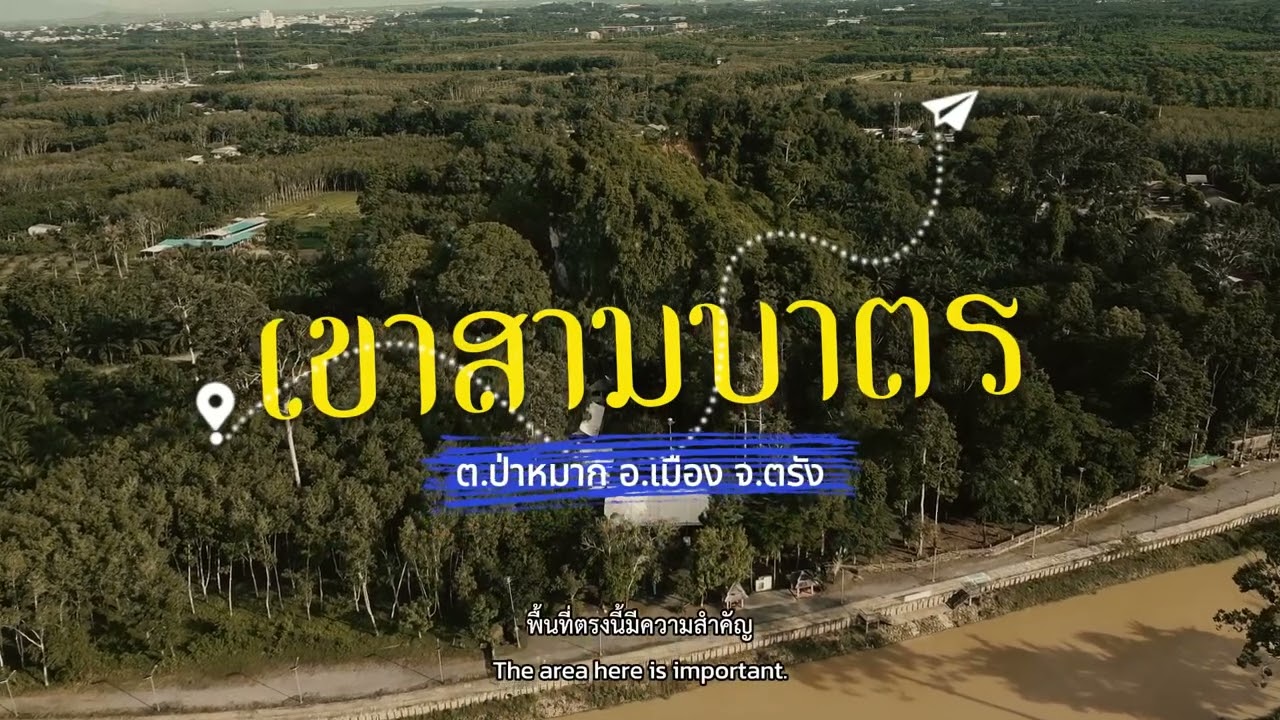
 Click to Access the Navigation Map GPS
Khao Sam Bat Cave Map
Recommend

 Art, Culture and Heritage
 Historical Sites and Monuments(1)
 Landmarks and Memorials(2)
 Art, Craft Centres, Tradition(3)
 Museums(2)
 Places of Worship
 Temple(15)
 Mosque(1)
 Other Sacred Sites(6)
 Research and Development
 Royal Project(1)
 Suburban Living
 Village, Community(5)
 National Parks and Marine Reserves(6)
 Mountain (Doi)(8)
 Dam, Reservoir, Lake(1)
 Waterfalls(20)
 Hot Springs(1)
Caves(11)
Hot Springs(1)
Caves(11)
 Bays and Beaches(11)
 Islands(12)
 Other natural attractions(3)
 Entertainment and Agricultural
 Farms, Parks and Ecotourism(8)
 Outdoor and Adventure Activities(1)
 Travel Articles, Recipes
 Southern Food Menu, Southern Food Recipes(1)


