
lovethailand home >South Travel Attractions >Surat Thani Travel Attractions >Kan Chana Dit >Tha U Thae > Tham Nam Thip
TL;DR: Tham Nam Thip is located at Moo 6, Tha Uthae Subdistrict, Kanchanadit District, Surat Thani Province, open Daily, hours 08.00 – 17.00.
Tham Nam Thip
Open Days: Daily
Opening Hours: 08.00 – 17.00
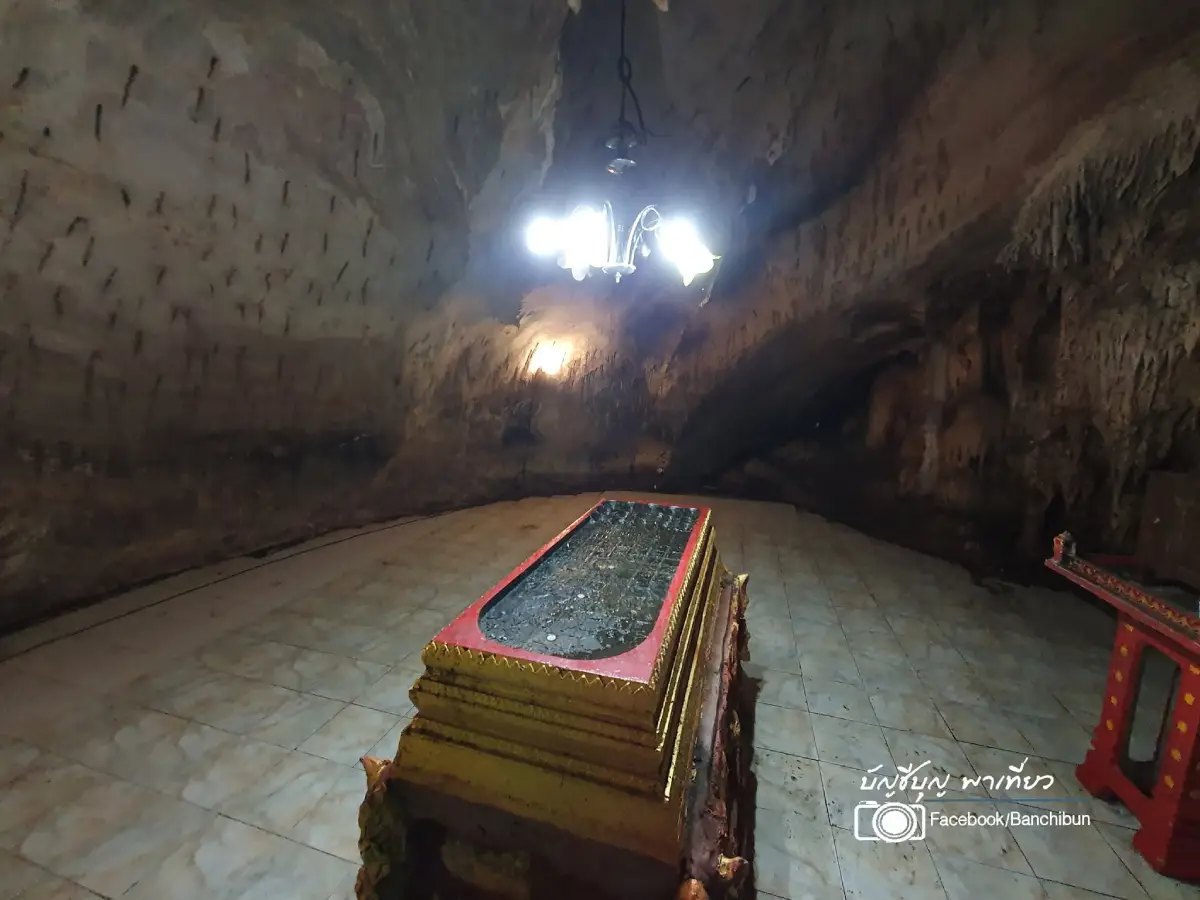
Tham Nam Thip, also known as Tham Bo Nam Thip Monastery or Tham Bo Nam Thip Buddhist retreat, is a natural cave and religious site in Tha Uthae Subdistrict, Kanchanadit District, Surat Thani Province. The site is known for its peaceful forest atmosphere, sacred cave setting, ancient Buddha images, a naturally formed area known in Thai as Wihan Sawan, a lotus-shaped stone stupa formation, and 3 deep sacred water wells inside the cave. The surrounding monastery area is also home to many monkeys, making this destination a combination of Buddhist worship, limestone cave nature, sacred water, and local wildlife.
Tham Nam Thip is suitable for visitors who want to experience Surat Thani beyond beaches, islands, and large urban attractions. The name “Nam Thip” suggests blessed or sacred water, and the place is closely associated with the water wells inside the cave. For local worshippers and visitors, the cave is not simply a geological site. It is a quiet spiritual place where natural formations, sacred water, Buddha images, forest atmosphere, and local faith are connected.
Tourism sources identify the monastery as being in Moo 6, Tha Uthae Subdistrict, Kanchanadit District, Surat Thani Province, around 2.6 kilometers from Wat Phra Phutthabat Si Surat. The site can be found under several names, including Tham Nam Thip, Tham Bo Nam Thip, Tham Bo Nam Thip Monastery, and Tham Bo Nam Thip Buddhist retreat. When using map navigation, adding Tha Uthae, Kanchanadit, and Surat Thani helps avoid confusion with similarly named places in other provinces.
In physical terms, Tham Nam Thip belongs to the limestone cave landscape of Surat Thani. International cave survey data lists Tham Bo Nam Thip as cave code ST0075 in Kanchanadit District, with an approximate surveyed length of 225 meters. This means the cave is more than a small shrine opening. It has enough internal distance to include cave passages, chambers, natural surfaces, and the water features that give the place its name.
Older tourism information describes the cave as an ancient cave discovered around 1977. Over time, it became a place of Buddhist worship and nature-based visitation. The presence of ancient Buddha images and sacred water wells helped turn the cave into a spiritual destination for local people and travelers. A visit here is therefore not just a cave walk, but a visit to a local sacred landscape.
Several features inside the cave make the visit memorable. Wihan Sawan creates the feeling of a sacred cave hall. The lotus-shaped stone stupa formation reflects the connection between natural stone forms and Buddhist symbolism. Ancient Buddha images inside the cave reinforce the religious atmosphere. Visitors should move quietly, avoid touching sacred objects, and treat the cave as a place of respect rather than as an ordinary tourist stop.
The 3 sacred water wells are the central feature of Tham Nam Thip. Each well is about 1 meter wide and approximately 8–10 meters deep. Because of this depth, visitors should never climb near the edge, lean over carelessly, throw objects into the wells, or allow children to approach them without close supervision. The wells should be viewed as both natural cave features and sacred elements of the monastery.
The word Nam Thip also gives the site a strong spiritual meaning. Local visitors may regard the cave water as blessed or auspicious. Anyone wishing to use or collect water should ask the local caretaker or monastery staff first. Respectful behavior is essential because the water is part of the sacred identity of the place.
Many monkeys live around the monastery and natural area. Although they are accustomed to the surroundings, visitors should not approach, touch, tease, or feed them without permission. Food, plastic bags, glasses, phones, and small personal items should be kept securely. The safest way to share the area with monkeys is to stay calm, keep distance, and avoid encouraging animals to associate visitors with food.
The approach to the cave has a shaded forest atmosphere with steps, religious images, and natural scenery. Walking slowly helps visitors appreciate the setting before entering the cave. Photography should be done respectfully, without blocking the path or disturbing people who come to pray or meditate. The overall value of the site lies in its quietness, not in loud activity.
Natural caves are fragile environments. Rock formations, cave floors, cave walls, and underground water features all need protection. Visitors should not touch stalactites or stalagmites, scratch the cave wall, climb on rocks, leave rubbish, or perform any activity that creates soot, dirt, or disturbance in inappropriate areas. Conservation-minded behavior helps keep the cave meaningful and accessible for future visitors.
Families with children should be especially careful. The site includes steps, uneven surfaces, deep wells, and monkeys. Children should not run inside the cave, stand near the wells, hold visible food, or shout. Elderly visitors should assess their ability to climb and walk on damp surfaces. Shoes with good grip are recommended, especially during or after rain.
The best time to visit is in the morning or early afternoon. These periods allow enough time to walk up to the cave, pay respect to the Buddha images, view the wells, and return safely. Visiting close to evening is not recommended because caves and forested monastery areas are easier and safer to visit when there is sufficient daylight.
During the rainy season, the cave route requires extra care. Steps, ground surfaces, and cave floors may become slippery. Moisture inside the cave may increase, and certain areas may be darker than expected. A small flashlight or a fully charged phone is useful, even if some parts of the route have lighting or natural light.
Visitors should dress modestly because the place is a Buddhist monastery. Clothing should be appropriate for both worship and walking. Bring drinking water, a small towel, personal medicine if needed, and a bag for carrying out rubbish. Avoid bringing strong-smelling food into the cave area. If food is carried, it should be kept securely inside a bag to avoid attracting monkeys.
Tham Nam Thip can be combined easily with Wat Phra Phutthabat Si Surat, which is located on Khao To in Tha Uthae Subdistrict. The Buddha footprint temple is one of the important sacred sites in the area. A practical route is to visit Wat Phra Phutthabat Si Surat and then continue to Tham Bo Nam Thip, or to visit the cave first and continue to the temple afterward. This creates a meaningful faith-and-nature route within Tha Uthae.
Travelers with more time can continue toward Kanchanadit town, Wat Tham Khuha, the Stone Fish Museum, Wat Khao Phra Nim, or the Kadae seafood zone. A half-day trip works well for visitors staying in Surat Thani City, while a full-day route can combine cave temples, cultural sites, and local seafood in Kanchanadit District.
Getting There from Surat Thani City follows the Surat Thani – Nakhon Si Thammarat route toward Kanchanadit. Continue past the Tha Kup junction and the Bang Kung junction, then follow the route toward Ban Phra Phutthabat and Road 4177. After about 2.5 kilometers, look for the sign to Tham Bo Nam Thip Monastery on the left. The final approach leads into a quiet Buddhist retreat area, so visitors should drive slowly and respectfully.
For map navigation, search for Tham Bo Nam Thip Monastery, Tham Bo Nam Thip, or สำนักสงฆ์ถ้ำบ่อน้ำทิพย์ together with Tha Uthae, Kanchanadit, Surat Thani. Reference coordinates from cave survey data place the cave area around Latitude 9.164829 and Longitude 99.587199. These should be treated as reference coordinates for the cave site rather than exact coordinates for every structure within the monastery grounds.
The site remains relevant as a religious and nature destination. Public tourism sources continue to list daily visiting hours, while the Surat Thani Provincial Office of Buddhism has also published information about a field inspection at the Tham Bo Nam Thip Buddhist retreat in Tha Uthae, Kanchanadit. This confirms the continuing religious status of the place.
Visitors should not enter areas that are not open for visitation, explore narrow cave passages without guidance, approach deep wells carelessly, or remain inside the cave alone. If a barrier or warning sign is present, follow it immediately. Cave conditions can change with humidity, rain, light, and rock surfaces, so careful movement is essential.
Overall, Tham Nam Thip is one of Kanchanadit District’s meaningful quiet cave destinations. Its highlights include an ancient cave, Wihan Sawan, a lotus-shaped stone stupa formation, ancient Buddha images, 3 sacred wells, a shaded monastery environment, and resident monkeys. For travelers who value respectful, conservation-minded, and spiritually aware travel, Tham Nam Thip offers a deeper side of Surat Thani beyond the familiar island and beach routes.
| Name | Tham Nam Thip / Tham Bo Nam Thip Monastery / Tham Bo Nam Thip Buddhist Retreat |
| Location | Moo 6, Tha Uthae Subdistrict, Kanchanadit District, Surat Thani Province |
| Address | Tha Uthae Subdistrict, Kanchanadit District, Surat Thani 84160, Thailand |
| Reference Coordinates | Latitude 9.164829, Longitude 99.587199 |
| Highlights | Ancient cave, Wihan Sawan, lotus-shaped stone stupa formation, ancient Buddha images, 3 sacred wells, forest monastery setting, and resident monkeys |
| History / Period | An ancient cave known locally since around 1977, later becoming a Buddhist retreat and nature-based sacred destination in Tha Uthae Subdistrict |
| Cave Information | Listed as Tham Bo Nam Thip, cave code ST0075, in Surat Thani cave survey data, with an approximate surveyed length of 225 meters |
| Sacred Wells | 3 wells, each about 1 meter wide and approximately 8–10 meters deep |
| Name Origin | The names Tham Nam Thip and Tham Bo Nam Thip are connected with the sacred water wells inside the cave. |
| Travel Information | From Surat Thani City, take the Surat Thani – Nakhon Si Thammarat route toward Kanchanadit, continue to Road 4177 toward Ban Phra Phutthabat, and follow the sign to Tham Bo Nam Thip Monastery. |
| Current Status | Still functioning as a Buddhist retreat and nature-faith destination of Tha Uthae Subdistrict, with public tourism information and provincial Buddhist office records confirming the site. |
| Open Days | Daily |
| Opening Hours | 08.00 – 17.00 |
| Facilities | Monastery area, cave access path, worship area, cave zone, and parking space according to site conditions |
| Main Areas / Zones | Monastery grounds, cave approach, cave entrance, cave chamber, Wihan Sawan, stone stupa formation, ancient Buddha image area, 3 sacred wells, and natural monkey area |
| Caretaker / Local Authority | Tham Bo Nam Thip Monastery and Tha Uthae Subdistrict Administrative Organization |
| Local Contact Information | Tha Uthae Subdistrict Administrative Organization, Mayor Hotline 08-9868-1837 |
| Nearby Tourist Attractions | 1. Wat Phra Phutthabat Si Surat, about 3 km 2. Wat Khao Tham Thamma Uthai / Tham Thamma Uthai, about 7 km 3. Kanchanadit District Town, about 20 km 4. Wat Tham Khuha, about 22 km 5. Wat Khao Phra Nim, about 25 km 6. Kadae Seafood Zone, Kanchanadit, about 38 km |
| Nearby Restaurants | 1. @Na Amphoe Kandit Restaurant, about 20 km, Tel. 086-951-0994, 095-420-6687 2. D'Duck Kanchanadit, about 26 km, Tel. 064-549-9945 3. Jungle Cafe Kanchanadit Branch, about 27 km, Tel. 083-506-4019 4. Ruean Mai @Kanchanadit, about 30 km, Tel. 082-537-9246 5. Kiang Lay Seafood Kanchanadit, about 38 km, Tel. 077-255-243, 085-571-1819 6. Kluai Thap Mae Fat Coconut Milk Drink, Kanchanadit Branch, about 25 km, Tel. 089-594-1709 |
| Nearby Accommodations | 1. Klang Na Resort, Kanchanadit, about 26 km, Tel. 080-531-5119 2. Phattariya Resort, Kanchanadit, about 30 km, Tel. 077-310-838 3. Rose Garden Resort, Kanchanadit, about 32 km, Tel. 085-112-2339 4. Sinmana Farmstay, Kanchanadit, about 40 km, Tel. 081-597-7575 5. K Park Grand Hotel Surat Thani, about 38 km, Tel. 077-213-700 6. Accommodations In Surat Thani City, about 40 km |
Frequently Asked Questions (FAQ)
Q: Where is Tham Nam Thip located?
A: Tham Nam Thip, or Tham Bo Nam Thip Monastery, is located in Moo 6, Tha Uthae Subdistrict, Kanchanadit District, Surat Thani Province.
Q: What is special about Tham Nam Thip?
A: The cave features Wihan Sawan, a lotus-shaped stone stupa formation, ancient Buddha images, 3 sacred wells, a peaceful monastery atmosphere, and monkeys living around the natural area.
Q: Is Tham Nam Thip open daily?
A: Yes. The listed opening schedule is daily from 08.00 to 17.00.
Q: What are the sacred wells inside the cave like?
A: There are 3 sacred wells inside the cave. Each is about 1 meter wide and approximately 8–10 meters deep, so visitors should view them carefully and keep children supervised.
Q: Who is Tham Nam Thip suitable for?
A: It is suitable for visitors interested in cave temples, limestone caves, Buddhist worship, quiet natural places, and conservation-minded travel in Tha Uthae Subdistrict.
Q: Are there monkeys at Tham Nam Thip?
A: Yes. Many monkeys live around the monastery and natural area. Visitors should keep distance, avoid feeding them without permission, and secure personal belongings.
Q: What should visitors prepare before visiting?
A: Visitors should dress modestly, wear stable walking shoes, bring drinking water, carry a small flashlight, keep food secure, and avoid touching cave formations or sacred objects.
Q: What nearby places can be combined with this trip?
A: Nearby options include Wat Phra Phutthabat Si Surat, Wat Khao Tham Thamma Uthai, Kanchanadit town, Wat Tham Khuha, Wat Khao Phra Nim, and the Kadae seafood zone.
 Category: ●Nature and Wildlife
 Group: ●Caves
Last Update : 3 DayAgo
 Last Update : 3 DayAgo
 Click to Access the Navigation Map GPS
 Art, Culture and Heritage
 Landmarks and Memorials(1)
 Art, Craft Centres, Tradition(8)
 Museums(5)
 Educational Places
 Educational Gardens, Farm(1)
 Places of Worship
 Temple(32)
 Other Sacred Sites(8)
 Research and Development
 Royal Project(1)
 Suburban Living
 Village, Community(6)
 Local Market(1)
 National Parks and Marine Reserves(8)
 Mountain (Doi)(2)
 Dam, Reservoir, Lake(8)
 Waterfalls(34)
 Hot Springs(7)
Caves(18)
Hot Springs(7)
Caves(18)
 River, Canal(11)
 Bays and Beaches(30)
 Islands(16)
 Other natural attractions(10)
 Entertainment and Agricultural
 Animal camps and shows(6)
 Farms, Parks and Ecotourism(7)
 Outdoor and Adventure Activities(2)
 Shopping
 Shopping and Night Market(1)
 Travel Articles, Recipes
 Southern Food Menu, Southern Food Recipes(1)


