
lovethailand home >South Travel Attractions >Surat Thani Travel Attractions >Kan Chana Dit >Chang Sai > Tham Mae Nang Phao
TL;DR: Tham Mae Nang Phao is located at Moo 1, Ban Krut, Krut Subdistrict, Kanchanadit District, Surat Thani Province, open Daily, hours 08.00 – 17.00.
Tham Mae Nang Phao
Open Days: Daily
Opening Hours: 08.00 – 17.00
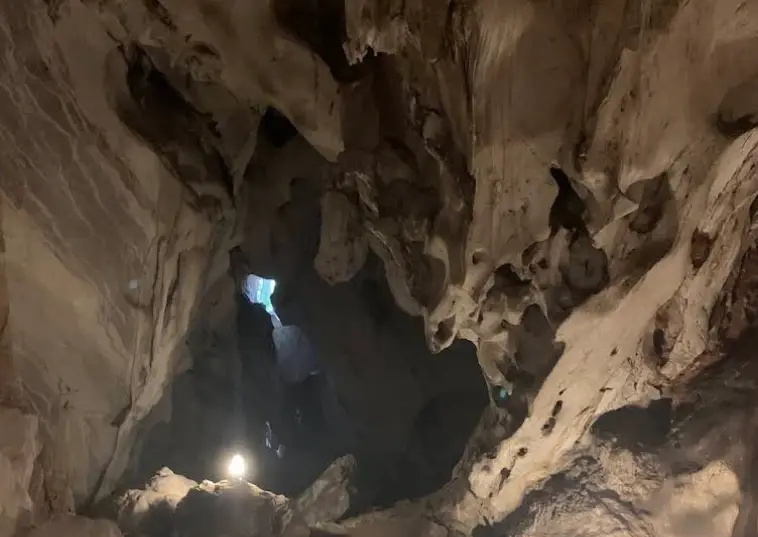
Tham Mae Nang Phao, also known locally as Tham Khao Nang Phao, is a natural cave and cultural heritage site in Moo 1, Ban Krut, Krut Subdistrict, Kanchanadit District, Surat Thani Province. The cave is located on Khao Nang Phao hill within the grounds of Wat Khao Nang Phao, where a staircase leads visitors up from the temple area to the cave. Its main appeal is the combination of a limestone cave, stalactites and stalagmites, a quiet temple setting, Buddhist images, and archaeological evidence found both inside the cave and around the old temple area.
This site is best understood through two connected dimensions: nature and religion. Tham Mae Nang Phao is not an isolated cave hidden deep in the forest, but a cave that belongs to the wider sacred landscape of Wat Khao Nang Phao and Ban Krut community. Visitors begin from the temple grounds, then walk up the staircase to the cave. Inside the cave are natural rock formations and signs of Buddhist use over time. This creates a travel experience that combines geology, faith, art, and local history.
Wat Khao Nang Phao is a local Buddhist temple under the Mahanikaya order, located in Ban Krut, Krut Subdistrict, Kanchanadit District. The temple lies on the lower slope of the hill, a setting commonly associated with cave temples in southern Thailand. According to the national cultural-environment heritage database, the site includes two important areas: the temple and the cave. Together they cover about 12 rai. Archaeological objects have been found in both areas. The exact historical period is not fully confirmed, but the evidence has been associated by scholars with the Ayutthaya period.
The most important cultural evidence includes red sandstone Buddha images in the old ordination hall, stone boundary markers around the temple, many fragments of red sandstone Buddha images inside the cave, and groups of Buddha images within the cave itself. These elements give Tham Mae Nang Phao value beyond scenic beauty. It is a place of worship and heritage, not only a natural attraction. Visitors should therefore treat the cave and temple objects with respect.
The landscape of Tham Mae Nang Phao is a hill-foot setting connected with Khao Nang Phao. The lower area is the temple, where local religious activities take place. The upper area is the cave, where the atmosphere becomes cooler, quieter, and more enclosed. The cave has lighting installed to help visitors walk and view the interior more safely. However, as with all caves, visitors should still move carefully because surfaces may be uneven or slippery, especially during or after rain.
The stalactites and stalagmites inside the cave are natural formations that take a very long time to develop. They are formed when mineral-rich water passes through limestone and deposits minerals drop by drop over time. Visitors should not touch, climb on, scratch, or break these formations. Even a small amount of damage can permanently alter features that took centuries or longer to form.
Tham Mae Nang Phao is suitable for travelers who prefer quiet, meaningful travel rather than noisy sightseeing. Because the cave is part of a temple and contains Buddhist images and heritage objects, visitors should dress modestly, speak softly, avoid disruptive behavior, and never move or touch any ancient object. Writing on cave walls, leaving rubbish, or taking objects from the cave is unacceptable.
In local historical terms, the cave helps explain the identity of Krut Subdistrict. Krut is one of the communities of Kanchanadit District with both natural and cultural resources. The subdistrict includes hot springs, swamp forest areas, scout-camp learning sites, and Khao Nang Phao Cave. This range of sites shows that Ban Krut is not merely a pass-through village, but an area with natural, religious, and cultural assets worth visiting.
Wat Khao Nang Phao itself is also part of the attraction. The temple acts as a religious center for the local community and has long been associated with ceremonies, Buddhist practice, and community events. A visit to Tham Mae Nang Phao should therefore include time for the temple grounds, not only the cave. The temple setting helps visitors understand why the cave has remained meaningful to local people.
The charm of Tham Mae Nang Phao lies in its simplicity. This is not a large commercial attraction with extensive tourist facilities. It is a cave within a local temple, with a staircase leading upward and lighting inside the cave. Visitors should prepare accordingly by wearing stable footwear, bringing drinking water, walking slowly, and avoiding visits during heavy rain when steps and cave surfaces may be slippery.
The best time to visit is in the morning or early afternoon. These times allow enough daylight for walking up to the cave, exploring the temple, and continuing to nearby attractions. Late afternoon visits should be planned carefully so that visitors are not inside or around the cave close to closing time. Caves require attention to lighting, safety, and the return route.
Photography is allowed in general visitor areas, but it should be done respectfully. Good subjects include the staircase, cave entrance, interior rock formations, Buddhist images, and the temple setting. Visitors should avoid using flash in a disruptive manner near Buddha images or old objects. If local people are praying or making merit, keep a respectful distance and do not block walkways.
Families with children should supervise them closely. The cave route includes steps and uneven ground, and children should not run, climb on rocks, touch formations, or handle Buddhist objects. Elderly visitors should assess their ability to climb before going up to the cave and should rest when needed. A slow visit is safer and allows more time to appreciate the site.
A visit to Tham Mae Nang Phao can be combined with other local attractions in Krut Subdistrict and Kanchanadit District. Nearby options include Wat Khao Nang Phao in the same area, the Krut hot spring in Moo 5, Ban Mae Mok scout-camp area, Ban Krut community, and the town area of Kanchanadit. Travelers with more time can continue toward Kadae seafood areas, which are well known for local seafood restaurants.
A half-day itinerary can begin in the morning at Wat Khao Nang Phao, continue up the staircase to Tham Mae Nang Phao, and allow time to observe the cave formations and cultural objects. After that, visitors can stop in Kanchanadit town for food or continue to the hot spring and other community attractions in Krut Subdistrict. This route combines cave, temple, local heritage, and food in one practical trip.
Conservation is essential here. Tham Mae Nang Phao contains both fragile natural formations and cultural heritage. Stalactites and stalagmites can be damaged easily by touching or climbing, while red sandstone Buddha images and fragments are valuable historical evidence. Responsible visitors help protect the cave by staying on the path, not touching artifacts, not leaving rubbish, and respecting the sacred character of the place.
Travelers should note that the site name may appear in different forms. Some tourism sources call it Tham Mae Nang Phao, while local government sources more commonly use Tham Khao Nang Phao. Both names refer to the cave area connected with Khao Nang Phao hill and Wat Khao Nang Phao in Ban Krut. When using map navigation, searching for Wat Khao Nang Phao, Tham Khao Nang Phao, or Khao Nang Phao Cave is usually the clearest option.
Getting There is easiest by private car or rental vehicle. From Surat Thani City, travel toward Kanchanadit District, then continue to Krut Subdistrict and Ban Krut, Moo 1. The destination is within the grounds of Wat Khao Nang Phao. Roads to Krut connect with Highway 4010, Highway 4143, and local roads. Because the cave name may not appear clearly on every map application, visitors should use Wat Khao Nang Phao or Tham Khao Nang Phao as the main navigation keyword.
Upon arrival, park only in appropriate areas and avoid blocking temple or community access. Dress respectfully before entering the temple and walking up to the cave. Stay on the prepared route, avoid entering unmarked cave sections, and follow any local advice or warning signs. If the cave floor is wet or visibility is poor, walk slowly and prioritize safety.
Overall, Tham Mae Nang Phao is more than a natural cave. It is a place where limestone geology, Buddhist faith, local art, and community history meet. With its staircase access, cave lighting, stalactites and stalagmites, Buddha images, red sandstone fragments, and old temple setting, it offers a quiet and meaningful side of Surat Thani for visitors who want to explore beyond beaches, islands, and major city attractions.
| Name | Tham Mae Nang Phao / Tham Khao Nang Phao / Khao Nang Phao Cave |
| Location | Moo 1, Ban Krut, Krut Subdistrict, Kanchanadit District, Surat Thani Province |
| Address | Wat Khao Nang Phao area, Ban Krut, Moo 1, Krut Subdistrict, Kanchanadit District, Surat Thani 84160, Thailand |
| Reference Coordinates | Latitude 9.090137449286, Longitude 99.523127136687 |
| Highlights | Natural cave within Wat Khao Nang Phao, staircase access, cave lighting, stalactites and stalagmites, Buddha images, and cultural objects found in both the temple and cave areas |
| History / Period | A cultural heritage site connected with Wat Khao Nang Phao. Ancient objects have been found in both the temple and cave areas; the exact period is uncertain, but the site has been associated with the Ayutthaya period. |
| Key Evidence | Red sandstone Buddha images in the old ordination hall, stone boundary markers around the temple, red sandstone Buddha image fragments, and groups of Buddha images inside the cave |
| Name Origin | The names Tham Mae Nang Phao and Tham Khao Nang Phao are connected with Khao Nang Phao hill, Wat Khao Nang Phao, and Ban Krut community. |
| Distinctive Features | A hill-foot cave with both natural and cultural significance, suitable for cave observation, Buddhist worship, local history, and heritage learning |
| Travel Information | From Surat Thani City, travel toward Kanchanadit District, continue to Krut Subdistrict and Ban Krut Moo 1. Search for Wat Khao Nang Phao or Tham Khao Nang Phao on map applications. |
| Current Status | Still promoted as a natural and cultural attraction of Krut Subdistrict, with local government information and cultural heritage records confirming the site. |
| Open Days | Daily |
| Opening Hours | 08.00 – 17.00 |
| Facilities | Staircase to the cave, cave lighting, temple grounds, and parking space within the temple area where appropriate |
| Main Areas / Zones | Wat Khao Nang Phao area, staircase route, cave entrance, cave interior, stalactite and stalagmite zone, and Buddhist image / heritage object area inside the cave |
| Local Authorities | Krut Subdistrict Municipality and Wat Khao Nang Phao |
| Main Contact Number | Krut Subdistrict Municipality, Tel. 077-297189 |
| Nearby Tourist Attractions | 1. Wat Khao Nang Phao, about 0 km 2. Krut Hot Spring, about 8 km 3. Ban Mae Mok Scout Camp Area, about 9 km 4. Ban Krut Community And Krut Subdistrict Municipality Area, about 3 km 5. Kanchanadit Town Area, about 12 km 6. Kadae Seafood Zone, Kanchanadit, about 25 km |
| Nearby Restaurants | 1. D'Duck Kanchanadit, about 13 km, Tel. 064-549-9945 2. Jungle Cafe Kanchanadit Branch, about 13 km, Tel. 083-506-4019 3. @Na Amphoe Kandit Restaurant, about 12 km, Tel. 086-951-0994, 095-420-6687 4. Ruean Mai @Kanchanadit, about 13 km, Tel. 082-537-9246 5. Kiang Lay Seafood Kanchanadit, about 25 km, Tel. 077-255-243, 085-571-1819 6. Kluai Thap Mae Fat Kanchanadit Branch, about 14 km, Tel. 089-594-1709 |
| Nearby Accommodations | 1. Klang Na Resort, Kanchanadit, about 18 km, Tel. 080-531-5119 2. Phattariya Resort, Kanchanadit, about 18 km, Tel. 077-310-838 3. Rose Garden Resort, Kanchanadit, about 18 km, Tel. 085-112-2339 4. Sinmana Farmstay, Kanchanadit, about 22 km, Tel. 081-597-7575 5. Jantara Resort & Restaurant, about 28 km, Tel. 081-426-3291 6. K Park Grand Hotel Surat Thani, about 32 km, Tel. 077-213-700 |
Frequently Asked Questions (FAQ)
Q: Where is Tham Mae Nang Phao located?
A: It is located in Moo 1, Ban Krut, Krut Subdistrict, Kanchanadit District, Surat Thani Province, within the area of Khao Nang Phao hill and Wat Khao Nang Phao.
Q: Are Tham Mae Nang Phao and Tham Khao Nang Phao the same place?
A: They refer to the cave area connected with Khao Nang Phao hill and Wat Khao Nang Phao. Local government sources commonly use the name Tham Khao Nang Phao, while some tourism sources use Tham Mae Nang Phao.
Q: What is interesting about Tham Mae Nang Phao?
A: The cave has stalactites, stalagmites, staircase access, lighting inside the cave, Buddha images, and cultural objects found in both the temple and cave areas.
Q: Is Tham Mae Nang Phao open daily?
A: Yes. The listed opening schedule is daily from 08.00 to 17.00.
Q: Who is this cave suitable for?
A: It is suitable for travelers interested in natural caves, old temples, local history, Buddhist art, ancient Buddha images, and quiet cultural travel.
Q: What should visitors prepare before visiting?
A: Visitors should dress respectfully, wear stable walking shoes, bring drinking water, walk carefully, and avoid touching rock formations or cultural objects inside the cave.
Q: Are there coordinates for Tham Mae Nang Phao?
A: Reference coordinates for the Wat Khao Nang Phao and cave area are Latitude 9.090137449286 and Longitude 99.523127136687.
Q: What nearby places can be combined with this trip?
A: Nearby options include Wat Khao Nang Phao, Krut Hot Spring, Ban Mae Mok Scout Camp Area, Kanchanadit town, and the Kadae seafood zone.
 Category: ●Nature and Wildlife
 Group: ●Caves
Last Update : 1 MonthAgo
 Last Update : 1 MonthAgo
 Click to Access the Navigation Map GPS
 Art, Culture and Heritage
 Landmarks and Memorials(1)
 Art, Craft Centres, Tradition(8)
 Museums(5)
 Educational Places
 Educational Gardens, Farm(1)
 Places of Worship
 Temple(32)
 Other Sacred Sites(8)
 Research and Development
 Royal Project(1)
 Suburban Living
 Village, Community(6)
 Local Market(1)
 National Parks and Marine Reserves(8)
 Mountain (Doi)(2)
 Dam, Reservoir, Lake(8)
 Waterfalls(34)
 Hot Springs(7)
Caves(18)
Hot Springs(7)
Caves(18)
 River, Canal(11)
 Bays and Beaches(30)
 Islands(16)
 Other natural attractions(10)
 Entertainment and Agricultural
 Animal camps and shows(6)
 Farms, Parks and Ecotourism(7)
 Outdoor and Adventure Activities(2)
 Shopping
 Shopping and Night Market(1)
 Travel Articles, Recipes
 Southern Food Menu, Southern Food Recipes(1)


