
lovethailand home >South Travel Attractions >Surat Thani Travel Attractions >Khiri Rat Nikhom >Tham Sing Khon > Wat Tham Singkhon
TL;DR: Wat Tham Singkhon is located at Ban Tham Singkhon, Tham Singkhon Subdistrict, Khiri Rat Nikhom District, Surat Thani Province, open Daily, hours 07.00 – 18.00.
Wat Tham Singkhon
Open Days: Daily
Opening Hours: 07.00 – 18.00
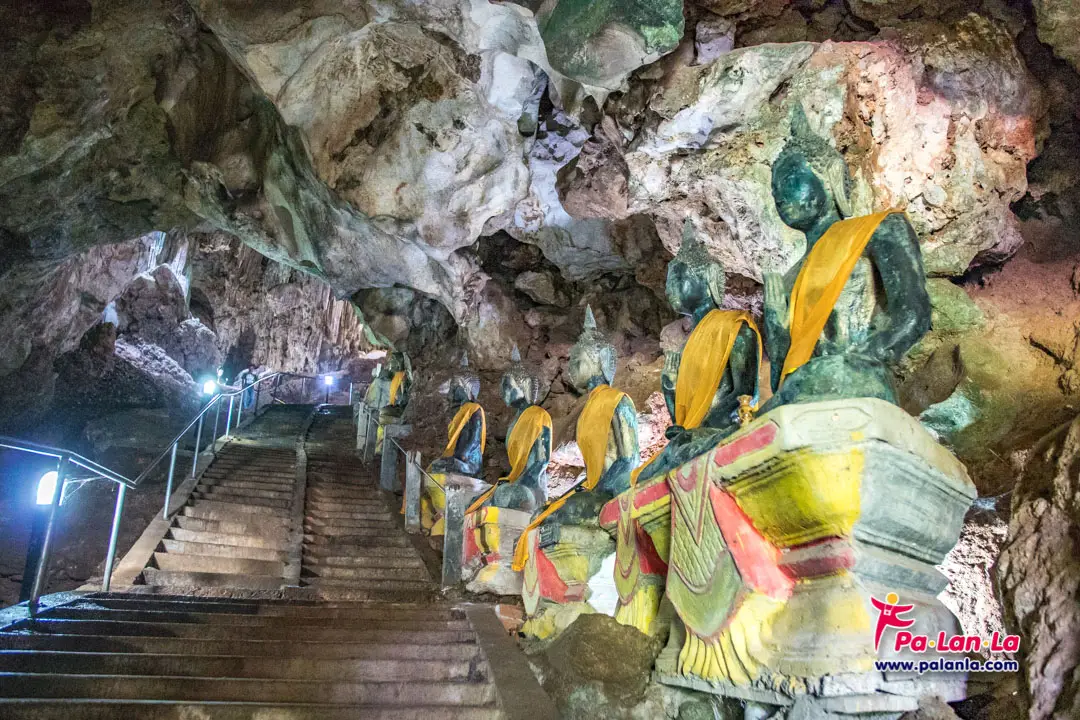
Wat Tham Singkhon in Surat Thani is an ancient cave temple in Khiri Rat Nikhom District, located in Ban Tham Singkhon, Tham Singkhon Subdistrict. The temple is known for its large cave, stucco Buddha images, a seated Buddha image with pendant legs, a replica Buddha footprint, stucco figures of deities, giants, Mae Phra Thorani, and mythical animals. Its cave walls and ceiling are decorated with old ceramic bowls and plates, while the front of the cave features a brick-and-stucco chedi inspired by Srivijaya-style architecture. This rare combination of cave, mountain, river, Buddhist art, and ancient ceramic decoration makes Wat Tham Singkhon one of the most distinctive cultural attractions in mainland Surat Thani.
Wat Tham Singkhon is suitable for travelers interested in history, Buddhist art, archaeology, local culture, and quiet temple visits away from the busier island routes of Surat Thani. The temple is not only a place for worship, but also a valuable cultural site where visitors can observe how natural geography and sacred architecture work together. The front side of the temple is connected with the Phum Duang River, while the rear side rises toward a limestone hill with an ancient cave. This setting gives the temple a strong sense of place and helps explain why the cave has long been respected by the local community.
The temple is a local Buddhist temple under the Maha Nikaya order. It stands in Tham Singkhon Subdistrict, Khiri Rat Nikhom District, Surat Thani Province, an inland area shaped by waterways, hills, caves, agricultural communities, and old settlement routes. The name Tham Singkhon is closely associated with the cave, the local village, and the hill behind the temple. For visitors, this makes the temple more than an isolated religious site; it is part of a wider cultural landscape along the Phum Duang River.
The history of Wat Tham Singkhon is layered. Its visible cultural evidence includes Buddhist cave art, stucco images, old ceramic decoration, sandstone boundary stones, and a chedi influenced by Srivijaya-style forms. Conservation records identify the temple as a cave within a temple compound, with large stucco Buddha images, various smaller Buddha images, stucco figures such as deities and giants, painted traces, decorative stucco patterns, and a Srivijaya-style chedi in front of the cave. These elements make Wat Tham Singkhon an important local heritage site for understanding religious art in Surat Thani.
The cave is the main focus of a visit. Inside, Buddha images of different sizes are placed along the cave walls and interior spaces. A central chamber contains important stucco Buddha images, while other images line the rear wall. The arrangement creates a sacred atmosphere that blends the natural form of the cave with religious devotion. Cave temples are found in several parts of southern Thailand, but Wat Tham Singkhon is especially notable for its combination of stucco work, ceramic decoration, a decorated ceiling, and a chedi positioned at the cave entrance.
The stucco work inside the cave deserves careful attention. Figures of deities, giants, Mae Phra Thorani, and mythical creatures appear on the walls and in the cave space. These figures are not merely decorative; they reflect Buddhist cosmology, local belief, and the imagination of traditional artisans. The ceiling includes curling stucco patterns and sections decorated with ceramic bowls and plates. When viewed from below, these ceramics create a striking visual layer above the sacred interior of the cave.
The use of old ceramic bowls and plates is one of the temple’s defining characteristics. The ceramics appear on parts of the cave ceiling and walls, as well as on the chedi in front of the cave. This style of decoration gives the site a visual identity that is difficult to find elsewhere. Visitors should avoid touching the cave walls, ceramics, stucco reliefs, or Buddha images, as many of these elements are old and sensitive to humidity, contact, and gradual deterioration.
The chedi in front of the cave is another key highlight. It is a brick-and-stucco structure inspired by Srivijaya-style architecture and decorated with ceramic pieces. The chedi includes directional niches and sacred images, making it both a religious monument and an architectural landmark. Seen together with the cave entrance and the hill behind it, the chedi creates one of the most memorable views of Wat Tham Singkhon.
Other features in and around the temple compound include sandstone boundary stones, a stone reliquary box, bases of sacred images, and traces of the old ordination hall area. Local tourism information also lists several points of interest at the temple, including the decorated chedi, the Phra Pa Lelai-style Buddha image, boundary stones, a damaged four-armed Vishnu figure, sacred image bases, stucco reliefs, mural traces, and ceramic decoration. These details make the temple valuable not only for worshippers, but also for travelers who want to understand the artistic and historical depth of inland Surat Thani.
Wat Tham Singkhon is also connected with local ritual life. One important tradition is the annual bathing of Buddha images inside the cave, held around the end of the fifth lunar month and the beginning of the sixth lunar month. Local communities gather for merit-making, sermons, food offerings, and the ritual bathing of sacred images in the cave. Another annual ritual in the sixth lunar month includes offerings and Nora dance performances dedicated to sacred presences associated with the cave. These traditions show that Wat Tham Singkhon remains a living cultural site, not only a historical monument.
The atmosphere around the temple is calm and local. Visitors should dress respectfully, keep their voices low, and behave appropriately inside the cave and temple grounds. Photography may be possible in suitable areas, but visitors should avoid flash near old paintings or delicate surfaces. The temple is best experienced slowly, as many of its most important details are found in small visual elements on the walls, ceiling, and sacred structures.
Getting There is most convenient by private car. From Surat Thani city, take Highway 401, the Surat Thani – Takua Pa route, toward Khiri Rat Nikhom and Ban Ta Khun. Around kilometer markers 34 – 35, turn onto the local road leading to the temple for about 2 km. The temple is not far from the Tham Singkhon Subdistrict Administrative Organization area. Travelers using public transport should first reach Khiri Rat Nikhom or a nearby local center, then arrange local transport to the temple.
The best time to visit is in the morning or late afternoon, when the weather is more comfortable and natural light is better for viewing the cave entrance, hill, and chedi. Inside the cave, walk carefully because some areas may be uneven or humid. Families with children and older travelers should move slowly and stay close together. A visit to Wat Tham Singkhon can be combined with nearby natural and cultural attractions such as Khlong Nam Sai, Ban Khao Noi Hot Spring, Wat Khuan Thong Thammaram, Khao Phang Suspension Bridge, Ratchaprapha Dam, and Ban Nam Rad Watershed Forest.
For a one-day inland Surat Thani route, travelers can begin at Wat Tham Singkhon in the morning, then continue to Khlong Nam Sai or the hot spring area in Tham Singkhon Subdistrict. With more time, the route can extend toward Khao Phang Suspension Bridge and Ratchaprapha Dam in Ban Ta Khun District. This itinerary reveals a side of Surat Thani that is different from its famous islands: caves, rivers, hills, old temples, village traditions, and the cultural landscape of the Phum Duang River basin.
Wat Tham Singkhon is therefore worth visiting for more than a quick stop. It offers Buddhist devotion, cave art, local ritual memory, ancient ceramic decoration, and a strong relationship between nature and sacred space. Travelers who take time to look closely will find that the temple tells the story of Surat Thani through stone, stucco, ceramics, river geography, and living community traditions.
| Name | Wat Tham Singkhon |
| Location | Ban Tham Singkhon, Tham Singkhon Subdistrict, Khiri Rat Nikhom District, Surat Thani Province |
| Address | Moo 3, Tham Singkhon Subdistrict, Khiri Rat Nikhom District, Surat Thani 84180, Thailand |
| Coordinates | Latitude 9.0413089966, Longitude 99.04153957 |
| Highlights | Ancient cave, stucco Buddha images, seated Buddha image with pendant legs, Srivijaya-style chedi, and old ceramic decoration on the cave walls and ceiling |
| History | An ancient cave temple with artistic evidence linked to the Ayutthaya period and Srivijaya-style influence in southern Thailand, closely connected with Ban Tham Singkhon and the Phum Duang River basin |
| Name Origin | The name is associated with Ban Tham Singkhon and the hill of Wat Tham Singkhon, a distinctive geographical feature of the area |
| Distinctive Features | A cave temple combining stucco reliefs, mural traces, ceramic decoration, Buddha images, a chedi, boundary stones, and sacred stone objects in one site |
| Travel Information | From Surat Thani city, take Highway 401 toward Khiri Rat Nikhom. Around kilometer markers 34 – 35, turn onto the local road and continue for about 2 km to the temple. |
| Current Status | Open to visitors as a historical, artistic, and religious attraction in Khiri Rat Nikhom District |
| Open Days | Daily |
| Opening Hours | 07.00 – 18.00 |
| Facilities | Parking available |
| Main Areas / Zones | Tham Singkhon Cave, chedi in front of the cave, stucco Buddha image area, replica Buddha footprint, ordination hall and boundary stone area, Phum Duang River area |
| Caretaker / Local Information | Tham Singkhon Subdistrict Administrative Organization, Tel. 0-7740-6195 |
| Nearby Tourist Attractions | 1. Khlong Nam Sai, about 7 km 2. Ban Khao Noi Hot Spring, about 8 km 3. Wat Khuan Thong Thammaram, about 10 km 4. Khao Phang Suspension Bridge, about 25 km 5. Ratchaprapha Dam, about 28 km 6. Ban Nam Rad Watershed Forest, about 32 km |
| Nearby Restaurants | 1. Isan Chao Suan Restaurant, about 9 km, Tel. 086-093-9164 2. Krua Kiri, about 14 km, Tel. 098-759-5057 3. Krua Bai Jai, about 14 km, Tel. 081-317-5478 4. Steak Ban Mhuad, about 13 km 5. Jungle Cafe Khiri Rat Nikhom Branch, about 14 km |
| Nearby Accommodations | 1. Tumneab Guest House, about 20 km, Tel. 081-537-2945 2. Ban Kiang Klong Resort, about 22 km, Tel. 094-391-9979 3. Dion Forest Resort, about 19 km 4. Ongsa Resort, about 21 km 5. Subtawee Resort, about 24 km |
Frequently Asked Questions (FAQ)
Q: Where is Wat Tham Singkhon located?
A: Wat Tham Singkhon is located in Ban Tham Singkhon, Moo 3, Tham Singkhon Subdistrict, Khiri Rat Nikhom District, Surat Thani Province.
Q: What is Wat Tham Singkhon known for?
A: It is known for its ancient cave, stucco Buddha images, seated Buddha image with pendant legs, stucco figures of deities and giants, ceramic decoration, and a Srivijaya-style chedi in front of the cave.
Q: What are the opening hours of Wat Tham Singkhon?
A: The temple is open daily from 07.00 to 18.00.
Q: Is there an entrance fee for Wat Tham Singkhon?
A: There is no confirmed official admission-fee announcement for general visits.
Q: How can travelers get to Wat Tham Singkhon from Surat Thani city?
A: Take Highway 401 toward Khiri Rat Nikhom and Ban Ta Khun. Around kilometer markers 34 – 35, turn onto the local road and continue for about 2 km to the temple.
Q: What should visitors wear at Wat Tham Singkhon?
A: Visitors should dress respectfully, keep quiet, and avoid touching the stucco reliefs, cave walls, ceramic decorations, or Buddha images.
Q: What nearby attractions can be combined with Wat Tham Singkhon?
A: Nearby options include Khlong Nam Sai, Ban Khao Noi Hot Spring, Wat Khuan Thong Thammaram, Khao Phang Suspension Bridge, Ratchaprapha Dam, and Ban Nam Rad Watershed Forest.
 Category: ●Places of Worship
 Group: ●Temple
Last Update : 2 MonthAgo
 Last Update : 2 MonthAgo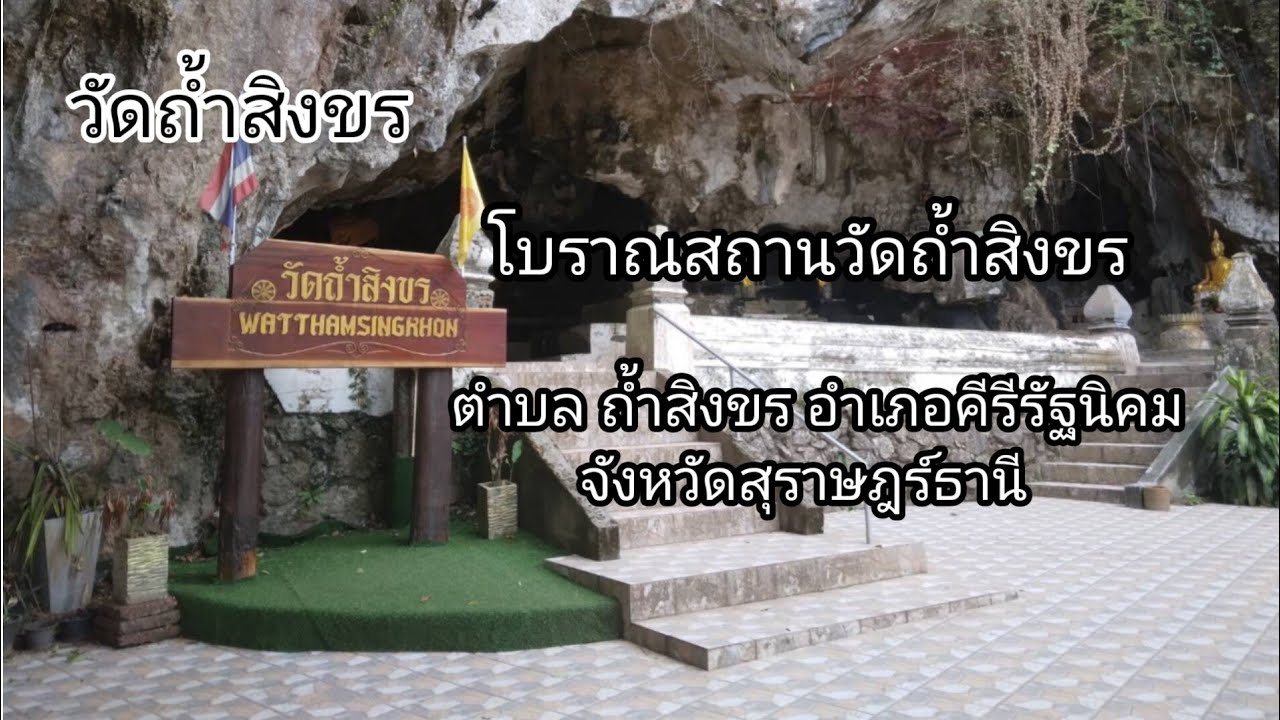
 Click to Access the Navigation Map GPS
Wat Tham Singkhon Map
Recommend

 Art, Culture and Heritage
 Landmarks and Memorials(1)
 Art, Craft Centres, Tradition(8)
 Museums(5)
 Educational Places
 Educational Gardens, Farm(1)
Temple(32)
Educational Gardens, Farm(1)
Temple(32)
 Other Sacred Sites(8)
 Research and Development
 Royal Project(1)
 Suburban Living
 Village, Community(6)
 Local Market(1)
 Nature and Wildlife
 National Parks and Marine Reserves(8)
 Mountain (Doi)(2)
 Dam, Reservoir, Lake(8)
 Waterfalls(34)
 Hot Springs(7)
 Caves(18)
 River, Canal(11)
 Bays and Beaches(30)
 Islands(16)
 Other natural attractions(10)
 Entertainment and Agricultural
 Animal camps and shows(6)
 Farms, Parks and Ecotourism(7)
 Outdoor and Adventure Activities(2)
 Shopping
 Shopping and Night Market(1)
 Travel Articles, Recipes
 Travel Review, Food Review(1)
 Southern Food Menu, Southern Food Recipes(1)


