
lovethailand home >South Travel Attractions >Surat Thani Travel Attractions >Koh Pha Ngan >Koh Pha Ngan > Chao Mae Kuan Im Shrine
TL;DR: Chao Mae Kuan Im Shrine is located at Moo 7, Ban Chalok Lam, Ko Pha-ngan Subdistrict, Ko Pha-ngan District, Surat Thani Province, open Daily, hours 08.00 – 17.00.
Chao Mae Kuan Im Shrine
Open Days: Daily
Opening Hours: 08.00 – 17.00
Chao Mae Kuan Im Shrine, also known as Guan Yin Temple Koh Phangan, is a Chinese-style hillside shrine in Moo 7, Ban Chalok Lam, Ko Pha-ngan Subdistrict, Ko Pha-ngan District, Surat Thani Province. Located about 9 km from Thong Sala, it was completed in March 1993 and is known for its colorful Chinese architecture, Guan Yin worship area, and panoramic views over Koh Phangan and Chalok Lam Bay.
Chao Mae Kuan Im Shrine in Surat Thani is one of the most distinctive cultural and spiritual places on Koh Phangan. The shrine is located in Moo 7, Ban Chalok Lam, Ko Pha-ngan Subdistrict, Ko Pha-ngan District, Surat Thani Province, on the main route from Thong Sala to Chalok Lam. Set on a hillside, it offers a quiet worship space, bright Chinese architecture, and a broad view over the northern part of the island. For travelers who want to see Koh Phangan beyond beaches and nightlife, this shrine is a meaningful stop.
The shrine is about 9 km from Thong Sala, the island’s main pier and transport hub. This makes it easy to include in a northern Koh Phangan itinerary. Visitors can combine the shrine with Ban Chalok Lam, Haad Khom, Mae Haad Beach, Ko Ma, Paradise Waterfall, and other natural attractions nearby. Its hillside location is the main reason the place is memorable: after reaching the shrine area, visitors can see the green mountains, Chalok Lam Bay, and the sea in the distance.
Chao Mae Kuan Im Shrine was completed in March 1993. It was created as a place of faith for the local community and as a shrine dedicated to Guan Yin, the Bodhisattva of compassion and mercy. In Chinese and Thai-Chinese belief, Guan Yin is widely worshipped for kindness, protection, healing, safety, and peacefulness. The shrine’s location above a travel route gives it an added symbolic role as a place where visitors can pause, pray, and ask for protection before continuing their journey around the island.
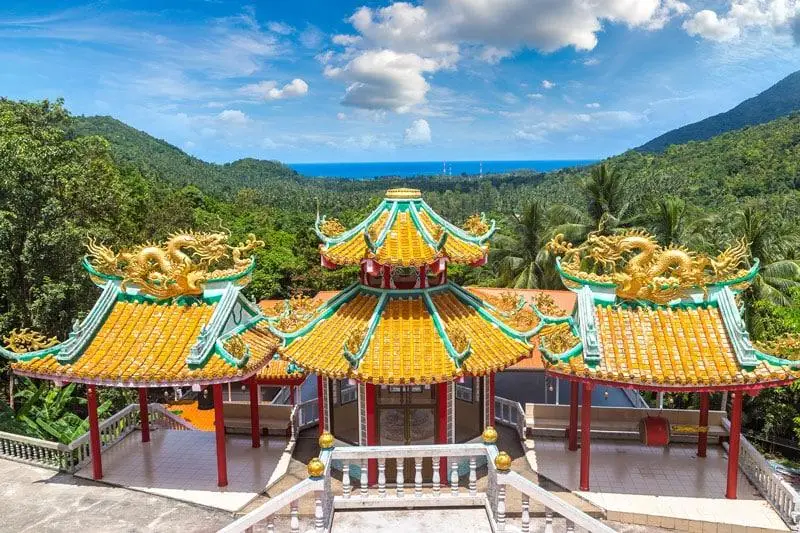
The architecture is the most striking visual feature of the shrine. Its yellow-gold tiled roofs, turquoise-green trim, red columns, and golden dragon ornaments create a vivid Chinese sacred atmosphere. Red, gold, and green are auspicious colors in Chinese visual culture, and here they stand out clearly against the green hillside and open sky. Many visitors remember the shrine from the image of its layered roofs and stairways descending along the hill, with the forest and sea forming the background.
The shrine complex includes several worship and viewing areas. Visitors can walk up the stairways, observe the Chinese decorative details, pay respect to Guan Yin, and then pause to enjoy the view. The site is not extremely large, but it has enough architectural detail to reward slow observation. Important features include the rooflines, dragon decorations, red columns, worship points, incense area, smaller pavilions, and the open platform overlooking the surrounding landscape.
The viewpoint is one of the main reasons the shrine is popular. From the front of the shrine, visitors can see a high-angle landscape of Koh Phangan, including green mountain slopes and the sea around Chalok Lam. This is different from a beach-level view because the scenery is seen from a sacred hillside space. On a clear day, the contrast between the greenery and the blue water is especially attractive, making the shrine suitable for both worship and travel photography.
From a spiritual perspective, a visit to Chao Mae Kuan Im Shrine should be calm and respectful. Visitors commonly pray for compassion, health, safety, smooth travel, and peace in life. For those riding or driving around Koh Phangan, stopping at the shrine before continuing toward Chalok Lam, Haad Khom, or Mae Haad can feel like beginning the journey with an auspicious moment. The shrine is particularly appropriate for travelers interested in Chinese Buddhist culture and quiet places of reflection.
The atmosphere is more peaceful than many busier attractions on the island. It is not located directly on a party beach or commercial beachfront. Instead, it sits along a hillside road between the central and northern parts of Koh Phangan. Visitors often use the place as a short rest stop, a prayer stop, and a viewpoint. This layered experience is what gives the shrine its value: it is not only a viewpoint, and it is not only a religious building, but a balanced combination of faith, architecture, and landscape.
In the wider context of Koh Phangan, the shrine reveals a cultural side of the island that is sometimes overlooked. Koh Phangan is internationally famous for beaches, the Full Moon Party, diving, yoga, and tropical nature. However, the island also has old communities, Buddhist temples, Chinese shrines, mountain routes, and sacred local places. Chao Mae Kuan Im Shrine represents this cultural diversity and shows how Chinese devotional traditions have become part of the island’s lived landscape.
The architecture deserves more than a quick photo. The layered Chinese roofs, red columns, dragon ridge ornaments, and auspicious colors create a strong ceremonial character. The gold dragon details catch the sunlight, especially in the morning and late afternoon. Each level of the shrine gives a different angle: looking up toward the roof structures, looking down from the stairway, and looking outward toward the hills and sea. Travelers interested in photography should walk the site slowly and avoid blocking worship areas.
The best time to visit is in the morning or late afternoon. Morning offers a quieter atmosphere and cooler weather, while late afternoon gives softer light for photography. Midday can be hot because some parts of the site are open and exposed. Visitors should bring water, wear comfortable shoes, and be careful when walking up and down the steps, especially after rain.
Getting There is straightforward from Thong Sala. Follow the Thong Sala – Chalok Lam route for about 9 km toward the northern part of Koh Phangan. Older travel information mentions the songthaew route from Thong Sala to Ban Chalok Lam, and visitors today can also travel by songthaew, local taxi, rental car, or rental motorcycle. The road includes hills and curves, so careful driving is important, especially for motorcycle riders and during rainy weather.
If traveling independently, drive from Thong Sala toward Chalok Lam and look for the Chinese-style shrine on the hillside. Park only in a suitable area and avoid blocking the road. From the parking area, walk up to the shrine for worship and sightseeing. Riders who are not comfortable with steep roads should drive slowly and avoid speeding downhill, as Koh Phangan roads can change condition with weather and traffic.
A practical half-day route starts from Thong Sala, stops at Chao Mae Kuan Im Shrine for worship and views, then continues to Ban Chalok Lam for food or a short walk around the fishing village. After that, travelers can continue to Haad Khom, Mae Haad Beach, Ko Ma, or Paradise Waterfall. This route combines shrine, mountain, local village, beach, and nature in one compact northern Koh Phangan trip.
Ban Chalok Lam, near the shrine, is an old seaside village with a different rhythm from Haad Rin or central Thong Sala. It has restaurants, cafés, small resorts, a pier area, and a quieter beach atmosphere. Travelers who visit the shrine can easily continue to Chalok Lam for lunch, coffee, or an overnight stay. This makes the shrine useful not only as a sightseeing stop but also as a natural gateway to the northern part of the island.
There is no admission fee to enter Chao Mae Kuan Im Shrine. Visitors may enter during opening hours to pay respect and enjoy the view, though donations are welcome if they wish to support maintenance of the place. Dress modestly, speak quietly, avoid climbing on sacred structures, do not touch sacred images unnecessarily, and take photos without disturbing people who are praying or meditating.
The shrine is suitable for many types of visitors: people who want to pray, travelers interested in Chinese culture, photographers, families, and those looking for a quiet viewpoint on the way to Chalok Lam. Elderly visitors and families with children should take care on stairways and uneven surfaces. Visitors who come mainly for photography should choose softer light and move respectfully around the worship areas.
For cultural travel, Chao Mae Kuan Im Shrine helps complete the story of Koh Phangan. The island is not only a beach destination; it is also a place of temples, shrines, forests, mountain roads, fishing villages, and long-standing community belief. The presence of a Chinese shrine on a hillside near Chalok Lam reflects the island’s cultural mix and shows how different forms of faith coexist in local life.
Overall, Chao Mae Kuan Im Shrine is a worthwhile stop for travelers who want to understand Koh Phangan in a quieter and more meaningful way. Its strength lies in the combination of Guan Yin worship, colorful Chinese architecture, panoramic hillside views, easy access from Thong Sala, and its connection with Chalok Lam village. For a more complete Koh Phangan trip, this shrine should be included in a northern island route.
| Name | Chao Mae Kuan Im Shrine, or Guan Yin Temple Koh Phangan |
| Location | Moo 7, Ban Chalok Lam, Ko Pha-ngan Subdistrict, Ko Pha-ngan District, Surat Thani Province |
| Address | Ban Chalok Lam, Moo 7, Ko Pha-ngan Subdistrict, Ko Pha-ngan District, Surat Thani 84280, Thailand |
| Coordinates | 9.76729, 100.00661 |
| Highlights | Chinese hillside shrine, Guan Yin worship area, red-and-gold Chinese architecture, and panoramic views of Koh Phangan and Chalok Lam Bay |
| History | Completed in March 1993 as a place of faith and worship dedicated to Guan Yin on Koh Phangan |
| Name Origin | Named after Chao Mae Kuan Im, or Guan Yin, the Bodhisattva of compassion and mercy in Chinese Buddhist belief |
| Distinctive Features | Golden-yellow tiled roofs, turquoise-green roof trim, red columns, golden dragon ornaments, and stairways leading to the hillside shrine area |
| Key Sacred Elements | Guan Yin image, Chinese pavilions, worship points, incense area, viewpoint platform, and Chinese architectural details |
| Travel Information | About 9 km from Thong Sala on the Thong Sala – Ban Chalok Lam route. Visitors can travel by songthaew, local taxi, rental car, or rental motorcycle, with care on hilly road sections. |
| Current Status | Open for worship and sightseeing as a sacred shrine and viewpoint on the Chalok Lam route |
| Open Days | Daily |
| Opening Hours | 08.00 – 17.00 |
| Fees | No admission fee |
| Facilities | Parking area, stairways, worship area, viewpoint, and photo spots around the shrine |
| Main Areas / Zones | Entrance stairway, main shrine, smaller pavilions, Guan Yin worship area, viewpoint platform, and Chinese architecture photo areas |
| Caretaker / Related Body | Local shrine caretakers and the Ban Chalok Lam community |
| Local Area Information | Ko Pha-ngan Municipality, Tel. 077 377 062 |
| Nearby Tourist Attractions | 1. Paradise Waterfall, about 2 km 2. Ban Chalok Lam, about 2 km 3. Haad Khom, about 4 km 4. Mae Haad Beach and Ko Ma, about 5 km 5. Haad Salad, about 6 km 6. Phaeng Waterfall and Dom Sila Viewpoint, about 6 km |
| Nearby Restaurants | 1. Foods & Roots Chaloklum, about 2 km, Tel. 032 567 893 2. MyThai Guesthouse & Burgers Chaloklum, about 2 km, Tel. 097 974 7326 3. BIG O Restaurant Chaloklum, about 2 km, Tel. 081 397 8220 4. Lemongrass Restaurant Chaloklum, about 2 km, Tel. 077 961 578 5. Sunshine Restaurant Mae Haad, about 6 km, Tel. 087 888 3244 6. Koh Ma Beach Restaurant, about 6 km, Tel. 077 374 173 |
| Nearby Accommodations | 1. Chaloklum Bay Resort, about 2 km, Tel. 077 374 147 2. Malibu Beach Bungalows, about 3 km, Tel. 077 374 057 3. Mandalai Hotel, about 3 km, Tel. 081 801 8949 4. Silan Residence, about 3 km, Tel. 097 924 3394 5. Chaloklum Residence By Kupu Kupu Phangan, about 3 km, Tel. 098 216 5025 6. Wattana Resort, about 5 km, Tel. 084 769 5955 |
Frequently Asked Questions (FAQ)
Q: Where is Chao Mae Kuan Im Shrine on Koh Phangan located?
A: It is located in Moo 7, Ban Chalok Lam, Ko Pha-ngan Subdistrict, Ko Pha-ngan District, Surat Thani Province, on the route from Thong Sala to Chalok Lam.
Q: What are the opening hours of Chao Mae Kuan Im Shrine?
A: The shrine is open daily from 08.00 to 17.00.
Q: Is there an admission fee?
A: No. There is no admission fee to enter the shrine, pay respect, or enjoy the viewpoint.
Q: When was Chao Mae Kuan Im Shrine completed?
A: The shrine was completed in March 1993 as a Guan Yin worship place on Koh Phangan.
Q: What is special about the shrine?
A: Its highlights are the colorful Chinese architecture, dragon details, hillside location, Guan Yin worship area, and panoramic views of Koh Phangan and Chalok Lam Bay.
Q: How do visitors get there from Thong Sala?
A: Follow the Thong Sala – Ban Chalok Lam route for about 9 km. Visitors can travel by songthaew, local taxi, rental car, or rental motorcycle.
Q: What is the best time to visit?
A: Morning and late afternoon are the best times because the weather is cooler and the light is better for viewing and photography.
Q: What nearby places can be visited after the shrine?
A: Nearby places include Paradise Waterfall, Ban Chalok Lam, Haad Khom, Mae Haad Beach, Ko Ma, Haad Salad, and Phaeng Waterfall.
 Category: ●Places of Worship
 Group: ●Other Sacred Sites
Last Update : 1 MonthAgo
 Last Update : 1 MonthAgo
 Click to Access the Navigation Map GPS
Chao Mae Kuan Im Shrine Map
Recommend

 Art, Culture and Heritage
 Landmarks and Memorials(1)
 Art, Craft Centres, Tradition(8)
 Museums(5)
 Educational Places
 Educational Gardens, Farm(1)
 Temple(32)
Other Sacred Sites(8)
Temple(32)
Other Sacred Sites(8)
 Research and Development
 Royal Project(1)
 Suburban Living
 Village, Community(6)
 Local Market(1)
 Nature and Wildlife
 National Parks and Marine Reserves(8)
 Mountain (Doi)(2)
 Dam, Reservoir, Lake(8)
 Waterfalls(34)
 Hot Springs(7)
 Caves(18)
 River, Canal(11)
 Bays and Beaches(30)
 Islands(16)
 Other natural attractions(10)
 Entertainment and Agricultural
 Animal camps and shows(6)
 Farms, Parks and Ecotourism(7)
 Outdoor and Adventure Activities(2)
 Shopping
 Shopping and Night Market(1)
 Travel Articles, Recipes
 Southern Food Menu, Southern Food Recipes(1)


