
lovethailand home >South Travel Attractions >Surat Thani Travel Attractions >Chai Ya >Lamet > Wat Long
TL;DR: Wat Long is located at Moo 4, Talat Subdistrict, Chaiya District, Surat Thani Province, Thailand, open Daily, hours 08.00 – 17.00.

Wat Long
Open Days: Daily
Opening Hours: 08.00 – 17.00
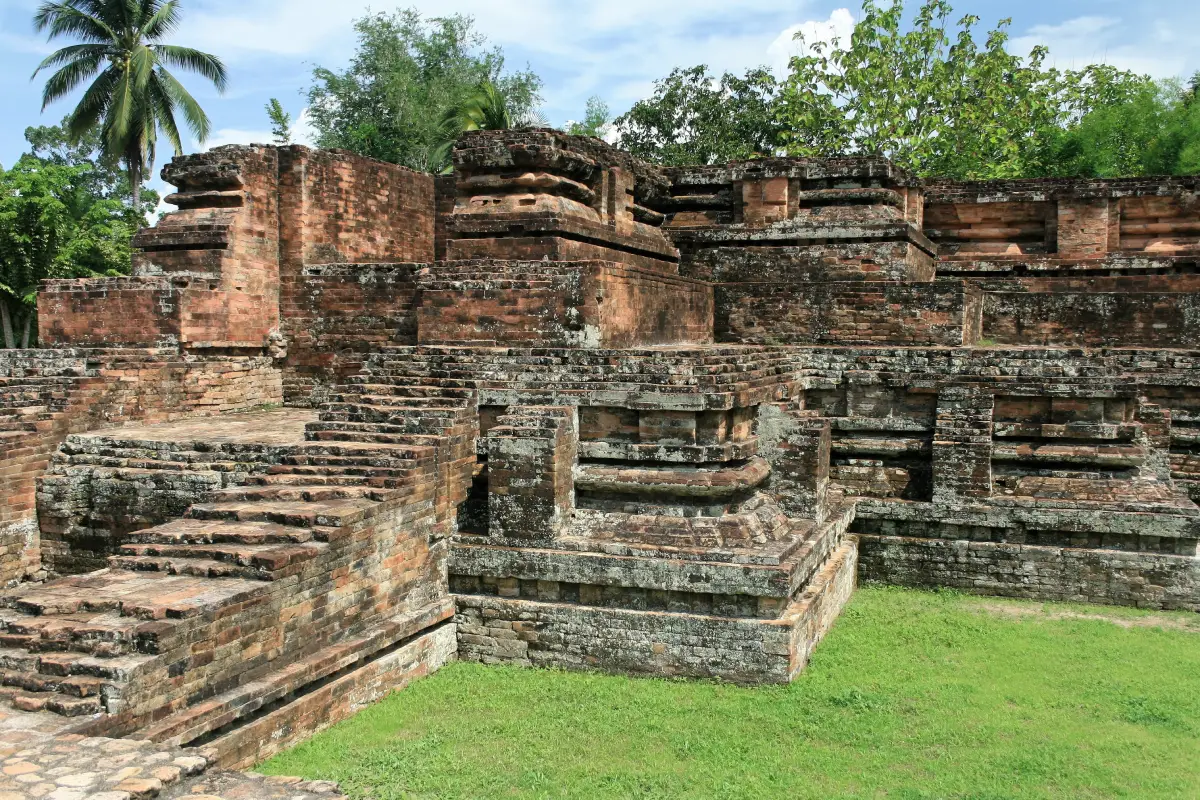
Wat Long in Chaiya District, Surat Thani Province, is an important Srivijaya-period archaeological site in ancient Chaiya. Located between Wat Wiang and Wat Kaeo, it preserves the brick foundation of a large chedi excavated and restored by Thailand’s Fine Arts Department during 1982–1984. It is ideal for visitors interested in Srivijaya architecture, ancient Chaiya, and cultural routes near Wat Phra Borommathat Chaiya.
Wat Long in Surat Thani Province is an important archaeological site in ancient Chaiya. It is located in Moo 4, Talat Subdistrict, Chaiya District, within the same sand-ridge landscape as Wat Wiang and Wat Kaeo. The site is significant for the study of Srivijaya-period religious architecture in southern Thailand. Although the upper structure of the monument has collapsed and only the brick foundation remains, the visible remains still reveal the scale, layout, and former importance of this ancient religious site.
Wat Long should be understood as an archaeological monument rather than an ordinary tourist temple. Visitors do not come here for newly built halls or colorful decoration. The value of the site lies in the exposed brick base, the cruciform plan, the traces of architectural tiers, and the quiet atmosphere of an ancient structure that has survived for more than a thousand years. For anyone interested in Chaiya’s history, Wat Long is a necessary companion to Wat Phra Borommathat Chaiya, Wat Kaeo, Wat Wiang, and Chaiya National Museum.
The name Wat Long is locally believed by some to have developed from the older word Wat Luang, meaning a royal or major temple. This interpretation fits the scale of the monument, as the Wat Long stupa is considered the largest stupa structure in ancient Chaiya and approximately twice the size of Phra Borommathat Chaiya. The name therefore may preserve a memory of the site’s former status as an important religious monument before it fell into ruin.
Geographically, Wat Long stands on a large sand ridge about 3 kilometers long from north to south and about 500 meters wide. The ridge rises around 3–4 meters above mean sea level and about 1–2 meters above the surrounding land. Along the middle of this ridge are three important ancient religious sites: Wat Wiang, Wat Long, and Wat Kaeo. Wat Long stands between Wat Wiang to the north and Wat Kaeo to the south, with Khlong Chaiya flowing nearby to the south of the monument.
This sand-ridge setting is essential for understanding ancient Chaiya. Elevated ridges were suitable for settlement and religious construction, while nearby waterways connected the community to broader coastal and maritime networks. The alignment of Wat Wiang, Wat Long, and Wat Kaeo suggests that these monuments formed part of a larger sacred and urban landscape rather than isolated ruins. Wat Long therefore helps visitors understand the spatial organization of ancient Chaiya.
The Wat Long monument is built of brick without mortar. It was abandoned for a long time and became heavily damaged, leaving only brick remains and foundation traces. The Archaeology Division of the Fine Arts Department excavated and restored the site during 1982–1984, revealing the structure more clearly. Before excavation, the monument was covered by soil and large trees, making careful archaeological work necessary to preserve the original architectural evidence.
Excavation revealed that the lowest base of the structure included a lotus-molding base in a cruciform plan measuring about 21.65 by 21.65 meters. The plan included projections and corners connected with a four-faced central structure. The base showed brick grooves, molded profiles, and traces of attached pilasters. This level appears to have functioned as a circumambulatory platform, with an eastern stairway or entrance leading into the hall of the central structure.
Only the base of the central structure survives, but the evidence shows that it had four projecting porticoes. The eastern projection was larger than the other three and measured about 4 by 4 meters, while the remaining projections were smaller. Traces of pilasters were found on the exterior walls. These elements suggest that the original monument was a stupa or shrine structure with a strong central axis, closely related to Srivijaya and Mahayana Buddhist architectural traditions in maritime Southeast Asia.
Based on architectural evidence, Wat Long is generally believed to have been built around the 14th–15th Buddhist centuries during the Srivijaya period. The site was later reused during the Ayutthaya period, around the 18th–22nd Buddhist centuries. Archaeological traces show later alterations, including brickwork surrounding the original base, compacted earth fill, a broad circumambulatory-like platform, and new access routes aligned with the four projections of the central structure.
Many types of artifacts have been found at Wat Long, including Dvaravati and Khmer-influenced unfired votive tablets, Song and Yuan dynasty Chinese ceramics, celadon ware, Ming and Qing dynasty ceramics, Sukhothai ceramics, local earthenware, glass beads, semi-precious stone beads, green glass fragments, molded bricks, and stamped earthenware fragments. These finds show that the area was used across many periods, not only during the initial Srivijaya phase.
The Chinese ceramics found at the site are especially important because they connect Chaiya with wider trade and cultural networks. Chaiya was once linked with maritime routes and coastal exchange across Southeast Asia. The presence of ceramics from several Chinese dynasties suggests continued use and contact over a long period. Wat Long therefore provides evidence not only for religious architecture but also for the wider cultural and commercial life of ancient Chaiya.
In the 2021 fiscal year, the 12th Regional Office of Fine Arts in Nakhon Si Thammarat conducted further archaeological excavation southeast of the Wat Long monument. The excavation found a brick alignment about 26 meters from the chedi. It was about 70 centimeters below the present ground surface, about 73 centimeters wide, and about 160 centimeters long, aligned north-south. Its construction technique was similar to the brick retaining wall around the chedi base, leading scholars to suggest that it may have been part of another ancient structure or a boundary wall built during the Ayutthaya-period modification of the site.
This recent excavation shows that Wat Long remains an active subject of archaeological study. The area around the visible brick base may still contain buried evidence that can clarify the former extent and organization of the monument. Visitors should therefore treat not only the visible brickwork but also the surrounding ground with care, as the archaeological record may continue beneath the surface.
Wat Long was registered as an ancient monument by the Fine Arts Department in the Royal Gazette on 27 September 1936. Today, it is an open-air archaeological site managed by the Fine Arts Department and can be visited without an admission fee. This official protection reflects the national importance of the site as evidence of ancient Chaiya and Srivijaya-period architecture in southern Thailand.
Compared with Wat Phra Borommathat Chaiya and Wat Kaeo, Wat Long offers a different kind of experience. It requires visitors to look carefully and imagine the vanished superstructure based on the remaining foundation. Its value lies not in complete form but in archaeological clarity. Walking around the base allows visitors to see the cruciform plan, the eastern access, the four projections, the molded base, and the brick construction technique that connects the site with other Srivijaya monuments.
The atmosphere is quiet and suitable for slow observation. The old brick base, grass, trees, and site signage create a simple but meaningful setting for cultural study. It is a good place for documentary photography and historical reflection, especially for travelers who prefer ancient sites over crowded attractions. Every brick line and foundation edge contributes to the story of Chaiya’s past.
A visit to Wat Long should be combined with Wat Wiang, Wat Kaeo, Wat Phra Borommathat Chaiya, and Chaiya National Museum. Wat Wiang and Wat Kaeo help explain the distribution of ancient religious sites along the sand ridge. Wat Phra Borommathat Chaiya shows a more complete and active Srivijaya-style relic monument. The museum adds context through artifacts, ceramics, and sculptures found in the ancient Chaiya area, including objects from Wat Long and Wat Kaeo.
Getting There is straightforward from Chaiya town. Follow Highway 4011 toward Chaiya intersection, cross the railway, and continue about 500 meters until Wat Wiang appears on the left. Turn left into the lane beside Wat Wiang, which leads toward Khao Nam Phu Ron. Drive straight for about 500 meters, and Wat Long will be on the left. From Wat Phra Borommathat Chaiya, the site is a short drive within the ancient Chaiya cultural route.
The best time to visit is in the morning or late afternoon, when the heat is lower and the light highlights the texture of the old brickwork. A focused visit to Wat Long may take around 30–45 minutes. A half-day route can include Wat Wiang, Wat Long, Wat Kaeo, Wat Phra Borommathat Chaiya, and Chaiya National Museum for a deeper understanding of Srivijaya-period Chaiya.
Visitors should dress respectfully, avoid climbing on the monument, avoid stepping on or moving bricks, avoid touching the ancient structure unnecessarily, and keep the area clean. Wat Long is an archaeological site and a former religious monument, so careful conduct is essential. Preserving the site helps protect the historical memory of Chaiya for future generations.
Wat Long is ideal for travelers who want to understand Surat Thani through history and archaeology. It may not offer the visual completeness of a restored temple, but it has exceptional value as one of the largest Srivijaya-period religious monuments in ancient Chaiya. Walking around its foundation and connecting it with Wat Kaeo, Wat Wiang, and Phra Borommathat Chaiya reveals the depth of Chaiya as a former religious, cultural, and maritime center of southern Thailand.
| Name | Wat Long / Wat Long Archaeological Site |
| Location | Moo 4, Talat Subdistrict, Chaiya District, Surat Thani Province, Thailand |
| Address | Ban Wat Long, Moo 4, Talat Subdistrict, Chaiya District, Surat Thani 84110, Thailand |
| Coordinates | 9.382207, 99.190407 |
| Highlights | Large Srivijaya-period brick chedi foundation, cruciform plan, lotus-molding base, four projections, eastern access, and archaeological evidence of ancient Chaiya |
| History | Believed to have been built around the 14th–15th Buddhist centuries during the Srivijaya period, with later reuse during the Ayutthaya period and subsequent periods |
| Site Status | Open-air ancient monument registered by the Fine Arts Department and open to the public |
| Distinctive Features | Brick construction without mortar, foundation measuring about 21.65 x 21.65 meters, four-faced central structure, and the largest known stupa structure in ancient Chaiya |
| Important Elements | Wat Long Chedi Foundation, Lotus-Molding Base, Circumambulatory Platform, Central Structure Projections, Eastern Entrance, Brick Alignment And Archaeological Traces |
| Main Areas / Zones | Ancient Chedi Foundation Area, Chedi Courtyard, Brick-Base Walking Route, Site Signage Area, Archaeological Observation Area, Nearby Parking Area |
| Responsible Agency | Fine Arts Department |
| Current Status | Open for cultural visits, archaeological study, and observation of Srivijaya-period architecture in ancient Chaiya |
| Open Days | Daily |
| Opening Hours | 08.00 – 17.00 |
| Admission Fee | Free Admission |
| Travel Information | From Chaiya town, follow Highway 4011, cross the railway, continue about 500 m to Wat Wiang, turn into the lane beside Wat Wiang, then continue about 500 m; Wat Long is on the left |
| Nearby Tourist Attractions | 1. Wat Wiang, about 500 m 2. Wat Rattanaram / Wat Kaeo, about 500 m 3. Wat Phra Borommathat Chaiya Ratchaworawihan, about 1 km 4. Chaiya National Museum, about 1 km 5. Suan Mokkhaphalaram, about 5 km 6. Phumriang Community / Phumriang Silk, about 8 km |
| Nearby Restaurants | 1. Krua Phi Yoon Chaiya, about 1 km, Tel. 084-625-9929 2. Sabiang Chaiya, about 2 km, Tel. 093-357-3753 3. Baan Phak Wan Cafe & Restaurant, about 3 km, Tel. 063-242-6595, 077-431-500 4. Krua Manorom, about 3 km, Tel. 095-418-9515 5. Krua Chaiya, about 6 km, Tel. 086-316-8888 |
| Nearby Accommodations | 1. JP Place, about 2 km, Tel. 096-296-4246 2. Suwan Wan Resort, about 5 km, Tel. 077-310-393 3. Krua Chaiya Surat Thani, about 6 km, Tel. 086-316-8888 4. Happy House Resort, about 7 km, Tel. 064-957-6564 5. Phupha Resort Chaiya, about 8 km, Tel. 098-118-8959 6. Maruay Resort Chaiya, about 8 km, Tel. 093-661-5693 |
Frequently Asked Questions (FAQ)
Q: Where is Wat Long located?
A: Wat Long is located in Moo 4, Talat Subdistrict, Chaiya District, Surat Thani Province, between Wat Wiang and Wat Kaeo and not far from Wat Phra Borommathat Chaiya.
Q: What are the opening days and hours of Wat Long?
A: Wat Long is open daily from 08.00 to 17.00.
Q: Is there an admission fee at Wat Long?
A: No. Admission is free.
Q: What is Wat Long best known for?
A: Wat Long is best known for its large Srivijaya-period brick chedi foundation, cruciform plan, lotus-molding base, four projections, and archaeological evidence connected with ancient Chaiya.
Q: When was the Wat Long chedi built?
A: The exact construction date is not known, but architectural evidence suggests it was built around the 14th–15th Buddhist centuries during the Srivijaya period.
Q: How is Wat Long related to Wat Kaeo and Wat Phra Borommathat Chaiya?
A: Wat Long is part of the ancient Chaiya archaeological landscape on the same sand ridge as Wat Wiang and Wat Kaeo, and it is believed to be close in period to Phra Borommathat Chaiya.
Q: How can visitors get to Wat Long?
A: From Chaiya town, follow Highway 4011, cross the railway, continue about 500 meters to Wat Wiang, turn into the lane beside Wat Wiang, and continue about 500 meters. Wat Long is on the left.
Q: What nearby places can be visited with Wat Long?
A: Nearby places include Wat Wiang, Wat Rattanaram or Wat Kaeo, Wat Phra Borommathat Chaiya, Chaiya National Museum, Suan Mokkhaphalaram, and Phumriang community.
 Category: ●Places of Worship
 Group: ●Temple
Last Update : 4 WeekAgo
 Last Update : 4 WeekAgo
 Click to Access the Navigation Map GPS
 Art, Culture and Heritage
 Landmarks and Memorials(1)
 Art, Craft Centres, Tradition(8)
 Museums(5)
 Educational Places
 Educational Gardens, Farm(1)
Temple(32)
Educational Gardens, Farm(1)
Temple(32)
 Other Sacred Sites(8)
 Research and Development
 Royal Project(1)
 Suburban Living
 Village, Community(6)
 Local Market(1)
 Nature and Wildlife
 National Parks and Marine Reserves(8)
 Mountain (Doi)(2)
 Dam, Reservoir, Lake(8)
 Waterfalls(34)
 Hot Springs(7)
 Caves(18)
 River, Canal(11)
 Bays and Beaches(30)
 Islands(16)
 Other natural attractions(10)
 Entertainment and Agricultural
 Animal camps and shows(6)
 Farms, Parks and Ecotourism(7)
 Outdoor and Adventure Activities(2)
 Shopping
 Shopping and Night Market(1)
 Travel Articles, Recipes
 Southern Food Menu, Southern Food Recipes(1)


