lovethailand home >South Travel Attractions >Surat Thani Travel Attractions >Chai Ya >Lamet > Wat Rattanaram (Wat Kaew)
TL;DR: Wat Rattanaram (Wat Kaew) is located at Ban Wat Kaeo, Lamet Subdistrict, Chaiya District, Surat Thani Province, Thailand, open Daily, hours 08.00 – 17.00.

Surat Thani

Wat Rattanaram (Wat Kaew)

Wat Rattanaram (Wat Kaew)

Open Days: Daily
Opening Hours: 08.00 – 17.00
 
Wat Rattanaram, also known as Wat Kaeo, is an old temple in Chaiya District, Surat Thani Province. It is best known for the Wat Kaeo Chedi, an open-air Srivijaya-period brick monument believed to date from around the 14th–15th Buddhist centuries. Located about 1 kilometer from Wat Phra Borommathat Chaiya, it is a key stop for understanding ancient Chaiya, Srivijaya architecture, and southern Thai Buddhist heritage.
 
Wat Rattanaram (Wat Kaeo) in Surat Thani Province is an old and culturally important temple at Ban Wat Kaeo, Lamet Subdistrict, Chaiya District. The temple is closely connected with the ancient city of Chaiya and preserves one of the most important Srivijaya-period monuments in the area: the Wat Kaeo Chedi. Together with Wat Phra Borommathat Chaiya, Wat Long, and Wat Wiang, Wat Kaeo forms part of a significant archaeological landscape that helps explain the religious and cultural development of ancient Chaiya.
 
The official name of the temple is Wat Rattanaram, while the name Wat Kaeo is more widely used by local people and travelers because of its location at Ban Wat Kaeo. The temple is only about 1 kilometer from Wat Phra Borommathat Chaiya Ratchaworawihan, making it easy to visit both sites in the same cultural route. If Wat Phra Borommathat Chaiya represents the most complete and active sacred center of Chaiya, Wat Kaeo reveals another important archaeological layer through its ancient brick chedi and associated evidence.
 
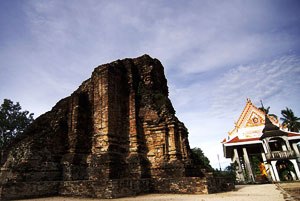
The Wat Kaeo Chedi is an open-air ancient monument located within the present temple grounds. It is built of brick without mortar, with a square base, four projecting porticoes, indented corners, and a chambered structure. The eastern niche includes a passage leading into the central chamber of the chedi. Buddha images in the subduing Mara posture were once enshrined in the niches. This layout gives the monument strong architectural and religious significance.
 
The importance of Wat Kaeo lies in its survival as a visible example of Srivijaya-period brick architecture. Although the monument has been affected by time, its plan, base, porticoes, and brickwork remain clear enough to show the original architectural concept. The cruciform-like plan and construction techniques can be compared with other monuments in Chaiya, especially Phra Borommathat Chaiya. This makes Wat Kaeo essential for anyone who wants to understand the wider historical landscape rather than visit only the best-known temple.
 
The exact date of Wat Kaeo’s foundation is not known. However, based on architectural evidence and the context of ancient Chaiya, the chedi is generally believed to date from around the 14th–15th Buddhist centuries, during the period of Srivijaya influence in southern Thailand. At that time, Chaiya was connected with maritime routes, Buddhist networks, and cultural exchange across Southeast Asia. The monument therefore represents not only a local temple structure, but also part of a larger regional civilization.
 
The site stands on a large sand ridge in the Khlong Chaiya basin. This landscape is important because sand ridges provided slightly elevated ground suitable for settlement and religious buildings in the past. Wat Wiang, Wat Long, and Wat Kaeo are distributed along the same ridge, showing that ancient Chaiya was organized around a cluster of religious sites rather than isolated temples. This spatial relationship helps visitors understand why the Chaiya area is so important to the study of southern Thai archaeology.
 
The Fine Arts Department carried out archaeological excavation and restoration work at Wat Kaeo during 1976–1979, with further study in 1980. The work revealed a cross-axis plan and construction methods similar to Phra Borommathat Chaiya. Important finds included a headless seated stone Buddha image on a base decorated with double vajra and lion motifs, associated with the Buddha Akshobhya or a Jina Buddha image. These findings connect Wat Kaeo with Mahayana and Vajrayana Buddhist ideas that once had influence in the region.
 
The archaeological evidence at Wat Kaeo makes the site valuable beyond its visible brick structure. It helps explain the religious worldview of ancient Chaiya, where Buddhist art and ritual were shaped by multiple traditions. Elements such as the vajra motif and Jina-related iconography indicate that the site may have been connected with forms of Buddhism different from later mainstream temple practice in Thailand. This gives Wat Kaeo special value for those interested in religious history.
 
Many archaeologists and art historians have studied Wat Kaeo, including Thai and international scholars. The site has been compared with Cham, Javanese, pre-Angkorian Khmer, Pala, Dvaravati, and Srivijaya art. While scholarly interpretations have varied, the shared conclusion is that Wat Kaeo is a key monument showing how Chaiya absorbed and adapted artistic influences from several cultural worlds across maritime Southeast Asia.
 
Wat Kaeo was registered as an ancient monument by the Fine Arts Department in the Royal Gazette on 27 September 1936. This official protection reflects the national importance of the site. Today, the monument is maintained through the temple and the Fine Arts Department. Visitors may enter without an admission fee, but they should be careful not to touch, climb, or damage the ancient brickwork, as every part of the structure is an irreplaceable piece of historical evidence.
 
Wat Rattanaram remains an active Buddhist temple with resident monks and community religious activities. The current abbot is Phra Maha Thongchai Wannaviro. The temple continues to support Buddhist practice, religious education, moral development, and cultural tourism. This living role is important because Wat Kaeo is not simply an abandoned ruin; it is an ancient monument within a functioning temple environment.
 
Visitors should understand Wat Kaeo in two dimensions. First, it is Wat Rattanaram, an active local temple used by monks and community members. Second, it is the location of Wat Kaeo Chedi, a Srivijaya-period ancient monument and protected archaeological site. Seeing both dimensions helps explain how old temples in southern Thailand often remain connected to present community life while preserving evidence of the distant past.
 
The atmosphere at Wat Kaeo is quieter than at Wat Phra Borommathat Chaiya. It is suitable for slow observation, cultural photography, and historical study. The beauty of the site lies not in bright decoration or new construction, but in old brick surfaces, architectural remains, the proportion of the chedi, and the sense of time preserved in the structure. For travelers who appreciate archaeological sites, Wat Kaeo is a rewarding stop.
 
A good way to explore the site is to first stand back and observe the overall plan of the chedi, then slowly walk around it to see the square base, projecting porticoes, indented corners, niches, and the eastern passage into the central chamber. Walking around the monument reveals how carefully the structure was planned. It also helps visitors understand the relationship between architecture, religious symbolism, and ancient construction methods.
 
For visitors interested in art history, Wat Kaeo should be combined with Wat Phra Borommathat Chaiya, Wat Long, Wat Wiang, and Chaiya National Museum. Each site adds a different layer to the story of ancient Chaiya. Wat Phra Borommathat Chaiya shows the most complete and active relic monument, Wat Kaeo preserves a major brick archaeological structure, Wat Long and Wat Wiang show related ancient sites on the same sand ridge, and the museum provides historical interpretation through objects and displays.
 
Getting There is straightforward from Chaiya town. Follow Highway 4011 toward Chaiya intersection, cross the railway, and continue about 500 meters until Wat Wiang appears on the left. Turn left into the lane beside Wat Wiang toward the Khao Nam Ron road. Continue about 500 meters past Wat Long, then drive another 500 meters to reach Wat Kaeo. From Wat Phra Borommathat Chaiya, the temple is only about 1 kilometer away.
 
The best time to visit is morning or late afternoon, when the heat is lower and the light brings out the texture of the old brickwork. A focused visit to Wat Kaeo may take around 30–45 minutes. A half-day itinerary can include Wat Phra Borommathat Chaiya, Chaiya National Museum, Wat Long, Wat Wiang, and Wat Kaeo for a fuller understanding of Srivijaya-period Chaiya.
 
Visitors should dress respectfully, speak quietly, avoid touching or climbing the ancient monument, and avoid moving any brick or object within the site. Wat Kaeo is both an active temple and a nationally protected ancient monument, so proper conduct is part of preserving the site for future generations. Photography should be done carefully and without disturbing worshippers or the temple community.
 
Wat Rattanaram, or Wat Kaeo, is ideal for travelers who want to understand Surat Thani through history and culture. It may not have the scale or crowds of the province’s most famous sites, but it has exceptional value as a Srivijaya-period monument and a witness to the ancient city of Chaiya. For anyone exploring Chaiya beyond the main relic pagoda, Wat Kaeo is an essential stop.
 
NameWat Rattanaram / Wat Kaeo
LocationBan Wat Kaeo, Lamet Subdistrict, Chaiya District, Surat Thani Province, Thailand
AddressSantinimit Road, Moo 2, Lamet Subdistrict, Chaiya District, Surat Thani 84110, Thailand
Coordinates9.377856, 99.190232
HighlightsWat Kaeo Chedi, a Srivijaya-period brick ancient monument with a square base, four porticoes, indented corners, chambered niches, and traces of Buddha images in the subduing Mara posture
HistoryThe chedi is believed to date from around the 14th–15th Buddhist centuries during the period of Srivijaya influence in ancient Chaiya
Temple StatusActive local Buddhist temple and location of Wat Kaeo ancient monument, registered by the Fine Arts Department
Distinctive FeaturesBrick construction without mortar, cruciform-like plan, square base, four projecting porticoes, and architectural relationship with Phra Borommathat Chaiya
Important Sacred ObjectsWat Kaeo Chedi, chambered niches, central chamber, Buddha images in the niches, worship area, ordination hall, temple buildings, and archaeological remains
Main Areas / ZonesWat Kaeo Ancient Monument Area, Chedi Courtyard, Worship Area, Wat Rattanaram Buildings, Parking Area, Walking Route Around The Ancient Monument
Current AbbotPhra Maha Thongchai Wannaviro
Current StatusOpen for worship, merit-making, and visits to the open-air ancient monument within the temple grounds
Open DaysDaily
Opening Hours08.00 – 17.00
Admission FeeFree Admission
Travel InformationFrom Chaiya town, follow Highway 4011, cross the railway, turn left beside Wat Wiang, pass Wat Long, and continue to Wat Kaeo. From Wat Phra Borommathat Chaiya, the temple is about 1 km away
Nearby Tourist Attractions1. Wat Long, about 500 m
2. Wat Wiang, about 1 km
3. Wat Phra Borommathat Chaiya Ratchaworawihan, about 1 km
4. Chaiya National Museum, about 1 km
5. Suan Mokkhaphalaram, about 5 km
6. Phumriang Community / Phumriang Silk, about 8 km
Nearby Restaurants1. Krua Phi Yoon Chaiya, about 1 km, Tel. 084-625-9929
2. Sabiang Chaiya, about 2 km, Tel. 093-357-3753
3. Baan Phak Wan Cafe & Restaurant, about 3 km, Tel. 063-242-6595, 077-431-500
4. Krua Manorom, about 3 km, Tel. 095-418-9515
5. Krua Chaiya, about 6 km, Tel. 086-316-8888
Nearby Accommodations1. JP Place, about 2 km, Tel. 096-296-4246
2. Suwan Wan Resort, about 5 km, Tel. 077-310-393
3. Krua Chaiya Surat Thani, about 6 km, Tel. 086-316-8888
4. Happy House Resort, about 7 km, Tel. 064-957-6564
5. Phupha Resort Chaiya, about 8 km, Tel. 098-118-8959
6. Maruay Resort Chaiya, about 8 km, Tel. 093-661-5693
 
Frequently Asked Questions (FAQ)
Q: Where is Wat Rattanaram or Wat Kaeo located?
A: Wat Rattanaram, also known as Wat Kaeo, is located at Ban Wat Kaeo on Santinimit Road, Moo 2, Lamet Subdistrict, Chaiya District, Surat Thani Province, about 1 kilometer from Wat Phra Borommathat Chaiya.
 
Q: What are the opening days and hours of Wat Kaeo?
A: Wat Kaeo is open daily from 08.00 to 17.00.
 
Q: Is there an admission fee at Wat Kaeo?
A: No. Admission is free.
 
Q: What is Wat Kaeo best known for?
A: Wat Kaeo is best known for the Wat Kaeo Chedi, a Srivijaya-period brick ancient monument with a square base, four porticoes, indented corners, and chambered niches.
 
Q: When was the Wat Kaeo Chedi built?
A: The exact construction date is not known, but the chedi is generally believed to date from around the 14th–15th Buddhist centuries during the Srivijaya period.
 
Q: How is Wat Kaeo related to Wat Phra Borommathat Chaiya?
A: Wat Kaeo is part of the ancient Chaiya archaeological landscape and is believed to be close in period to Phra Borommathat Chaiya. Its architecture and construction techniques can be studied together with the main relic pagoda.
 
Q: How can visitors get to Wat Kaeo?
A: From Chaiya town, follow Highway 4011, cross the railway, turn left beside Wat Wiang, pass Wat Long, and continue to Wat Kaeo. From Wat Phra Borommathat Chaiya, it is about 1 kilometer away.
 
Q: What nearby places can be visited with Wat Kaeo?
A: Nearby places include Wat Long, Wat Wiang, Wat Phra Borommathat Chaiya Ratchaworawihan, Chaiya National Museum, Suan Mokkhaphalaram, and Phumriang community.

Places of WorshipCategory: ●Places of Worship

TempleGroup: ●Temple

Last Update : 4 WeekAgo

Vote for us - Review and rate Love Thailand
Landmarks and Memorials Landmarks and Memorials(1)
Art, Craft Centres, Tradition Art, Craft Centres, Tradition(8)
Museums Museums(5)
Educational Gardens, Farm Educational Gardens, Farm(1)
Temple Temple(32)
Other Sacred Sites Other Sacred Sites(8)
Royal Project Royal Project(1)
Village, Community Village, Community(6)
Local Market Local Market(1)
National Parks and Marine Reserves National Parks and Marine Reserves(8)
Mountain (Doi) Mountain (Doi)(2)
Dam, Reservoir, Lake Dam, Reservoir, Lake(8)
Waterfalls Waterfalls(34)
Hot Springs Hot Springs(7)
Caves Caves(18)
River, Canal River, Canal(11)
Bays and Beaches Bays and Beaches(30)
Islands Islands(16)
Other natural attractions Other natural attractions(10)
Animal camps and shows Animal camps and shows(6)
Farms, Parks and Ecotourism Farms, Parks and Ecotourism(7)
Outdoor and Adventure Activities Outdoor and Adventure Activities(2)
Shopping and Night Market Shopping and Night Market(1)
Southern Food Menu, Southern Food Recipes Southern Food Menu, Southern Food Recipes(1)