
lovethailand home >Eastern Travel Attractions >Trat Travel Attractions >Muang Trat >Bang Phra > Merit-Making at the Foot of Trees Tradition
TL;DR: Merit-Making at the Foot of Trees Tradition, Trat attractions : Art, Culture and Heritage, Art, Craft Centres, Tradition.
Merit-Making at the Foot of Trees Tradition
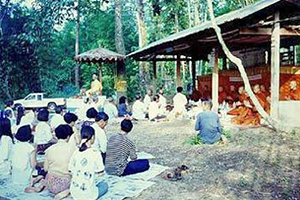
Open Days: Held according to each community’s schedule, usually in April and after the full moon of the twelfth lunar month
Opening Hours: According to the ceremonial schedule of each community
The Merit-Making at the Foot of Trees Tradition in Trat Province is a deeply meaningful local tradition that reflects the relationship between people, community life, nature, Buddhism, and ancestral beliefs in eastern Thailand. The tradition is usually held in April after Songkran merit-making, and in some communities after the full moon of the twelfth lunar month or after Loy Krathong. At its heart, the ceremony is a communal act of gratitude toward sacred spirits believed to dwell in trees, forests, fields, wetlands, canals, ponds, and village landscapes.
This tradition is more than a local religious ceremony. It is a living expression of how the people of Trat have long understood their dependence on land, water, forests, and natural surroundings. Trat is a province shaped by agricultural communities, coastal settlements, fishing villages, old trading routes, and waterways. For local people, nature is not merely a resource to be used. It is part of life, memory, livelihood, and spiritual protection.
The main meaning of the Merit-Making at the Foot of Trees tradition is gratitude. Villagers believe that large trees, forest edges, rice fields, open plains, and water sources may be protected by local spirits. These spirits are often referred to in folk belief as spirits of the forest, salt-lick spirits, field spirits, and rice-field spirits. Through merit-making, villagers express thanks for protection, fertility, good harvests, abundant food, safe livelihoods, and peace within the community.
The ceremony also strengthens social unity. Before the ritual day, villagers agree on the date, divide responsibilities, prepare food, flowers, candles, incense, and ceremonial objects, and assign a suitable person such as a temple steward, village elder, or community representative to invite monks. This shared preparation turns the ceremony into a collective act. Every household can contribute something, whether food, labor, knowledge, or participation.
The timing of the tradition is closely connected to the rhythm of local life. April is the season of Songkran, the Thai New Year, when many families return home, make merit, honor elders, and begin the year with blessings. The period after the full moon of the twelfth lunar month is also significant because it follows the rainy season and the cycle of agricultural work. These seasonal moments give the ceremony a natural place in the annual calendar of the community.
The ritual begins with Buddhist merit-making. Villagers gather at an appointed place, which may be a village hall, a temple, a sacred tree area, or another important communal site. They bring sweet and savory food, flowers, candles, incense, and offerings. Monks are invited to chant, receive offerings, and conduct the religious part of the ceremony. Villagers then pour water as a gesture of transferring merit to ancestors, spirits, and protective beings connected with the community landscape.
After the Buddhist ceremony, villagers perform the boat procession. A small ceremonial boat is made from betel palm sheath and shaped like a vessel by folding or curving both ends. Inside the boat, villagers place flowers, incense, candles, food, shallots, garlic, salt, chili, and other symbolic items. These objects serve both as offerings and as ritual symbols representing nourishment, protection, purification, and the wish to send misfortune away.
The procession moves toward a natural water source such as a stream, pond, canal, or marsh. In some communities, villagers beat wooden instruments at the front of the procession. This sound marks the movement of the group and gives the ceremony a distinct local character. When the group reaches the water, the ceremonial boat is released. Villagers dedicate the merit to the spirits of the forest, fields, and waterways, while symbolically sending away illness, misfortune, and harmful influences.
The floating of the palm-sheath boat is one of the most important moments of the tradition. As the boat drifts away, it represents the removal of suffering from the village. It also reflects a belief that human well-being is connected to unseen forces and to the balance of the natural world. The use of biodegradable local materials such as palm sheath also reveals traditional ecological wisdom, as the ceremony relies on natural objects rather than harmful materials.
When the boat-releasing ritual is completed, villagers return to the merit-making place and share a communal meal. This final part of the ceremony is not simply about eating together. It is a moment of social bonding, storytelling, and intergenerational learning. Children observe how elders prepare offerings, how monks are invited, how the boat is made, and how people behave respectfully during the ritual. In this way, the tradition is passed on through experience rather than formal instruction alone.
The tradition plays an important role in teaching younger generations to love forests, land, and water. It shows that nature should not be treated as something to exploit without responsibility. Instead, the ceremony teaches respect, gratitude, and care. This makes the Merit-Making at the Foot of Trees tradition one of Trat’s most valuable examples of local environmental wisdom embedded in ritual practice.
Morally, the tradition emphasizes gratitude, generosity, compassion, and coexistence. Villagers do not make merit only for themselves. They make merit for the community, for ancestors, for unseen protectors, and for the shared well-being of the village. This way of thinking helps sustain mutual care among people and reinforces the idea that individual happiness is inseparable from the happiness of others and the health of the natural environment.
The ceremony also demonstrates the harmonious blending of Buddhism and folk belief in Thai local culture. The first part of the ritual follows Buddhist practice through chanting, offerings, merit-making, and water-pouring. The second part, involving the procession and boat release, reflects older local beliefs in spirits and sacred landscapes. Rather than contradicting each other, these elements coexist and give the tradition its full cultural meaning.
For foreign travelers, this tradition offers a rare opportunity to understand local Thai culture beyond temples and beaches. Trat is often known for islands such as Ko Chang, Ko Kut, and Ko Mak, but its mainland communities also preserve rich cultural practices. The Merit-Making at the Foot of Trees tradition reveals a quieter and more intimate side of the province, where spirituality, ecology, and village life are closely connected.
Travelers who wish to observe the tradition should check the local schedule in advance because the ceremony is not held as a fixed tourist event in every place. It depends on the calendar and readiness of each village. Areas associated with similar boat-releasing and merit-making practices include communities in Mueang Trat District, Huai Nam Khao, Nong Sano, Khlong Yai District, and some areas in Laem Ngop District.
Getting There is easiest by traveling first to Trat town. From Bangkok, visitors can drive east via Chon Buri, Rayong, and Chanthaburi before reaching Trat, or take an interprovincial bus to Trat Bus Terminal. From there, local transport, hired vehicles, or community arrangements may be needed to reach the village where the ceremony is held. Since the date varies by community, travelers should confirm the schedule before making the trip.
Visitors should dress politely, behave respectfully, and avoid disturbing the procession or ritual objects. Photography should be done with discretion, especially during the Buddhist chanting and boat-releasing moments. A respectful attitude allows travelers to experience the ceremony meaningfully while preserving the dignity and sacredness of the local tradition.
The Merit-Making at the Foot of Trees tradition in Trat Province is worth preserving because it brings together gratitude, Buddhist merit-making, community cooperation, ecological awareness, and local belief in one deeply rooted ceremony. In a time when many people are increasingly distant from nature, this tradition reminds us that forests, land, and water are not only natural resources, but living foundations of culture, memory, and community life.
| Name | Merit-Making at the Foot of Trees Tradition, Trat Province |
| Location | Local communities in Trat Province, with related practices found in Mueang Trat, Khlong Yai, and Laem Ngop areas |
| Time Of Year | Usually in April after Songkran merit-making, and in some communities after the full moon of the twelfth lunar month or after Loy Krathong |
| Highlights | Buddhist merit-making, palm-sheath boat procession, boat release into natural water sources, and dedication of merit to forest, field, and water spirits |
| Cultural Meaning | A ceremony of gratitude toward nature, protective spirits, ancestors, and the shared environment of the village |
| Main Rituals | Villagers offer food and ceremonial items to monks, pour water to transfer merit, join a boat procession, and release a palm-sheath boat into a stream, pond, canal, or marsh |
| Ritual Objects | Palm-sheath boat, flowers, incense, candles, sweet and savory food, shallots, garlic, salt, chili, and traditional merit-making offerings |
| Beliefs | Belief in spirits of forests, salt licks, fields, rice fields, trees, and water sources that protect the community |
| Caretaker / Organizer | Local communities, temple stewards, village leaders, and appointed community representatives who coordinate monks and ceremonial preparation |
| Fees | No admission fee for respectful observation in the community |
| Main Areas / Zones | Merit-making area or village hall, offering area for monks, procession assembly point, and water source used for the boat-releasing ritual |
| Facilities | Facilities vary by community. Trat town provides restaurants, accommodations, temples, local attractions, and tourism services |
| Travel Information | Travel first to Trat town by private car or interprovincial bus, then continue by local transport or hired vehicle to the community where the ceremony is held |
| Tourism Information | Tourism Authority of Thailand, Trat Office, Tel. 039-597-259 |
| Nearby Tourist Attractions | 1. Trat City Pillar Shrine, about 0 km 2. Wat Yothanimit, about 1 km 3. Wat Phai Lom, about 1 km 4. Trat City Museum, about 1 km 5. Wat Buppharam, about 2 km 6. Ban Nam Chiao Community, about 10 km |
| Nearby Restaurants | 1. Kaikon Seafood Trat, about 2 km, Tel. 064-574-9075 2. Tewtara, about 12 km, Tel. 080-575-3598, 039-593-669, 063-047-1204 3. Pook Yen Ta Fo Noodle, about 1 km 4. Let’s Meat, about 2 km 5. Orchid Restaurant & Guesthouse, about 2 km |
| Nearby Accommodations | 1. Trat Center Hotel, about 1 km, Tel. 039-531-234, 086-749-8899 2. Trat City Hotel, about 2 km, Tel. 039-510-711 3. Avada Hotel Trat, about 4 km, Tel. 039-510-345, 082-006-1308 4. BaanRimNam Resort Trat, about 1 km, Tel. 091-232-8848 5. Rimklong Boutique Hotel Trat, about 1 km |
Frequently Asked Questions (FAQ)
Q: What is the Merit-Making at the Foot of Trees tradition in Trat?
A: It is a local tradition in Trat Province in which villagers make merit and dedicate blessings to protective spirits believed to dwell in trees, forests, fields, and water sources.
Q: When is the tradition usually held?
A: It is usually held in April after Songkran merit-making and, in some communities, after the full moon of the twelfth lunar month or after Loy Krathong.
Q: Why do villagers release a palm-sheath boat?
A: The boat symbolizes the sending away of illness, misfortune, and negative influences, while merit is dedicated to protective spirits of the forest, fields, and waterways.
Q: What objects are used in the ceremony?
A: Common ritual objects include a palm-sheath boat, flowers, candles, incense, sweet and savory food, shallots, garlic, salt, chili, and traditional offerings.
Q: Why is this tradition important to the local community?
A: It strengthens community unity, teaches gratitude toward nature, and passes on values of generosity, respect, and environmental care to younger generations.
Q: Can foreign travelers observe the ceremony?
A: Yes, when the community allows visitors to observe. Travelers should check the local schedule in advance, dress politely, and follow community etiquette.
Q: How can travelers reach the communities that hold the ceremony?
A: Travelers should first reach Trat town by car or bus, then continue by local transport or hired vehicle to the specific village where the ceremony is held.
Q: Is this the same as the boat-releasing tradition?
A: The boat release is an important ritual element within or closely related to the tradition. Merit-making at the foot of trees focuses on gratitude toward sacred natural forces, while the boat release symbolizes sending misfortune away through water.
 Category: ●Art, Culture and Heritage
 Group: ●Art, Craft Centres, Tradition
Last Update : 4 MonthAgo
 Last Update : 4 MonthAgo
Recommend

 Historical Sites and Monuments(1)
 Landmarks and Memorials(1)
Art, Craft Centres, Tradition(3)
Landmarks and Memorials(1)
Art, Craft Centres, Tradition(3)
 Museums(2)
 Educational Places
 Museum for Study(1)
 Educational Gardens, Farm(2)
 Places of Worship
 Temple(11)
 Mosque(2)
 Other Sacred Sites(2)
 Suburban Living
 Village, Community(6)
 Local Market(2)
 Nature and Wildlife
 National Parks and Marine Reserves(2)
 Mountain (Doi)(1)
 Dam, Reservoir, Lake(3)
 Waterfalls(15)
 River, Canal(1)
 Bays and Beaches(21)
 Islands(19)
 Other natural attractions(12)
 Entertainment and Agricultural
 Outdoor and Adventure Activities(1)
 Shopping
 Shopping and Night Market(1)


