
lovethailand home >Eastern Travel Attractions >Trat Travel Attractions >Bo Rai >Bo Phloi > Gem City Museum
TL;DR: Gem City Museum is located at Bo Phloi Subdistrict, Bo Rai District, Trat Province 23140, open Tuesday – Sunday, hours 09.00 – 16.30. Highlights include Realistic wax figures showing gemstone mining, gem selection, heat treatment, and gem cutting.
Gem City Museum
Open Days: Tuesday – Sunday
Opening Hours: 09.00 – 16.30
Gem City Museum in Trat Province is located in Bo Phloi Subdistrict, Bo Rai District, Trat Province. It is an important local learning center created to preserve the memory of Bo Rai’s gemstone-mining history, a chapter of the province that has largely disappeared from everyday life. The museum is especially meaningful because Bo Rai was once known as a prosperous gemstone area, particularly for Siamese rubies. People from many parts of Thailand came to the area to dig for gems, work in mines, trade stones, and build livelihoods connected with the gemstone economy.
The museum was officially opened to visitors on 1 March 2013. Its purpose is to help later generations understand the importance of gemstone mining in Bo Rai and the surrounding communities. What was once a lively mining landscape has now become a story of memory, local identity, and cultural preservation. Gem City Museum serves as a bridge between the past and the present, allowing visitors to see how gemstones shaped the lives, hopes, and economy of this part of Trat.
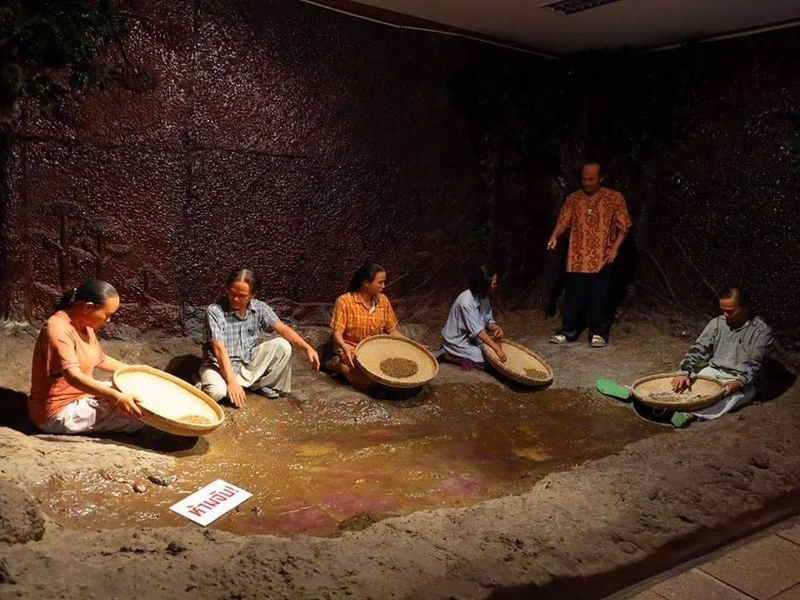
The highlight of the museum is its use of realistic wax figures arranged in various scenes. These figures recreate the working life of gemstone miners and people involved in the gem trade. Visitors can follow the story from the search for gemstones and the mining process to gem selection, heat treatment, and finally cutting and polishing. This visual style makes the museum easy to understand even for travelers who have never studied gem mining before.
As visitors walk through the exhibition, they are introduced to the atmosphere of Bo Rai during its gemstone era. In the past, Bo Phloi and nearby areas were rich in gemstones, attracting people seeking fortune beneath the soil. Some worked directly in mining pits, some sold tools and food, some became gem traders, and others developed skills in burning and cutting stones. The museum helps visitors imagine how a rural district became a busy place because of natural resources hidden underground.
The first part of the exhibition focuses on gemstone searching and mining. This process required physical strength, patience, skill, and knowledge of the land. Miners needed to understand soil layers, dig carefully, and wash or sift earth and gravel to separate possible gemstones from ordinary stones. The wax figures and explanatory panels help visitors see that every gemstone required hard labor long before it became beautiful enough to be worn as jewelry.
The next stage is gemstone selection. Raw gemstones vary in color, clarity, weight, cracks, and internal structure. Experienced workers had to examine each stone carefully and decide which pieces were worth treating, which could be cut, and which were less valuable. This stage reflects local wisdom and professional judgment. It shows that gemstones are not valued only by their natural origin, but also by the knowledge used to recognize their hidden potential.
One of the most important parts of Bo Rai’s gem story is heat treatment. Heating gemstones is a distinctive local process used to improve color, brightness, and market value. A raw stone that appears less impressive may become more attractive after proper treatment. The museum presents this process through models, images, and explanations, helping visitors understand that beautiful gemstones are shaped by both nature and human expertise.
The final stage of the exhibition shows gem cutting and polishing. This is where a raw stone is transformed into a refined gemstone with shape, shine, and visual depth. Cutting requires precision, patience, and a clear understanding of light, angles, and the structure of each stone. A skilled cutter must decide how to bring out the best beauty of each gemstone. This section makes visitors appreciate the craftsmanship behind every finished gem.
In addition to wax figures, each exhibition corner includes photographs and explanatory captions. These help visitors follow the story in sequence, from the background of Bo Rai as a gemstone town to the techniques used in mining and gem processing. The presentation is simple, direct, and educational, making the museum suitable for families, students, cultural travelers, and anyone interested in the history of Thai gemstones.
Gem City Museum is valuable because it preserves local economic history. Bo Rai was not only a rural district of Trat; it was once part of Thailand’s gemstone economy. Many ordinary people were connected to the mining boom, including miners, traders, heat-treatment workers, cutters, business owners, and families whose lives changed as the gem trade rose and declined. The museum records this human side of history rather than presenting gemstones only as luxury objects.
For travelers interested in local culture, the museum explains how natural resources can transform a small town. When gemstones were abundant, Bo Rai became lively with trade, labor, services, and dreams of fortune. When resources declined and the economy changed, the town had to adapt. The museum therefore tells both sides of the story: prosperity and transition, opportunity and memory, wealth and the passing of time.
As a travel destination, Gem City Museum can be included in a cultural route through Bo Rai District and eastern Trat. Visitors can spend time learning about gemstone history before continuing to natural attractions, waterfalls, border areas, or local communities nearby. This makes a trip to Trat more meaningful because it reveals a side of the province beyond islands, beaches, and coastal scenery.
Visitors should spend time especially in the mining simulation zone, where wax figures show the working postures and tools used in the past. The gem selection and heat-treatment zones are suitable for those interested in gem knowledge, while the cutting and polishing section shows the final transformation of raw stones into beautiful gemstones. Reading the captions while viewing the displays gives a fuller understanding of the entire process.
The museum is also suitable for educational visits. It connects natural resources, local history, community economy, craftsmanship, and cultural memory in one place. Students can learn how local resources affected people’s livelihoods and why preserving community history matters. Although the mining era has passed, its knowledge and memory can still become cultural value for the present generation.
Visitors should plan their trip according to the museum’s opening days. Gem City Museum is open from Tuesday to Sunday, from 09.00 to 16.30, and is closed on Mondays and public holidays. There is no admission fee, making it an accessible learning destination for families, schools, and travelers who want to understand Trat’s gemstone heritage.
Getting There is convenient by private car or rental car. Travelers can follow Sukhumvit Road toward Trat, continue through the Saen Tung junction, then turn toward Bo Rai District and Bo Phloi Subdistrict. The route is suitable for a day trip from Trat town or as part of a longer itinerary linking Bo Rai with natural attractions, waterfalls, and local communities in the province.
What makes Gem City Museum important is not only its wax figures or gemstone displays. Its deeper value lies in preserving the memory of a town once shaped by gems. When the mining era faded, this museum became a place where visitors could still understand the labor, hope, risk, skill, and local wisdom behind every gemstone. A ruby or gem is not only beautiful; it carries the story of people and place.
For international travelers who want to see a different side of Trat, Gem City Museum is a worthwhile stop. It reveals Trat as a province of local history, natural resources, craftsmanship, and community identity. A visit here adds depth to any journey through eastern Thailand and offers a meaningful alternative to the province’s more familiar coastal attractions.
| Name | Gem City Museum, Trat Province |
| Location | Bo Phloi Subdistrict, Bo Rai District, Trat Province 23140 |
| Address | Gem City Learning Center, Moo 9, Bo Phloi Subdistrict, Bo Rai District, Trat Province 23140 |
| Highlights | Realistic wax figures showing gemstone mining, gem selection, heat treatment, and gem cutting |
| History | Officially opened on 1 March 2013 to preserve the history of gemstone mining in Bo Rai, once an important source of Siamese rubies in Trat Province |
| Name Origin | The name refers to Bo Rai’s past as a gemstone town known for gem mining and Siamese rubies |
| Distinctive Features | Uses wax figures, photographs, and explanatory panels to tell the story of gemstones from mining to cutting |
| Main Areas / Zones | Bo Rai gemstone history zone, mining simulation zone, gem selection zone, heat-treatment zone, cutting and polishing zone, and photo-caption learning corners |
| Caretaker | Local administrative organization / Bo Phloi Subdistrict Municipality |
| Current Status | Open to visitors |
| Open Days | Tuesday – Sunday, closed on Mondays and public holidays |
| Opening Hours | 09.00 – 16.30 |
| Fees | No admission fee |
| Main Contact Number | 0 3959 1111 ext. 15 |
| Facilities | Indoor exhibition space, explanatory panels, photographs, local history learning corners, and educational visit areas |
| Travel Information | Follow Sukhumvit Road toward Trat, pass the Saen Tung junction, then turn toward Bo Rai District and Bo Phloi Subdistrict. Best reached by private car, rental car, or local hired vehicle |
| Nearby Tourist Attractions | 1. Wat Bo Phloi, about 2 km 2. Namtok Khlong Kaeo National Park, about 15 km 3. Khlong Kaeo Waterfall, about 18 km 4. Ban Hat Lek Border Market, about 70 km 5. Ban Chang Thun Community, about 80 km 6. Trat Town, about 60 km |
| Nearby Restaurants | 1. Mawa Cafe, about 8 km, Tel. 082-364-0944 2. Local Restaurants in Bo Rai Town, about 3 km 3. Noodle and Made-to-Order Food Shops in Bo Rai, about 3 km 4. Cafes in Bo Rai Area, about 5 km 5. Local Restaurants Along Bo Rai-Saen Tung Route, about 10 km |
| Nearby Accommodations | 1. Borai Resort, about 5 km, Tel. 086-563-0955, 085-054-4555 2. Bai Boon Resort, about 6 km 3. Baan Roi Pi Riverside Resort Huai Raeng, about 45 km, Tel. 081-308-9823, 081-351-5672 4. Trat Center Hotel, about 60 km 5. Trat City Hotel, about 60 km |
Frequently Asked Questions (FAQ)
Q: Where is Gem City Museum located?
A: Gem City Museum is located in Bo Phloi Subdistrict, Bo Rai District, Trat Province 23140.
Q: What days is Gem City Museum open?
A: The museum is open from Tuesday to Sunday, from 09.00 to 16.30, and is closed on Mondays and public holidays.
Q: Is there an admission fee?
A: No. The museum does not charge an admission fee, making it suitable for families, students, and cultural travelers.
Q: What can visitors see inside the museum?
A: Visitors can see realistic wax figures, photographs, and explanations about gemstone searching, mining, selection, heat treatment, and cutting.
Q: Why is Gem City Museum important to Trat Province?
A: It preserves the history of Bo Rai’s gemstone mining era, when the district was known as an important source of Siamese rubies.
Q: How can visitors get to Gem City Museum?
A: Travelers can follow Sukhumvit Road toward Trat, pass the Saen Tung junction, then turn toward Bo Rai District and Bo Phloi Subdistrict. A private car or rental car is recommended.
Q: How long should visitors spend at the museum?
A: Visitors should allow about 1 – 2 hours to view the exhibition, read the captions, and understand the complete gemstone-mining process.
Q: What nearby attractions can be visited after Gem City Museum?
A: Nearby places include Wat Bo Phloi, Namtok Khlong Kaeo National Park, Khlong Kaeo Waterfall, and other attractions in Bo Rai and Trat Province.
Tel : 039591111
 Tel : 039591111
 Category: ●Art, Culture and Heritage
 Group: ●Museums
Last Update : 4 MonthAgo
 Last Update : 4 MonthAgo
 Click to Access the Navigation Map GPS
 Historical Sites and Monuments(1)
 Landmarks and Memorials(1)
 Art, Craft Centres, Tradition(3)
Museums(2)
Art, Craft Centres, Tradition(3)
Museums(2)
 Educational Places
 Museum for Study(1)
 Educational Gardens, Farm(2)
 Places of Worship
 Temple(11)
 Mosque(2)
 Other Sacred Sites(2)
 Suburban Living
 Village, Community(6)
 Local Market(2)
 Nature and Wildlife
 National Parks and Marine Reserves(2)
 Mountain (Doi)(1)
 Dam, Reservoir, Lake(3)
 Waterfalls(15)
 River, Canal(1)
 Bays and Beaches(21)
 Islands(19)
 Other natural attractions(12)
 Entertainment and Agricultural
 Outdoor and Adventure Activities(1)
 Shopping
 Shopping and Night Market(1)
 Travel Articles, Recipes
 Travel Review, Food Review(1)


