
lovethailand home >Eastern Travel Attractions >Trat Travel Attractions >Khao Saming >Wang Takhian > Wat Si Bua Thong
TL;DR: Wat Si Bua Thong is located at Moo 3, Wang Takhian Subdistrict, Khao Saming District, Trat Province, open Daily, hours Daytime.
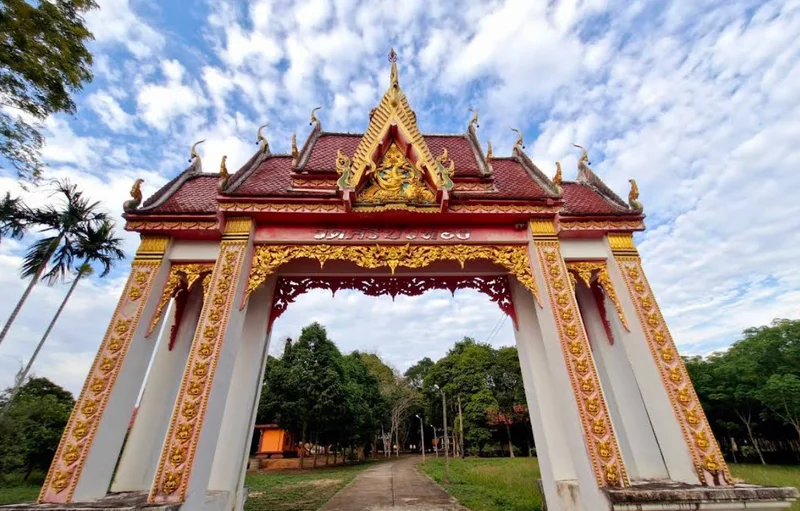
Wat Si Bua Thong
Open Days: Daily
Opening Hours: Daytime
Wat Si Bua Thong in Trat Province is an old rural Buddhist temple in Wang Takhian Subdistrict, Khao Saming District. The temple is known for its ancient ordination hall, old boundary stones, and quiet local atmosphere. It is a meaningful destination for travelers who want to explore Trat beyond islands and beaches, especially those interested in old temples, Buddhist boundary stones, rural heritage, and hidden cultural sites in eastern Thailand.
Located in Moo 3, Wang Takhian Subdistrict, Wat Si Bua Thong is part of a local community landscape in Khao Saming District. The surrounding area includes village roads, agricultural land, local houses, temples, and routes connecting Khao Saming with Trat town. This setting makes the temple a good stop for visitors who enjoy quiet cultural travel rather than crowded tourist attractions.
The most important features of Wat Si Bua Thong are its old ordination hall and ancient boundary stones. In Thai Buddhist tradition, an ordination hall is not only a temple building. It is a sacred area used for important monastic ceremonies such as ordination and official acts of the Sangha. Boundary stones, known in Thai as sema stones, mark the sacred boundary of this ceremonial space. Their presence shows that the temple has long served an important religious function in the community.
For international travelers, the boundary stones are especially worth noticing. They are not decorative objects placed randomly around the temple. They define the Buddhist ritual boundary of the ordination hall and reflect the formal religious status of the space. At old temples, ancient sema stones can help visitors understand how Buddhist sacred geography is organized in Thailand.
Local historical information describes Wat Si Bua Thong as having been built by a figure known as Phraya Changwang, probably during the reign of King Rama 4. This period places the temple within a wider historical context of rural administration, local communities, routes, and taxation systems in eastern Thailand. The nearby place name connected with a tax or tribute canal also suggests the relationship between temple, settlement, waterways, and local governance in the past.
The name “Si Bua Thong” has a graceful Buddhist meaning. “Si” conveys auspiciousness, beauty, and prosperity, while “Bua Thong” refers to a golden lotus. In Buddhism, the lotus is a powerful symbol of purity and spiritual growth. The temple name therefore gives the place a peaceful and auspicious identity, suitable for a temple that has long served as a spiritual center for the local community.
Wat Si Bua Thong is not a temple that impresses visitors through grandeur or commercial tourism. Its appeal lies in its quietness, age, and local character. The temple remains connected to village life and local Buddhist practice. Visitors can come to pay respect to the Buddha, observe the old ordination hall and boundary stones, and experience the calm atmosphere of a rural temple in Trat.
The old ordination hall is the main area to observe. Travelers should look at the building form, proportions, orientation, and the placement of the boundary stones around it. These details reveal that Thai temple architecture is not only about visual beauty. It is also structured by Buddhist ritual rules, sacred space, and community use. The more carefully visitors look, the more clearly the meaning of the temple becomes visible.
The old sema stones are among the most valuable elements of the temple. They mark the sacred boundary of the ordination hall and indicate the space where formal monastic ceremonies take place. In this sense, the stones are important evidence of the temple’s religious continuity. They show that Wat Si Bua Thong has functioned as more than a simple village worship area; it has been a formal Buddhist ceremonial site.
The artistic value of the old ordination hall and sema stones also deserves attention. Although detailed academic dating of the stones is limited in public sources, their presence gives the temple local heritage value. They show how rural temples in Trat preserved religious architecture and sacred markers across generations. For visitors interested in local craftsmanship and Buddhist heritage, Wat Si Bua Thong offers a quiet but meaningful study site.
The temple’s history includes several monks and abbots who cared for the site over time. Local accounts mention Luang Pu Rang, Luang Pu Di, Luang Pu Mong, Acharn Mom, and Acharn Thuan. The temple was later abandoned for a period and then developed again through the efforts of Luang Pu Nil, Acharn Thueang, Acharn Plik, Acharn Khamla, and Phra Acharn Somsak Sujitto. This story reflects the changing life of many old rural temples: periods of prosperity, decline, abandonment, and revival.
The revival of Wat Si Bua Thong is important because it shows how temples survive through the faith and care of monks and local communities. Old temples can disappear from memory if they are not maintained. When monks and villagers restore them, they become living religious places again. Wat Si Bua Thong is therefore not only an old temple; it is a place that has been preserved through community devotion.
Today, Wat Si Bua Thong is a local Buddhist temple under the Mahanikaya order. It continues to serve the Wang Takhian community. Visitors can come for merit-making, quiet reflection, and cultural observation. This is a temple best experienced slowly. Its value is not found in quick sightseeing, but in understanding the old ordination hall, the sema stones, the village setting, and the temple’s connection with local history.
Wat Si Bua Thong is also connected with local memory of Luang Pu Nil Thammavaro, a monk associated with the revival period of the temple and remembered by local devotees. Such stories add another layer of spiritual significance. A temple is not only made of buildings and stones; it is also shaped by monks, devotees, ceremonies, memories, and faith passed down through generations.
For travelers planning a cultural route in Khao Saming District, Wat Si Bua Thong can be combined with nearby temples and sites such as Wat Wang Takhian, Wat Saen Tung, Wat Lamphurai, Wat Mueang Kao Saen Tum, Khao To Mo Archaeological Site, and Trat town. This route helps visitors understand the quieter inland side of Trat Province, which is often overlooked by travelers heading directly to the islands.
Khao Saming District has a rich rural landscape of communities, temples, farms, roads, and local markets. Wat Si Bua Thong adds cultural depth to this district. Many travelers know Trat mainly as a gateway to Ko Chang, Ko Kut, or Laem Ngop, but inland areas such as Wang Takhian show another identity of the province: local temples, village heritage, and Buddhist community life.
For students, cultural travelers, and researchers, Wat Si Bua Thong is useful as a case study of an old community temple. It helps explain how temples are founded, how ordination boundaries are marked, how local abbots shape temple history, how abandoned temples are revived, and how Buddhism remains connected with everyday rural life. Learning from a real place like this makes local history easier to understand.
Visitors should dress respectfully and behave quietly because Wat Si Bua Thong is an active religious site. When observing the old ordination hall and boundary stones, do not climb, scratch, move, or touch the old elements carelessly. Photography should be done respectfully and should not disturb monks or worshippers. These simple practices help preserve the temple and show respect for the local community.
Getting There is most convenient by private car or rental car. From Trat town or Khao Saming, travel toward Wang Takhian Subdistrict and set the destination as Wat Si Bua Thong, Wang Takhian, Khao Saming, Trat. Local hired vehicles can also be arranged from Khao Saming or Trat town. A private vehicle is recommended because it allows visitors to combine the temple with other nearby cultural sites.
The best time to visit is in the morning or late afternoon, when the weather is more comfortable for walking around the temple. These times also provide softer light for photography. Visitors should allow enough time to pay respect to the Buddha, observe the ordination hall, look at the sema stones, and experience the quiet rural atmosphere of the temple.
Wat Si Bua Thong is suitable for a half-day cultural route. Travelers can visit the temple, have a meal in Khao Saming or Wang Takhian, and continue to other temples or Trat town. Those planning to travel onward to Ko Chang or Laem Ngop may also stay in Khao Saming or Trat town before continuing their journey the next day.
The main strength of Wat Si Bua Thong is its quiet heritage value. It is not crowded and not highly commercialized. This makes it appealing to travelers who prefer hidden cultural places, old Buddhist architecture, and authentic local temple life. A visit here helps reveal that Trat Province has deep rural and religious heritage, not only coastal scenery and island tourism.
For international travelers, Wat Si Bua Thong can be understood as an old rural Buddhist temple with an ancient ordination hall and boundary stones. It is especially suitable for visitors interested in local temple culture, Buddhist sacred boundaries, rural heritage, and hidden cultural attractions in Trat. The experience is quiet, respectful, and culturally meaningful.
In summary, Wat Si Bua Thong is an important old temple in Wang Takhian Subdistrict, Khao Saming District, Trat Province. Its highlights include the old ordination hall, ancient sema stones, local history connected with the reign of King Rama 4, and the revival of the temple through generations of monks and villagers. It is recommended for travelers who want to explore the deeper cultural side of Trat in a calm and meaningful way.
| Name | Wat Si Bua Thong |
| Location | Moo 3, Wang Takhian Subdistrict, Khao Saming District, Trat Province |
| Address | Wang Takhian Subdistrict, Khao Saming District, Trat 23130, Thailand |
| Coordinates | Latitude 12.473916284, Longitude 102.484167412 |
| Highlights | Old rural Buddhist temple in Wang Takhian with an ancient ordination hall, old sema boundary stones, peaceful village atmosphere, and local history linked with the reign of King Rama 4 |
| History | Local accounts describe Phraya Changwang as the temple founder, probably during the reign of King Rama 4. The temple is also associated with a nearby tribute or tax canal known in local memory |
| Name Origin | The name Si Bua Thong conveys auspiciousness and the golden lotus, a key symbol of purity and spiritual growth in Buddhism |
| Distinctive Features | Old ordination hall, ancient sema stones, sacred boundary area, and authentic local temple atmosphere in Wang Takhian community |
| Travel Information | From Trat town or Khao Saming, travel toward Wang Takhian Subdistrict and set the destination as Wat Si Bua Thong, Wang Takhian, Khao Saming, Trat. A private car, rental car, or local hired vehicle is recommended |
| Current Status | Active local Buddhist temple in Wang Takhian Subdistrict, Khao Saming District, Trat Province |
| Open Days | Daily |
| Opening Hours | Daytime |
| Facilities | Worship Area, Old Ordination Hall Area, Ancient Boundary Stone Area, Parking Area Inside The Temple |
| Main Areas / Zones | Old Ordination Hall, Ancient Sema Stones, Sacred Boundary Area, Worship Area, Local Temple Grounds |
| Abbot / Caretaker | Phra Thammathon Somsak Sujitto |
| Nearby Tourist Attractions | 1. Wat Wang Takhian, About 2 km 2. Wang Takhian Subdistrict Administrative Organization, About 4 km 3. Wat Saen Tung, About 10 km 4. Wat Lamphurai, About 12 km 5. Wat Mueang Kao Saen Tum And Khao To Mo Archaeological Site, About 30 km 6. Trat Town, About 28 km |
| Nearby Restaurants | 1. Pad Thai Hoi Tod Si Bua Thong, About 2 km, Tel. 084-874-8289 2. Kuay Tiew Ruea Nai Kor, About 14 km 3. Krua Lamphurai Riverside, About 15 km, Tel. 063-190-1099 4. Esther Home Cafe, About 18 km 5. Berry Cafe, About 18 km 6. Café Amazon Khao Saming Branch, About 18 km |
| Nearby Accommodations | 1. Palm Suay Resort, About 16 km, Tel. 039-599-399, 092-996-6288 2. Lamphurai Riverside Resort & Spa, About 15 km, Tel. 063-190-1099 3. Khao Saming Paradise Resort, About 18 km 4. Villa Green Leaf Saen Tung, About 12 km 5. Garden Home Saen Tung, About 12 km 6. Accommodations In Trat Town, About 28 km |
Frequently Asked Questions (FAQ)
Q: Where is Wat Si Bua Thong located?
A: Wat Si Bua Thong is located in Moo 3, Wang Takhian Subdistrict, Khao Saming District, Trat Province. It is a local Buddhist temple in the Wang Takhian community.
Q: What is the main highlight of Wat Si Bua Thong?
A: The main highlights are the old ordination hall, ancient sema boundary stones, sacred boundary area, and peaceful rural temple atmosphere.
Q: How old is Wat Si Bua Thong?
A: Local accounts describe the temple as being founded by Phraya Changwang, probably during the reign of King Rama 4. The old ordination hall and boundary stones reflect its long history.
Q: Why are the sema stones important?
A: Sema stones mark the sacred boundary of the ordination hall where formal Buddhist monastic ceremonies take place. They are important evidence of the temple’s religious function.
Q: What type of travelers should visit Wat Si Bua Thong?
A: The temple is suitable for travelers interested in old temples, local Buddhist culture, rural heritage, boundary stones, and quiet cultural attractions in Trat.
Q: How can visitors get to Wat Si Bua Thong?
A: From Trat town or Khao Saming, travel toward Wang Takhian Subdistrict and set the destination as Wat Si Bua Thong, Wang Takhian, Khao Saming, Trat. A private car or local hired vehicle is recommended.
Q: What nearby places can be combined with Wat Si Bua Thong?
A: Nearby places include Wat Wang Takhian, Wat Saen Tung, Wat Lamphurai, Wat Mueang Kao Saen Tum, Khao To Mo Archaeological Site, and Trat town.
Q: What should visitors be careful about when visiting?
A: Visitors should dress respectfully, avoid climbing or touching old boundary stones carelessly, keep quiet, and respect the temple as an active religious site.
 Category: ●Places of Worship
 Group: ●Temple
Last Update : 4 MonthAgo
 Last Update : 4 MonthAgo
 Click to Access the Navigation Map GPS
 Art, Culture and Heritage
 Historical Sites and Monuments(1)
 Landmarks and Memorials(1)
 Art, Craft Centres, Tradition(3)
 Museums(2)
 Educational Places
 Museum for Study(1)
 Educational Gardens, Farm(2)
Temple(11)
Educational Gardens, Farm(2)
Temple(11)
 Mosque(2)
 Other Sacred Sites(2)
 Suburban Living
 Village, Community(6)
 Local Market(2)
 Nature and Wildlife
 National Parks and Marine Reserves(2)
 Mountain (Doi)(1)
 Dam, Reservoir, Lake(3)
 Waterfalls(15)
 River, Canal(1)
 Bays and Beaches(21)
 Islands(19)
 Other natural attractions(12)
 Entertainment and Agricultural
 Outdoor and Adventure Activities(1)
 Shopping
 Shopping and Night Market(1)


