
lovethailand home >Eastern Travel Attractions >Trat Travel Attractions >Muang Trat >Laem Klat > Wat Saphan Hin
TL;DR: Wat Saphan Hin is located at 9 Moo 5, Ban Saphan Hin, Laem Klat Subdistrict, Mueang Trat District, Trat Province 23000, open Daily, hours 08.00 – 17.00.
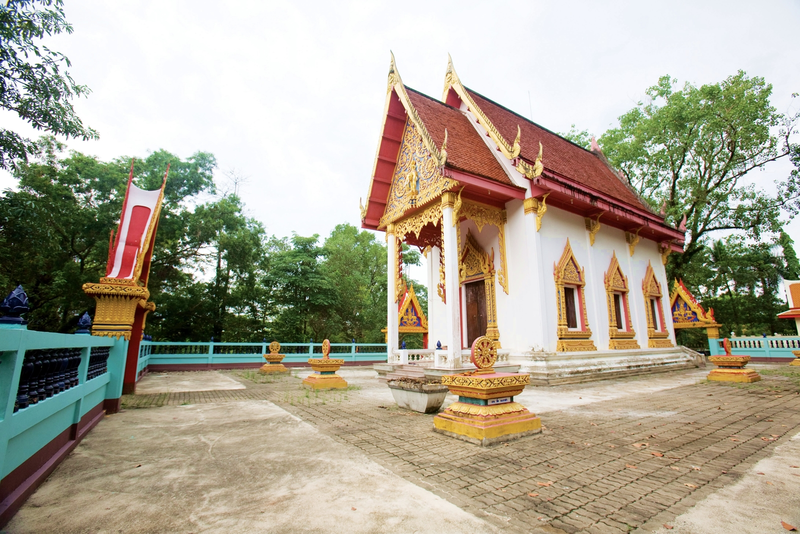
Wat Saphan Hin
Open Days: Daily
Opening Hours: 08.00 – 17.00
Wat Saphan Hin in Trat Province is an old community temple located in Laem Klat Subdistrict, Mueang Trat District, along Highway 318 on the Trat-Khlong Yai route. The temple is situated around Km. 31-32 of the road heading toward Khlong Yai District. Although there is no clear historical record confirming exactly when the temple was founded, it is believed to be more than 100 years old. One of the most important pieces of evidence is the old ordination hall, built in 1913, which remains a meaningful landmark of the temple.
Wat Saphan Hin is valuable not because of grand decoration or large-scale architecture, but because of its quiet atmosphere, old religious structures, and strong connection with local geography. The temple is associated with a pond, an old ordination hall, a natural stone formation, and a canal that once served the everyday life of local people. This makes it a good destination for travelers who want to experience a local temple with a real sense of place rather than a highly commercialized attraction.
The most distinctive feature of the temple is the old ordination hall located in the middle of a pond. This setting creates a peaceful and almost timeless atmosphere. The water surrounding the building gives the structure a feeling of separation from the outside world, making it a quiet space for reflection. Visitors who enjoy old temples, simple architecture, and calm temple grounds will find this area especially interesting.
The name Saphan Hin means stone bridge. It refers to a natural line of stones about 1 km from the temple that connects two sides of a canal. In the past, local villagers used this stone formation as a route for crossing and traveling between communities. Before modern roads and bridges were common, natural features such as stone ridges, streams, and canals were part of daily transportation. The temple’s name therefore preserves a memory of how people once moved through the landscape.
Wat Saphan Hin is closely connected with the local community. Like many rural Thai temples, it is not only a place for Buddhist rituals. It is also a center for merit-making, ordination ceremonies, community gatherings, local traditions, and the everyday spiritual life of villagers. For generations, the temple has served as a place where families, monks, elders, and young people have gathered during important Buddhist occasions.
The fact that the exact founding date is unknown adds another layer of interest to the temple. Instead of relying on written records alone, visitors can read the history of the place through what remains: the old ordination hall, the temple name, the pond, the stone formation, and the surrounding community. This kind of travel encourages careful observation and helps visitors understand how local history is often preserved through landscape and memory.
Architecturally, the old ordination hall is important as a surviving religious building from the early 20th century. Local temple buildings of this type often reflect the faith, resources, and craftsmanship of the community that built them. They may not be as elaborate as royal temples, but they carry strong local value. Wat Saphan Hin therefore helps visitors understand how small communities in Trat created and maintained sacred spaces through collective faith.
The natural stone formation located about 1 km from the temple is also culturally meaningful. It is not simply a geological feature. It once functioned as part of the local transportation system. The use of this natural crossing shows how communities adapted to their environment before modern infrastructure became dominant. It also explains why the name Wat Saphan Hin is so strongly connected to the area.
For travelers, Wat Saphan Hin is suitable as a cultural stop along the road from Trat town to Khlong Yai. The temple may not be crowded or heavily developed for tourism, but that is part of its charm. It offers a quiet and genuine look at a local temple in eastern Thailand. Visitors can stop to pay respect, see the old ordination hall, learn the story behind the name, and continue toward coastal attractions further south.
The temple is also interesting for photography, especially the old ordination hall in the pond and the quiet temple grounds. Morning light is usually softer and more pleasant for taking photos, while late afternoon offers a cooler atmosphere for walking around. Visitors should move respectfully, avoid disturbing monks or local worshippers, and take care around old structures and water areas.
Wat Saphan Hin can also be used as an educational site for learning about local history, religion, and geography. Students or cultural travelers can study how a temple name reflects the landscape, how old religious buildings preserve community memory, and how natural routes were once used for daily movement. The temple provides a simple but meaningful example of the relationship between Buddhism and local ways of life.
Visitors should observe normal Thai temple etiquette. Dress politely, keep noise low, avoid climbing on old structures, and do not enter restricted areas. If taking photographs inside the temple grounds, do so respectfully and avoid disturbing religious activities. Because this is a living community temple, visitors should remember that the space is used by monks and local residents as part of daily religious life.
Getting There from Trat town is straightforward. Take Highway 318, the Trat-Khlong Yai road, toward Khlong Yai District. The temple is located around Km. 31-32, with a left turn from the main road into the temple. It is best reached by private car, rental car, or local hired vehicle. The route is convenient for travelers continuing to beaches, Khao Lan, Mai Rut, Ban Chuen, and Khlong Yai.
Wat Saphan Hin can be combined with nearby natural and coastal attractions. Travelers can continue to Saphan Hin Waterfall, Lan Sai Beach, Mai Rut Beach, Ban Chuen Beach, the Rachakarun Centre of the Thai Red Cross Society at Khao Lan, and Khlong Yai District. This makes the temple a useful cultural stop on a route that includes old temples, waterfalls, fishing communities, beaches, and humanitarian history.
Overall, Wat Saphan Hin is a quiet but meaningful temple. Its value lies in its age, old ordination hall, pond setting, natural stone bridge, and continuing role in the local community. It is best suited for travelers who appreciate simple historic places, local stories, and authentic temple atmospheres. A visit here adds cultural depth to a journey through southern Trat Province.
A visit to Wat Saphan Hin offers both calm and local understanding. Visitors can see an old temple that has served the community for generations, learn how a natural stone crossing became part of the place name, and appreciate the relationship between Buddhism, landscape, and village life in Trat. It is one of the small but valuable sites that help explain the cultural character of the Trat-Khlong Yai route.
| Name | Wat Saphan Hin, Trat Province |
| Location | 9 Moo 5, Ban Saphan Hin, Laem Klat Subdistrict, Mueang Trat District, Trat Province 23000 |
| Highlights | Historic temple over 100 years old, old ordination hall in the middle of a pond, and a natural stone formation once used as a crossing over a canal |
| History | The exact founding period is unknown, but the temple is believed to be more than 100 years old. The old ordination hall built in 1913 is an important historical feature |
| Name Origin | The name Saphan Hin means stone bridge and refers to a natural stone formation connecting two sides of a canal, once used as a local route |
| Distinctive Features | A local temple connected with water, a pond, a natural stone crossing, and traditional community movement in the past |
| Main Areas / Zones | Old ordination hall in the pond, main temple grounds, worship area, pond area, community religious space, and route toward the natural stone crossing near the canal |
| Abbot / Caretaker | Phra Khru Kittiwat Thamrong, abbot of Wat Saphan Hin |
| Current Status | Open as a community temple, Buddhist worship site, and cultural attraction on the Trat-Khlong Yai route |
| Open Days | Daily |
| Opening Hours | 08.00 – 17.00 |
| Fees | No admission fee |
| Facilities | Temple courtyard, worship area, parking space, and community religious areas |
| Travel Information | From Trat town, take Highway 318 on the Trat-Khlong Yai route. The temple is around Km. 31-32, with a left turn from the main road into the temple |
| Nearby Tourist Attractions | 1. Saphan Hin Waterfall, about 2 km 2. Lan Sai Beach, about 15 km 3. Mai Rut Beach, about 18 km 4. Ban Chuen Beach, about 24 km 5. Rachakarun Centre of the Thai Red Cross Society, Khao Lan, about 24 km 6. Khlong Yai District, about 30 km |
| Nearby Restaurants | 1. Local Food Shops in Ban Saphan Hin, about 1 km 2. Local Restaurants in Laem Klat Community, about 8 km 3. Ta Joke Rong Muek Restaurant, Mai Rut, about 18 km 4. Nong Four Seafood, Ban Chuen Beach, about 24 km, Tel. 090-235-9791 5. Restaurant Inside Rachakarun Centre, about 24 km |
| Nearby Accommodations | 1. Golden Cliff Beach Resort, about 12 km 2. Rachakarun Centre Accommodation, about 24 km, Tel. 087-600-0686, 039-510-821 3. Centara Chaan Talay Resort & Villas Trat, about 25 km, Tel. 039-521-561-70, 090-880-0248 4. Mairood Resort, about 25 km, Tel. 089-841-4858, 092-999-2538 5. The Veranio Resort, about 28 km |
Frequently Asked Questions (FAQ)
Q: Where is Wat Saphan Hin located?
A: Wat Saphan Hin is located at 9 Moo 5, Ban Saphan Hin, Laem Klat Subdistrict, Mueang Trat District, Trat Province, along Highway 318 on the Trat-Khlong Yai route.
Q: How old is Wat Saphan Hin?
A: The temple is believed to be more than 100 years old. Its old ordination hall, built in 1913, is an important historical feature.
Q: What is the main highlight of Wat Saphan Hin?
A: The main highlights are the old ordination hall in the middle of a pond and the natural stone formation once used as a crossing between two sides of a canal.
Q: Why is it called Wat Saphan Hin?
A: The name comes from a natural stone formation that functioned like a stone bridge across a canal and was used by local people as a route in the past.
Q: Who is the abbot of Wat Saphan Hin?
A: The abbot of Wat Saphan Hin is Phra Khru Kittiwat Thamrong.
Q: Is there an admission fee?
A: No. There is no admission fee. Visitors can pay respect, see the old ordination hall, and learn about the local history of the temple.
Q: How can visitors get there from Trat town?
A: From Trat town, take Highway 318 toward Khlong Yai. The temple is around Km. 31-32, with a left turn from the main road into the temple.
Q: What nearby places can be visited after Wat Saphan Hin?
A: Nearby places include Saphan Hin Waterfall, Lan Sai Beach, Mai Rut Beach, Ban Chuen Beach, Rachakarun Centre of the Thai Red Cross Society at Khao Lan, and Khlong Yai District.
 Category: ●Places of Worship
 Group: ●Temple
Last Update : 3 MonthAgo
 Last Update : 3 MonthAgo
 Click to Access the Navigation Map GPS
 Art, Culture and Heritage
 Historical Sites and Monuments(1)
 Landmarks and Memorials(1)
 Art, Craft Centres, Tradition(3)
 Museums(2)
 Educational Places
 Museum for Study(1)
 Educational Gardens, Farm(2)
Temple(11)
Educational Gardens, Farm(2)
Temple(11)
 Mosque(2)
 Other Sacred Sites(2)
 Suburban Living
 Village, Community(6)
 Local Market(2)
 Nature and Wildlife
 National Parks and Marine Reserves(2)
 Mountain (Doi)(1)
 Dam, Reservoir, Lake(3)
 Waterfalls(15)
 River, Canal(1)
 Bays and Beaches(21)
 Islands(19)
 Other natural attractions(12)
 Entertainment and Agricultural
 Outdoor and Adventure Activities(1)
 Shopping
 Shopping and Night Market(1)


