
lovethailand home >Eastern Travel Attractions >Trat Travel Attractions >Muang Trat >Takang > Wat Khiri Wihan (Wat Tha Lean)
TL;DR: Wat Khiri Wihan (Wat Tha Lean) is located at Ban Tha Luean, Chamrak Subdistrict, Mueang Trat District, Trat Province 23000, open Daily, hours 08.00 – 18.00.
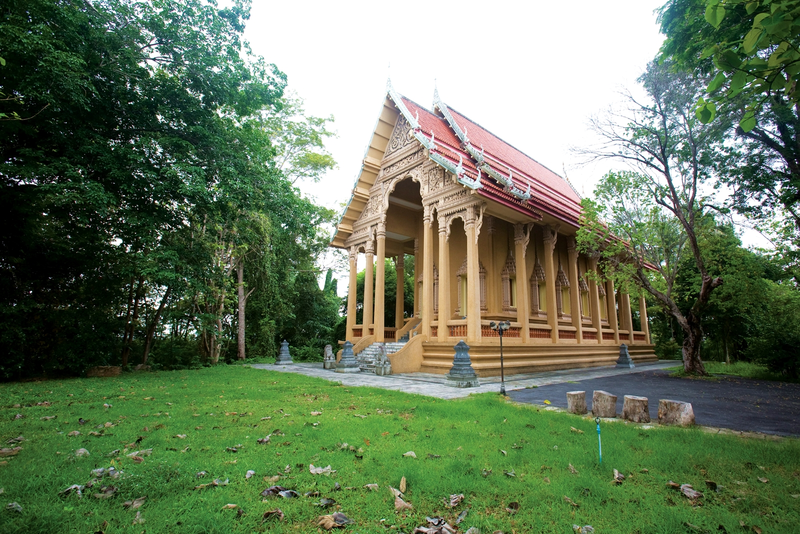
Wat Khiri Wihan (Wat Tha Lean)
Open Days: Daily
Opening Hours: 08.00 – 18.00
Wat Khiri Wihan in Trat Province, also written in official Thai sources as Wat Khiriwihan or Wat Kiri Wihan, is one of the most important old temples in Trat. Formerly known as Wat Tha Luean or Wat Phu Khao Yuan, the temple is located at Ban Tha Luean in Chamrak Subdistrict, Mueang Trat District. With a history dating back to 1886, it has stood for more than 110 years and remains a meaningful Buddhist site where local history, faith, architecture, and natural scenery come together.
The temple is built on a hill, giving visitors a wide view of the surrounding landscape. From the temple grounds, visitors can see forested areas, hills, local communities, and glimpses of the sea below. This hilltop setting gives Wat Khiri Wihan a peaceful atmosphere that feels different from temples in the town center. It is suitable for travelers who want to make merit, pay respect to sacred images, enjoy a quiet viewpoint, and explore a historic temple along the Trat-Khlong Yai route.
Although Wat Khiri Wihan is an old temple, much of the temple complex has been restored and maintained until it looks clean, bright, and orderly. The restoration has not removed its historical character. Instead, it has allowed the temple to continue functioning as a living religious site for monks, local devotees, and visitors. The temple is especially notable for its architectural blend of Thai, Chinese, and modern artistic elements, creating a distinctive style that reflects the cultural diversity of Trat.
The history of Wat Khiri Wihan is connected with the development of eastern Thailand and Trat’s border history. The temple was established in 1886 and was originally known as Wat Tha Luean, after the local village. During the period when the French had influence over Trat, the temple was also called Wat Phu Khao Yuan. After Trat returned to Thailand, Somdet Phra Sangharaja Chao Krommaluang Vajirananavongs gave three possible names for the temple, and the name Wat Khiri Wihan eventually came into use. The name of the temple therefore carries traces of local history and political change.
The word khiri or kiri refers to a mountain, which matches the temple’s hilltop location. When visitors arrive, they can feel the calmness of the elevated setting. Trees and green areas surround the temple, and teak trees are planted in an orderly pattern, giving parts of the temple a small forest-like atmosphere. This makes the temple both a sacred place and a quiet natural retreat.
Inside the temple grounds are several important religious and architectural sites, including a large ordination hall, a pagoda, a royal reception residence associated with Her Royal Highness Princess Maha Chakri Sirindhorn, Kuti Thammasan Uthit, Kuti Niramit Samakkhi, a sermon hall, and a Chinese-style vihara. Each area serves religious, cultural, and community functions, making the temple complex rich in both meaning and visual interest.
The large ordination hall is one of the central structures of the temple. It is used for important Buddhist ceremonies and monastic functions. Visitors can observe its elegant form, decorative details, and peaceful surroundings. This area is suitable for quiet worship and for appreciating the craftsmanship that has been carefully maintained through restoration.
The temple’s pagoda is another important sacred site. On 22 November 1996, Her Royal Highness Princess Maha Chakri Sirindhorn visited Wat Khiri Wihan to enshrine relics of the Buddha in the pagoda. This gives the pagoda special religious and historical significance. For many visitors, it is one of the most meaningful places within the temple grounds.
The royal reception residence associated with Her Royal Highness Princess Maha Chakri Sirindhorn adds another layer of importance to the temple. It reflects the temple’s role not only as a local Buddhist monastery, but also as a significant religious site in Trat Province connected with important royal and Buddhist events.
The Chinese-style vihara is one of the temple’s most distinctive areas. It houses Phra Phuttha Udom Sombun, Avalokitesvara Bodhisattva, and Phra Sangkachai. This section reflects the blending of Thai and Chinese devotional traditions within a Thai Buddhist temple. Avalokitesvara is associated with compassion, while Phra Sangkachai is widely respected as a symbol of abundance and good fortune. The Chinese vihara is therefore meaningful for both worshippers and visitors interested in religious art.
The sermon hall, Kuti Thammasan Uthit, and Kuti Niramit Samakkhi show the temple’s everyday role as a functioning Buddhist monastery. These areas support merit-making, Dharma activities, monastic residence, and community gatherings. Together with the ordination hall, pagoda, and Chinese vihara, they form a complete religious environment where faith, learning, and community life are connected.
Wat Khiri Wihan is a third-class royal temple of the ordinary type under the Dhammayut Nikaya. Its current abbot is Phra Sophon Thammathada, also known as Phra Sophon Thammathada (Han Kunavanto), who is also associated with the monastic administration of Trat Province. This status gives the temple a wider importance beyond its role as a local place of worship.
The scenery from the temple is one of its major attractions. Because the temple is located on a hill, visitors can look out over forests, hills, villages, and the sea. The view is especially pleasant in the morning or late afternoon, when the light is softer and the weather is less hot. The peaceful surroundings make the temple suitable for photography, reflection, and slow travel.
The orderly teak trees inside the temple create a shady, forest-like feeling. This green environment softens the temple architecture and makes walking around the grounds more pleasant. For travelers driving along the Trat-Khlong Yai route, Wat Khiri Wihan is a valuable stop for rest, worship, and cultural appreciation.
For cultural travelers, Wat Khiri Wihan is interesting because it brings together many layers of meaning: the history of Trat during a period of French influence, an old temple founded in the late 19th century, royal religious events, Thai-Chinese artistic influences, and a hilltop natural setting. A visit here is not only about paying respect to Buddhist images, but also about understanding Trat through one of its important religious landmarks.
Visitors should allow around 1 – 2 hours to explore the temple properly. This gives enough time to pay respect in the ordination hall, see the pagoda, visit the Chinese vihara, enjoy the viewpoint, and walk through the shaded temple grounds. Because the temple is on a hill, some areas may involve slight slopes or steps, so visitors should walk carefully, especially elderly travelers.
Temple etiquette should be observed. Dress politely, keep your voice low, avoid touching sacred objects inappropriately, and take photographs respectfully. If a ceremony is taking place, visitors should avoid disturbing monks or local worshippers. Respectful behavior helps preserve the calm atmosphere of the temple.
Getting There from Trat town is straightforward. Take Highway 318, the Trat-Khlong Yai-Ban Hat Lek route, for about 20 km. The temple is located around Ban Tha Luean in Chamrak Subdistrict, along the same route that continues toward Khlong Yai District and the southern coastal area of Trat Province. It is best reached by private car, rental car, or local hired vehicle.
Wat Khiri Wihan can be included in a travel route from Trat town toward Khlong Yai or Ban Hat Lek. Visitors can stop at the temple for merit-making and sightseeing before continuing to Ban Nam Chiao Community, the Yuttanavi Memorial Monument at Ko Chang, Black Sand Beach, Laem Ngop Pier, Rachakarun Centre, Mai Rut Beach, Ban Chuen Beach, or Khlong Yai District. This makes the temple a convenient cultural stop between Trat town and the coastal attractions of southern Trat.
Overall, Wat Khiri Wihan is ideal for travelers seeking a peaceful, meaningful, and culturally rich experience in Trat. It offers a long history, royal temple status, beautiful architecture, a Chinese vihara, sacred religious sites, a hilltop viewpoint, and a shaded natural environment. It is suitable for Buddhist visitors, photographers, cultural travelers, history lovers, and anyone who wants to discover Trat beyond its islands and beaches.
A visit to Wat Khiri Wihan gives travelers both spiritual calm and historical understanding. Visitors can pay respect to sacred images, learn about one of Trat’s old temples, admire mixed architectural styles, and enjoy nature from a hilltop setting. This makes Wat Khiri Wihan one of the most valuable temple attractions in Trat Province.
| Name | Wat Khiri Wihan / Wat Kiri Wihan Royal Temple |
| Former Name | Wat Tha Luean or Wat Phu Khao Yuan |
| Location | Ban Tha Luean, Chamrak Subdistrict, Mueang Trat District, Trat Province 23000 |
| Coordinates | 12.212652, 102.656107 |
| Highlights | Historic hilltop temple over 110 years old, scenic views of forest, hills and sea, and architecture blending Thai, Chinese, and modern artistic styles |
| History | Established in 1886. Formerly called Wat Tha Luean and later Wat Phu Khao Yuan. The temple later came to be known as Wat Khiri Wihan and received its consecrated boundary on 28 April 1980 |
| Name Origin | The word Khiri or Kiri refers to a mountain, matching the temple’s hilltop setting |
| Distinctive Features | Peaceful hilltop atmosphere, orderly teak trees, shaded grounds, and several beautifully restored religious buildings |
| Main Areas / Zones | Large ordination hall, pagoda, royal reception residence associated with Her Royal Highness Princess Maha Chakri Sirindhorn, Kuti Thammasan Uthit, Kuti Niramit Samakkhi, sermon hall, Chinese vihara, viewpoint, and shaded temple garden |
| Sacred Images | Pagoda, Phra Phuttha Udom Sombun, Avalokitesvara Bodhisattva, Phra Sangkachai, and the main Buddha image in the ordination hall |
| Abbot / Caretaker | Phra Sophon Thammathada (Han Kunavanto), abbot of Wat Khiri Wihan Royal Temple |
| Current Status | Open as a royal temple, Buddhist worship site, and cultural attraction in Trat Province |
| Open Days | Daily |
| Opening Hours | 08.00 – 18.00 |
| Fees | No admission fee |
| Main Contact Number | 0 3959 7259 |
| Facilities | Parking area, worship areas, sermon hall, walking paths, viewpoint, and shaded rest areas |
| Travel Information | From Trat town, take Highway 318 on the Trat-Khlong Yai-Ban Hat Lek route for about 20 km. The temple is best reached by private car, rental car, or local hired vehicle |
| Nearby Tourist Attractions | 1. Ban Nam Chiao Community, about 10 km 2. Yuttanavi Memorial Monument at Ko Chang, about 11 km 3. Black Sand Beach, about 13 km 4. Laem Ngop Pier, about 14 km 5. Laem Ngop Lighthouse, about 14 km 6. Rachakarun Centre of the Thai Red Cross Society, Khao Lan, about 28 km |
| Nearby Restaurants | 1. Toruzu Cafe, about 3 km, Tel. 099-717-8610 2. Khon Phlat Thin, about 13 km 3. Kuai Tiao Pu, about 16 km 4. Kiao Nong Bua, about 16 km 5. Thanyarat Seafood, about 19 km |
| Nearby Accommodations | 1. Banpu Resort & Spa, about 11 km 2. Yamada Ya Beach Resort, about 12 km 3. BaanRimNam Resort Trat, about 16 km, Tel. 091-232-8848, 098-534-2833 4. Trat Center Hotel, about 17 km, Tel. 039-531-234, 086-749-8899 5. Trat City Hotel, about 17 km, Tel. 039-510-711 |
Frequently Asked Questions (FAQ)
Q: Where is Wat Khiri Wihan located?
A: Wat Khiri Wihan is located at Ban Tha Luean, Chamrak Subdistrict, Mueang Trat District, Trat Province, along Highway 318 on the Trat-Khlong Yai-Ban Hat Lek route.
Q: What were the former names of Wat Khiri Wihan?
A: The temple was formerly known as Wat Tha Luean and Wat Phu Khao Yuan. It was established in 1886.
Q: What are the main highlights of Wat Khiri Wihan?
A: Highlights include the large ordination hall, pagoda, Chinese vihara, Phra Phuttha Udom Sombun, Avalokitesvara, Phra Sangkachai, hilltop viewpoint, and shaded temple grounds.
Q: Who is the abbot of Wat Khiri Wihan?
A: The abbot is Phra Sophon Thammathada (Han Kunavanto), abbot of Wat Khiri Wihan Royal Temple.
Q: Is there an admission fee?
A: No. There is no admission fee, but visitors should dress politely and behave respectfully inside the temple grounds.
Q: How can visitors travel from Trat town to Wat Khiri Wihan?
A: From Trat town, take Highway 318 toward Khlong Yai and Ban Hat Lek for about 20 km. The temple is best reached by private car, rental car, or local hired vehicle.
Q: How long should visitors spend at the temple?
A: Visitors should allow about 1 – 2 hours to pay respect, see the ordination hall, pagoda, Chinese vihara, viewpoint, and shaded grounds.
Q: What nearby attractions can be visited after Wat Khiri Wihan?
A: Nearby places include Ban Nam Chiao Community, Yuttanavi Memorial Monument at Ko Chang, Black Sand Beach, Laem Ngop Pier, Laem Ngop Lighthouse, and Rachakarun Centre of the Thai Red Cross Society, Khao Lan.
 Category: ●Places of Worship
 Group: ●Temple
Last Update : 2 WeekAgo
 Last Update : 2 WeekAgo
 Click to Access the Navigation Map GPS
Wat Khiri Wihan (Wat Tha Lean) Map
Recommend

 Art, Culture and Heritage
 Historical Sites and Monuments(1)
 Landmarks and Memorials(1)
 Art, Craft Centres, Tradition(3)
 Museums(2)
 Educational Places
 Museum for Study(1)
 Educational Gardens, Farm(2)
Temple(11)
Educational Gardens, Farm(2)
Temple(11)
 Mosque(2)
 Other religious and spiritural sites(2)
 Suburban Living
 Village, Community(6)
 Local Market(2)
 Nature and Wildlife
 National Parks and Marine Reserves(2)
 Mountain (Doi)(1)
 Dam, Reservoir, Lake(3)
 Waterfalls(15)
 River, Canal(1)
 Bays and Beaches(21)
 Islands(19)
 Other natural attractions(12)
 Entertainment and Agricultural
 Outdoor and Adventure Activities(1)
 Shopping
 Shopping and Night Market(1)


