
lovethailand home >Eastern Travel Attractions >Chon Buri Travel Attractions >Phanat Nikhom >Wat Bot > Wat Uthokkhep Simaram
TL;DR: Wat Uthokkhep Simaram., also known by locals as Wat Nam or the Water Temple, is a historic and culturally significant temple located in Phanat Nikhom District.

Wat Uthokkhep Simaram
Operating day: Daily
Operating time: 08.00 - 17.00
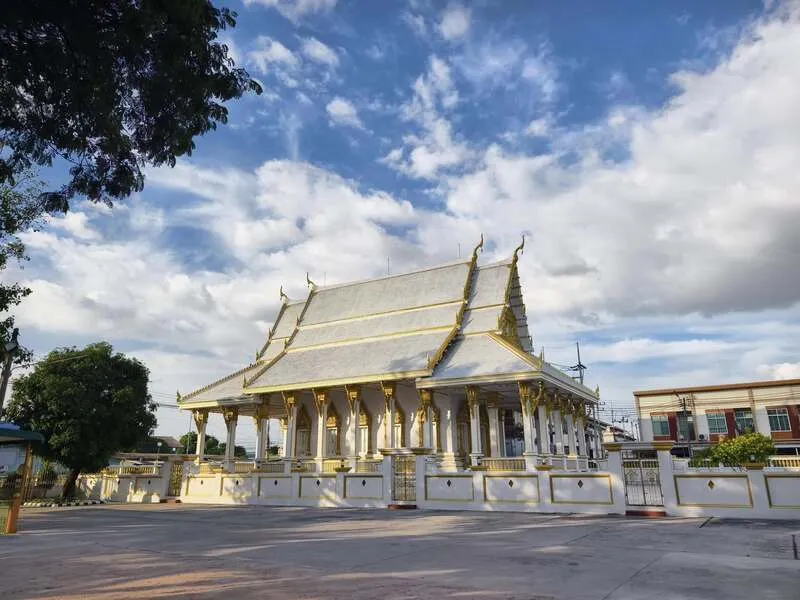
Wat Uthokkhep Simaram, also known by locals as Wat Nam or the Water Temple, is a historic and culturally significant temple located in Phanat Nikhom District, Chonburi Province, Thailand. The temple was originally built during the reign of King Chulalongkorn (Rama V) and is renowned for its traditional Thai architecture. Its ordination hall, or Ubosot, is uniquely positioned right by the water, reflecting the community’s close relationship with rivers and canals. In the past, Wat Uthokkhep Simaram was the center of several important local traditions, such as the Lotus-Throwing Alms Offering Ceremony and vibrant Songkran Festival celebrations, which brought people from surrounding areas together in a spirit of harmony and devotion.
In the present reign, the temple has been extensively developed to meet modern needs while preserving its traditional identity. New structures have been added, including Thai-style pavilions, traditional Thai houses, a Dhamma courtyard, riverside pavilions, and floating platforms used for ceremonies and community events. The temple is also home to the Local Aquatic Heritage Museum, which highlights the region’s history, environment, and way of life connected to water. In 2006, this museum was awarded the Sema Dhammachak Award for its excellence in promoting environmental conservation, making it an important educational destination for both locals and visitors.
The temple’s history dates back to 1893 (B.E. 2436) when it was founded by Phra Cholthopmakuṇamuni (Phut Punnakathera), affectionately known as “Chao Khun Thao.” He played a vital role in spreading Buddhism and providing spiritual guidance to the community. In 1916 (B.E. 2459), the temple was officially granted Wisungkhamsima, the royal decree establishing the boundaries of its first ordination hall. The consecration ceremony for embedding the sacred boundary stones was later held on April 18, 1924 (B.E. 2467). This marked a significant milestone as the temple became the first Dhammayutika Nikaya temple (a reformed sect of Thai Buddhism) in the Phanat Nikhom area. Phra Cholthopmakuṇamuni oversaw and nurtured the temple’s growth until his passing. After his death, Phra Khemathassi (Iam Mekhiyathera), the abbot of Wat Khao Bang Sai, took on the responsibility of caring for the temple until the appointment of the first official abbot in 1920 (B.E. 2463).
The first abbot was Phra Kru Sanghawutthikorn (Thiang Yanuchuko), who served from 1920–1930. Despite limited resources, he successfully completed the construction of the first Ubosot with strong support from the local community. Following him, Phra Athikan Dam (Jullako) led the temple from 1931–1941, continuing the work of building and maintaining the temple’s structures. From 1941–1962, Phra Kru Niwatworakhun (Kluean Minindalo Thongnapakun) focused on promoting Buddhist education. During this period, Somdet Phra Buddhakosajarn (Charoen Yanawaro Thera) from Wat Thepsirintrawat came to the temple annually to ordain local young men, with about 20–30 ordinations each year. In 1940 (B.E. 2483), he also oversaw the construction of Utok Witthayakon School, a two-story reinforced concrete building that became the first such educational building in Phanat Nikhom, earning the nickname “White Building.”
During the tenure of Phra Kru Vinaiwatee (Charoen Atiwuttho Thamraks), from 1962–2001, the temple underwent significant modernization. The old sermon hall was demolished and replaced with a new structure in 1977 (B.E. 2520). In collaboration with other respected monks, he also helped acquire land adjacent to the temple to establish Utok Witthayakhom School, a secondary school that opened in 1979 (B.E. 2522) and continues to operate today. Other developments included the construction of a crematorium in 1984 (B.E. 2527) and the temple’s re-designation of Wisungkhamsima in 1993 (B.E. 2536), expanding the ordination hall’s boundaries to 28 meters wide and 46 meters long. In 1999 (B.E. 2542), the old Ubosot was demolished, and a new one was built, with the roof-finial raising ceremony held from February 5–7, 1999. Unfortunately, Phra Kru Vinaiwatee passed away on April 24, 2001, before the consecration ceremony for embedding sacred boundary stones took place in February 2002.
The current abbot, Phra Chonayanmuni (Dr. Somphot Thammabhotcho, Naksithileut, N.Th. Ek, P.Th.3, Ph.D.), assumed leadership in 2002 (B.E. 2545) under the directive of Somdet Phra Yanavarodom (Prayun Santangkuro) from Wat Thepsirintrawat. He has since played a key role in modernizing and beautifying the temple while maintaining its deep-rooted spiritual and cultural heritage. His leadership has led to the expansion of educational initiatives, the construction of new facilities, and the overall growth of the temple as a spiritual, cultural, and environmental hub for the local community.
Today, Wat Uthokkhep Simaram is not only a sacred place for religious ceremonies but also a center for cultural preservation and environmental education. The temple continues to uphold ancient traditions such as the Lotus-Throwing Alms Offering and Songkran festivities, which highlight the community’s enduring relationship with water and traditional ways of life. Its museum and serene riverside location make it a unique destination for history enthusiasts, cultural explorers, and those seeking to experience the spiritual heart of Chonburi Province.
 Category: ●Places of Worship
 Group: ●Temple
Last Update : 8 MonthAgo
 Last Update : 8 MonthAgo
 Click to Access the Navigation Map GPS
Wat Uthokkhep Simaram Map
Recommend
 Art, Culture and Heritage
 Historical Sites and Monuments(4)
 Landmarks and Memorials(4)
 Royal Palace(1)
 Art, Craft Centres, Tradition(5)
 Museums(11)
 Art Gallery(1)
 Educational Places
 Educational Gardens, Farm(2)
 Training Center(2)
Temple(42)
Training Center(2)
Temple(42)
 Church(1)
 Mosque(2)
 Other religious and spiritural sites(14)
 Suburban Living
 Village, Community(5)
 Local Market(4)
 Floating Market(1)
 Nature and Wildlife
 National Parks and Marine Reserves(2)
 Mountain (Doi)(2)
 Dam, Reservoir, Lake(4)
 Waterfalls(3)
 Caves(3)
 Bays and Beaches(20)
 Islands(7)
 Other natural attractions(1)
 Entertainment and Agricultural
 Zoos and Aquariums(6)
 Animal camps and shows(2)
 Stadium(9)
 Farm, Parks, Gardens and Ecotourism(9)
 Amusement Park(3)
 Waterpark(3)
 Theater(5)
 Cinema(1)
 Outdoor and Adventure Activities(4)
 Shopping
 Shopping and Night Market(1)


