
lovethailand home >Central Travel Attractions >Chachoengsao Travel Attractions >Bang Khla >Bang Kra Chet > Wat Ratsatthatham (Wat Sam Yaek)
TL;DR: Wat Ratsatthatham (Wat Sam Yaek) is located at No. 123, Moo 2, Bang Krajet Subdistrict, Bang Khla District, Chachoengsao 24110, open Daily, hours 08.00 – 17.00.
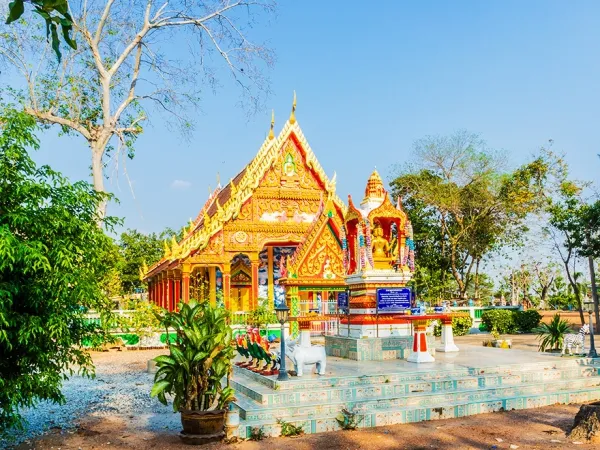
Wat Ratsatthatham (Wat Sam Yaek)
Open Days: Daily
Opening Hours: 08.00 – 17.00
Wat Ratsatthatham (Wat Sam Yaek) is a local community temple in Chachoengsao Province. People in the area have long respected this temple and continue to use it as a central venue for religious ceremonies. Located within a community zone connected to the “three-way intersection” and the nearby market area, the atmosphere blends the calm of a neighborhood temple with the liveliness of everyday local life around it. If you plan to come to pay respects, make merit, or simply pause for a quiet moment while traveling around the Bang Khla–Bang Pakong area, setting your destination by GPS coordinates is the most reliable approach, since some sources describe the administrative location slightly differently.
Wat Ratsatthatham (Wat Sam Yaek) is closely tied to community life in Bang Khla District, Chachoengsao. For locals, “Wat Sam Yaek” is not merely a nickname; it reflects the landscape of an area where transport routes and a market-centered way of life naturally intersect. Many residents use this temple as a focal point for religious activities—from traditional merit-making and memorial rites for loved ones, to monastic affairs and community gatherings. In this sense, being a “community temple” gives the place an authentic atmosphere—unpretentious, grounded, and shaped by generations of shared use and shared faith.
Wat Ratsatthatham is a local (rat) temple under the Mahanikaya order. The temple area is approximately 21 rai 3 ngan 47 square wah, with clearly recorded boundaries: the north borders private land, the south borders the Sam Yaek market area, the east borders private land, and the west borders a canal. These geographic details help explain how the temple sits between commerce and waterways—two lifelines of Central Thailand communities. It is therefore unsurprising that the temple has been able to support public and communal activities effectively, because “temple–market–canal” has long been a mutually supportive triad in local life.
The temple’s establishment record states that it was founded on 23 June 1934. The land was donated to build the temple by Mr. Kao and Mrs. Hia Sombunsap, affluent patrons from Ban Bang Kham, Bang Kham Subdistrict, Ban Sang District, Prachinburi Province. Such land donations for temple building reflect a long-standing Thai social value that views temples as both spiritual centers and community infrastructure. In many parts of Central Thailand, temples did not emerge from formal government town planning, but from the faith of people who needed a place to hold ceremonies, study the Dhamma, and unite in shared acts of merit. Once a temple was established, communities often expanded around it and gradually organized relationships among homes, markets, travel routes, and agricultural areas with the temple serving as a key reference point.
Later, the temple received a royal grant of Wisungkham Sima on 12 March 1965. This is a significant milestone for Thai temples because Wisungkham Sima formally defines the consecrated boundary for the ordination hall, enabling the temple to perform important monastic acts in full accordance with the Vinaya. In practical terms, the grant affirms the temple’s stability and recognized status within the Sangha structure and within the community as well. Once a temple holds full legal and ecclesiastical elements, its role as a community anchor becomes even clearer—supporting ceremonies, moral education, and major life events across generations.
The name “Wat Sam Yaek” is widely used by locals and is closely associated with the temple’s location near an intersection of routes in the area and near a market district that residents know well. One reason many visitors feel it is easy to reach is that the surroundings often carry unmistakable signs of community life—trading spots, traffic flow, and local buildings that signal this is a true center of the area rather than an isolated place. This makes the temple suitable both for a purposeful merit-making visit and for a brief stop to pay respects before continuing to other destinations in Chachoengsao.
From the standpoint of visitor experience, Wat Ratsatthatham feels like a friendly neighborhood temple. People commonly come with simple intentions—paying respects, making merit within their means, or joining ceremonies connected to family and community. This type of community temple moves at an unhurried rhythm. Even though it is near a market and a three-way junction, once you step inside the temple grounds, the mood shifts toward calm and order, consistent with a sacred place. Another layer of tranquility comes from the fact that one side of the temple borders a canal, as indicated by the recorded boundary, which contributes to an overall sense of water, shade, and a softer pace.
If we view the temple as part of the social structure, Wat Ratsatthatham continues to support religious ceremonies that the community relies on. This is what makes the temple more meaningful than a tourist stop: at its core, it is “a space of relationships”—between people and faith, between families and rituals, and between neighbors who help one another. When a community has a temple as its center, people can coordinate gatherings, support shared tasks, and join in merit-making more easily. In this way, the temple becomes a focal point of social capital that strengthens the community over time.
For visitors who wish to make merit in a simple, respectful way, the best approach is to keep your voice low, dress modestly, and follow temple guidelines. If a ceremony is in progress, avoid walking across the front of the ritual area or causing disturbance. Photography should be done with respect, especially in areas connected to religious rites or monastic quarters. If you would like to offer donations or items, it is sensible to choose useful, practical supplies that the temple can genuinely use, or to make a monetary contribution according to your faith. These are not “strict rules,” but rather courtesies that make the experience positive for both visitors and local worshippers.
A key advantage of Wat Ratsatthatham for trip planning is its convenient position for linking to attractions in the Bang Khla area and along the Bang Pakong River. Chachoengsao offers many important temples, historic communities, and lifestyle-based routes. As a result, those who come to make merit at Wat Sam Yaek can easily extend the visit into a half-day or full-day itinerary—starting at the temple, continuing to a nearby market or other temples, and finishing at a riverside restaurant or a café in the area. This type of plan keeps cultural travel smooth and relaxed while still prioritizing respect for the temple as the main purpose of the visit.
Getting There The most direct way to reach Wat Ratsatthatham is by private car and setting your destination using the temple’s GPS coordinates, since some sources describe the administrative area slightly differently at the subdistrict or district level. Using coordinates helps you arrive at the correct location more accurately. In general, the temple is in Bang Khla District, Chachoengsao, and close to the area locals call “Sam Yaek / Sam Yaek Market,” which also helps with orientation through recognizable community activity around the site. If you do not have a private vehicle, a practical option is to travel first to a central point in the district or the province, then continue by local hired transport or ride-hailing services. When doing so, refer to the destination as “Wat Sam Yaek, Bang Krajet Subdistrict,” and confirm the GPS location again before departing.
Once you arrive, it helps to give yourself a little time rather than rushing to cover every corner. The charm of a community temple often lies in its atmosphere and the feeling of “quiet restoration,” more than in checking off a list of sights. If you come alone, you might pay respects, walk calmly through the grounds, and sit quietly for a moment. If you come with family, making merit together in a simple way allows everyone to experience temple culture naturally—especially children, who can learn etiquette and the meaning of a sacred place through real practice.
From the perspective of local history, Wat Ratsatthatham is one piece of evidence reflecting how communities in Chachoengsao expanded before and after the Second World War era. The temple’s founding in 1934 occurred during a period when many Central Thailand communities were gradually reorganizing relationships among farmland, waterways, and increasingly defined land routes. Temples established through land donations by socially prominent local patrons often became starting points for stable community structures. Over time, the temple continued to support change—both in population growth and in the expansion of markets—while meeting the increasing need for a shared space for religious ceremonies as the community grew.
Putting everything together, Wat Ratsatthatham (Wat Sam Yaek) is well suited for travelers who want a relaxed cultural visit, wish to experience a community temple with a tangible role in local life, and want a convenient starting point for exploring nearby destinations around Bang Khla and Mueang Chachoengsao. The best visit is one made with respect, intention, and sensitivity to the temple’s quiet order. When approached this way, the temple becomes more than a “check-in point”—it becomes a place where you can feel the meaning of faith that has gradually shaped and sustained a community up to the present day.
| Place Name | Wat Ratsatthatham (Wat Sam Yaek) |
| Address | No. 123, Moo 2, Bang Krajet Subdistrict, Bang Khla District, Chachoengsao 24110 |
| GPS Coordinates | 13.872606, 101.224926 |
| Summary | A Mahanikaya community temple in Bang Khla that serves as a long-standing center for religious ceremonies and local gatherings. |
| Highlights | A convenient community temple near the Sam Yaek/market area, suitable for simple merit-making and as a starting point for exploring Bang Khla and Chachoengsao. |
| History (Verified) | Established on 23 June 1934; received Wisungkham Sima on 12 March 1965; temple area approx. 21 rai 3 ngan 47 square wah. |
| Abbot / Current Overseer | Phra Khru Withan Thurathon (Kittisak Inthachoto) |
| Current Status | Open for visiting, worship, and merit-making during operating days and hours. |
| Nearby Tourist Attractions (Approx. Distance) | 1) Bang Khla Floating Market (approx. 8 km) 2) Wat Pak Nam Jolo (approx. 9 km) 3) Wat Pho Bang Khla (approx. 10 km) 4) Wat Sothon Wararam Worawihan (approx. 25 km) 5) Ganesha Park, Khlong Khuean (approx. 18 km) |
| Popular Restaurants Nearby (Approx. Distance + Phone) | 1) Ban-Nam-Chan by Kunawut (approx. 8 km) – 081-911-1618 2) Thaokae Sheu (approx. 10 km) – 038-541-020 3) Bang Khla Cafe & Restaurant (approx. 8 km) – 082-510-4538 4) Present Bangkhla (approx. 10 km) – 066-048-5298 5) Pae Phayong Riverside (approx. 22 km) – 097-969-5932 |
| Popular Accommodations Nearby (Approx. Distance + Phone) | 1) Tamarindee Stay & Cafe Riverside, Bang Khla (approx. 10 km) – 061-425-3716 2) Suklutai Hotel and Service Apartment (approx. 11 km) – 086-330-7368 3) Love Inn Bang Khla (approx. 11 km) – 038-542-244 4) Blue Ozone Resort & Spa (approx. 14 km) – 063-212-1444 5) T Vintage Hotel (approx. 15 km) – 092-689-4442 |
Frequently Asked Questions (FAQ)
Q: Is Wat Ratsatthatham (Wat Sam Yaek) open every day?
A: Yes, it is open daily.
Q: What are the opening hours of Wat Ratsatthatham (Wat Sam Yaek)?
A: 08.00 – 17.00
Q: What should I wear when visiting Wat Sam Yaek?
A: Dress modestly, avoid overly short or tight clothing, and respect the calm atmosphere of the temple.
Q: Where should I pin the location if I am worried about getting lost?
A: Use the temple’s GPS coordinates (13.872606, 101.224926) and confirm the name “Wat Ratsatthatham (Wat Sam Yaek), Bang Krajet, Bang Khla” before you set off.
Q: What is the brief verified history of this temple?
A: The temple was established on 23 June 1934 and received Wisungkham Sima on 12 March 1965. It has long served as a community center for religious ceremonies in the area.
 Category: ●Places of Worship
 Group: ●Temple
Last Update : 6 MonthAgo
 Last Update : 6 MonthAgo
 Click to Access the Navigation Map GPS
Wat Ratsatthatham (Wat Sam Yaek) Map
Recommend

 Art, Culture and Heritage
 Historical Sites and Monuments(3)
 Landmarks and Memorials(4)
 Royal Palace(1)
 Art, Craft Centres, Tradition(10)
 Museums(2)
 Historic Homes and Cities(1)
 Educational Places
 Museum for Study(1)
 Library(1)
 Educational Gardens, Farm(2)
Temple(50)
Educational Gardens, Farm(2)
Temple(50)
 Mosque(2)
 Other Sacred Sites(7)
 Research and Development
 Royal Project(4)
 Suburban Living
 Village, Community(5)
 Local Market(4)
 Floating Market(1)
 Nature and Wildlife
 National Parks and Marine Reserves(2)
 Mountain (Doi)(1)
 Dam, Reservoir, Lake(6)
 Waterfalls(1)
 Caves(1)
 River, Canal(2)
 Bays and Beaches(1)
 Islands(2)
 Other natural attractions(2)
 Entertainment and Agricultural
 Zoos and Aquariums(1)
 Animal camps and shows(1)
 Farms, Parks and Ecotourism(6)
 Spas and Wellness
 Spas and Wellness(1)
 Travel Articles, Recipes
 Travel Review, Food Review(3)


