
TL;DR: Wat Bang Phung is located at Bang Phueng Subdistrict, Bang Pakong District, Chachoengsao Province, open Open Daily, hours 08:00 – 18:00.
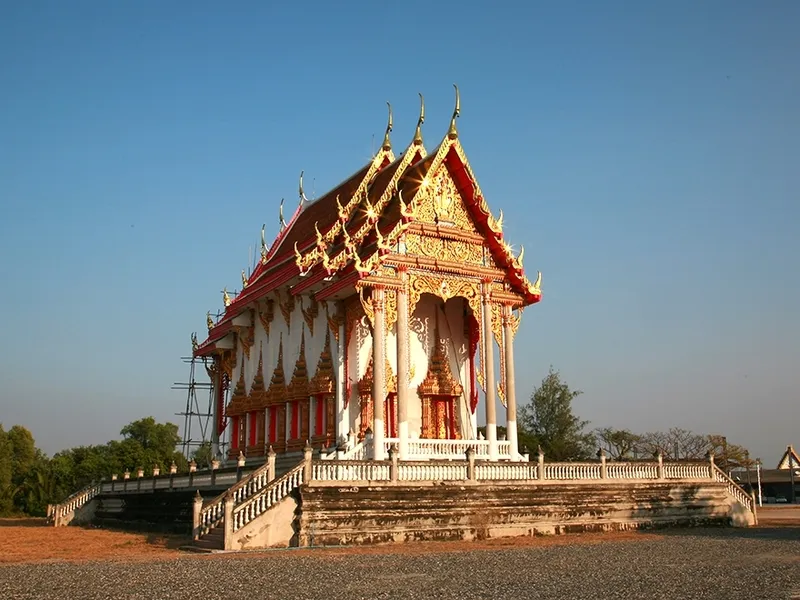
Wat Bang Phung
Open Days: Open Daily
Opening Hours: 08:00 – 18:00
Wat Bang Phueng in Bang Phueng Subdistrict, Bang Pakong District, Chachoengsao Province, is a long-established community temple closely tied to local faith for generations. The spiritual heart of the temple is “Luang Pho To of Wat Bang Phueng,” revered as the sacred protector of the subdistrict. Local tradition tells of a stone that drifted in with the water about 100 years ago; villagers noticed the topknot (ushnisha/“ket”) of a Buddha image within the stone, and together they respectfully brought it ashore to enshrine as a place of worship for the community. The temple’s charm lies in its simple, lived-in atmosphere as a true community temple—visitors can come to pay respects, make merit, regain composure, and recharge in a relaxed 1–2 hour visit.
The temple was founded in 1873 and has continued to develop alongside the community, especially in education. It supports both a Buddhist scripture school (Dhamma division) and the use of temple land to establish Wat Bang Phueng School, clearly reflecting the temple’s role as a community hub. It also fits well into a one-day itinerary paired with attractions along the Bang Pakong River and landmarks around Paet Riu (Chachoengsao), such as Wat Sothon Wararam Worawihan, Ban Mai 100-Year Market, Bang Khla Floating Market, or Wat Saman Rattanaram.
Wat Bang Phueng (Wat Bang Phueng) in Bang Phueng Subdistrict, Bang Pakong District, Chachoengsao Province, is a local temple under the Mahanikaya order that has long served its community and continues to do so today. The first impression is not the grandeur of a built-for-tourism attraction, but a calm sense that “your mind slows down as you arrive.” This is the strength of local temples that steadily fulfill their role: a spiritual refuge, a place to make merit, a gathering point for family and community ceremonies, and a cultural anchor for the subdistrict.
The heart of Wat Bang Phueng is the shared devotion to “Luang Pho To of Wat Bang Phueng,” regarded by residents as the subdistrict’s sacred protector. The distinctive local account says that about 100 years ago a stone drifted in and appeared in the Bang Phueng area. Villagers saw the topknot (ushnisha/“ket”) of a Buddha image inside that stone, and they came together to respectfully bring it ashore and enshrine it for public worship. Stories like this do more than function as folklore; they explain the beginning of the bond between people and temple. They also give worship here a grounded but powerful meaning—people come to honor what the community believes in together, and to settle the heart in a way that feels genuinely accessible.
Another layer of local faith often spoken about is the tradition of making vows and “entrusting oneself as a child of Luang Pho To.” In earlier times, when villagers or children were seriously ill and could not recover through treatment, families would come to make vows and symbolically entrust the child to Luang Pho To. When the illness improved or the child recovered, devotion deepened and continued across generations. This reflects a Thai worldview in which religion is not separated from everyday life; faith becomes a mechanism of emotional healing in moments when people feel trapped. Over time, these stories are preserved as shared memory, and Wat Bang Phueng remains a place people “think of” and return to at turning points in life.
Historically, Wat Bang Phueng has key dates that clearly show its development. The temple was established in 1873. Khun Pracha Phlusiri donated land for its construction—8 rai 1 ngan 35 wa—and the temple area later expanded to about 20 rai today. These details show that the temple did not appear by chance; it was built on people, land, and community consensus. The fact that land was donated and later expanded also reflects long-term care across generations and highlights the temple as a public community space sustained through shared devotion.
Beyond spiritual life, Wat Bang Phueng also plays a strong educational role. It has a Buddhist scripture school (Dhamma division), opened in 1941, demonstrating that the temple is not limited to rituals but supports religious learning at the community level. Another key point is the temple’s relationship with local education through the establishment of Wat Bang Phueng School on temple land. The school was founded on 21 June 1922, first using the sermon hall (sala kan parian) as a classroom, and later developing into a school that currently teaches from Kindergarten 1 through Grade 6. This makes Wat Bang Phueng more than a place to worship—it is a practical community structure that helped education take root locally.
Another important institutional milestone is the royal grant of Wisungkhamsima on 5 January 2009, formally defining the ubosot boundary for official monastic rites. Many casual visitors overlook this detail, but for a community temple it signals readiness in religious infrastructure, continuity of care, and clear recognition within the sangha administration.
When you visit Wat Bang Phueng, the best rhythm is to begin by paying respects to Luang Pho To in a calm, focused way. Give yourself time to be fully present. There is no need to rush through a long list of wishes. Instead, choose a clear intention—such as peace, protection, or renewed strength—express it respectfully, then make merit according to your capacity. After that, take a gentle walk through the temple grounds, which often feels orderly and clean, and clearly serves the daily life of local residents. This is why the temple works well for both locals and travelers looking for a peaceful stop while driving through the Bang Pakong–Paet Riu area.
The charm of community temples like Wat Bang Phueng is the balance of time and space. With just 1–2 hours, you can worship, make merit, walk around, and leave with real calm—without complicated planning and without the fatigue of a full-day itinerary. This suits travelers who want to begin a trip with quiet focus, because once your mind settles, the rest of your Chachoengsao route often feels noticeably smoother and more enjoyable.
From a travel perspective, Wat Bang Phueng can serve as a strong “starting point” for a Bang Pakong riverside route. Bang Pakong offers well-known temples, riverside markets, seafood restaurants, and scenic spots that can be mixed and matched into many types of day trips. If you plan a one-day itinerary, Wat Bang Phueng fits naturally in the morning, then you can continue to Wat Sothon Wararam Worawihan to pay respects to Luang Pho Sothon, or stop at Ban Mai 100-Year Market for local snacks and riverside atmosphere, and finish with riverside dining in Bang Pakong or Bang Khla. If you prefer a more relaxed pace, staying overnight near Chachoengsao town is a good option to keep the trip comfortable while enjoying the signature Bang Pakong River vibe more fully.
Another cultural value of Wat Bang Phueng is how local “legend” and community “history” coexist in the same place. The drifting-stone story is preserved as shared memory, while the historical timeline is supported by specific years—land donation, establishment, expansion, educational development, and Wisungkhamsima status. This is why Wat Bang Phueng should not be framed only as a “tourist stop,” but as a “community portrait” with the temple as its core. That is the true value of the site, and the reason community temples often endure far longer than passing travel trends.
In terms of temple etiquette, Wat Bang Phueng is best visited in modest clothing, with quiet voices in worship areas, and respect for local residents who come regularly to make merit. If you visit with children or elders, plan a comfortable walking rhythm and choose morning or late afternoon to avoid heat, ensuring a smooth experience while preserving the calm atmosphere that defines this community temple.
Getting There Wat Bang Phueng is in Bang Phueng Subdistrict, Bang Pakong District, Chachoengsao Province. The most convenient way to travel is by private car. Set your map pin to “Wat Bang Phueng” or “Wat Bang Phueng (Wat Bang Phueng)” and follow the local roads directly into Bang Phueng Subdistrict. If using public transport, travel first to the Bang Pakong area and get off near Bang Phueng Subdistrict, then continue by local motorbike taxi or hired vehicle to reach the temple as appropriate.
| Name | Wat Bang Phueng (Wat Bang Phueng) |
| Location | Bang Phueng Subdistrict, Bang Pakong District, Chachoengsao Province |
| Summary | A Mahanikaya community temple in Bang Phueng, anchored by devotion to “Luang Pho To,” revered as the subdistrict’s sacred protector. Local tradition tells of a drifting stone revealing the topknot of a Buddha image, which villagers brought ashore to enshrine for worship. Ideal for a calm 1–2 hour stop, and easy to pair with Bang Pakong riverside attractions around Paet Riu (Chachoengsao). |
| Highlights | 1) Pay respects to “Luang Pho To of Wat Bang Phueng,” revered as the subdistrict’s sacred protector 2) Distinctive local legend of the drifting stone that revealed a Buddha image’s topknot 3) Simple, lived-in community-temple atmosphere, ideal for merit-making and a calm reset 4) Strong educational role through a Dhamma scripture school and the local temple school 5) Easy to plan as part of a one-day itinerary with Bang Pakong riverside landmarks in Chachoengsao |
| Contact Number | 089-832-1185 |
| Abbot (Latest) | Phra Khru Sangharak Sayan Panyadipo |
| Nearby Accommodations | 1) Bangpakong Boat Club – approx. 12 km, tel. 063-535-2521 2) Baan Plaloma – approx. 16 km, tel. 038-574-318 3) JK Living Hotel & Service Apartment Chachoengsao – approx. 28 km, tel. 038-511-255 4) Heaven Hotel Chachoengsao – approx. 30 km, tel. 038-511-150 5) V-Verve Service Apartment – approx. 30 km, tel. 081-762-9151 |
| Nearby Attractions | 1) Wat Hong Thong (Temple on the Water) – approx. 18 km, tel. 081-915-5728 2) Bang Khla Floating Market – approx. 28 km, tel. 038-541-027 3) Ban Mai 100-Year Market – approx. 30 km, tel. 097-259-6438 4) Wat Sothon Wararam Worawihan – approx. 32 km, tel. 038-511-048 5) Wat Saman Rattanaram – approx. 38 km, tel. 081-983-0400 |
| Nearby Restaurants | 1) Krua Ban Rim Nam (Bang Pakong) – approx. 20 km, tel. 038-834-131 2) Phae Khiang Nam (Bang Pakong) – approx. 26 km, tel. 038-574-444 3) The River Barn (Chachoengsao) – approx. 32 km, tel. 038-515-892 4) Ban Mai Rim Nam (Paet Riu) – approx. 32 km, tel. 038-512-064 5) Pu Ka A Riverside – approx. 36 km, tel. 063-313-3999 |
Frequently Asked Questions (FAQ)
Q: Where is Wat Bang Phueng located?
A: Wat Bang Phueng is in Bang Phueng Subdistrict, Bang Pakong District, Chachoengsao Province. The easiest way is by private car—set your map pin to the temple name and follow local roads into Bang Phueng Subdistrict.
Q: Why is “Luang Pho To of Wat Bang Phueng” considered important?
A: Luang Pho To is revered as the sacred protector of the subdistrict. Local tradition speaks of a drifting stone that revealed the topknot of a Buddha image, which villagers brought ashore to enshrine for worship, forming the spiritual center of community devotion.
Q: When was Wat Bang Phueng established?
A: The temple was established in 1873 and has developed continuously as a community hub, including education through a Dhamma scripture school and the local temple school on temple land.
Q: Who is the current abbot of Wat Bang Phueng?
A: The abbot listed in the latest published information is Phra Khru Sangharak Sayan Panyadipo.
Q: How much time should I plan for a visit?
A: Plan about 1–2 hours to pay respects to Luang Pho To, make merit, walk the temple grounds, and enjoy a calm reset before continuing to other attractions in Chachoengsao.
Q: What is the contact number for Wat Bang Phueng?
A: 089-832-1185
 Category: ●Places of Worship
 Group: ●Temple
 Last Update : 1 MonthAgo
 Click to Access the Navigation Map GPS
 Art, Culture and Heritage
 Historical Sites and Monuments(
 Landmarks and Memorials(
 Royal Palace(
 Art, Craft Centres, Tradition(
 Museums(
 Historical Houses and The Ancient City(
 Educational Places
 Museum for Study(
 Library(
 Educational Gardens, Farm(
 University
 Mosque(
 Other religious and spiritural sites(
 Research and Development
 Royal Project(
 Suburban Living
 Village, Community(
 Local Market(
 Floating Market(
 Nature and Wildlife
 National Parks and Marine Reserves(
 Mountain (Doi)(
 Dam, Reservoir, Lake(
 Waterfalls(
 Caves(
 River, Canal(
 Bays and Beaches(
 Islands(
 Other natural attractions(
 Entertainment and Agricultural
 Zoos and Aquariums(
 Animal camps and shows(
 Farm, Parks, Gardens and Ecotourism(
 Spas and Wellness
 Spas and Wellness(
 Travel Articles, Recipes
 Travel Review, Food Review(


