
lovethailand home >Central Travel Attractions >Chachoengsao Travel Attractions >Bang Khla >Hua Sai > Wat Thang Kham Noi
TL;DR: Wat Thang Kham Noi is located at Moo 4, Hua Sai Subdistrict, Bang Khla District, Chachoengsao, open Daily, hours 08.00 – 17.00.
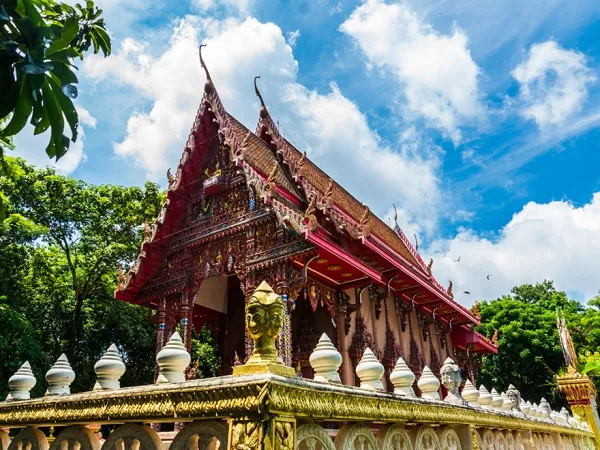
Wat Thang Kham Noi
Open Days: Daily
Opening Hours: 08.00 – 17.00
Wat Thang Kham Noi (Hua Sai Subdistrict, Bang Khla District, Chachoengsao) is a community temple beside Khlong Hua Sai, best known for the “Luang Pho Phra Phuttha Chinnarat (replica)” enshrined in its ubosot. The temple holds annual celebrations in honor of the revered image, making it a good choice for visitors who want a peaceful, simple merit-making experience and a calm temple atmosphere, and who also want to continue their day trip to Bang Khla Floating Market or popular riverside grilled-prawn restaurants nearby.
Wat Thang Kham Noi in Chachoengsao Province is a local temple under the Mahanikaya order with a distinctly “community temple” character. It sits in the rural landscape of Bang Khla District beside Khlong Hua Sai, so the surroundings feel open and quiet, with the rhythms of the Bang Pakong river-basin countryside still clearly visible. The temple was never designed as a major tourist landmark; it is a living place of faith where local people come to make merit, meet one another, and organize religious events throughout the year. For this reason, it suits visitors who want to “pay respects and truly rest the mind” rather than rush in for a quick check-in.
What gives Wat Thang Kham Noi deep meaning for the local community is its principal sacred image: the “Luang Pho Phra Phuttha Chinnarat (replica)” enshrined in the ubosot. For Thai Buddhists, Phra Phuttha Chinnarat is among the most revered Buddha images, admired for its outstanding Buddhist artistry and recognized as a symbol of steadfast faith. When a community temple has a principal image that people naturally connect with, the temple becomes the village’s spiritual anchor almost automatically — on observance days, during merit-making ceremonies, at ordinations, and even on ordinary days when someone quietly needs a place to steady the heart.
Historically, the temple was once known as “Wat Si Wilai Ratsadon Sattha Tham Kham Noi.” Local accounts link the temple’s beginnings to a period when three wandering monks (thudong) from Nakhon Ratchasima arrived in Ban Thang Kham Noi. The community invited the three monks to stay and observe the rains retreat in the village. With resident monks as a foundation, villagers then discussed establishing a proper monastic residence (samnak song), so there would be an organized place for religious activities. Local devotees donated about 12 rai of land and offered several houses to be converted into monks’ quarters, creating a temple space that the community “built with their own hands” and has continued to “care for together” over time.
Although the temple developed gradually according to the community’s resources, one of the key milestones that completed its formal monastic status was receiving the royal grant of Wisungkhamsima on 17 July 1987. This recognition allows the temple’s ubosot to be used officially for important monastic rites, especially ordination, which requires a legally recognized boundary. Once the temple reached this complete status, its role as a ceremonial center for the community became even clearer — supporting ordinations, merit-making events, and religious activities across the Buddhist calendar.
Another point that makes the temple’s story distinctive is its strong intention to have a principal image that could unify shared faith. The community traveled to Phitsanulok and arranged for craftsmen to create a replica of Phra Phuttha Chinnarat to be enshrined in the ubosot. This gave the temple a clear spiritual heart: people come to pay respects to the main image, make wishes, strengthen the mind, and begin their sense of calm by setting intention with what the temple holds most sacred. Inside the ubosot, what stands out is the simplicity and sincerity of a community temple — not focused on luxury, but on quiet order and a peaceful atmosphere that supports sincere worship.
From a traveler’s perspective, Wat Thang Kham Noi is best visited in the morning. The air tends to be clearer, the light softer, and the temple environment especially still. Paying respects to Luang Pho Phra Phuttha Chinnarat when there are fewer people helps you notice the “silence” of the space, the neatness of the ubosot, and the overall temple layout at a relaxed pace. If you enjoy cultural photography, community temples often look best when you keep an appropriate distance, avoid intruding into ritual areas, and choose angles that show the “canal-side setting” and the “quiet character” of the temple, rather than focusing closely on individuals or activities.
The temple’s sense of “life” comes not only from the principal image but also from continuing traditions. Wat Thang Kham Noi holds celebrations for Luang Pho Phra Phuttha Chinnarat twice each year, bringing meaningful energy to the temple grounds. The first is held on the 1st waning moon of the 11th lunar month. In earlier times, the sacred image was carried in a procession along the Bang Pakong River, reflecting the water-based life of river communities. Later, the procession shifted to a vehicle parade, showing how the community adapted to modern travel and changing conditions while still preserving the essential spirit of honoring the revered image.
The second celebration is a gold-leaf merit-making event held over two days: the 12th and 13th waxing moons of the 4th lunar month. This tradition is appealing because it is accessible to people of every age; it is a form of merit-making that feels tangible and immediate when you place gold leaf with your own hands. If you plan to visit during this period, you are likely to see a genuine community temple festival atmosphere — local cooperation, organized worship areas, possible charity food offerings, and shared care for order and cleanliness. Compared with an ordinary day, the festival period can show the temple’s role as the community’s spiritual center more vividly.
To gain real value from visiting a community temple, the key is respecting the space. Wat Thang Kham Noi is used for actual religious practice, so visitors should dress modestly, avoid loud voices, avoid playing music, and refrain from close-up photography of people without permission. If you come with family and young children, guiding them gently through temple etiquette can make the trip more meaningful than treating the temple merely as a photo location, and it also shows genuine respect to the community that maintains the site.
If you want to make merit in a way that suits a community temple, there are several simple options depending on your means: offering alms on days when monks go on alms round, presenting a modest set of offerings, or contributing to restoration and maintenance projects that the temple is currently supporting. The essential point is to do it calmly, without rushing, without disturbing others, and without turning merit-making into something stressful. A good community temple should leave visitors feeling lighter, not pressured.
Getting There Wat Thang Kham Noi is located in Hua Sai Subdistrict, Bang Khla District, Chachoengsao. The most convenient way to visit is by private car, because it makes it easy to plan a smooth day trip. You can start from Bang Khla town center or Chachoengsao town and head toward the Hua Sai area. When you approach the temple, look for the entrance along the canal-side community roads and park only in designated or appropriate areas without blocking traffic. If coming from Bangkok, a common route is to enter Chachoengsao Province first, continue to Bang Khla District, and then proceed to Hua Sai. Building extra time into the schedule helps preserve the calm feeling of the temple visit and still leaves time to continue to Bang Khla Floating Market or riverside restaurants later in the morning.
If you want a “complete but not exhausting” itinerary, start at the temple in the morning and spend about 45–90 minutes paying respects, walking through the temple grounds, and making merit. Then head to Bang Khla Floating Market to explore local snacks and enjoy the riverside atmosphere, followed by a grilled prawn restaurant or a riverside kitchen for lunch. After that, add one more key stop such as Wat Pho Bang Khla (known for bats), Wat Saman Rattanaram, or Wat Pak Nam Jolo. This sequence keeps the morning calm at the temple and saves the food-and-sightseeing portion for later, without forcing the day into a rushed pace.
Overall, Wat Thang Kham Noi is a temple that “tells the story of the river basin” through both its canal-side setting and its annual traditions that once included a water procession before shifting to a vehicle parade. Combined with the presence of the Phra Phuttha Chinnarat replica as the spiritual center, the temple meets the needs of both worshippers seeking quiet and travelers who want to witness a living community temple culture in Bang Khla that continues year after year.
| Name | Wat Thang Kham Noi |
| Address | Moo 4, Hua Sai Subdistrict, Bang Khla District, Chachoengsao |
| Place Summary | A Mahanikaya community temple beside Khlong Hua Sai in Bang Khla, centered on a Phra Phuttha Chinnarat (replica) in the ubosot, with annual celebrations that reflect a living local faith tradition. |
| Highlights | Phra Phuttha Chinnarat (replica) in the ubosot, canal-side community temple atmosphere, two annual celebrations (1st waning moon of the 11th lunar month and gold-leaf event on the 12th–13th waxing moons of the 4th lunar month), and the temple’s continuing role as a merit-making center for the Bang Khla community. |
| Open Days | Daily |
| Opening Hours | 08.00 – 17.00 |
| Abbot (Latest) | Phra Maha Thannap Kantadhammo |
| Temple Contact Number | 081-586-9418 |
| Nearby Tourist Attractions (Driving Distance) | 1) Bang Khla Floating Market – 12 km 2) Wat Pho Bang Khla (Bat Viewing) – 14 km 3) Wat Saman Rattanaram – 18 km 4) Wat Pak Nam Jolo – 27 km 5) Wat Sothon Wararam Worawihan – 30 km |
| Nearby Restaurants (Driving Distance + Phone) | 1) Rom Mai Sai Than – 12 km – 086-155-7111 2) Kor Kung Phao (Bang Khla Floating Market) – 12 km – 081-861-1655 3) Krua Ban Rim Nam Km.49 – 16 km – 081-350-6803 4) NGON-Ngon (Vietnamese & Steak, Bang Khla) – 16 km – 090-227-2256 5) Tang Seng Jua (Desserts & Local Souvenirs, Bang Khla) – 18 km |
| Nearby Accommodations (Driving Distance + Phone) | 1) Tala Bangkla Riviera – 12 km – 062-323-7424 2) T Vintage Hotel (Bang Khla) – 16 km – 092-689-4442 3) Tamarind @ Bangkhla (Riverside Stay & Cafe) – 16 km – 065-563-2392 4) Blue Ozone Resort & Spa – 22 km – 063-212-1444 5) Suklutai Hotel & Service Apartment – 18 km – 086-330-7368 |
Frequently Asked Questions (FAQ)
Q: What is the best time to visit Wat Thang Kham Noi?
A: The morning, especially 08.00–10.00, is usually best because the air is clearer and the atmosphere is quiet, making it ideal for worship and a relaxed walk around the temple grounds.
Q: What is the main highlight to worship when visiting the temple?
A: Begin by paying respects to the “Luang Pho Phra Phuttha Chinnarat (replica)” in the ubosot, which is the temple’s spiritual center, and then walk around to appreciate the calm canal-side setting.
Q: When are the annual celebrations for Luang Pho Phra Phuttha Chinnarat held?
A: The temple holds two annual celebrations: one on the 1st waning moon of the 11th lunar month, and a two-day gold-leaf event on the 12th and 13th waxing moons of the 4th lunar month.
Q: What should I keep in mind when taking photos at the temple?
A: Dress modestly, keep your voice low, avoid close-up photos of people without permission, and do not stand or walk in ways that disturb worshippers or ritual areas.
Q: Where should I go after visiting Wat Thang Kham Noi?
A: A popular plan is to continue to Bang Khla Floating Market and a riverside grilled prawn restaurant, then add one more stop such as Wat Pho Bang Khla (for bat viewing), Wat Saman Rattanaram, or Wat Pak Nam Jolo, before heading into Chachoengsao town to visit Wat Sothon.
Q: How can I contact the temple?
A: You can call the temple directly using the phone number in the summary table, and check updates about events through the temple’s social media channels.
 Category: ●Places of Worship
 Group: ●Temple
Last Update : 6 MonthAgo
 Last Update : 6 MonthAgo
 Click to Access the Navigation Map GPS
 Art, Culture and Heritage
 Historical Sites and Monuments(3)
 Landmarks and Memorials(4)
 Royal Palace(1)
 Art, Craft Centres, Tradition(10)
 Museums(2)
 Historic Homes and Cities(1)
 Educational Places
 Museum for Study(1)
 Library(1)
 Educational Gardens, Farm(2)
Temple(50)
Educational Gardens, Farm(2)
Temple(50)
 Mosque(2)
 Other Sacred Sites(7)
 Research and Development
 Royal Project(4)
 Suburban Living
 Village, Community(5)
 Local Market(4)
 Floating Market(1)
 Nature and Wildlife
 National Parks and Marine Reserves(2)
 Mountain (Doi)(1)
 Dam, Reservoir, Lake(6)
 Waterfalls(1)
 Caves(1)
 River, Canal(2)
 Bays and Beaches(1)
 Islands(2)
 Other natural attractions(2)
 Entertainment and Agricultural
 Zoos and Aquariums(1)
 Animal camps and shows(1)
 Farms, Parks and Ecotourism(6)
 Spas and Wellness
 Spas and Wellness(1)
 Travel Articles, Recipes
 Travel Review, Food Review(3)


