
lovethailand home >Central Travel Attractions >Chachoengsao Travel Attractions >Bang Khla >Samet Tai > Wat Samet Tai
TL;DR: Wat Samet Tai is located at 36/1 Moo 1, Samet Tai Subdistrict, Bang Khla District, Chachoengsao 24110, open Open Daily, hours 08:00 – 17:00.
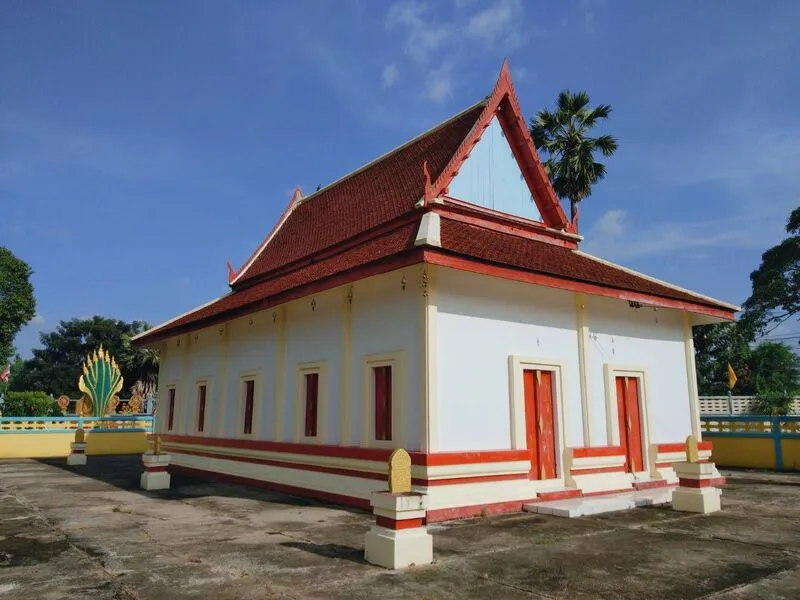
Wat Samet Tai
Open Days: Open Daily
Opening Hours: 08:00 – 17:00
Wat Samet Tai (Samet Tai Subdistrict, Bang Khla District, Chachoengsao) is a Maha Nikaya community temple that has been built and cared for collectively since the early 20th century. Its highlights include a clearly recorded founding story with identifiable land donors, an old ordination hall built in 1925, official consecration of the ubosot boundary (wisungkhamsima) granted on March 1, 1928, and a replica Buddha footprint for worship. It suits a calm merit-making stop in Bang Khla, then an easy continuation to the floating market and riverside restaurants in a single day.
Wat Samet Tai is located at 36/1, Moo 1, Samet Tai Subdistrict, Bang Khla District, Chachoengsao. It is a local Maha Nikaya temple that has long served as a spiritual anchor for the village and nearby communities. From a cultural-travel perspective, this is not a “photo-stop temple” designed for quick sightseeing. Instead, it is a living community temple you can read through its real structure: traces of beginnings powered by faith, gradual expansion of buildings according to local capacity, and the ongoing care of ritual spaces that remain actively used to the present. That grounded, unhurried character is exactly why many people still come on weekends to find a quieter rhythm and a steadier state of mind.
According to historical records, the temple was founded on January 1, 1909. The land was donated by “Nang Sanguan Yimprayoon,” and the construction was carried out by “Nai Klan.” This detail matters for understanding community temples, because it shows how a temple rarely begins as a large, capital-heavy project. It begins with an act of transforming lived land into sacred space, supported by donations and collective effort. Once the temple takes root, it gradually gathers new layers of meaning over time: religious meaning, social meaning, and cultural meaning. It becomes a place for merit-making, a place to meet and maintain relationships, a place for festivals and local traditions, and a place people return to as an emotional anchor through different stages of life.
A key milestone that places a community temple on a complete and formal footing within the monastic system is the granting of wisungkhamsima. This is the official demarcation of the ubosot boundary for formal monastic rites, ensuring major ceremonies—especially ordination—can be performed properly under Sangha regulations. Wat Samet Tai received wisungkhamsima on March 1, 1928. Read together with the founding date in 1909, the timeline shows step-by-step growth: first establishing a temple as the community’s refuge, then completing the ritual framework so the temple can support long-term religious life across generations.
Another “time-marker” that gives Wat Samet Tai historical depth is its old ordination hall. Records state the old ubosot measures about 8 meters wide and 14 meters long and was built in 1925. This scale helps you imagine how community temples of the era were typically built for real use rather than grandeur—creating a suitable space for rites that the community could sustain. Over time, such buildings become evidence of proportion and practicality in local temple architecture, and they also hold the shared memories of villagers who have come to the temple from childhood into adulthood.
Overall, Wat Samet Tai clearly functions as a “village temple.” People in Moo 1 of Samet Tai Subdistrict and surrounding communities use it for religious ceremonies and for Thai cultural and traditional activities. In everyday reality, the role of a village temple is most visible on days and occasions when people rely on shared communal space: Buddhist observance days, merit-making and dedication ceremonies, ordinations, kathin and pha pa offerings, funerals, and other events that require collective participation. When you visit with the intention of reading local life, you can sense that the temple’s importance does not depend on being new or large; it depends on continuous real-world use passed from one generation to the next.
What keeps a community temple like Wat Samet Tai “alive” is not only its buildings, but the rhythm of merit-making and community activities recurring through the Buddhist calendar and local life. The temple has its own communication channels and periodically publicizes merit activities, reflecting that the community still uses the temple as a contemporary shared space rather than a place frozen in the past. Consistent communication also makes the temple more accessible to younger generations, helping sustain its role as a living cultural public space.
Another point of interest for many visitors is the temple’s replica Buddha footprint. This kind of symbol appears in many Thai temples and often becomes a quiet, contemplative worship point. In Thai Buddhist practice, venerating a replica footprint is a way of recalling the Buddha through a sign that represents his presence in the human world. For many people, it becomes a simple place to set an intention without elaborate ritual, supporting calmness and a return to one’s inner balance. The Buddha footprint at Wat Samet Tai is also referenced in public information about the temple, so the temple’s identity is not only architectural; it includes devotional points that naturally encourage visitors to move slowly and be more deliberate.
When walking through a community temple, what makes the visit feel worthwhile is rarely the number of photo spots. It is the small details that reveal bigger truths: the orderliness of ritual spaces, pathways and courtyards, donation points, and the cadence of people using the temple at different times of day. Wat Samet Tai carries the character of a village temple not designed for commercial tourism. The overall atmosphere is typically quiet, suitable for simple merit-making. You can spend a short time here and still feel genuinely rested, especially if you work in a fast-paced environment and want a slower, less crowded place on your day off.
If you want to understand Wat Samet Tai as an experience, it helps to view the temple as a “space of relationships” more than just a “place.” Community temples connect people through shared merit-making and collective work for events. Kathin and pha pa seasons often show the community’s energy most clearly, as people come together to support religious structures and communal activities. Ordinations and funerals show another layer of the temple’s role: it supports life transitions—beginnings, growth, and farewells. These functions are why a community temple holds meaning beyond being a religious building.
In terms of administration, public records list the temple’s abbots and show continuity across periods. Based on the latest publicly available information, the current abbot is “Phra Khru Palat Nattawat Khamsa-at,” who assumed the role on December 22, 2023. Clear leadership succession information strengthens trustworthiness in a cultural-travel article, because it confirms the temple continues to be managed and remains a functioning spiritual center for the community.
For travelers who want a “merit-making–food–rest” day in Bang Khla District, Wat Samet Tai can be an excellent starting point. Samet Tai and nearby areas connect easily to Bang Khla’s well-known riverside lifestyle spots and restaurants. A popular plan is to arrive in the morning for comfortable weather, make a simple offering, walk the old ubosot area and key worship points, then continue to lifestyle attractions such as Bang Khla Floating Market or a riverside grilled-river-prawn restaurant. If you have time and prefer an overnight stay, accommodations in the Bang Khla area make it easy to extend the atmosphere into the evening. This pacing keeps the day from feeling rushed and lets faith, culture, and food sit naturally within one itinerary.
Getting There Wat Samet Tai is located at 36/1, Moo 1, Samet Tai Subdistrict, Bang Khla District, Chachoengsao. Driving is the most convenient option. Pin “Wat Samet Tai, Bang Khla” on your map and follow the route into Samet Tai Subdistrict. Parking is generally available within the temple grounds as appropriate. If you are using public transportation, it is typically easiest to enter Bang Khla District first, then take a local taxi or hired vehicle directly to the temple to save time and reduce multiple transfers.
To get the most from a visit while keeping the temple atmosphere intact, follow basic temple etiquette: dress modestly, keep quiet in the ubosot area, avoid loud conversation, and respect worshippers and ongoing religious activities. If you would like to make merit, a simple offering according to your means is appropriate—such as contributing to temple maintenance or joining announced merit activities. Community temples often endure through many small acts of support, and this kind of giving helps sustain the shared cultural space without placing unnecessary burden on the temple.
In the end, if you are looking for a Bang Khla temple that feels authentically local, Wat Samet Tai fits well. It has a clear founding record, long-standing wisungkhamsima, an old ubosot that preserves a sense of era, and a replica Buddha footprint that invites genuine quiet. Paired with Bang Khla’s floating market and riverside dining, it becomes a day trip that blends calmness with good food—while keeping the unpretentious, lived-in charm that Chachoengsao does so well.
| Place Name | Wat Samet Tai |
| Address | 36/1 Moo 1, Samet Tai Subdistrict, Bang Khla District, Chachoengsao 24110 |
| Summary | A Maha Nikaya community temple in Samet Tai, founded on January 1, 1909. Wisungkhamsima was granted on March 1, 1928. The temple features an old ubosot built in 1925 and a replica Buddha footprint for worship, making it a calm merit-making stop in a Bang Khla day trip. |
| Highlights | Clear founding record with named land donor, long-standing wisungkhamsima, old ubosot (8 m x 14 m) built in 1925, replica Buddha footprint for worship, quiet village-temple atmosphere suitable for a reflective visit. |
| History | Founded January 1, 1909. Land donor: Nang Sanguan Yimprayoon. Construction led by: Nai Klan. Wisungkhamsima granted March 1, 1928. Old ubosot built in 1925 (approx. 8 m wide, 14 m long). |
| Current Abbot | Phra Khru Palat Nattawat Khamsa-at |
| Contact Number | 080-549-2895 |
| Current Status | Open to visitors for worship and community merit activities as scheduled. |
| Nearby Attractions (Road Distance) | 1) Bang Khla Floating Market – 9 km 2) Wat Hua Suan (Stainless-Steel Ubosot) – 7 km 3) Wat Pho Bang Khla – 11 km 4) Wat Pak Nam Jolo – 19 km 5) Wat Saman Rattanaram – 27 km |
| Nearby Restaurants (Road Distance + Phone) | 1) Kor Kung Pao (Bang Khla) – 10 km. Tel. 081-861-1655 2) Je Tem Kung Yang Pla Pao (Bang Khla) – 10 km. Tel. 063-209-0258 3) Phae Kung Samerng – 13 km. Tel. 081-410-2498 4) Thao Kae Chue (Bang Khla) – 11 km. Tel. 038-541-020 5) P&P Kung Pao (Bang Khla) – 12 km. Tel. 098-553-9299 |
| Nearby Accommodations (Road Distance + Phone) | 1) Bang Khla Resort – 16 km. Tel. 085-224-4139 2) Tamarind@Bangkhla – 17 km. Tel. 065-563-2392 3) Little Bangkhla – 16 km. Tel. 062-492-4953 4) Blue Ozone Resort & Spa – 21 km. Tel. 081-611-1144 5) Tala Bangkla Riviera – 18 km. Tel. 062-323-7424 |
Frequently Asked Questions (FAQ)
Q: When was Wat Samet Tai founded?
A: The temple was founded on January 1, 1909. Public records name Nang Sanguan Yimprayoon as the land donor and Nai Klan as the person who carried out the construction.
Q: When did the temple receive wisungkhamsima?
A: Wisungkhamsima was granted on March 1, 1928, establishing the official boundary for formal monastic rites in the ubosot.
Q: What are the key historical and architectural highlights of Wat Samet Tai?
A: Highlights include the old ubosot built in 1925 (about 8 meters wide and 14 meters long) and the temple’s well-documented founding history with named donors and dates.
Q: What is a notable worship point inside the temple?
A: A notable worship point is the replica Buddha footprint, which many visitors venerate as a quiet place to set intentions and reflect.
Q: What time of day is best for visiting?
A: Morning to late morning is best for cooler weather and a calmer atmosphere, while afternoon works well for a relaxed stop before continuing to Bang Khla’s food and riverside routes.
Q: Where should I go after visiting Wat Samet Tai to complete a Bang Khla day trip?
A: You can continue to Bang Khla Floating Market, enjoy riverside grilled river prawns, then add nearby temples or an overnight stay in the Bang Khla area for a full-day itinerary.
 Category: ●Places of Worship
 Group: ●Temple
Last Update : 6 MonthAgo
 Last Update : 6 MonthAgo
 Click to Access the Navigation Map GPS
Wat Samet Tai Map
Recommend

 Art, Culture and Heritage
 Historical Sites and Monuments(3)
 Landmarks and Memorials(4)
 Royal Palace(1)
 Art, Craft Centres, Tradition(10)
 Museums(2)
 Historic Homes and Cities(1)
 Educational Places
 Museum for Study(1)
 Library(1)
 Educational Gardens, Farm(2)
Temple(50)
Educational Gardens, Farm(2)
Temple(50)
 Mosque(2)
 Other Sacred Sites(7)
 Research and Development
 Royal Project(4)
 Suburban Living
 Village, Community(5)
 Local Market(4)
 Floating Market(1)
 Nature and Wildlife
 National Parks and Marine Reserves(2)
 Mountain (Doi)(1)
 Dam, Reservoir, Lake(6)
 Waterfalls(1)
 Caves(1)
 River, Canal(2)
 Bays and Beaches(1)
 Islands(2)
 Other natural attractions(2)
 Entertainment and Agricultural
 Zoos and Aquariums(1)
 Animal camps and shows(1)
 Farms, Parks and Ecotourism(6)
 Spas and Wellness
 Spas and Wellness(1)
 Travel Articles, Recipes
 Travel Review, Food Review(3)


