
lovethailand home >Northeastern Travel Attractions >Udon Thani Travel Attractions >Ban Phu >Kham Duang > Wat Apinya Thesittham
TL;DR: Wat Apinya Thesittham is located at Ban Na Luang, Kham Duang Subdistrict, Ban Phue District, Udon Thani Province, Thailand, open Daily, hours 08.00 – 17.00.
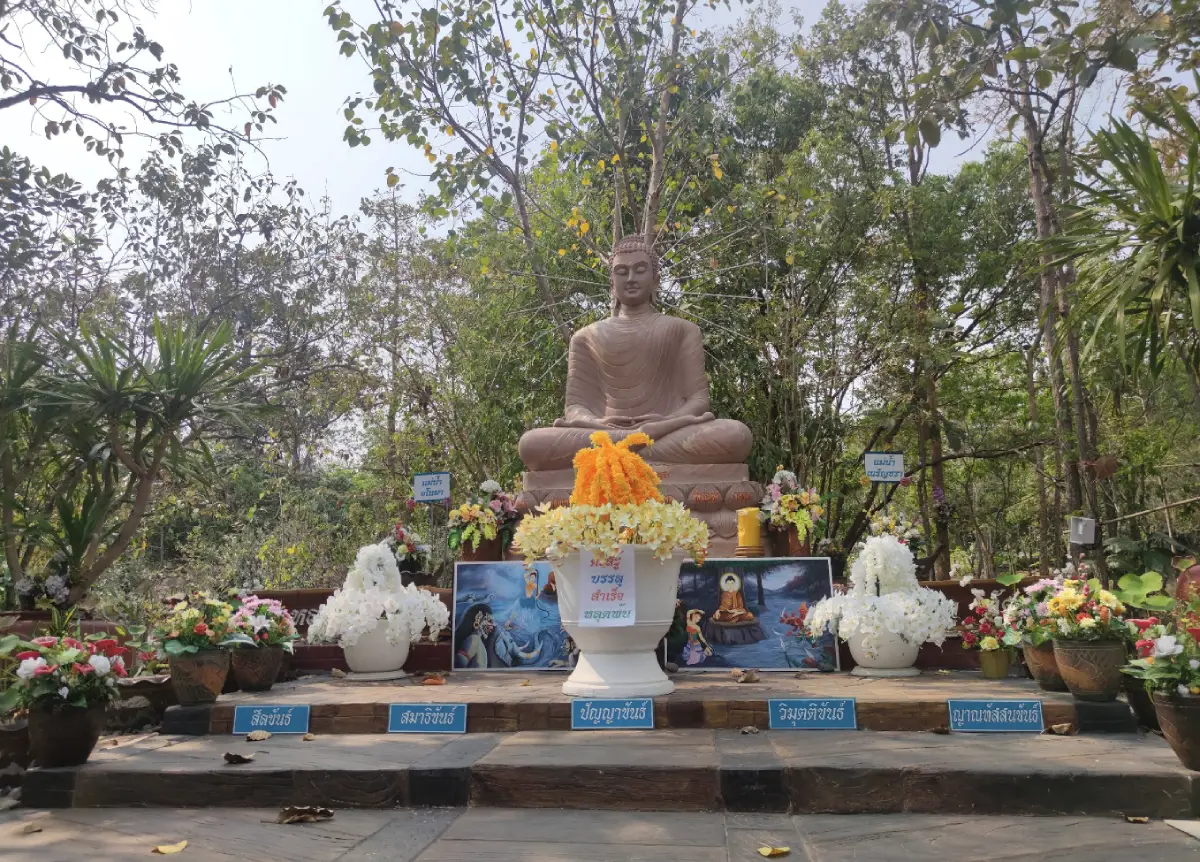
Wat Apinya Thesittham
Open Days: Daily
Opening Hours: 08.00 – 17.00
Wat Apinya Thesittham in Udon Thani, officially known today as Wat Na Luang and also widely called Wat Phu Ya U, is located on the summit of Phu Ya U Mountain at Ban Na Luang, Kham Duang Subdistrict, Ban Phue District, Udon Thani Province. It is one of the most respected meditation temples in Udon Thani and is deeply admired by people in Kham Duang Subdistrict, Ban Phue District, and many other areas. The temple stands within the forested mountain landscape of the Nam Som-Nayung National Reserved Forest and is known for its serious role in Samatha and Vipassana meditation training. This is not a temple focused on entertainment or sightseeing spectacle. Its true identity lies in forest practice, discipline, Dhamma training, mindfulness, simplicity, and the quiet mountain atmosphere that supports inner peace.
The name Wat Apinya Thesittham carries a strong Dhamma meaning. It suggests a place where teachings are delivered and where the mind is trained toward higher understanding. After the site was officially recognized as a complete temple, it became formally known as Wat Na Luang, a name connected with Ban Na Luang village. The name Wat Phu Ya U comes from the mountain on which the temple stands. These three names preserve three dimensions of the same place: the Dhamma mission, the local community, and the mountain landscape. Wat Apinya Thesittham expresses the temple’s original meditation identity, Wat Na Luang is its official temple name, and Wat Phu Ya U reflects the mountain that gives the temple its character.
The temple’s history became clear in 1986, when Phra Phavana Visuddhacharn, widely known as Luang Pho Thongbai Pabhassaro, searched for a suitable place for Dhamma practice and teaching. He found Phu Ya U in an area locally known as Tham Koeng, within the Nam Som-Nayung National Reserved Forest at Ban Na Luang, Kham Duang Subdistrict, Ban Phue District, Udon Thani Province. The site was quiet, remote from ordinary disturbance, and naturally suitable for meditation. Seeing its spiritual suitability, Luang Pho Thongbai selected this mountain as the place to establish a meditation center that later became one of Udon Thani’s most important forest monasteries.
January 9, 1986, is an important date in the history of the temple. On that day, Luang Pho Thongbai Pabhassaro, together with five monks and two novices, set up their forest umbrellas under the twin banyan trees on Phu Ya U. Local devotees and villagers helped build temporary huts to support the monastic stay. The beginning of Wat Apinya Thesittham was therefore not a large construction project. It began with forest umbrellas, simple shelters, the stillness of the mountain, the faith of villagers, and the intention of a meditation teacher who wished to use nature as a support for spiritual training.
In its early period, the site remained a meditation center, but each year many monks came to spend the rains retreat there and practiced both Samatha and Vipassana meditation with strong discipline. The center was named Wat Apinya Thesittham. Because it stood on Phu Ya U Mountain, people also called it Wat Phu Ya U. On June 16, 2000, the Ministry of Education officially recognized the place as a complete temple under the name Wat Na Luang. On January 1, 2001, it was appointed as the provincial Vipassana meditation center of Udon Thani, giving the temple a major role in Dhamma training, meditation education, and spiritual development for the public.
Phra Ratchasitthachan, also known as Luang Pho Thongbai Pabhassaro, is the founding spiritual figure and monastic president of Wat Na Luang. He is deeply respected as a monk of disciplined conduct, strong Dhamma commitment, and compassion toward the public. His decision to establish the meditation center on Phu Ya U transformed the mountain into a Dhamma retreat where people could listen to teachings, practice meditation, and train their minds in a quiet forest environment. His role remains central to the identity of the temple.
Phra Phavana Dhammaphinan, also known as Phra Bunthan Aggadhammo, is the abbot of Wat Na Luang and continues the temple’s meditation mission. He plays an important role in administering the temple and guiding the work of the meditation center. Phra Khru Panya Sutaphon, also known as Phra Maha Samri Dhammacharo, serves as deputy abbot and supports the training of monks, novices, nuns, laymen, laywomen, students, and members of the public in both scriptural study and Vipassana practice. Together, the monastic leadership keeps the temple’s practice system clear, disciplined, and accessible to sincere practitioners.
After the Buddhist Lent period, Wat Apinya Thesittham often receives government offices, organizations, public groups, schools, universities, students, and members of the public who request meditation training. The purpose is not only to learn seated meditation. Participants are trained to understand Buddhist teachings, cultivate mindfulness and clear comprehension, live with restraint, observe discipline, and see their own thoughts, emotions, and behavior more clearly. The training helps people bring Dhamma into daily life rather than leaving it as theory.
The mountain forest atmosphere is one of the temple’s most important supports for practice. Wat Apinya Thesittham is quieter than temples located in towns or villages. Natural sounds, mountain air, walking paths, forest shade, and the simplicity of monastic buildings all help reduce outside distraction. The journey up to the temple is therefore not only physical travel. It is also a gradual movement away from daily noise and toward a place that encourages self-observation and inner calm.
The built religious area of the temple covers about 15 rai and is used for monastic residences, practitioner accommodation, Dhamma training, chanting, meditation, and Buddhist activities. The temple also plays a role in helping care for the surrounding forest within the Nam Som-Nayung National Reserved Forest. For this reason, Wat Apinya Thesittham has value beyond religious practice. It also represents a forest monastery model in which Dhamma training and environmental care support each other.
Meditation training at Wat Apinya Thesittham emphasizes actual practice. Participants learn to observe precepts, chant, listen to Dhamma, sit in meditation, walk in meditation, restrain body and speech, and apply mindfulness to daily activities. During training, monks, meditation teachers, and senior assistants give guidance with compassion. This support helps beginners adjust to the discipline of a forest temple and helps experienced practitioners deepen their practice step by step.
The temple is especially suitable for serious mental training because the forest mountain setting supports patience, simplicity, punctuality, and restraint. Practitioners learn that peace does not come from escaping problems, but from understanding body and mind directly. Reducing distraction, reducing unnecessary speech, letting go of comfort, and contemplating life through Dhamma are central to the training here.
The twin banyan trees are important in the founding story of the temple because they mark the place where Luang Pho Thongbai and the first group of monks set up their forest umbrellas. This image reflects the roots of Thai forest Buddhism: a monk, a tree, a quiet place, and determination to practice. The temple did not begin from architecture; it began from faith, effort, and the search for a place suitable for Dhamma cultivation.
The main areas inside the temple include the worship and chanting area, meditation training halls, Dhamma listening spaces, monks’ residences, nuns’ and lay practitioners’ areas, walking meditation paths, Dhamma courtyards, the twin banyan area, and the surrounding Phu Ya U forest. The buildings are simple and functional, following the character of a forest monastery. Visitors should walk quietly, avoid entering monastic or practitioner areas without permission, and respect the temple’s rules.
Wat Apinya Thesittham is suitable for different kinds of visitors. Devotees can come to pay respect and make merit. Dhamma students can listen to teachings and observe the discipline of a forest monastery. Practitioners can contact the temple in advance to ask about meditation training and accommodation. Nature-oriented visitors can experience the quiet forested mountain atmosphere without disturbing those who are practicing. The temple combines faith, Dhamma education, meditation, and forest conservation in one place.
For international visitors, Wat Apinya Thesittham gives a clear view of Thai forest Buddhism. It does not emphasize decorative architecture or tourism-oriented display. It emphasizes discipline, mindfulness, teacher guidance, quietness, and the use of nature as support for inner training. Foreign visitors can understand that Thai Buddhism is not only ritual and temple art. It is also a living system of mental education supported by teachers, community, daily routine, and natural surroundings.
The journey to the temple has its own character because the route climbs toward a mountain forest. From Udon Thani city to Ban Phue District is about 52 kilometers. From Ban Phue to Kham Duang Subdistrict is about 23 kilometers. From Kham Duang to Wat Na Luang or Wat Apinya Thesittham is about 27 kilometers. The total distance from Udon Thani city is about 102 kilometers. Some parts of the road are rural, and some sections climb hills. Travelers should use a vehicle in good condition and pay attention to brakes, tires, fuel, and road conditions, especially during the rainy season.
Getting There is easiest by private car, rental car, or chartered local vehicle because the temple is located on a mountain and is not served by frequent public transport. Travelers from Udon Thani city should leave in the morning to allow enough time to reach the temple, pay respect, listen to Dhamma if available, walk quietly through the grounds, and return before dark. Those who wish to stay for meditation practice should contact the temple in advance and prepare modest clothing, personal medicine, a flashlight, and necessary items suitable for a forest monastery.
The best time to visit is in the morning or early afternoon, when there is enough daylight for the mountain road. Morning is suitable for worship and quiet practice, while early afternoon is practical for visitors coming from Ban Phue or nearby areas. Travelers unfamiliar with mountain roads should avoid unnecessary night driving. During the cool season, the mountain atmosphere is especially pleasant for meditation, but warm clothing may be needed in the morning and evening. During the rainy season, extra care is required because some road sections may become slippery.
Temple etiquette is essential because Wat Apinya Thesittham is an active meditation monastery, not an entertainment destination. Visitors should dress modestly, speak quietly, avoid music or loud behavior, refrain from disturbing practitioners, and avoid entering monastic or retreat areas without permission. Photography should be respectful and should not interrupt Dhamma practice. Respectful conduct helps preserve the peace of the temple and allows visitors to receive real benefit from the atmosphere.
The temple can be included in a wider Dhamma and nature route through Udon Thani. Nearby route options include Ban Phue District, Nam Som District, Phu Phrabat Historical Park, Phra Phutthabat Bua Bok, Wat Pa Phu Kon, Na Kha Textile Market, and Udon Thani city. Travelers with limited time should focus on Wat Apinya Thesittham and Ban Phue. Those with a full day can add Phu Phrabat or Wat Pa Phu Kon, depending on road conditions and travel plans.
Considering its founding by Luang Pho Thongbai Pabhassaro, its official status as Udon Thani’s provincial Vipassana meditation center, the leadership of Phra Phavana Dhammaphinan, its training for monks, students, organizations, and the public, and its protected mountain forest setting, Wat Apinya Thesittham is one of the most important meditation temples in Udon Thani. Visitors can pay respect, listen to Dhamma, learn about Thai forest practice, experience the quietness of Phu Ya U, and understand that inner peace is developed through consistent training.
| Name | Wat Apinya Thesittham, also known as Wat Na Luang / Wat Phu Ya U |
| Location | Ban Na Luang, Kham Duang Subdistrict, Ban Phue District, Udon Thani Province, Thailand |
| Address | Phu Ya U Mountain, Ban Na Luang, Village No. 5, Kham Duang Subdistrict, Ban Phue District, Udon Thani 41160, Thailand |
| Highlights | Mountain forest meditation temple, Udon Thani provincial Vipassana meditation center, peaceful Phu Ya U forest setting, Samatha and Vipassana training areas, twin banyan trees in the temple’s founding history, and Dhamma training for monks, students, organizations, and the public |
| History | Founded on Phu Ya U on January 9, 1986, by Phra Phavana Visuddhacharn, or Luang Pho Thongbai Pabhassaro, together with five monks and two novices. It was officially recognized as Wat Na Luang on June 16, 2000, and appointed as Udon Thani’s provincial Vipassana meditation center on January 1, 2001 |
| Name Origin | Wat Apinya Thesittham was the original meditation-center name, expressing its Dhamma teaching and training purpose. Wat Na Luang is connected with Ban Na Luang, while Wat Phu Ya U refers to the mountain where the temple stands |
| Distinctive Features | A Dhammayut local forest temple and mountain Vipassana monastery, with about 15 rai of religious-use area and an important role in helping preserve the surrounding forest within the Nam Som-Nayung National Reserved Forest |
| Travel Information | From Udon Thani city, travel to Ban Phue District for about 52 km, continue to Kham Duang Subdistrict for about 23 km, then continue up to the temple for about 27 km. The total distance is about 102 km. Some sections are rural and mountainous, so a private car, rental car, or chartered vehicle is recommended |
| Current Status | Open for worshippers, visitors, and Dhamma practitioners to pay respect, listen to Dhamma, visit the temple grounds, and contact the temple for meditation training according to temple regulations |
| Open Days | Daily |
| Opening Hours | 08.00 – 17.00 |
| Facilities | Meditation hall, chanting hall, monks’ residences, practitioner accommodation areas, Dhamma training spaces, walking meditation paths, shaded forest areas, and temple contact areas according to temple regulations |
| Main Areas / Zones | Worship And Chanting Area Samatha And Vipassana Meditation Training Hall Dhamma Listening And Dhamma Discussion Area Monastic Area Nuns’ And Lay Practitioners’ Area Dhamma Courtyard And Walking Meditation Paths Twin Banyan Trees From The Temple’s Founding History Phu Ya U Forest Area And Nam Som-Nayung Forest Landscape Reception And Registration Area For Meditation Practitioners |
| Abbot / Caretaker | Phra Phavana Dhammaphinan, also known as Phra Bunthan Aggadhammo, Abbot of Wat Na Luang Phra Ratchasitthachan, also known as Luang Pho Thongbai Pabhassaro, Monastic President And Advisor To The Abbot Phra Khru Panya Sutaphon, also known as Phra Maha Samri Dhammacharo, Deputy Abbot |
| Official Website / Official Page | Wat Na Luang (Apinya Thesittham) Official Website Official Dhamma Media And Social Channels Of Wat Na Luang (Apinya Thesittham) |
| Nearby Tourist Attractions | 1. Ban Na Luang, Kham Duang Subdistrict, about 5 km 2. Kham Duang Subdistrict, Ban Phue District, about 27 km 3. Nam Som District, about 45 km 4. Ban Phue Town, about 46 km 5. Phu Phrabat Historical Park, about 55 km, Tel. 042-219-837 6. Phra Phutthabat Bua Bok, about 58 km 7. Wat Pa Phu Kon, Na Yung District, about 60 km 8. Na Kha Textile Market, about 80 km 9. Udon Thani City, about 102 km |
| Nearby Restaurants | 1. Local Shops And Restaurants In Ban Na Luang / Kham Duang, about 5-27 km 2. Namsom Food And Herbland Shop, Nam Som District, about 45 km, Tel. 082-152-4372 3. Ma Kin Nee Nam Som, Nam Som District, about 45 km, Tel. 080-755-0244 4. My Home Coffee Namsom, Nam Som District, about 45 km, Tel. 091-058-1041 5. Jungle Cafe Ban Phue Branch, about 46 km, Tel. 086-396-3624 6. Fueang Fa Restaurant, Ban Phue, about 46 km, Tel. 042-219-385 7. PunThai Coffee Chonbot Bamrung Road, Ban Phue, about 46 km, Tel. 080-071-9270 8. Phim Made-To-Order Food, Ban Phue, about 47 km, Tel. 083-843-7638 |
| Nearby Accommodations | 1. Local Homestays And Community Accommodations In Kham Duang / Ban Na Luang, about 5-27 km 2. Wilarwaree Resort, Nam Som District, about 45 km, Tel. 089-417-2222 3. Jiranan Resort, Nam Som District, about 45 km, Tel. 042-287-453 4. Euang Kham Resort, Nam Som District, about 45 km, Tel. 084-797-0755, 082-111-1748 5. Orapin Resort, Nam Som District, about 45 km, Tel. 095-143-5297 6. Oonrak Resort Ban Phue, about 46 km, Tel. 061-196-9897 7. Rom Ruen Resort Ban Phue, about 46 km, Tel. 064-963-9053 |
Frequently Asked Questions (FAQ)
Q: Where is Wat Apinya Thesittham in Udon Thani located?
A: Wat Apinya Thesittham, also known as Wat Na Luang or Wat Phu Ya U, is located on Phu Ya U Mountain at Ban Na Luang, Kham Duang Subdistrict, Ban Phue District, Udon Thani Province, within the Nam Som-Nayung National Reserved Forest area.
Q: What are the opening days and hours of Wat Apinya Thesittham?
A: The temple is open daily from 08.00 to 17.00. Visitors who wish to join meditation training should contact the temple in advance and follow its regulations.
Q: Is Wat Apinya Thesittham the same place as Wat Na Luang?
A: Yes. Wat Apinya Thesittham was the original meditation-center name. The site was later officially recognized as Wat Na Luang, while many people also call it Wat Phu Ya U because it stands on Phu Ya U Mountain.
Q: Who is the abbot of Wat Apinya Thesittham?
A: The abbot of Wat Na Luang, or Wat Apinya Thesittham, is Phra Phavana Dhammaphinan, also known as Phra Bunthan Aggadhammo. Phra Ratchasitthachan, or Luang Pho Thongbai Pabhassaro, serves as monastic president and advisor to the abbot.
Q: Is Wat Apinya Thesittham suitable for meditation practice?
A: Yes. The temple is highly suitable for meditation practice because it is Udon Thani’s provincial Vipassana meditation center, has a quiet forest mountain setting, follows clear practice discipline, and provides guidance from monks and meditation assistants.
Q: How can travelers get to Wat Apinya Thesittham?
A: From Udon Thani city, travel to Ban Phue District for about 52 km, continue to Kham Duang Subdistrict for about 23 km, and then continue up to the temple for about 27 km. The total distance is about 102 km, and a private car, rental car, or chartered vehicle is recommended.
Q: Is there an admission fee for Wat Apinya Thesittham?
A: Wat Apinya Thesittham is a meditation temple open to worshippers and Dhamma practitioners during visiting hours. Visitors who wish to join a meditation program or stay for practice should contact the temple directly and follow its regulations.
Q: What nearby places can visitors combine with Wat Apinya Thesittham?
A: Nearby places include Ban Phue District, Nam Som District, Phu Phrabat Historical Park, Phra Phutthabat Bua Bok, Wat Pa Phu Kon, Na Kha Textile Market, and Udon Thani city.
 Category: ●Places of Worship
 Group: ●Temple
Last Update : 3 WeekAgo
 Last Update : 3 WeekAgo
 Click to Access the Navigation Map GPS
Wat Apinya Thesittham Map
Recommend

 Art, Culture and Heritage
 Historical Sites and Monuments(1)
 Landmarks and Memorials(1)
 Art, Craft Centres, Tradition(2)
 Museums(2)
Temple(21)
Museums(2)
Temple(21)
 Other Sacred Sites(8)
 Suburban Living
 Village, Community(3)
 Nature and Wildlife
 National Parks and Marine Reserves(3)
 Mountain (Doi)(1)
 Dam, Reservoir, Lake(8)
 Waterfalls(6)
 Caves(1)
 River, Canal(4)
 Islands(1)
 Other natural attractions(1)
 Entertainment and Agricultural
 Farms, Parks and Ecotourism(3)
 Waterpark(1)
 Shopping
 Shopping and Night Market(1)


