
lovethailand home >Northeastern Travel Attractions >Udon Thani Travel Attractions >Nong Han >Nong Phai > Ban Hai Sok Community Fishery Pond
TL;DR: Ban Hai Sok Community Fishery Pond is located at Moo 10, Ban Hai Sok, Nong Phai Subdistrict, Nong Han District, Udon Thani Province, open Daily, hours 08.00 – 17.00.

Ban Hai Sok Community Fishery Pond
Open Days: Daily
Opening Hours: 08.00 – 17.00
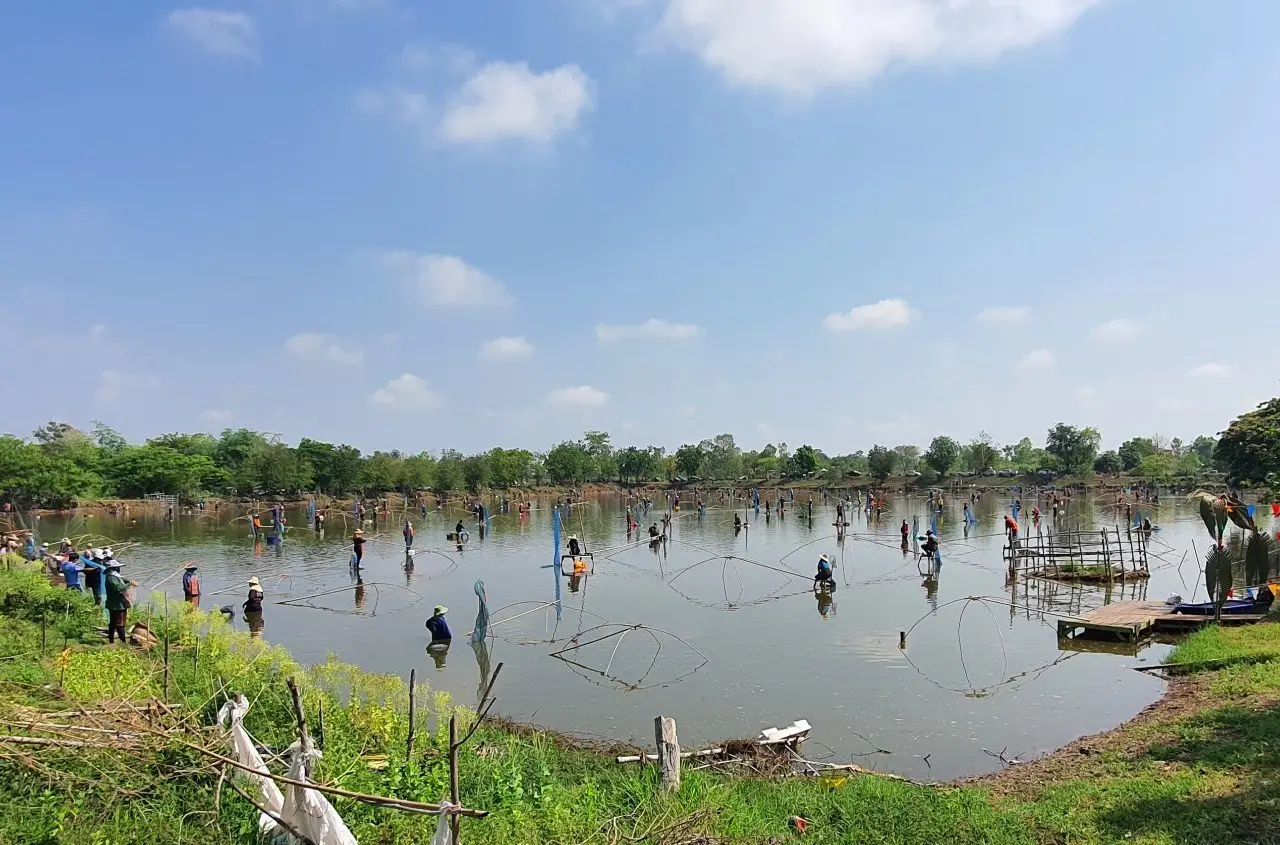
Ban Hai Sok Community Fishery Pond is located in Moo 10, Ban Hai Sok, Nong Phai Subdistrict, Nong Han District, Udon Thani Province. It is a small community water source that reflects the rural way of life in northeastern Thailand. The pond is connected with local freshwater fishing, household vegetable growing, seasonal farming, and community-based use of natural resources. After the rice harvest season, villagers use the moist land around the pond to grow vegetables for household consumption and local use. This makes the pond more than a simple body of water. It is a living community landscape where water, soil, rice fields, fish, vegetables, and everyday village life are closely connected.
Ban Hai Sok Community Fishery Pond is suitable for travelers who want to see a quieter and more local side of Udon Thani. It is not a large commercial tourist attraction with heavy facilities or staged scenery. Instead, it is a real village water source where the local community continues to use the surrounding area in practical ways. The value of the place lies in its authenticity. Visitors can observe how a rural community uses a pond for fishing, seasonal vegetable growing, and everyday livelihood. The landscape is modest, but it gives a clear view of how local people live with natural resources.
The pond has an important role as a village water resource. In rural Isan communities, ponds and reservoirs are often central to daily life. They store water, support fish, provide moisture for nearby soil, and serve as shared spaces for the community. After the main rice-growing period ends, the land around the pond can become useful for small vegetable plots. This seasonal use of land is a practical form of local knowledge. Villagers understand when the soil is moist, which areas can be planted, and how to make use of the period after harvesting without leaving the land unused.
The fishery aspect of Ban Hai Sok Community Fishery Pond is also significant. The pond is associated with community fishery activities and participatory fish production support. Such activities help local water sources become more useful for food security and household income. Freshwater fish such as tilapia, common carp, rohu-like carp, and other locally raised fish are important for rural consumption. A village pond that supports fishery activities can help strengthen the local food system while encouraging the community to care for the water source together.
The charm of the pond comes from its ordinary but meaningful rural character. Visitors should not expect a dramatic waterfall, mountain viewpoint, or large architectural landmark. The experience here is more subtle. It is about seeing vegetable plots along the edge of the pond, observing the calm water surface, understanding the farming landscape after the harvest, and recognizing how villagers turn a local water source into a productive shared space. For travelers interested in community life, agricultural culture, and rural landscapes, this small pond offers a valuable perspective.
Ban Hai Sok is located in Nong Phai Subdistrict, Nong Han District, a district known for its connection with Ban Chiang, temples, agriculture, and cultural heritage. A visit to the pond can therefore be included in a broader Nong Han travel route. Travelers can combine Ban Hai Sok Community Fishery Pond with Wat Hai Sok, Ban Chiang National Museum, the archaeological site at Wat Pho Si Nai, Ban Chiang community, and Wat Santi Wanaram. This route brings together local nature, rural livelihoods, Buddhist sites, and world-class archaeological heritage in one district.
From an ecological perspective, the pond functions as a small wetland-like community space. Water helps retain moisture in the landscape, aquatic plants support small habitats, fish provide food, and the surrounding soil can be used for seasonal cultivation. The vegetable plots around the pond demonstrate how villagers adapt to the rhythm of the agricultural year. After rice harvesting, household labor shifts toward smaller-scale activities such as vegetable growing, fishing, and local food preparation. This pattern reflects the flexibility of rural livelihoods in northeastern Thailand.
The post-harvest season is especially meaningful at Ban Hai Sok Community Fishery Pond. During this period, the pondside area becomes more active as villagers use the land to grow kitchen vegetables. These plots may not look like formal agricultural attractions, but they show the real production of food at household level. Travelers who appreciate local culture can see how a rural community uses available land and water wisely. The vegetable plots also show the connection between agriculture and family life, because many of these crops support daily meals rather than large commercial production.
The pond also represents local food security. A water source that supports fish and vegetable growing reduces dependence on outside food. Households can use fish and vegetables from the village environment, while surplus products may be shared, exchanged, or sold locally. This kind of system is part of the resilience of rural communities. It may appear simple, but it helps explain why small village water sources remain important in Isan. They are not only scenic features; they support life, work, and community relationships.
For cultural travelers, Ban Hai Sok Community Fishery Pond should be visited with an understanding of context. This is a working community space rather than a fully separated tourist zone. Walking quietly, observing the vegetable plots, looking at the pond, and noticing how the village is arranged around the water can reveal much about local life. The place is suitable for travelers who enjoy rural routes, small communities, agriculture, local food systems, and lesser-known destinations that still feel connected to everyday life.
The best time to visit is in the morning or late afternoon, when the weather is more comfortable and the light is better for photography. The post-harvest period is particularly interesting because villagers use the pondside area for vegetable growing. During the rainy season, the pond and surrounding greenery may look fuller and fresher, but visitors should be careful with wet soil, slippery paths, and soft ground near the water. The site is simple, so travelers should prepare for a local outdoor environment.
Respectful behavior is important when visiting Ban Hai Sok Community Fishery Pond. Visitors should avoid blocking village roads, walking into vegetable plots without permission, picking vegetables, disturbing fishing equipment, leaving rubbish, or making loud noise. The pond and its surroundings are still used by local people. This means visitors are entering a lived-in community space. Respect for the village, the land, and the water is part of the travel experience.
For photography, the pond is better suited to rural lifestyle images than dramatic landmark photography. Interesting scenes include the pond surface in soft light, vegetable plots along the water, soil paths, rice fields after harvest, and the quiet atmosphere of the village. If local people appear in the frame, visitors should ask permission before taking close photographs. This is especially important when photographing agricultural work, private plots, or fishing-related activities.
The pond can also be viewed as a learning site for small-scale freshwater fishery. Community ponds are practical places where villagers understand seasonal water levels, fish behavior, and the balance between use and care. Fishery activities encourage people to value the water source and to maintain it for future use. Fish in the pond are not only food; they represent a shared resource that requires cooperation. This makes the pond a useful example of community-based natural resource management.
Nong Han District is also rich in cultural and historical attractions. Ban Chiang National Museum, located within the same district, is one of the most important archaeological destinations in Thailand. Combining Ban Hai Sok Community Fishery Pond with Ban Chiang allows travelers to move from present-day rural life to prehistoric human settlement and material culture. This contrast makes the route more meaningful. In one day, visitors can see both the everyday life of a modern village and the ancient heritage of one of Thailand’s most significant archaeological areas.
Another suitable route is to combine the pond with nearby temples. Wat Hai Sok is close to the Ban Hai Sok area and is connected with the local community. Wat Santi Wanaram, known for its lotus-shaped ordination hall in the middle of the water, is another interesting destination in Nong Han District. A route that links the pond, temples, Ban Chiang, and local restaurants gives visitors a fuller view of Nong Han. It is a route that includes nature, community life, faith, food, and history.
The main areas around Ban Hai Sok Community Fishery Pond can be understood as several practical zones: the pond surface, the pondside vegetable-growing area, the community fishery area, the village access paths, the surrounding rice field landscape, and the Ban Hai Sok residential area connected to the pond. These are not formal tourist zones, but they help visitors understand how the place functions. Seeing the pond as a working community landscape makes the visit more respectful and more meaningful.
Visitors should prepare simple outdoor essentials such as walking shoes, drinking water, a hat, sun protection, and a personal rubbish bag. During or after rain, the ground can be wet and slippery. If visitors want to speak with villagers about vegetable growing or fishery activities, they should do so politely and ask before entering working areas. The vegetable plots and fishing equipment belong to local people and represent their labor and livelihood.
Getting There is most convenient by private car or rental car. From Udon Thani city, travel toward Nong Han District along the main Udon Thani–Sakon Nakhon route, then continue into Nong Phai Subdistrict and Ban Hai Sok, Moo 10. The trip can be done as a day trip from Udon Thani city. Since this is a small community destination, signs may not be as visible as those at major attractions. Visitors should use navigation and confirm directions with local residents when approaching the village.
Travelers coming from nearby provinces such as Sakon Nakhon, Nong Khai, or Khon Kaen can connect to Nong Han District and continue toward Nong Phai Subdistrict. For a practical route, visit the pond in the morning, continue to Wat Hai Sok and a local restaurant in Nong Han, then visit Ban Chiang National Museum or Wat Santi Wanaram in the afternoon. This route avoids unnecessary backtracking and provides a good mix of rural scenery, community life, history, and temple culture.
Ban Hai Sok Community Fishery Pond is best visited as a short but meaningful stop. It does not need a full-day visit by itself, but it adds important depth to a Nong Han itinerary. Travelers can spend time observing the pond, vegetable plots, and rural surroundings before continuing to nearby attractions. This style of travel suits people who want to understand a place rather than simply collect landmark photographs.
Overall, Ban Hai Sok Community Fishery Pond is valuable because of its simplicity. It tells the story of village fishery, post-harvest vegetable growing, shared natural resources, and rural self-reliance in Udon Thani. For travelers who want to experience more than the best-known attractions of the province, this pond offers a quiet but revealing look at community life. Alongside Ban Chiang, temples, and larger tourist sites, it helps complete the picture of Nong Han District as a place where history, agriculture, water, faith, and everyday livelihood continue to exist side by side.
| Name | Ban Hai Sok Community Fishery Pond |
| Location | Moo 10, Ban Hai Sok, Nong Phai Subdistrict, Nong Han District, Udon Thani Province |
| Address | Ban Hai Sok, Moo 10, Nong Phai Subdistrict, Nong Han District, Udon Thani 41130, Thailand |
| Highlights | A local community pond connected with freshwater fishery, post-harvest vegetable growing, and rural village life in Ban Hai Sok |
| History | A village water source used for community fishery and pondside agriculture, with recorded fishery-related activities in Moo 10, Nong Phai Subdistrict, Nong Han District |
| Distinctive Features | A community pond where villagers grow kitchen vegetables along the pond after the harvest season and use the water source for local fishery activities |
| Travel Information | From Udon Thani city, travel toward Nong Han District, then continue to Nong Phai Subdistrict and Ban Hai Sok, Moo 10. A private car or rental car is recommended. Use navigation together with local directions when approaching the village. |
| Current Status | Open as a nature and community-lifestyle attraction in Nong Phai Subdistrict, Nong Han District, Udon Thani Province |
| Open Days | Daily |
| Opening Hours | 08.00 – 17.00 |
| Facilities | Community pond and rural viewing area. Visitors should bring drinking water, sun protection, suitable walking shoes, and personal supplies. |
| Main Areas / Zones | Pond Surface Pondside Vegetable-Growing Area Community Fishery Area Village Access Paths Surrounding Rice Field Landscape Ban Hai Sok Community Area |
| Caretaker / Related Local Bodies | Ban Hai Sok community, Moo 10, together with fishery-related agencies in Udon Thani for community fishery activities |
| Nearby Tourist Attractions | 1. Wat Hai Sok, about 1 km 2. Wat Hai Sok - Wang Phaya Nak, about 2 km, Tel. 088-305-9498 3. Ban Chiang National Museum, about 13 km, Tel. 042-235040 4. Wat Pho Si Nai Archaeological Site, about 13 km 5. Ban Chiang Community Tourism Area, about 14 km 6. Wat Santi Wanaram, about 18 km 7. Nonghan Grand Hotel And Resort Water Park Area, about 12 km, Tel. 042-111408 |
| Nearby Restaurants | 1. Steak Nok Mueang Cafe Nong Han, about 9 km, Tel. 080-010-2216 2. Oh Wa Shabu Nong Han Branch, about 9 km, Tel. 063-743-3309 3. Jungle Cafe Nong Han Branch, about 10 km, Tel. 085-646-9149 4. Khanom Chin Chao Wang Restaurant, about 9 km, Tel. 098-828-9955 5. Sabai Jai Restaurant, about 10 km, Tel. 081-873-3837 6. Lap Pet Ban Chiang, about 14 km, Tel. 090-583-3437 |
| Nearby Accommodations | 1. Nonghan Grand Hotel And Resort, about 12 km, Tel. 042-111-408 2. Moai Homeplace, about 12 km 3. Pornprakai House Homestay Ban Chiang, about 13 km, Tel. 042-208-229 4. Huan Suan Nok Homestay Ban Chiang, about 14 km, Tel. 087-216-7001 5. Ban Chiang Hotel Udon Thani, about 45 km, Tel. 042-327-911 6. The Cottage Hotel Udon Thani, about 45 km, Tel. 082-662-6996 |
Frequently Asked Questions (FAQ)
Q: Where is Ban Hai Sok Community Fishery Pond located?
A: It is located in Moo 10, Ban Hai Sok, Nong Phai Subdistrict, Nong Han District, Udon Thani Province.
Q: What are the opening days and hours?
A: The pond is open daily from 08.00 to 17.00.
Q: What is the main highlight of Ban Hai Sok Community Fishery Pond?
A: The main highlight is its role as a community pond connected with local fishery and post-harvest vegetable growing along the pond edge.
Q: What kind of travelers is this place suitable for?
A: It is suitable for travelers interested in rural community life, local agriculture, freshwater fishery, and quiet village landscapes.
Q: When is the best time to visit?
A: Morning and late afternoon are the most comfortable times to visit. The post-harvest period is especially interesting for seeing vegetable plots along the pond.
Q: Is there an entrance fee?
A: A specific entrance fee is not listed for this community pond. Visitors should treat it as a local community water source and respect the working areas around it.
Q: What nearby attractions can be visited after the pond?
A: Nearby attractions include Wat Hai Sok, Ban Chiang National Museum, Wat Pho Si Nai Archaeological Site, Ban Chiang community, and Wat Santi Wanaram.
Q: How can travelers get there from Udon Thani city?
A: Travel from Udon Thani city toward Nong Han District, then continue to Nong Phai Subdistrict and Ban Hai Sok, Moo 10. A private car or rental car is the most convenient option.
 Category: ●Nature and Wildlife
 Group: ●River, Canal
Last Update : 2 WeekAgo
 Last Update : 2 WeekAgo
 Click to Access the Navigation Map GPS
Ban Hai Sok Community Fishery Pond Map
Recommend

 Art, Culture and Heritage
 Historical Sites and Monuments(1)
 Landmarks and Memorials(1)
 Art, Craft Centres, Tradition(2)
 Museums(2)
 Places of Worship
 Temple(21)
 Other Sacred Sites(8)
 Suburban Living
 Village, Community(3)
 National Parks and Marine Reserves(3)
 Mountain (Doi)(1)
 Dam, Reservoir, Lake(8)
 Waterfalls(6)
 Caves(1)
River, Canal(4)
Caves(1)
River, Canal(4)
 Islands(1)
 Other natural attractions(1)
 Entertainment and Agricultural
 Farms, Parks and Ecotourism(3)
 Waterpark(1)
 Shopping
 Shopping and Night Market(1)


