
lovethailand home >Northeastern Travel Attractions >Udon Thani Travel Attractions >Si That >Cham Pi > Wat Si That Pramancha (Wat Pa Maew)
TL;DR: Wat Si That Pramancha (Wat Pa Maew) is located at Ban Nong Waeng, Champi Subdistrict, Si That District, Udon Thani Province, Thailand, open Daily, hours 08.00 – 17.00.
Wat Si That Pramancha (Wat Pa Maew)
Open Days: Daily
Opening Hours: 08.00 – 17.00
Wat Si That Pramancha, also known as Wat Pa Maeo, in Udon Thani is located at Ban Nong Waeng, Champi Subdistrict, Si That District, Udon Thani Province. It is an old Buddhist temple and an important archaeological monument with strong religious, historical, artistic, and local cultural value. The temple is best known for its ancient stupa, an old Isan-style ordination hall, sandstone boundary stones, wooden Buddha images, sandstone Buddha images, a sandstone Buddha head, and a medicine-grinding stone. These features show that the area has long been associated with Buddhist worship, local craftsmanship, and community faith in upper northeastern Thailand.
The temple is also known locally as Wat Pa Maeo, a name connected with a folk legend about a golden cat and valuable objects hidden inside the stupa. This local name gives the temple a distinctive identity. Wat Si That Pramancha is not only a place where visitors can see old structures; it is also a place where local memory, Buddhist devotion, and storytelling are preserved together. For travelers who want to understand Udon Thani beyond standard sightseeing routes, this temple offers a quiet but meaningful experience of history, legend, archaeology, and Isan Buddhist culture.
According to local legend, people from Nakhon Rat, which may refer to Nakhon Ratchasima or another remembered city called Mueang Rat, carried valuables such as gems, jewelry, silver, and gold to Phu Kamphra in order to help build Phra That Phanom. When they reached Ban Nong Waeng, they learned that Phra That Phanom had already been completed. Deeply disappointed that they had arrived too late to take part in the construction, they decided to build a stupa to enshrine the valuable objects they had brought with them on the northern side of what is now Wat Nong Waeng.
Because the first stupa was too small to hold all the valuables, another stupa was built about 200 meters to the south to enshrine the remaining objects. Later, the northern stupa was destroyed by people digging for treasure, while the southern stupa remained in ruins at the present site of Wat Si That Pramancha. When a Lao Wiang community later settled in the area, a temple was established around the two stupa sites and became known as Wat Si That Pramancha.
The meaning of this legend is not limited to the idea of treasure hidden in a stupa. It reveals how the local community connects its sacred place with the wider Buddhist landscape of the Mekong region. Phra That Phanom is one of the most revered Buddhist monuments in northeastern Thailand and Laos. By linking Wat Si That Pramancha with the story of people traveling to help build Phra That Phanom, the legend gives the temple a strong spiritual identity. It presents the ancient stupa as a local sacred monument connected with merit, pilgrimage, and devotion to Buddhism.
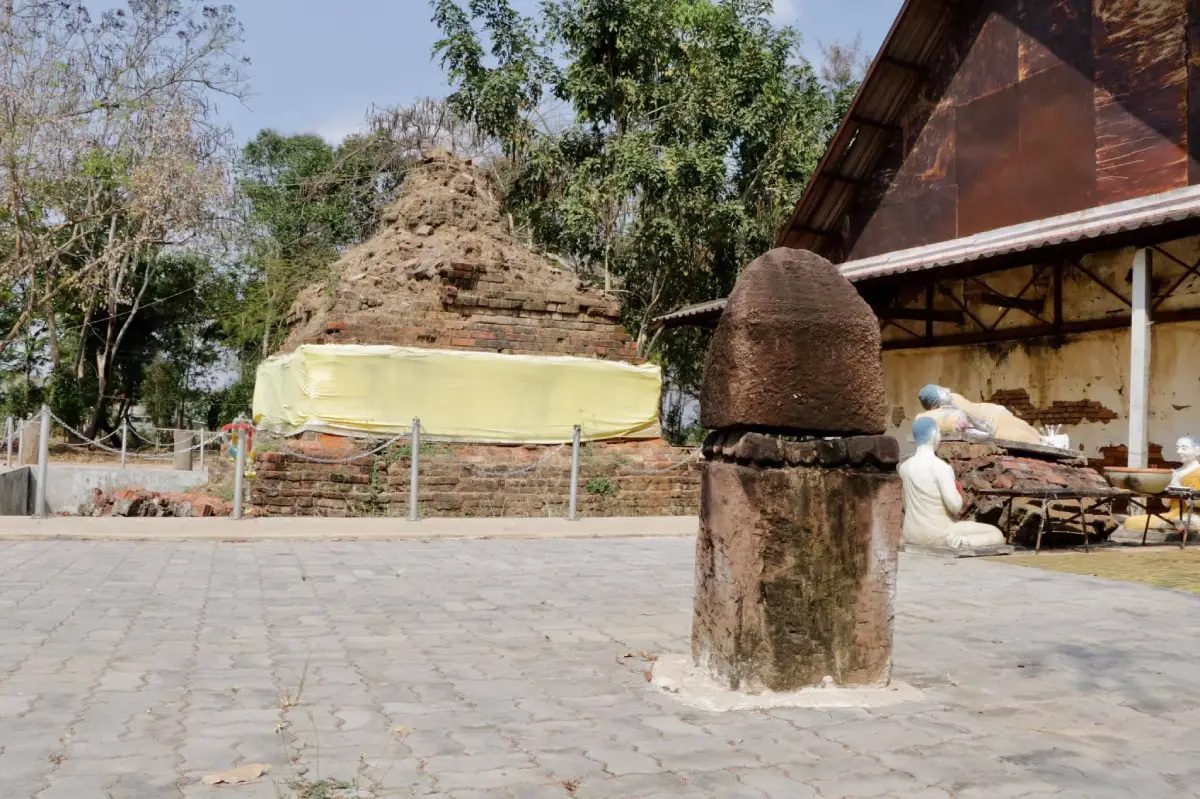
According to the Fine Arts Department, the main registered monuments at Wat Si That Pramancha are the ancient stupa and the ordination hall, or sim. The stupa is built of brick and clay mortar, with a square form and a lower base resembling a lotus base. Above the base, the structure rises in receding tiers before reaching the bell-shaped section. Its artistic style is associated with the Lan Xang cultural tradition. The complete form of the stupa is believed to have resembled Phra That Ing Hang in Laos, with a square central body, three receding tiers, and a lotus-bud finial.
The Lan Xang artistic character of the stupa is important because Udon Thani and the upper Isan region have long been connected culturally with the Mekong basin. Square stupas, receding bases, and lotus-bud forms are part of a regional Buddhist artistic vocabulary shared across northeastern Thailand and Laos. Seeing the stupa at Wat Si That Pramancha helps visitors understand that Buddhist art in Udon Thani is not isolated. It belongs to a wider cultural network that connects communities across the Mekong region.
The stupa has been dated to around the 23rd to 24th Buddhist centuries, within the Lan Xang cultural period. This makes Wat Si That Pramancha more than an ordinary village temple. It is an archaeological and religious site that preserves evidence of historical Buddhist art. Although the stupa survives in a damaged condition, its remaining form still communicates a great deal about past belief, architecture, and craftsmanship. Visitors should therefore regard the structure with respect, not as ordinary broken brickwork, but as cultural evidence that has endured for centuries.
The history of the site also records that Wat Si That Pramancha was once abandoned. In 1915, villagers from Ban Phan Lam migrated into the area and discovered an abandoned mound with a stupa and carved sandstone boundary stones arranged around it. Some of these boundary stones once had two lines of ancient writing, now lost. In 1919, a monk from Ban Tha Khantho came upon the abandoned temple during a pilgrimage and stayed there for the rains retreat. Later, villagers helped restore the site and rebuild the temple. The first ordination hall was built in 1921.
The restoration of the temple from an abandoned site is an important part of its meaning. It shows how a sacred place can return to life when a new community recognizes its value. The villagers did not see the old mound and stupa as meaningless ruins. They restored the site, rebuilt religious life around it, and returned it to active Buddhist use. Wat Si That Pramancha therefore represents several historical layers: prosperity, abandonment, rediscovery, restoration, official registration, and continued worship by the local community.
The old sim, or ordination hall, is another important feature of the temple. It is a rectangular Isan-style structure made of brick and plaster, about 8 meters wide, 12 meters long, and 3 meters high. It has four walls, a single-tier roof, and three door openings for ventilation. The wall behind the principal Buddha image is closed. This simple architectural form reflects the practical and modest character of local Isan Buddhist buildings. It is not grand in the manner of major urban temples, but it is highly significant as local religious architecture.
Inside the sim, wooden Buddha images and sandstone Buddha images made by local craftsmen were found around the principal Buddha platform. These images have both artistic and devotional value. Their beauty lies in local workmanship, sincerity, and religious intention rather than royal refinement or elaborate decoration. They represent the faith of ordinary people who created sacred images for worship in their own community temple. For this reason, they should be understood as important evidence of local Buddhist life.
Sandstone boundary stones found around the sim include both thick square forms and flat slab-like forms. Some are broken or damaged. Their bases are carved as lotus petals, and some stones bear stupa motifs. These features are associated with Dvaravati-style boundary stones, giving the site a historical depth that may extend beyond the Lan Xang period. The discovery of a sandstone Buddha head and a medicine-grinding stone further suggests that this area was part of a long-used religious and settlement landscape.
Wat Si That Pramancha was registered and its archaeological boundary was officially defined in the Royal Gazette on January 22, 1999, covering an area of 1 rai, 1 ngan, and 70 square wah. Before that, in 1996, the 7th Regional Office of Archaeology and National Museums in Khon Kaen carried out excavation and restoration work. This official conservation history is significant because archaeological monuments located within active communities must be protected from weathering, time, and unintentional damage. Conservation allows both local worship and historical learning to continue together.
Wat Si That Pramancha is a local temple under the Mahanikaya order in Champi Subdistrict, Si That District. Temple history records that it was established in 1827 and received Wisungkhamsima in 1887. Later it became abandoned before being rediscovered and restored by local residents. This layered history gives the temple a rare combination of religious, historical, and archaeological importance. It is a temple, a registered monument, a legendary sacred site, and a place still respected by the local community.
The name Wat Si That Pramancha reflects the sacred stupa at the heart of the site. “Si That” suggests an auspicious and revered stupa, while “Pramancha” is preserved in the temple’s formal name. The local name Wat Pa Maeo comes from the legend of the golden cat and valuables hidden within the stupa. These two names preserve different dimensions of the same place. The formal name emphasizes the stupa and religious identity, while the local name preserves memory, storytelling, and folk imagination.
Visitors interested in local history should allow enough time to walk slowly through the temple grounds. The site is not best understood by a quick glance. Important details are found in the stupa remains, the sim, the boundary stones, the Buddha images, and the landscape surrounding the temple. The value of Wat Si That Pramancha lies in the relationship between structure, story, and place. Each element helps explain how the temple became part of local identity.
Wat Si That Pramancha is suitable for cultural travelers who appreciate quiet places and historical depth. It is not a busy entertainment-oriented destination. Visitors should dress modestly, walk carefully, avoid climbing on the ancient structures, and refrain from moving bricks, stones, or any objects within the archaeological area. Because the temple is both an active Buddhist site and a registered monument, respectful behavior is essential.
Getting There from Udon Thani city can be done by following Highway 2 toward Khon Kaen, then turning toward Kumphawapi and continuing along Highway 2023 on the Kumphawapi-Si That route. From the Ban Phon Prachak area, continue toward Ban Nong Waeng and turn into Wat Si That Pramancha. A private car, rental car, or chartered local vehicle is the most convenient option because the temple is located in a rural community area.
Travelers coming from Kumphawapi or the Red Lotus Sea can also include Wat Si That Pramancha in the same day trip. A suitable route is to begin with the Red Lotus Sea in the morning, continue to Wat Mahathat Thep Chinda, and then visit Wat Si That Pramancha later in the day. This route combines natural scenery, local Buddhist monuments, and archaeological heritage, giving visitors a broader view of Udon Thani beyond the city center.
Those interested in archaeological and historical routes can combine Wat Si That Pramancha with Wat Mahathat Thep Chinda at Ban Diem and the Ban Chiang World Heritage area. Together, these places show different layers of Udon Thani’s cultural landscape. Wat Si That Pramancha represents Lan Xang-style Buddhist monuments and Dvaravati-style boundary stones. Wat Mahathat Thep Chinda adds another old stupa tradition, while Ban Chiang presents prehistoric settlement and archaeology.
The best times to visit are in the morning and late afternoon, when the weather is more comfortable and natural light reveals the details of the stupa, sim, and boundary stones more clearly. Morning visits are suitable for worship and quiet walking. Late afternoon visits are good for travelers arriving from Kumphawapi or nearby attractions. During the rainy season, visitors should walk carefully because some ground surfaces may be slippery. During the hot season, water, a hat, or an umbrella is useful.
Wat Si That Pramancha continues to be a place of local worship and community memory. Recent Buddhist administrative information identifies Phra Khru Thiti Suwannarat of Wat Si That Pramancha as Deputy District Ecclesiastical Chief of Si That District. This confirms that the temple remains connected with the present Buddhist structure in the area and is not merely an abandoned archaeological ruin. Visitors should understand the temple in two ways: as a protected cultural monument and as a living Buddhist place respected by local people.
For international visitors, Wat Si That Pramancha is especially valuable because it brings together folk legend, Lan Xang art, Dvaravati-style boundary stones, and rural Isan temple life in one location. Travelers who have already seen large temples in Bangkok or Chiang Mai will find a different kind of Buddhist heritage here. The temple is quieter, smaller, and less polished, but it carries deep historical meaning through ruins, sacred stories, and continued local worship.
For students, local historians, and archaeology enthusiasts, the temple is a strong example of how one place can be studied through several kinds of evidence: oral tradition, temple history, Fine Arts Department records, architecture, artifacts, inscriptions that have been lost, and current community use. This makes the temple a valuable learning site for understanding how history exists not only in books, but also in mounds, boundary stones, stupas, village names, and living religious practice.
Considering all of these elements, Wat Si That Pramancha, or Wat Pa Maeo, is one of the most meaningful cultural sites in Si That District, Udon Thani Province. It offers a legend connected with Phra That Phanom, an ancient Lan Xang-style stupa, an Isan sim, Dvaravati-style boundary stones, local Buddha images, and a continuing role as a place of worship. Visitors can make merit, study local history, see real archaeological remains, and understand Isan Buddhist culture in a quiet and authentic setting.
| Name | Wat Si That Pramancha, also known as Wat Pa Maeo |
| Location | Ban Nong Waeng, Champi Subdistrict, Si That District, Udon Thani Province, Thailand |
| Address | Village No. 3, Ban Nong Waeng, Champi Subdistrict, Si That District, Udon Thani 41230, Thailand |
| Coordinates | 17.970278, 103.180556 |
| Highlights | Ancient Lan Xang-style stupa, old Isan sim, sandstone boundary stones, wooden Buddha images, sandstone Buddha images, sandstone Buddha head, medicine-grinding stone, and the Wat Pa Maeo folk legend |
| History | An old temple connected with a local legend about valuables brought to help build Phra That Phanom. The ancient stupa dates to around the 23rd-24th Buddhist centuries in the Lan Xang cultural period. The site became abandoned, was rediscovered by villagers around 1915, restored from 1919 onward, and was registered as an archaeological monument on January 22, 1999 |
| Name Origin | The name Wat Si That Pramancha is connected with the ancient stupa at the temple, while the local name Wat Pa Maeo comes from the folk legend of a golden cat and valuables inside the stupa |
| Distinctive Features | A Mahanikaya local temple and registered Buddhist archaeological monument with Lan Xang-style stupa remains, an Isan sim, and Dvaravati-style sandstone boundary stones |
| Travel Information | From Udon Thani city, take Highway 2 toward Khon Kaen, turn toward Kumphawapi, continue on Highway 2023 on the Kumphawapi-Si That route, pass the Ban Phon Prachak area, continue to Ban Nong Waeng, and turn into Wat Si That Pramancha. A private car, rental car, or chartered vehicle is recommended |
| Current Status | Open for worshippers and visitors to pay respect, visit the ancient stupa, see the old sim, and explore the registered archaeological area of the temple |
| Open Days | Daily |
| Opening Hours | 08.00 – 17.00 |
| Facilities | Stupa worship area, archaeological viewing area, temple courtyard, access route from Ban Nong Waeng community, and parking space inside or near the temple depending on local conditions |
| Main Areas / Zones | Ancient Stupa Old Isan Sim Sandstone Boundary Stone Area Wooden And Sandstone Buddha Images Sandstone Buddha Head And Medicine-Grinding Stone Area Temple Courtyard And Worship Area Buddhist Temple Area Registered Archaeological Monument Area |
| Abbot / Caretaker | Phra Khru Thiti Suwannarat, Wat Si That Pramancha, Deputy District Ecclesiastical Chief of Si That District |
| Nearby Local Office | Champi Subdistrict Municipality, Si That District, Udon Thani Province |
| Archaeological Information Authority | Fine Arts Department, Ministry Of Culture |
| Nearby Tourist Attractions | 1. Si That District Town, about 8 km 2. Wat Mahathat Thep Chinda, Ban Diem, about 35 km, Tel. 062-164-1507 3. Red Lotus Sea, Kumphawapi District, about 38 km 4. Kumphawapi Monkey Park, about 35 km 5. Ban Chiang National Museum, about 70 km, Tel. 042-235-040 6. Wat Pho Si Nai And Ban Chiang Excavation Pit, about 70 km 7. Wat Santiwanaram Or Wat Pa Dong Rai, about 74 km 8. Udon Thani City, about 80 km |
| Nearby Restaurants | 1. Khun Oi Restaurant, Si That District, about 8 km, Tel. 089-621-6147 2. Jungle Cafe Si That Branch, Udon Thani, about 8 km, Tel. 080-185-2180 3. PunThai Coffee Highway 2023 Si That, about 8 km, Tel. 061-024-0585 4. Tao Than Khokhun Phon Yang Kham Si That, about 8 km, Tel. 065-646-5838 5. Khun Yai Restaurant, Si That, about 9 km 6. Local Restaurants And Cafes In Si That Town, about 8-10 km |
| Nearby Accommodations | 1. Dee Dee Resort, Champi Subdistrict, Si That District, about 7 km, Tel. 098-183-3313, 082-745-5515 2. Accommodations In Si That Town, about 8-10 km 3. KP Hotel Udon Thani, Kumphawapi District, about 35 km 4. Hom Deuk Resort, Kumphawapi District, about 35 km 5. Jajar Resort, Kumphawapi District, about 35 km 6. Accommodations In Udon Thani City, about 80 km |
Frequently Asked Questions (FAQ)
Q: Where is Wat Si That Pramancha, or Wat Pa Maeo, located?
A: Wat Si That Pramancha is located at Ban Nong Waeng, Champi Subdistrict, Si That District, Udon Thani Province. It is an old temple and important archaeological monument in Si That District.
Q: What are the opening days and hours of Wat Si That Pramancha?
A: The temple is open daily from 08.00 to 17.00. Morning and late afternoon are suitable times to pay respect to the stupa and visit the archaeological area.
Q: Why is Wat Si That Pramancha also called Wat Pa Maeo?
A: The name Wat Pa Maeo comes from a local legend about a golden cat and valuable objects inside the stupa, making it a memorable folk name used alongside the formal temple name.
Q: What is the main highlight of Wat Si That Pramancha?
A: The main highlights are the ancient Lan Xang-style stupa, the old Isan sim, sandstone boundary stones, wooden Buddha images, sandstone Buddha images, and the legend connected with Phra That Phanom.
Q: When was Wat Si That Pramancha registered as an archaeological monument?
A: Wat Si That Pramancha was registered and its archaeological boundary was officially defined on January 22, 1999. The key registered elements are the ancient stupa and the ordination hall, or sim.
Q: What ancient objects can visitors see at Wat Si That Pramancha?
A: Visitors can see the ancient stupa, the old sim, sandstone boundary stones, wooden Buddha images, sandstone Buddha images, a sandstone Buddha head, and a medicine-grinding stone within the temple area.
Q: How can travelers get to Wat Si That Pramancha?
A: From Udon Thani city, take Highway 2 toward Kumphawapi, continue on Highway 2023 toward Si That, pass the Ban Phon Prachak area, continue to Ban Nong Waeng, and turn into Wat Si That Pramancha.
Q: What nearby places can visitors combine with Wat Si That Pramancha?
A: Nearby places include Si That District town, Wat Mahathat Thep Chinda, the Red Lotus Sea, Kumphawapi Monkey Park, Ban Chiang National Museum, Wat Pho Si Nai, and Wat Santiwanaram.
 Category: ●Places of Worship
 Group: ●Temple
Last Update : 3 WeekAgo
 Last Update : 3 WeekAgo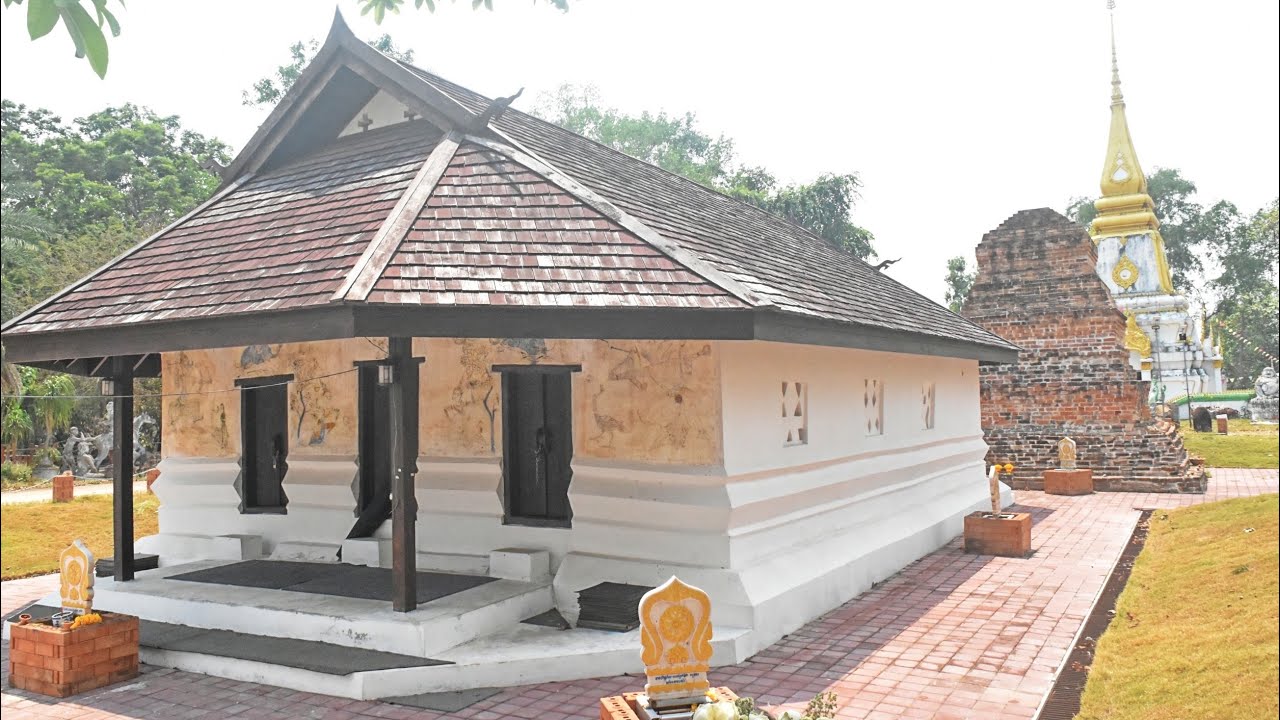
 Click to Access the Navigation Map GPS
Wat Si That Pramancha (Wat Pa Maew) Map
Recommend

 Art, Culture and Heritage
 Historical Sites and Monuments(1)
 Landmarks and Memorials(1)
 Art, Craft Centres, Tradition(2)
 Museums(2)
Temple(21)
Museums(2)
Temple(21)
 Other Sacred Sites(8)
 Suburban Living
 Village, Community(3)
 Nature and Wildlife
 National Parks and Marine Reserves(3)
 Mountain (Doi)(1)
 Dam, Reservoir, Lake(8)
 Waterfalls(6)
 Caves(1)
 River, Canal(4)
 Islands(1)
 Other natural attractions(1)
 Entertainment and Agricultural
 Farms, Parks and Ecotourism(3)
 Waterpark(1)
 Shopping
 Shopping and Night Market(1)


