
lovethailand home >Northeastern Travel Attractions >Udon Thani Travel Attractions >Ban Phu >Muang Phan > Phra Phutthabat Lang Tao
TL;DR: Phra Phutthabat Lang Tao is located at Phu Phrabat Historical Park, Mueang Phan Subdistrict, Ban Phue District, Udon Thani Province, open Daily, hours 08.30 – 16.30.
Phra Phutthabat Lang Tao
Open Days: Daily
Opening Hours: 08.30 – 16.30
Phra Phutthabat Lang Tao in Udon Thani Province is one of the important ancient sites inside Phu Phrabat Historical Park in Ban Phue District. It is located south of Phra Phutthabat Bua Bok, on the sandstone plateau of Phu Phrabat, a low sandstone mountain in the Phu Phan Noi range. The site is known for its rock-carved Buddha footprint, a nearby natural rock shelter shaped like a turtle shell, surrounding caves and rock shelters with ancient paintings, beautiful sandstone platforms, fragments of sema boundary stones, and carved sandstone Buddha images from the Dvaravati artistic tradition. For travelers, Phra Phutthabat Lang Tao offers a deep connection between Buddhist devotion, local legend, prehistoric evidence, and the striking sandstone landscape of Udon Thani.
Phra Phutthabat Lang Tao is a rewarding stop for visitors who want to understand Phu Phrabat beyond its most famous landmark, Ho Nang Usa. The site clearly shows how natural rock formations were transformed into sacred spaces. The sandstone floor, open rock platform, unusual sheltering rocks, and the carved Buddha footprint all reveal that people in the past did not separate religious meaning from nature. Instead, they used the existing landscape as the foundation for worship, ritual, and storytelling.
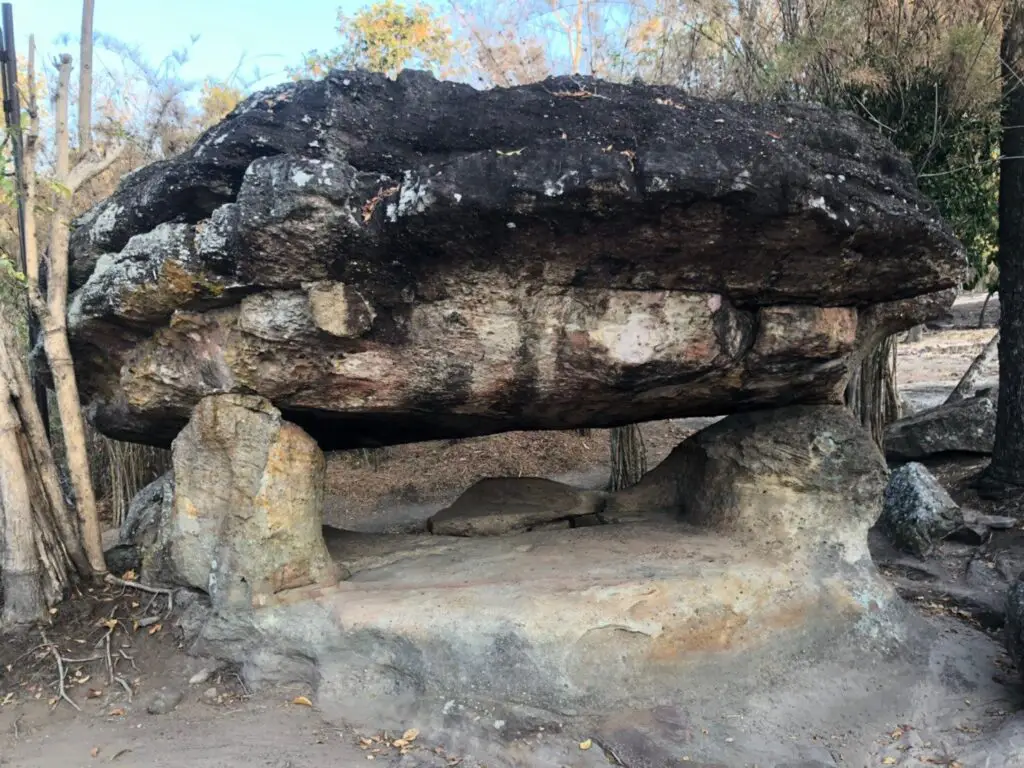
The name Lang Tao, meaning turtle back, comes from a large nearby rock whose upper surface is curved and patterned like a turtle shell. Because the Buddha footprint is located close to this distinctive rock, local people called it Phra Phutthabat Lang Tao. This name reflects a common local way of naming sacred places: people observed a memorable natural form and connected it with a religious object nearby. The result is a place name that is visually clear, easy to remember, and closely tied to the actual landscape.
The Buddha footprint itself is carved into the sandstone floor in a form resembling a human foot. The toe end points toward the southwest. At the center of the sole is a raised lotus motif with pointed petals, clearly visible on the rock surface. The footprint measures about 0.71 meters wide and 1.68 meters long. It was once surrounded by laterite blocks, but these were removed during later restoration. Today the footprint is partly damaged, with surviving plaster mainly in the sole area, but the site still preserves the essential form and sacred meaning of the original feature.
The lotus motif at the center of the footprint is highly meaningful in Buddhism. The lotus symbolizes purity, awakening, and the ability to rise above worldly impurity. When the lotus appears at the center of a Buddha footprint, the site becomes a symbol of the Buddha’s presence and the blossoming of the Dharma in the human world. The raised lotus petals on the stone floor give visitors a direct impression of a simple but powerful devotional artwork shaped by faith and natural material.
In the past, Phra Phutthabat Lang Tao was probably covered by a large structure built around the footprint and the surrounding rock platform. Archaeological interpretation suggests a two-level architectural arrangement. The first level was a small chamber covering the footprint, similar to a tunnel-like structure associated with Lao or Lan Xang culture. The second level was a larger open hall covering the footprint and surrounding rock floor. This suggests that the site once functioned as a ritual space capable of receiving many worshippers, not merely as a single footprint carved in stone.
Rows of postholes on the rock platform in front of the footprint and on the large adjacent rock provide additional evidence of former structures. The holes are arranged over an area about 15 meters long and 12 meters wide. They indicate that wooden structures once stood in relation to the sacred footprint. The combination of stone and wood is common in ancient sacred landscapes: stone provided the permanent base, while wood formed roofs, halls, shelters, or spaces for ritual gathering.
Phra Phutthabat Lang Tao is connected with the local version of the Phra Chao Liap Lok legend, a widespread Buddhist footprint tradition in northeastern Thailand and the Mekong region. The legend tells of the Buddha traveling to Phu Phrabat, where two unruly Naga beings, Kuttho Papanaga and Milinthanaga, lived. The Buddha subdued them and led them to faith in Buddhism. Milinthanaga then asked the Buddha to leave a footprint for worship. The Buddha granted the right footprint before continuing to Si Sattanakhanahut. This legend gives Phra Phutthabat Lang Tao meaning beyond archaeology; it connects the footprint with the Buddha, Naga belief, Lan Xang tradition, and sacred geography.
Phu Phrabat itself has an extraordinary geological character. The sandstone in this area belongs to the Phu Phan Formation of the Khorat Group and is many millions of years old. Wind, water, and long-term erosion shaped the stone into shelters, pillars, mushroom-like rocks, platforms, and unusual boulders. The harder upper layers remained while softer lower layers eroded away, creating overhangs and rock shelters. When humans began using the area, these natural formations were interpreted as sacred spaces, shelters, ritual places, and settings for stories.
The importance of Phra Phutthabat Lang Tao therefore lies not only in the footprint but also in the landscape around it. The turtle-shaped rock, the open sandstone floor, the carved footprint, and the traces of former structures show how ancient and later communities used the natural setting as part of the sacred design. The sacredness of the site comes from the interaction of stone, legend, Buddhist devotion, and ritual activity over time.
Several caves and rock shelters are distributed around Phra Phutthabat Lang Tao within Phu Phrabat Historical Park. Visitors can walk to nearby sites such as Tham Lai Mue, Tham Non Sao Ae, Tham Khon, and Tham Wua Daeng. These places are important because they preserve ancient paintings, including human figures, hand shapes, animal forms, and geometric motifs. These images show that Phu Phrabat was used by humans long before the later Buddhist sacred sites were created.
Tham Lai Mue is especially meaningful because hand images on the rock wall create a direct sense of human presence from the distant past. These hand marks may have expressed identity, ritual action, or symbolic communication. Although their exact meaning cannot be known with certainty, they show that ancient people used the rock shelters of Phu Phrabat as places of activity and expression long before the development of Buddhist monuments in the area.
Tham Khon and Tham Wua Daeng preserve images of people and animals painted on the rock surface. Human figures, animal forms, and line drawings reflect the relationship between ancient people, movement, animals, and environment. Their location near later Buddhist sacred areas shows that Phu Phrabat was repeatedly used and reinterpreted across time. It began as a landscape of prehistoric activity and later became a Buddhist ritual landscape connected with sema stones, rock shelters, and Buddha footprints.
Tham Non Sao Ae and the Non Sao Ae stone platform add another layer to the cultural landscape. The area contains rock shelters, paintings, and beautiful natural stone surfaces. Local stories connect the place with women preparing themselves before going to worship the Buddha footprint. Such stories show that natural rock formations were not understood only as geology. They were woven into social memory, ritual imagination, and local legend.
At Wat Pho Ta and Wat Luk Khoei rock shelters, fragments of sema boundary stones and carved sandstone Buddha images in Dvaravati style have been found. Sema stones marked sacred Buddhist ritual boundaries. Their presence in the same landscape as caves, paintings, and natural rock shelters shows the transformation of Phu Phrabat into a Buddhist sacred area. The site preserves layers of human use from prehistoric expression to historic Buddhist practice.
Phu Phrabat Historical Park was inscribed as a World Heritage cultural property under the name Phu Phrabat, a testimony to the Sima stone tradition of the Dvaravati period. Its global importance lies in the remarkable preservation of sema stones and Buddhist sacred areas within a sandstone landscape. Phra Phutthabat Lang Tao contributes to this wider significance by showing that Phu Phrabat is not only a place of sema stones but also a landscape of Buddha footprints, Lan Xang legend, ritual buildings, prehistoric paintings, and natural shelters.
As an archaeological and sacred site, Phra Phutthabat Lang Tao has several layers of meaning. First, it is a Buddha footprint that functions as a symbol of the Buddha and a focus of devotion. Second, it preserves evidence of past architecture built over and around the sacred footprint. Third, it is part of a natural sandstone landscape shaped by erosion into striking forms. Fourth, it belongs to a local legend that links the Buddha, Naga beings, Lan Xang tradition, and sacred geography. These layers make the site valuable for both worshippers and cultural travelers.
Visitors should move slowly at Phra Phutthabat Lang Tao because many details are easy to miss. The stone floor, postholes, raised lotus motif, direction of the footprint, and shape of the nearby turtle-like rock all help explain how the site was once used. A quick look may reveal only a damaged footprint on stone, but careful observation shows a larger sacred system involving architecture, ritual space, and landscape design.
The best time to visit is in the morning or before midday. The weather is cooler, the light makes stone details easier to see, and walking through the historical park is more comfortable. Phu Phrabat includes many outdoor trails and exposed sandstone areas, so visitors should wear comfortable shoes and bring drinking water, a hat, or an umbrella. Those who want to visit Phra Phutthabat Lang Tao together with nearby caves, rock shelters, and major monuments should allow about 1.5 to 3 hours.
Proper behavior is important because the site is both a sacred place and an ancient monument. Visitors should dress respectfully, avoid climbing on the footprint, avoid touching or rubbing ancient paintings, avoid moving stones or fragments, avoid placing personal items on ancient features, and keep the area clean. Following the designated walking route helps protect both the archaeological remains and the natural sandstone landscape.
A visit to Phra Phutthabat Lang Tao is best combined with other important sites inside Phu Phrabat Historical Park, including Phra Phutthabat Bua Bok, Ho Nang Usa, Tham Phra, Tham Wua, Tham Khon, Ku Nang Usa, Bo Nam Nang Usa, Wat Pho Ta, and Wat Luk Khoei. Together, these sites show the full story of Phu Phrabat: geology, prehistoric rock paintings, Dvaravati and Lopburi Buddhist evidence, Lan Xang devotion, and the local legend of Nang Usa and Thao Barot.
Getting There to Phra Phutthabat Lang Tao requires traveling to Phu Phrabat Historical Park in Mueang Phan Subdistrict, Ban Phue District, Udon Thani Province. From Udon Thani city, travel toward Nong Khai and turn left near Na Kha village onto Highway 2021 for about 67 kilometers to reach the historical park. Another option is to travel through Ban Phue District and continue to Phu Phrabat. Once at the visitor center, visitors should ask for the walking route to Phra Phutthabat Lang Tao and nearby sites so the route can be planned according to time and weather.
Phu Phrabat Historical Park is open daily from 08.30 to 16.30. Admission is 20 baht for Thai visitors and 100 baht for foreign visitors. The park has a visitor center, maps, walking trails, restrooms, parking, and basic visitor facilities. Starting at the visitor center is recommended because the historical park covers a large landscape and contains many sites that are best understood with route information.
Phra Phutthabat Lang Tao is suitable for many types of travelers. Buddhist visitors can pay respect to the footprint and learn about the Phra Chao Liap Lok legend. History lovers can observe evidence of ancient ritual use. Nature lovers can enjoy the unusual sandstone formations. Visitors interested in prehistoric art can continue to nearby caves and rock shelters. The site offers faith, archaeology, landscape, and walking exploration in one experience.
For Thai visitors, Phra Phutthabat Lang Tao reveals Udon Thani as a province with deeper cultural heritage than many mainstream travel images suggest. For foreign travelers, it is an important example of a Buddha footprint in a sandstone landscape, a sacred natural setting, prehistoric rock art, and the Dvaravati sema stone tradition in northeastern Thailand. Visiting this site helps explain how sacredness in this region was created through the layering of nature, art, legend, and human devotion across many periods.
Phra Phutthabat Lang Tao should not be overlooked when visiting Phu Phrabat Historical Park. Although it is less iconic than Ho Nang Usa, it is highly valuable as a Buddha footprint site connected with Lan Xang legend, traces of ritual architecture, and the sandstone landscape that defines Phu Phrabat. Visitors who spend time observing the site carefully will gain a fuller understanding of Phu Phrabat as a World Heritage cultural landscape and of Udon Thani as a province rich in faith, archaeology, and living cultural memory.
| Name | Phra Phutthabat Lang Tao |
| Location | Phu Phrabat Historical Park, Mueang Phan Subdistrict, Ban Phue District, Udon Thani Province |
| Address | Phu Phrabat Historical Park, Mueang Phan Subdistrict, Ban Phue District, Udon Thani 41160, Thailand |
| Highlights | Rock-carved Buddha footprint with a raised lotus motif at the center, located near a natural rock shelter shaped like a turtle shell within Phu Phrabat Historical Park |
| History / Period | Connected with the Phra Chao Liap Lok legend and the sacred footprint tradition of Phu Phrabat. Archaeological interpretation relates the footprint and associated remains to the Lan Xang period around the 22nd–23rd Buddhist centuries and later Rattanakosin-period activity after the 24th Buddhist century. |
| Name Origin | The name comes from a nearby natural rock whose curved upper surface resembles a turtle shell, leading local people to call the nearby Buddha footprint Phra Phutthabat Lang Tao. |
| Distinctive Features | Foot-shaped Buddha footprint on a sandstone platform, pointing southwest, about 0.71 meters wide and 1.68 meters long, with a raised lotus motif carved at the center of the sole |
| Key Evidence | Buddha footprint on sandstone, postholes on the rock platform, traces of former architecture, turtle-shaped rock shelter, nearby caves and rock shelters, ancient paintings, sema stone fragments, and carved sandstone Buddha images within the Phu Phrabat cultural landscape |
| Travel Information | From Udon Thani city, travel toward Nong Khai and turn left near Na Kha village onto Highway 2021 for about 67 km to reach Phu Phrabat Historical Park. From the visitor center, follow the walking route to Phra Phutthabat Lang Tao. |
| Current Status | Open for visitors within Phu Phrabat Historical Park as an archaeological, sacred, and cultural learning site in Ban Phue District |
| Open Days | Daily |
| Opening Hours | 08.30 – 16.30 |
| Fees | Thai Visitors: 20 Baht Foreign Visitors: 100 Baht |
| Facilities | Visitor center, maps, walking trails, restrooms, parking area, and electric four-wheel vehicle service for elderly visitors or those needing assistance |
| Main Areas / Zones | Phra Phutthabat Lang Tao footprint Turtle-shaped rock shelter Sandstone platform and ancient postholes Tham Lai Mue Tham Non Sao Ae Tham Khon and Tham Wua Daeng Non Sao Ae stone platform Wat Pho Ta and Wat Luk Khoei rock shelters |
| Caretaker | Phu Phrabat Historical Park, Fine Arts Department |
| Main Contact Number | Phu Phrabat Historical Park, Tel. 042-251-350 to 2 |
| Nearby Tourist Attractions | 1. Phra Phutthabat Bua Bok, about 2 km 2. Ho Nang Usa, about 2 km 3. Tham Phra, Phu Phrabat Historical Park, about 2 km 4. Ku Nang Usa, about 2 km 5. Thai Phuan Ban Phue Museum, about 22 km |
| Nearby Restaurants | 1. BaanYa Cafe’ - Moto-O Ban Phue, about 22 km, Tel. 095-651-5252 2. Jungle Cafe Ban Phue Branch, about 22 km, Tel. 086-396-3624 3. PunThai Coffee Chonnabot Bamrung Road Ban Phue, about 22 km, Tel. 080-071-9270 4. Pim Made-To-Order Food, about 23 km, Tel. 083-843-7638 5. Nakhon Pathom Noodle And Made-To-Order Food Branch 1 Ban Phue, about 23 km |
| Nearby Accommodations | 1. Thararin Resort Ban Phue, about 12 km, Tel. 088-552-0872 2. Oonrak Resort Ban Phue, about 19 km, Tel. 061-196-9897 3. Patchawan Resort, about 20 km, Tel. 099-536-1129, 082-532-6632 4. Romruen Resort Ban Phue, about 20 km, Tel. 064-963-9053 5. Nongmai Resort Ban Phue, about 24 km, Tel. 042-219-633 |
Frequently Asked Questions (FAQ)
Q: Where is Phra Phutthabat Lang Tao located?
A: Phra Phutthabat Lang Tao is located inside Phu Phrabat Historical Park in Mueang Phan Subdistrict, Ban Phue District, Udon Thani Province. It is south of Phra Phutthabat Bua Bok.
Q: What are the opening hours of Phra Phutthabat Lang Tao?
A: It follows the opening hours of Phu Phrabat Historical Park, which is open daily from 08.30 to 16.30.
Q: Is there an admission fee?
A: Yes. Admission to Phu Phrabat Historical Park is 20 baht for Thai visitors and 100 baht for foreign visitors.
Q: Why is it called Phra Phutthabat Lang Tao?
A: The name comes from a nearby natural rock that has a curved upper surface and patterns resembling a turtle shell.
Q: What is distinctive about the Buddha footprint?
A: The footprint is carved on a sandstone platform. At the center of the sole is a raised lotus motif with pointed petals, and the surrounding rock platform preserves traces of former ritual structures.
Q: What legend is connected with Phra Phutthabat Lang Tao?
A: It is connected with the Phra Chao Liap Lok legend, which tells of the Buddha visiting Phu Phrabat and leaving a footprint for the Naga and devotees to worship.
Q: What nearby sites should be visited together with Phra Phutthabat Lang Tao?
A: Visitors can combine it with Phra Phutthabat Bua Bok, Ho Nang Usa, Tham Phra, Tham Khon, Tham Wua Daeng, Ku Nang Usa, Wat Pho Ta, Wat Luk Khoei, and Non Sao Ae stone platform.
Q: How should visitors prepare for the visit?
A: Visitors should dress respectfully, wear comfortable walking shoes, bring drinking water and sun protection, avoid climbing on ancient remains, avoid touching rock paintings, and follow the designated walking route.
 Category: ●Places of Worship
 Group: ●Other Sacred Sites
Last Update : 1 MonthAgo
 Last Update : 1 MonthAgo
 Click to Access the Navigation Map GPS
Phra Phutthabat Lang Tao Map
Recommend

 Art, Culture and Heritage
 Historical Sites and Monuments(1)
 Landmarks and Memorials(1)
 Art, Craft Centres, Tradition(2)
 Museums(2)
 Temple(21)
Other Sacred Sites(8)
Temple(21)
Other Sacred Sites(8)
 Suburban Living
 Village, Community(3)
 Nature and Wildlife
 National Parks and Marine Reserves(3)
 Mountain (Doi)(1)
 Dam, Reservoir, Lake(8)
 Waterfalls(6)
 Caves(1)
 River, Canal(4)
 Islands(1)
 Other natural attractions(1)
 Entertainment and Agricultural
 Farms, Parks and Ecotourism(3)
 Waterpark(1)
 Shopping
 Shopping and Night Market(1)


