
lovethailand home >Northeastern Travel Attractions >Udon Thani Travel Attractions >Muang Udon Thani >Mak Khaeng > Monument of Krom Luang Prachaksinlapakhom
TL;DR: Monument of Krom Luang Prachaksinlapakhom is located at Thahan Road, Mak Khaeng Subdistrict, Mueang Udon Thani District, Udon Thani Province, open Daily, hours 24 Hours.
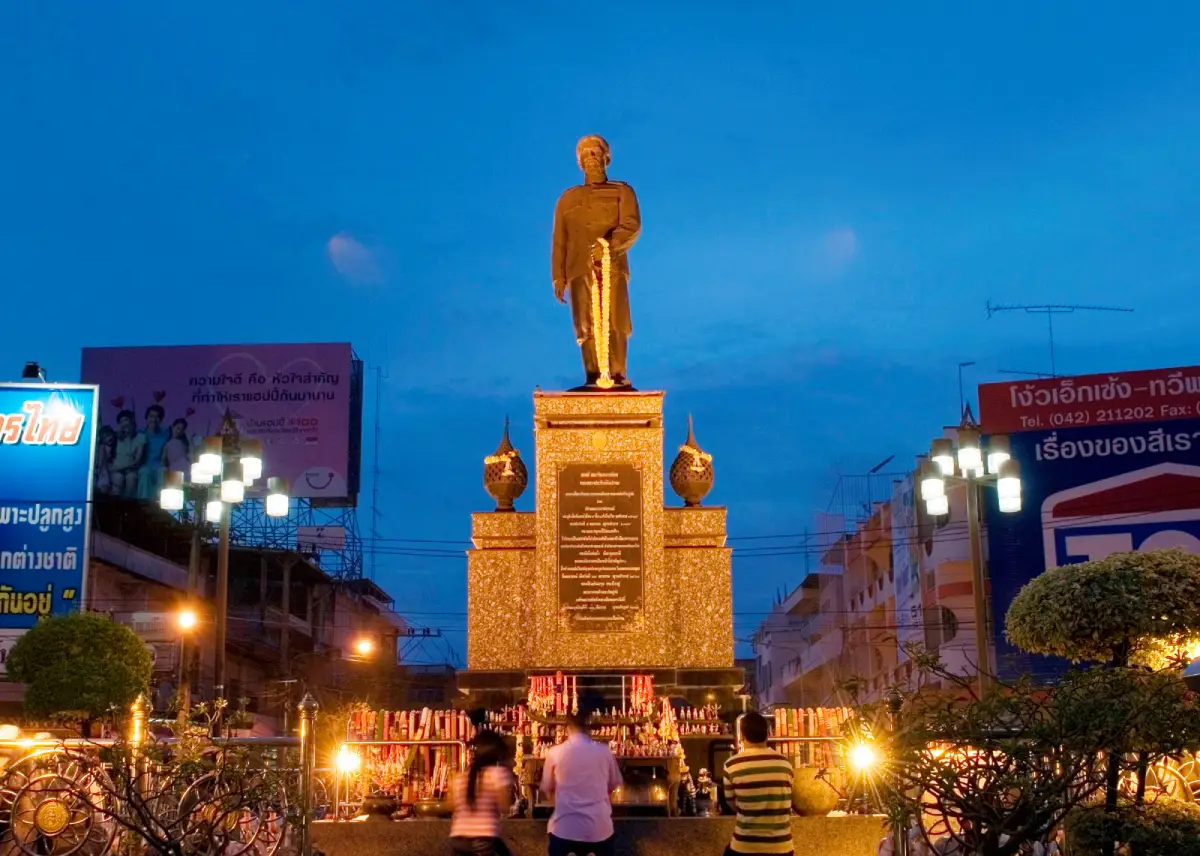
Monument of Krom Luang Prachaksinlapakhom
Open Days: Daily
Opening Hours: 24 Hours
The Monument of Krom Luang Prachaksinlapakhom stands in the heart of Udon Thani city on Thahan Road, Mak Khaeng Subdistrict, Mueang Udon Thani District. It is one of the most meaningful landmarks in the province and an important place for anyone who wants to understand the historical identity of Udon Thani. The monument honors Major General Prince Prachaksinlapakhom, a son of King Mongkut, Rama 4, and a key royal figure who laid the foundations of Udon Thani during the reign of King Chulalongkorn, Rama 5.
For travelers, this monument is more than a city statue. It represents the origin of modern Udon Thani, the development of administration in upper northeastern Thailand, and the deep respect that local people continue to hold for the prince. The bronze statue shows the prince standing in military uniform, holding a sword, and looking forward with dignity. Set on a high pedestal in a busy urban roundabout, the monument remains visible in the daily life of the city.
Visitors who come to Udon Thani for the first time should begin their city visit here. The monument gives context to the province before travelers continue to nearby places such as Wat Pothisomphon, Udon Thani Museum, Nong Prajak Silapakhom Public Park, the Thai-Chinese Cultural Center, UD Town, and Central Udon. Seeing the monument first helps visitors understand that Udon Thani did not grow without historical roots. It developed from strategic planning, government administration, transport connections, and the transformation of the region during the late 19th century.
Prince Prachaksinlapakhom was born in 1856 as a son of King Mongkut and Chao Chom Manda Sangwan. During the reign of King Chulalongkorn, he served as a royal representative and administered the northern administrative region that later became known as Monthon Udon. Between Rattanakosin Era 112 and 118, he played a decisive role in organizing government administration, stabilizing the area, and establishing Udon Thani in 1893. His work brought lasting benefits to local communities and helped shape the future of the province.
The historical importance of the prince becomes clearer when viewed in the context of Siam during the late 19th century. Northeastern Thailand was a strategic region connected with the Mekong River, Nong Khai, Vientiane, and the Lao territories. Establishing Udon Thani was therefore not just the creation of a new settlement. It was part of a wider administrative transformation, strengthening government organization, improving territorial management, and building a central city for the upper northeastern region.
Because of this historical role, the people of Udon Thani honor Prince Prachaksinlapakhom as the founder of the city. His name appears in major public places, local memory, and the provincial identity of Udon Thani. The monument is therefore not only a place to photograph but also a symbol of gratitude. Local residents often stop here to pay respect before beginning important journeys, work, ceremonies, or personal milestones.
The monument itself has a strong visual presence. The bronze figure stands firmly on a raised base, dressed in a military uniform and holding a sword. The posture reflects leadership, discipline, and public service. During the day, the monument is surrounded by the movement of traffic, shops, and city life. At night, the lights around the roundabout give the statue a solemn and dignified atmosphere, making it a memorable city scene for both Thai and international visitors.
The surrounding area is one of the most accessible parts of Udon Thani. The monument is close to the railway station, bus terminal, shopping areas, hotels, restaurants, and city attractions. Travelers can reach it easily by private car, taxi, local transport, or ride-hailing service. Because it is located in the urban center, it is suitable for a short visit at the beginning or end of a city itinerary.
Paying respect at the monument is a common local practice. Visitors often bring garlands, flowers, incense, candles, or other offerings. Many local people come to pray for good fortune, success, safe travel, or personal encouragement. The site therefore combines historical memory with living faith. It is not a museum object separated from everyday life; it remains part of the spiritual rhythm of Udon Thani city.
Every year on January 18, Udon Thani holds a ceremony to honor Prince Prachaksinlapakhom on the city’s founding day. This annual event includes a formal worship ceremony and a large traditional dance offering. Government agencies, local communities, students, private organizations, and residents participate in large numbers. The ceremony is one of the clearest expressions of civic pride in Udon Thani and shows how deeply the city continues to respect its founder.
The annual ceremony is more than a scheduled public event. It is an act of remembrance, gratitude, and unity. For local people, January 18 connects the past with the present. It recalls the founding of the city while reaffirming the shared identity of Udon Thani. Travelers who visit during this period can experience a meaningful cultural atmosphere, including ceremonial offerings, traditional dress, coordinated dance performances, and strong community participation.
From a travel perspective, the monument works well as the starting point for a historical route through Udon Thani city. After paying respect at the monument, visitors can continue to Wat Pothisomphon, one of the province’s most important royal temples. They can then visit Udon Thani Museum to learn about the city’s development, relax at Nong Prajak Silapakhom Public Park, and end the day in the shopping and dining zones around UD Town and Central Udon.
Nong Prajak Silapakhom Public Park is also closely connected with the name of Prince Prachaksinlapakhom. The park is one of the most popular recreational spaces in the city, with a large lake, walking paths, green areas, and well-known photo spots. Its name shows how the memory of the prince continues to shape major public places in Udon Thani. A visit to both the monument and the park gives travelers a stronger understanding of his lasting presence in the city.
Wat Pothisomphon is another nearby destination that fits naturally into the same route. This royal temple is an important Buddhist site in Udon Thani, with a peaceful atmosphere and significant religious structures. Visiting the temple after the monument adds a spiritual dimension to a city trip. Udon Thani Museum then provides the historical background needed to understand how the city grew from a regional settlement into an important center of the upper northeast.
The Thai-Chinese Cultural Center and Chao Pu-Ya Shrine show another layer of Udon Thani’s identity. The city is not defined only by Isan culture but also by Thai-Chinese communities that have played an important role in trade, society, and local religious life. Combining the monument with these sites helps visitors see Udon Thani as a city shaped by Thai, Isan, Lao, Chinese, and borderland cultural influences.
For foreign travelers, the Monument of Krom Luang Prachaksinlapakhom is a useful place to understand Udon Thani beyond its role as a transport hub to Nong Khai or Laos. It explains why the city became important, who shaped its early development, and why local people continue to treat the site with deep respect. It also introduces visitors to the broader history of Thai provincial administration during the reign of King Chulalongkorn.
A visit to the monument does not require a long time, but it is worth slowing down. Visitors should look at the statue, observe the pedestal, read the inscriptions, and notice how the monument stands within the living movement of the city. Cars pass around the roundabout, shops open nearby, people travel to work, and residents stop to pray. This connection with everyday life gives the monument a special character.
The best times to visit are early morning and late afternoon. In the morning, the atmosphere is quieter and suitable for paying respect. In the late afternoon and evening, the light around the city becomes more attractive for photography. Visitors should choose safe viewpoints, avoid standing in traffic areas, and use pedestrian spaces carefully. The monument is located in a busy urban roundabout, so road safety is important.
There is no admission fee. As a public city monument, the site can be viewed externally at any time of day. However, visitors should use good judgment when visiting late at night, especially when crossing roads or taking photographs. Those who come to pay respect should behave politely, avoid blocking public movement, and keep the surrounding area clean.
Getting There is easy from anywhere in central Udon Thani. Travelers arriving by train can take a short ride from Udon Thani Railway Station. Those arriving by plane can take a taxi, rental car, or ride-hailing service from Udon Thani International Airport. The monument is also close to bus terminals, hotels, shopping centers, and restaurants, making it convenient for visitors staying in the city center.
A half-day city route can begin at the monument, continue to Wat Pothisomphon and Udon Thani Museum, then move to Nong Prajak Silapakhom Public Park. If visitors have a full day, they can add the Thai-Chinese Cultural Center, Chao Pu-Ya Shrine, UD Town, Central Udon, and evening dining areas. This route gives a balanced view of Udon Thani through history, faith, urban culture, food, and everyday city life.
The area around the monument has many food options. Nearby choices include Thai-Chinese restaurants, Isan restaurants, late-night rice porridge shops, cafes, dessert shops, hotel restaurants, and casual local eateries. Udon Thani is known for its diverse food culture, including Isan dishes, Vietnamese-influenced food, Chinese-style meals, and local breakfast dishes. Staying near the monument makes it easy to explore the city’s food scene without long travel times.
Accommodation near the monument ranges from city hotels and hostels to larger hotels connected with shopping and business districts. Staying in this area is convenient because travelers are close to restaurants, the railway station, bus terminals, shopping centers, and many local attractions. It is also a good base for longer routes to Nong Khai, Wat Pa Phu Kon, Ban Chiang, the Red Lotus Sea, or Kham Chanot.
Culturally, the monument functions as a shared civic space for Udon Thani. Local people often refer to Prince Prachaksinlapakhom with respect as the founder of the city. This respect appears not only in the annual ceremony but also in place names, public memory, and the province’s identity. The fact that his name remains present in many parts of the city shows that his history is not limited to books. It continues to live in public space.
Visitors should observe proper manners at the monument. Dress respectfully, do not climb on the pedestal, do not place offerings in a way that blocks public space, and do not take photographs from dangerous traffic positions. A respectful visit helps preserve the dignity of the place and allows both local people and travelers to share the space appropriately.
Overall, the Monument of Krom Luang Prachaksinlapakhom is an essential stop for both Thai and international travelers visiting Udon Thani. It explains the foundation of the city, honors a major historical figure, and shows how civic memory, faith, and daily urban life meet in one place. Even a short visit can make a trip to Udon Thani more meaningful, especially for travelers who want to understand the province beyond surface-level sightseeing.
| Name | The Monument Of Krom Luang Prachaksinlapakhom |
| Location | Thahan Road, Mak Khaeng Subdistrict, Mueang Udon Thani District, Udon Thani Province |
| Address | 51 Thahan Road, Mak Khaeng Subdistrict, Mueang Udon Thani District, Udon Thani 41000, Thailand |
| Highlights | A monument honoring the founder of Udon Thani, a central city worship site, and the annual ceremony venue on January 18 |
| History | Prince Prachaksinlapakhom was born in 1856, was a son of King Mongkut, and founded Udon Thani in 1893 during the reign of King Chulalongkorn. |
| Distinctive Features | A standing bronze statue on a raised pedestal, showing the prince in military uniform holding a sword, symbolizing leadership, administration, and the foundation of Udon Thani. |
| Cultural Significance | A symbol of pride for Udon Thani people and the focal point of the annual worship ceremony on the city’s founding day. |
| Main Areas / Zones | 1. Statue And Monument Base 2. Worship And Garland Offering Area 3. City Roundabout And Urban Landscape 4. January 18 Annual Ceremony Area 5. Thahan Road District And Nearby City Attractions |
| Caretaker | Udon Thani City Municipality In Cooperation With Udon Thani Provincial Agencies |
| Travel Information | Easily reached from central Udon Thani by private car, taxi, local transport, or ride-hailing service from the airport, railway station, bus terminal, Central Udon, and UD Town. |
| Current Status | Open For External Viewing And Worship |
| Open Days | Daily |
| Opening Hours | 24 Hours |
| Admission Fee | Free Admission |
| Facilities | Located In The City Center Near Restaurants, Cafes, Hotels, Shopping Centers, The Railway Station, Bus Terminals, And Local Transport Services |
| Main Contact Number | Tourism Authority Of Thailand, Udon Thani Office: 042-325-406 |
| Nearby Tourist Attractions | 1. Central Udon, About 1 km 2. UD Town, About 1 km 3. Wat Pothisomphon, About 2 km 4. Udon Thani Museum, About 2 km 5. Nong Prajak Silapakhom Public Park, About 2 km 6. Thai-Chinese Cultural Center Udon Thani, About 3 km 7. Chao Pu-Ya Shrine Udon Thani, About 3 km |
| Nearby Restaurants | 1. Pang Pa Nom Sod, Krom Luang Roundabout Branch, About 200 m, Tel. 080-392-4757 2. Tam Wer Udon, About 200 m, Tel. 084-962-6595 3. Khao Tom Kolok, About 300 m, Tel. 096-641-9964 4. Jit Pochana, About 400 m, Tel. 096-941-9563 5. Wood You Like Cafe, About 1 km, Tel. 091-060-4670 6. VT Namnueng Posri Branch, About 3 km, Tel. 042-219-556 |
| Nearby Accommodations | 1. Civilize Hotel, About 300 m, Tel. 042-111-456, 081-465-4477 2. Centara Udon, About 900 m, Tel. 042-343-555 3. The Pannarai Hotel, About 1 km, Tel. 042-345-111, 042-344-999 4. La Malila Hostel, About 1 km, Tel. 097-314-8809 5. De Princess Hotel Udon Thani, About 2 km, Tel. 042-204-444 6. Brown House Hotel Udon Thani, About 2 km, Tel. 063-369-9888, 042-222-668 |
Frequently Asked Questions (FAQ)
Q: Where is the Monument of Krom Luang Prachaksinlapakhom located?
A: It is located on Thahan Road, Mak Khaeng Subdistrict, Mueang Udon Thani District, Udon Thani Province, in the city center.
Q: What are the opening hours of the monument?
A: The monument can be viewed externally and visited for worship daily, 24 hours a day.
Q: Is there an admission fee?
A: No. The monument is free to visit.
Q: Why is Prince Prachaksinlapakhom important to Udon Thani?
A: He founded Udon Thani in 1893 and laid the administrative foundations of the city, which is why local people honor him as the founder of Udon Thani.
Q: When is the annual ceremony held?
A: The annual worship ceremony is held on January 18, the founding day of Udon Thani.
Q: How long should visitors spend at the monument?
A: Most visitors spend about 15 to 30 minutes paying respect, taking photos, and reading the information on the monument base. A half-day is recommended if combined with nearby city attractions.
Q: What nearby attractions are easy to visit after the monument?
A: Nearby attractions include Wat Pothisomphon, Udon Thani Museum, Nong Prajak Silapakhom Public Park, the Thai-Chinese Cultural Center, UD Town, and Central Udon.
Q: What is the best time to visit?
A: Early morning and late afternoon are the best times because the weather is more comfortable, the light is suitable for photography, and moving around the city is convenient.
 Category: ●Art, Culture and Heritage
 Group: ●Landmarks and Memorials
Last Update : 2 MonthAgo
 Last Update : 2 MonthAgo
 Click to Access the Navigation Map GPS
Monument of Krom Luang Prachaksinlapakhom Map
Recommend

 Historical Sites and Monuments(1)
Landmarks and Memorials(1)
Historical Sites and Monuments(1)
Landmarks and Memorials(1)
 Art, Craft Centres, Tradition(2)
 Museums(2)
 Places of Worship
 Temple(21)
 Other Sacred Sites(8)
 Suburban Living
 Village, Community(3)
 Nature and Wildlife
 National Parks and Marine Reserves(3)
 Mountain (Doi)(1)
 Dam, Reservoir, Lake(8)
 Waterfalls(6)
 Caves(1)
 River, Canal(4)
 Islands(1)
 Other natural attractions(1)
 Entertainment and Agricultural
 Farms, Parks and Ecotourism(3)
 Waterpark(1)
 Shopping
 Shopping and Night Market(1)


