
lovethailand home >Northeastern Travel Attractions >Nong Khai Travel Attractions >Pho Tak >Phon Thong > Wat Phuttharangsi
TL;DR: Wat Phuttharangsi is located at Phon Thong Subdistrict, Pho Tak District, Nong Khai Province, open Daily, hours 08.00 – 17.00.
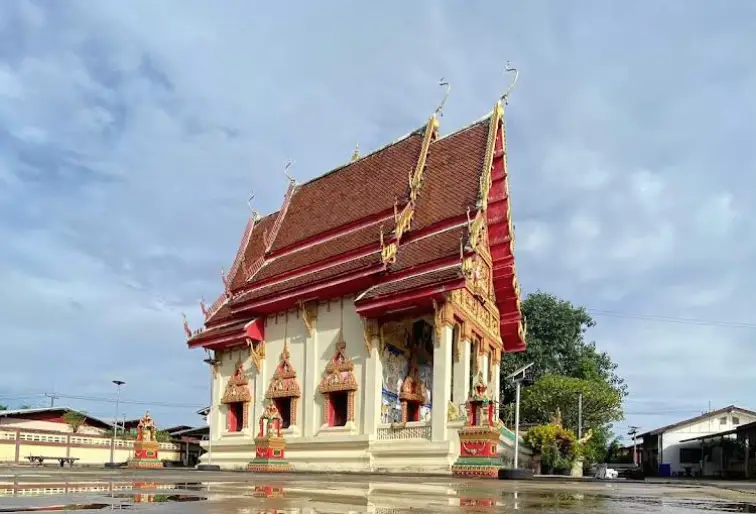
Wat Phuttharangsi
Open Days: Daily
Opening Hours: 08.00 – 17.00
Wat Phuttharangsi in Nong Khai Province is an old community temple in Phon Thong Subdistrict, Pho Tak District. It is meaningful not only as a Buddhist place of worship but also as a local cultural site where visitors can see boundary stones, known in Thai as bai sema, displayed for public viewing. These stones reflect the long continuity of Buddhist culture, religious customs, and community tradition in this part of northeastern Thailand. For travelers interested in quiet temples, local heritage, and the cultural landscape of Nong Khai, Wat Phuttharangsi offers a calm and authentic experience away from the busier attractions in the provincial city.
The temple is located in Phon Thong Subdistrict, Pho Tak District, Nong Khai Province. This area retains the character of a rural northeastern Thai community where the temple, village, school, and local traditions remain closely connected. Wat Phuttharangsi continues to serve as a center for worship, merit-making, community gatherings, Buddhist activities, and cultural learning. Its importance lies in the way it preserves both religious practice and local memory through objects, rituals, and community participation.
The most distinctive feature of Wat Phuttharangsi is the display of bai sema, or Buddhist boundary stones. In Thai Buddhist tradition, bai sema are associated with sacred boundaries, especially around an ordination hall where important monastic ceremonies take place. In many parts of northeastern Thailand, these stones are more than religious markers. They are cultural evidence that helps reveal how communities adopted Buddhism, created sacred spaces, and maintained religious traditions over generations. Seeing the boundary stones at Wat Phuttharangsi gives visitors a direct encounter with this important layer of local heritage.
A visit to Wat Phuttharangsi is best approached slowly and respectfully. The temple is not a large commercial attraction, and that is part of its appeal. Travelers can begin by paying respect to the Buddha images and then spend time observing the displayed boundary stones. The stones should be viewed not simply as old objects, but as cultural markers connected with sacred space, religious continuity, and the history of the local community. This makes the temple especially suitable for visitors interested in archaeology, Buddhist culture, local history, and traditional temple life.
The significance of bai sema lies in their role in defining religious space. In Thai temples, boundary stones are commonly linked with the ordination hall, which is used for important ceremonies such as ordination and formal monastic acts. Their presence at Wat Phuttharangsi gives the temple a deeper cultural meaning. They show that the temple is not just a place for daily worship, but also a site connected with the ritual structure and long-standing practice of Buddhism in the region.
Wat Phuttharangsi is classified as a local Buddhist temple, or wat rat. Temples of this kind are deeply tied to their surrounding communities. They often develop through the faith and support of villagers and continue to function as community centers. Their value is not measured by size or grandeur, but by their role in preserving faith, memory, and social connection. Wat Phuttharangsi represents this type of temple clearly. It remains a place where local people make merit, participate in Buddhist observances, and maintain cultural continuity.
Phon Thong and Pho Tak District have a quiet rural character that differs from the better-known riverside areas of Nong Khai city. Visiting Wat Phuttharangsi allows travelers to see a different side of the province. Instead of a large landmark, visitors encounter a living community temple where Buddhist practice remains part of everyday local life. The temple also shows how schools, villagers, and monks continue to participate in religious traditions together, especially during major Buddhist days such as Asalha Bucha Day and Buddhist Lent.
The temple also has a community welfare role. Information from recent local public health activity refers to a care-related monastic residence at Wat Phuttharangsi, showing that the temple is connected not only with religious practice but also with community well-being. In Thai society, temples often support more than spiritual life. They can also become places of care, social support, and mutual assistance. Wat Phuttharangsi therefore represents the wider role of a Thai temple as a place where faith, culture, and community care come together.
For cultural travelers, the boundary stones at Wat Phuttharangsi are the main highlight. Visitors should take time to observe their shapes, surfaces, size, placement, and overall presence within the temple grounds. Even without detailed academic explanation for each individual stone, the display itself is valuable because it allows the public to see material evidence connected with Buddhist sacred space. This direct experience helps travelers understand the meaning of local religious heritage more clearly than reading about it from a distance.
Wat Phuttharangsi is suitable for travelers who enjoy quiet cultural sites rather than crowded tourist attractions. It is a place for merit-making, reflection, and learning. Visitors interested in temple history, Buddhist boundary stones, local customs, and rural community life will find the temple rewarding. A visit of 30 minutes to 1 hour is usually enough for paying respect, walking through the temple grounds, and appreciating the displayed stones, although those interested in local history may wish to spend more time observing the details.
The temple can also be part of a wider cultural route in Nong Khai Province. Travelers can combine Wat Phuttharangsi with places in Pho Tak District, Tha Bo District, Sangkhom District, and Nong Khai city. Nearby options include the Phu Thai or Thai Phuan cultural area of Pho Tak, Huai Hin Khao Waterfall, Wat Si Chomphu Ong Tue in Tha Bo, Wat Phra That Bang Phuan, and Nong Khai Aquarium. This route gives visitors a broader view of the province, from community temples and old boundary stones to river culture, sacred Buddha images, and educational attractions.
Getting There is most convenient by private car or rental car. From Nong Khai city, travel toward Pho Tak District and continue to Phon Thong Subdistrict. The route passes through local communities and agricultural areas. Travelers should check a navigation map before departure because some sections are local roads. Having private transport also makes it easier to combine the temple with nearby attractions in Tha Bo, Pho Tak, Sangkhom, and Nong Khai city within the same day.
For visitors coming from Tha Bo District, Wat Phuttharangsi can be combined with Wat Si Chomphu Ong Tue and riverside attractions along the Mekong route. For those starting from Nong Khai city, the trip can be arranged after visiting Wat Pho Chai or Nong Khai Aquarium, then continuing westward toward Pho Tak District. This style of travel is suitable for visitors who want to see both the famous attractions of Nong Khai and the quieter cultural places that reveal local life more deeply.
The best time to visit Wat Phuttharangsi is in the morning or late afternoon, when the weather is more comfortable. Morning visits are suitable for merit-making and quiet observation, while afternoon visits work well as part of a longer sightseeing route. Visitors should dress modestly, keep their voices low, and avoid touching boundary stones or religious objects unnecessarily. Respectful behavior helps preserve the temple atmosphere and protects objects of cultural value.
Although Wat Phuttharangsi is not a large-scale tourist site, its charm lies in authenticity. It shows how an old community temple can preserve religious objects, support Buddhist customs, host local ceremonies, and remain part of daily community life. The displayed boundary stones give the temple a clear cultural identity, while its continuing use by local residents shows that heritage here is not separate from living tradition. This is what makes the temple valuable for travelers who want to understand Nong Khai beyond the main tourist route.
Wat Phuttharangsi adds depth to a Nong Khai cultural itinerary. Many travelers know the province for the Mekong River, Tha Sadet Market, Wat Pho Chai, the Thai-Lao Friendship Bridge, and riverside scenery. A visit to Wat Phuttharangsi introduces another side of the province: a quiet local temple where Buddhist boundary stones, community devotion, and long-standing tradition remain visible. For foreign travelers who appreciate meaningful local places, the temple offers a grounded and respectful way to experience Buddhist culture in rural Nong Khai.
| Name | Wat Phuttharangsi |
| Location | Phon Thong Subdistrict, Pho Tak District, Nong Khai Province |
| Address | Phon Thong Subdistrict, Pho Tak District, Nong Khai Province 43130, Thailand |
| Place Type | Local Buddhist Temple |
| Highlights | An old temple in Phon Thong Subdistrict where Buddhist boundary stones are displayed for visitors and local worshippers |
| Cultural Importance | Reflects the long continuity of Buddhist culture, local customs, and community religious tradition in Nong Khai Province |
| Distinctive Features | A quiet community temple with bai sema boundary stones as an important cultural learning point |
| Main Areas / Zones | Worship area, boundary stone display area, temple pavilion, community activity area, and community care residence area |
| Abbot / Caretaker | Phra Maha Boonkong Kantaviro |
| Travel Information | From Nong Khai city, travel toward Pho Tak District and continue to Phon Thong Subdistrict. Private car or rental car is the most convenient option. |
| Current Status | Open to visitors and still used as an active Buddhist and community religious site |
| Open Days | Daily |
| Opening Hours | 08.00 – 17.00 |
| Facilities | Worship area, temple pavilion, community activity space, and quiet resting areas within the temple |
| Nearby Tourist Attractions | 1. Pho Tak Thai Phuan Cultural Area, about 12 km 2. Huai Hin Khao Waterfall, about 25 km 3. Wat Si Chomphu Ong Tue, about 38 km, Tel. 042-431-418 4. Wat Phra That Bang Phuan, about 52 km 5. Nong Khai Aquarium, about 58 km, Tel. 0-4241-5623 |
| Nearby Restaurants | 1. Isan Kan Eng 9 Tha Bo, about 39 km, Tel. 083-585-9049 2. Khrua Ek Pla Phao Branch 2 Ban Tha Ma Fueang, about 41 km, Tel. 065-275-5097 3. The Model Cafe & Gallery Tha Bo, about 40 km 4. Phon Thong Nuea Yang Branch 2 Nong Khai, about 62 km, Tel. 087-866-3871 5. Krua Anchan & Gu Roti Cha Chak Nong Khai, about 64 km, Tel. 042-651-656 |
| Nearby Accommodations | 1. Punruk Resort Tha Bo, about 39 km, Tel. 095-192-1115 2. D.M. Resort Tha Bo, about 40 km, Tel. 042-432-260 3. Ban Phak Rim Khong Resort Tha Bo, about 42 km, Tel. 082-737-6171 4. PP Nong Khai Resort, about 62 km, Tel. 082-452-2599 5. Bualinn Resort Nong Khai, about 66 km, Tel. 062-359-3836 |
Frequently Asked Questions (FAQ)
Q: Where is Wat Phuttharangsi located?
A: Wat Phuttharangsi is located in Phon Thong Subdistrict, Pho Tak District, Nong Khai Province.
Q: What is Wat Phuttharangsi known for?
A: The temple is known as an old community temple that displays Buddhist boundary stones for visitors and local worshippers.
Q: What are the opening days and hours of Wat Phuttharangsi?
A: Wat Phuttharangsi is open daily from 08.00 to 17.00.
Q: Why are the boundary stones at Wat Phuttharangsi important?
A: Boundary stones are connected with sacred Buddhist space and monastic ceremonies, making them important cultural and religious evidence.
Q: Who should visit Wat Phuttharangsi?
A: The temple is suitable for travelers interested in Buddhism, local temples, boundary stones, rural culture, and quiet cultural places in Nong Khai.
Q: How can travelers get to Wat Phuttharangsi?
A: The most convenient way is by private car or rental car from Nong Khai city toward Pho Tak District, then continuing to Phon Thong Subdistrict.
Q: How long should visitors spend at Wat Phuttharangsi?
A: A visit of about 30 minutes to 1 hour is suitable for worship, walking around the temple, and observing the boundary stones.
Q: What nearby attractions can be combined with Wat Phuttharangsi?
A: Nearby places include the Pho Tak Thai Phuan Cultural Area, Huai Hin Khao Waterfall, Wat Si Chomphu Ong Tue, Wat Phra That Bang Phuan, and Nong Khai Aquarium.
 Category: ●Places of Worship
 Group: ●Temple
Last Update : 2 MonthAgo
 Last Update : 2 MonthAgo
 Click to Access the Navigation Map GPS
 Art, Culture and Heritage
 Historical Sites and Monuments(1)
 Landmarks and Memorials(2)
 Art, Craft Centres, Tradition(1)
 Educational Places
 Educational Gardens, Farm(1)
Temple(16)
Educational Gardens, Farm(1)
Temple(16)
 Mosque(1)
 Other Sacred Sites(8)
 Suburban Living
 Village, Community(3)
 Local Market(4)
 Nature and Wildlife
 National Parks and Marine Reserves(2)
 Dam, Reservoir, Lake(2)
 Waterfalls(4)
 River, Canal(8)
 Bays and Beaches(1)
 Entertainment and Agricultural
 Farms, Parks and Ecotourism(2)
 Shopping
 Shopping and Night Market(1)


