
lovethailand home >Northeastern Travel Attractions >Nong Khai Travel Attractions >Ratana Wapi >Phon Phaeng > Chao Pho Peng Chan Shrine
TL;DR: Chao Pho Peng Chan Shrine is located at Phon Phaeng Subdistrict, Rattanawapi District, Nong Khai Province, open Daily, hours 08.00 – 17.00.
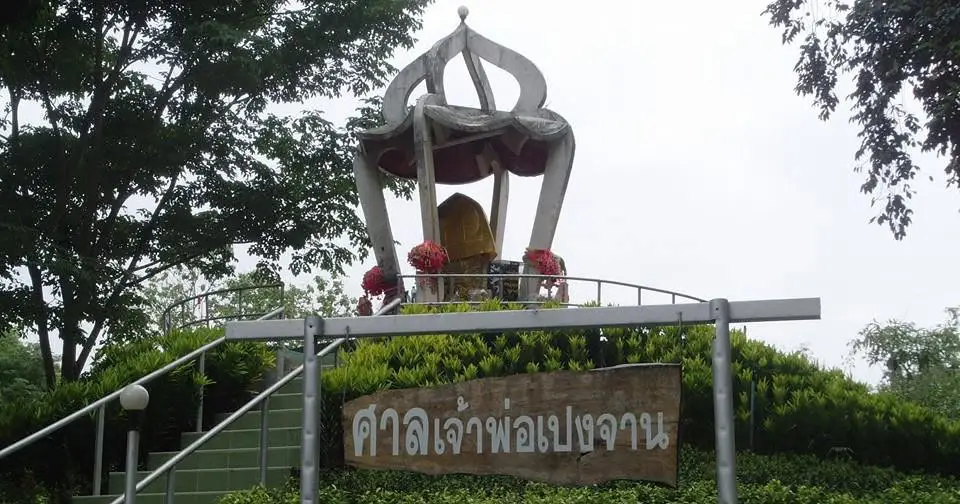
Chao Pho Peng Chan Shrine
Open Days: Daily
Opening Hours: 08.00 – 17.00
Admission Fee: Free Admission
Chao Pho Peng Chan Shrine in Nong Khai is one of the most meaningful sacred and historical sites in Rattanawapi District. Located in Phon Phaeng Subdistrict, within the area of the Phon Phisai Self-Help Settlement along the Nong Khai–Bueng Kan road, the shrine is respected by local residents as a guardian spirit site of the district. It is also connected with ancient stone boundary markers, inscriptions, and the local history of Peng Chan Nakhon Rat, an old settlement remembered in the cultural landscape of the Mekong River region.
For travelers who want to understand Nong Khai beyond its well-known riverside temples and Naga legends, Chao Pho Peng Chan Shrine offers a deeper journey into local faith, archaeology, community memory, and Mekong-side history. The shrine is not only a place for worship and blessing. It is also a cultural landmark where visitors can learn how ancient objects, local stories, and spiritual belief continue to shape the identity of a community. This makes it especially valuable for visitors interested in northeastern Thai history, Dvaravati-era traces, ancient inscriptions, and the living traditions of communities along the Thai-Lao border.
What makes Chao Pho Peng Chan Shrine distinctive is the connection between sacred belief and archaeological evidence. Cultural records describe a large stone boundary marker locally known as “Chao Pho Peng Chan.” The object is associated with the Dvaravati period, around the 12th Buddhist century, and bears traces of Pallava script from India at its base. These details give the shrine an importance that goes beyond ordinary local worship. It represents a rare place where a sacred community shrine and traces of an ancient city can be understood together.
Local tradition tells that around 50 years ago, some ancient stone markers were destroyed and thrown into the Mekong River, but one large stone marker survived. Local people later revered the surviving stone as Chao Pho Peng Chan. Over time, the object became more than an artifact. It became a sacred presence believed to protect the land, the settlement, and the people. This transformation from ancient object to community guardian is central to understanding the shrine’s cultural meaning.
The name “Peng Chan” carries strong local significance. It is linked not only to the shrine but also to Ban Peng Chan, the Thai-Lao temporary border trade area, and the concept of the ancient city known as Peng Chan Nakhon Rat. Local administrative information from Phon Phaeng Subdistrict mentions the inscription at Chao Pho Peng Chan Shrine and relates the area to an old city with a long history. When combined with traces of old bricks reportedly found along the Mekong River, the site suggests a larger historical landscape rather than an isolated shrine.
Chao Pho Peng Chan Shrine is therefore suitable for travelers who prefer meaningful cultural destinations rather than quick sightseeing stops. Visitors should take time to observe the shrine area, understand the setting, and consider how the stone marker, inscription, ancient-city memory, and local faith are connected. The shrine’s value does not come from the size of the structure but from the density of stories embedded in the place. It is a small site with a strong historical and spiritual presence.
In terms of belief, Chao Pho Peng Chan is respected by residents of Rattanawapi District as a sacred guardian. People visit to pray for family well-being, safe travel, success in work, protection, and peace in daily life. This type of local guardian belief is common in many Thai communities, especially in areas with ancient remains or long settlement histories. The shrine helps connect present-day residents with the memory of the old town and provides a spiritual center for community ceremonies.
Annual worship ceremonies at the shrine show that Chao Pho Peng Chan still plays a real role in community life. Local reports describe ceremonies held at the shrine with participation from the Phon Phisai Self-Help Settlement, local government agencies, community leaders, village heads, and residents. These ceremonies include merit-making, alms giving, food offerings to monks, and collective remembrance of Chao Pho Peng Chan as a protector of the area. Such activities show that the shrine is not simply a historical remnant but a living place of faith.
Phon Phaeng Subdistrict also has an important community and border-trade identity. The nearby Thai-Lao temporary border point and Ban Peng Chan border market are part of the wider local landscape. These places reflect the movement of people, goods, food, and culture across the Mekong River. When combined with a visit to Chao Pho Peng Chan Shrine, travelers can experience the connection between sacred heritage, community trade, riverside life, and border culture in a single route.
The shrine is accessible along the Nong Khai–Bueng Kan road. From Nong Khai town, travelers can head toward Phon Phisai District and continue to Rattanawapi District and Phon Phaeng Subdistrict. Private car, rental car, or hired van is the most convenient way to travel, especially for visitors who also want to continue to nearby Naga Fireball viewing points, the Ban Peng Chan border market, or Mekong riverside communities. During the Ok Phansa and Naga Fireball festival period, additional travel time is recommended because traffic along riverside districts can be heavier than usual.
For visitors interested in ancient history, Chao Pho Peng Chan Shrine deserves careful attention. The references to a stone boundary marker, Pallava script, Khmer-language inscription in the broader local record, and Peng Chan Nakhon Rat suggest that this area has deeper historical layers. The Mekong River has long been a corridor of settlement, trade, belief, and cultural exchange. The shrine allows visitors to see how these layers survive not only in written history but also in local worship and community storytelling.
Culturally, the shrine is a strong example of how an ancient object can become sacred in the eyes of a community. In archaeological terms, stone boundary markers are often connected with Buddhist sacred spaces. In local belief, however, the surviving stone marker became Chao Pho Peng Chan, a guardian spirit of the land. This shift in meaning is not unusual in Thailand. Many ancient objects continue to live within community practice because local people interpret them through faith, memory, and personal experience.
Visitors should approach the shrine with respect. Modest clothing is recommended, and behavior should be quiet and considerate. Since the shrine is located within or near an official and community area, visitors should avoid climbing on structures, touching sacred objects unnecessarily, blocking pathways, or disturbing people who are worshipping. If a ceremony is taking place, visitors should wait respectfully and keep an appropriate distance. Such behavior helps preserve the dignity of the shrine and respects the local community that maintains it.
Worship at Chao Pho Peng Chan Shrine can be simple. Visitors may offer flowers, incense, candles, garlands, or donations according to personal faith. Many people pray for safety, family peace, honest prosperity, and protection during travel. The most important part of the visit is sincerity and respectful intention. After worship, visitors should keep the area clean and avoid leaving waste from offerings or food.
A visit can also be combined with the Thai-Lao temporary border point and Ban Peng Chan border market. This market is an interesting stop for travelers who want to see local border commerce and the everyday connection between communities on both sides of the Mekong. Its atmosphere is simple and local, making it suitable for visitors interested in community products, food, and the rhythms of border life. Together, the shrine and the market reveal different dimensions of the same area: sacred memory and living trade.
Rattanawapi District is also associated with the Naga Fireball phenomenon during Ok Phansa. Phon Phaeng Subdistrict is part of the wider Mekong riverside zone where local stories mention glowing fireballs rising from the river and nearby water bodies during the festival period. When Chao Pho Peng Chan Shrine is understood within this setting, the destination becomes part of a larger cultural route involving ancient-city memory, sacred guardians, Naga beliefs, border trade, and Mekong landscapes.
Nearby places that can be included in the same trip are Ban Peng Chan border market, Ban Tan Chum Naga Fireball viewing area, Ban Tha Muang viewing area, Ban Nam Pe viewing area, and Lan Naga Boek Fa in Phon Phisai District. Travelers with more time can continue toward Nong Khai town, Wat Pho Chai, Phrathat La Nong, or the scenic Mekong route toward Sangkhom District. The route can be adapted according to interest, whether the focus is faith, history, border markets, Naga legends, or riverside scenery.
Facilities around the shrine are simple and community-based. Visitors should prepare drinking water, cash, and personal essentials, especially if they plan to continue to border-market areas or riverside viewing points. During festivals, the number of visitors can increase, and roads may become busier. Travelers who need local information can contact Phon Phaeng Subdistrict Administrative Organization or Rattanawapi District Office for area-related details.
Food options in and around Rattanawapi include local rice-and-curry shops, noodle shops, small restaurants, and cafes. Publicly listed nearby choices include Big Sator Southern Curry Rice in Rattanawapi, Suksomjai Farm Shop, Vientiane-Style Noodle Restaurant, and Jungle Cafe Rattanawapi Branch. Travelers continuing toward Sangkhom District can also stop at Mekong-side restaurants such as Hug Khong Na Sangkhom. Calling ahead is useful when phone numbers are available, especially on festival days or when traveling in a group.
Accommodation near the shrine is more limited than in Nong Khai town. Travelers who want to stay close to the route can consider places in Rattanawapi, Phon Phisai, or Sangkhom District, depending on the itinerary. Options that may support the route include Natrada Resort in Rattanawapi, Banwas Resort in Phon Phisai, and Mekong-side stays such as Wixky Hotel and Sand & River Hotel in Sangkhom. During Ok Phansa and Naga Fireball season, booking early is important because demand can rise quickly.
For a half-day trip, visitors can travel from Nong Khai town to Chao Pho Peng Chan Shrine in the morning, pay respect, observe the historic setting, and continue to the Ban Peng Chan border market before returning. For a full-day route, the shrine can be combined with Naga Fireball viewing points such as Ban Tan Chum, Ban Tha Muang, or Ban Nam Pe, followed by Lan Naga Boek Fa in Phon Phisai. A 2-day, 1-night itinerary allows more time for riverside communities, local food, and the Mekong cultural route.
For foreign travelers, Chao Pho Peng Chan Shrine helps explain how local Thai culture can combine archaeology, guardian-spirit belief, Buddhist-related objects, border identity, and river-based community life in one place. It should not be understood only as a small shrine. It is part of a larger cultural system in which ancient remains, oral history, sacred guardians, and the Mekong landscape continue to shape how people remember and protect their community.
Chao Pho Peng Chan Shrine in Nong Khai is therefore valuable on several levels. It is a sacred shrine respected by local residents. It preserves the memory of a stone boundary marker and inscription connected with Peng Chan Nakhon Rat. It also belongs to the living cultural landscape of the Mekong River, where border trade, Naga Fireball traditions, and Thai-Lao community life continue to overlap. A visit here is not only an act of worship but also an opportunity to enter a deeper story of Rattanawapi District and Nong Khai Province.
| Name | Chao Pho Peng Chan Shrine |
| Location | Phon Phaeng Subdistrict, Rattanawapi District, Nong Khai Province |
| Address | Within the area of the Phon Phisai Self-Help Settlement, Nong Khai–Bueng Kan Road, Phon Phaeng Subdistrict, Rattanawapi District, Nong Khai Province |
| Coordinates | 18.2199016, 103.1791168 |
| Highlights | A sacred shrine of Rattanawapi District with a stone boundary marker and inscription connected with the history of Peng Chan Nakhon Rat |
| History | Associated with a Dvaravati-period stone boundary marker from around the 12th Buddhist century, with traces of Pallava script at its base and links to the ancient town of Peng Chan Nakhon Rat along the Mekong River |
| Name Origin | The name “Chao Pho Peng Chan” comes from a large stone marker revered by local residents as a sacred guardian of the area |
| Distinctive Features | A site where local faith, ancient stone markers, inscriptions, and the memory of an old Mekong-side town are connected in one place |
| Travel Information | Best reached by private car, rental car, or hired van from Nong Khai town toward Phon Phisai, then onward to Rattanawapi District and Phon Phaeng Subdistrict along the Nong Khai–Bueng Kan route |
| Current Status | An active sacred site respected by residents of Rattanawapi District, with worship ceremonies still joined by local agencies and community members |
| Open Days | Daily |
| Opening Hours | 08.00 – 17.00 |
| Fees | Free Admission |
| Facilities | Shrine area, worship space, Phon Phisai Self-Help Settlement surroundings, access from the Nong Khai–Bueng Kan road, and parking space depending on site conditions |
| Main Areas / Zones | Chao Pho Peng Chan Shrine Zone, Stone Marker and Inscription Zone, Worship Area, Phon Phisai Self-Help Settlement Area, Ban Peng Chan and Phon Phaeng Community Zone, and the Thai-Lao Border Market Connection Zone |
| Caretaker / Related Authorities | Phon Phisai Self-Help Settlement, Phon Phaeng Subdistrict Administrative Organization, Rattanawapi District Office, Nong Khai Provincial Cultural Office, and local agencies in the area |
| Main Contact Number | Phon Phaeng Subdistrict Administrative Organization Tel. 042-019-019; Rattanawapi District Office Tel. 042-418-046; Phon Phisai Self-Help Settlement Tel. 042-019-009 |
| Nearby Tourist Attractions | 1. Thai-Lao Temporary Border Point and Ban Peng Chan Border Market, about 1 km 2. Ban Tan Chum Naga Fireball Viewing Area, Rattanawapi District, about 4 km 3. Ban Tha Muang Naga Fireball Viewing Area, Rattanawapi District, about 5 km 4. Ban Nam Pe Naga Fireball Viewing Area, Rattanawapi District, about 10 km 5. Lan Naga Boek Fa and Wat Thai, Phon Phisai District, about 30 km |
| Nearby Restaurants | 1. Big Sator Southern Curry Rice, Rattanawapi, about 8 km, Tel. 084-787-3177, 089-710-1081 2. Suksomjai Farm Shop, about 9 km, Tel. 095-169-7748 3. Vientiane-Style Noodle Restaurant, Rattanawapi, about 9 km 4. Jungle Cafe Rattanawapi Branch, Nong Khai, about 10 km 5. Hug Khong Na Sangkhom, about 55 km, Tel. 095-192-3897 |
| Nearby Accommodations | 1. Natrada Resort, Rattanawapi District, about 12 km 2. Banwas Resort Phonphisai, about 32 km, Tel. 089-570-7782 3. Accommodations in Phon Phisai District, about 30 km 4. Wixky Hotel, Sangkhom District, about 55 km, Tel. 098-792-6641 5. Sand & River Hotel, Sangkhom District, about 57 km, Tel. 095-375-5999 |
Frequently Asked Questions (FAQ)
Q: Where is Chao Pho Peng Chan Shrine located?
A: Chao Pho Peng Chan Shrine is located in Phon Phaeng Subdistrict, Rattanawapi District, Nong Khai Province, within the area of the Phon Phisai Self-Help Settlement along the Nong Khai–Bueng Kan road.
Q: What are the opening days and hours of Chao Pho Peng Chan Shrine?
A: The shrine is open daily from 08.00 to 17.00.
Q: Is there an admission fee to visit Chao Pho Peng Chan Shrine?
A: No. General admission is free. Visitors may make offerings or donations according to personal faith.
Q: Why is Chao Pho Peng Chan Shrine important?
A: It is a sacred shrine of Rattanawapi District and is connected with a stone boundary marker, an ancient inscription, and the history of Peng Chan Nakhon Rat.
Q: What historical period is Chao Pho Peng Chan associated with?
A: Cultural records associate the stone boundary marker with the Dvaravati period, around the 12th Buddhist century, with traces of Pallava script at its base.
Q: How can travelers get to Chao Pho Peng Chan Shrine?
A: The most convenient way is by private car, rental car, or hired van from Nong Khai town toward Phon Phisai, then onward to Rattanawapi District and Phon Phaeng Subdistrict.
Q: What nearby places can be visited with Chao Pho Peng Chan Shrine?
A: Travelers can continue to the Thai-Lao Temporary Border Point and Ban Peng Chan Border Market, Ban Tan Chum, Ban Tha Muang, Ban Nam Pe, and Lan Naga Boek Fa in Phon Phisai District.
Q: What should foreign travelers know before visiting?
A: Foreign travelers should understand that this is both a sacred local shrine and a historical cultural site. Modest clothing, respectful behavior, and daytime visits during opening hours are recommended.
 Category: ●Places of Worship
 Group: ●Other Sacred Sites
Last Update : 2 MonthAgo
 Last Update : 2 MonthAgo
 Click to Access the Navigation Map GPS
Chao Pho Peng Chan Shrine Map
Recommend

 Art, Culture and Heritage
 Historical Sites and Monuments(1)
 Landmarks and Memorials(2)
 Art, Craft Centres, Tradition(1)
 Educational Places
 Educational Gardens, Farm(1)
 Temple(16)
 Mosque(1)
Other Sacred Sites(8)
Mosque(1)
Other Sacred Sites(8)
 Suburban Living
 Village, Community(3)
 Local Market(4)
 Nature and Wildlife
 National Parks and Marine Reserves(2)
 Dam, Reservoir, Lake(2)
 Waterfalls(4)
 River, Canal(8)
 Bays and Beaches(1)
 Entertainment and Agricultural
 Farms, Parks and Ecotourism(2)
 Shopping
 Shopping and Night Market(1)


